Pressurisation Safety Valves and Warnings
Pressurisation safety valves are independent valves that stop the difference between cabin and outside pressure exceeding its structural limit, in either direction, if the normal pressure control fails. Blow-out panels, dump valves and the cabin altitude warning complete the protection of the structure and the occupants.
Pressurisation safety valves are the last line of structural protection in a pressurised aircraft. In normal operation a controller positions the outflow valve to hold the cabin pressure on its schedule (see pressurisation principles and control). If the controller fails or the outflow valve sticks, nothing in that chain stops the packs pumping the fuselage up beyond its design differential, or the outside air loading it inwards during a fast descent. Independent valves, frangible panels and a cabin altitude warning cover those failures.
The protection works on two quantities. Differential pressure (ΔP), the difference between the absolute pressure inside and outside, is a structural limit: the fuselage is built to carry a given difference, positive or negative, and no more. Cabin altitude is a physiological limit: above about 10,000 ft the occupants begin to suffer from hypoxia. The valves and panels guard the first; the cabin altitude warning guards the second and starts the drill described in decompression.
Positive pressure relief
The positive pressure relief valve, also called the outward safety valve, the safety relief valve or simply the pressurisation safety valve, stops the differential rising above the structural maximum. It is a simple pneumatic valve that compares cabin pressure with outside pressure and opens on that difference alone. It needs no signal from the pressure controller and no electrical power, so the failure that caused the overpressure, an outflow valve stuck closed or a controller running away, cannot disable it. Once open, it releases cabin air overboard until the differential falls back, then closes.
Its opening point lies a little above the highest differential the controller normally holds, so that it never opens in normal operation, and below the structural limit. ATPL texts place it about 0.25 psi above the normal maximum differential. The valves are duplicated, so that one valve stuck shut still leaves the structure protected, and they sit above the flotation line so that they cannot let water in after a ditching. The A320's two safety valves, for example, are on the rear pressure bulkhead.
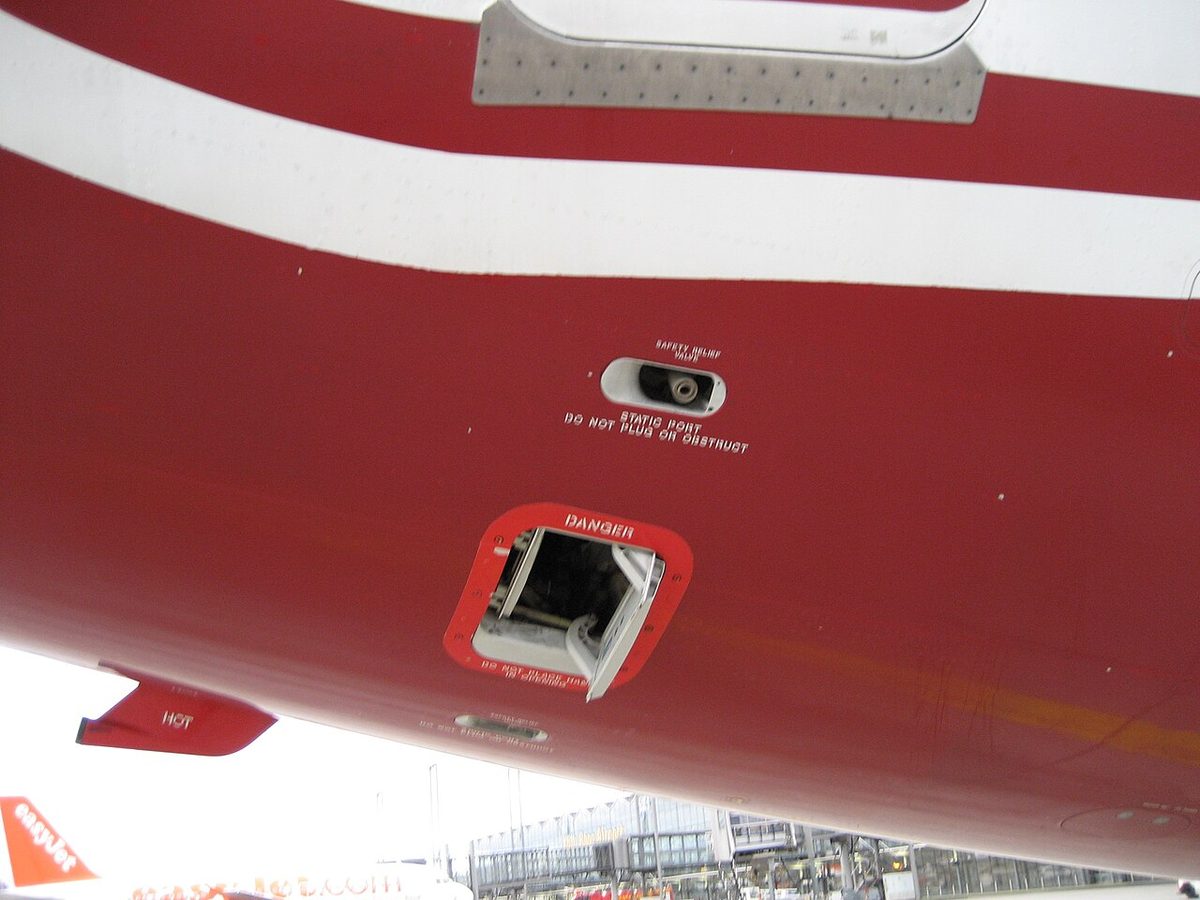
An open safety valve shows on the cabin differential pressure gauge, which stays pinned at the relief value instead of following the schedule. The valve is then doing its job; the fault lies upstream, in the outflow valve or the controller. The crew changes to the other automatic controller or to manual control to open the outflow valve, and descends if the differential cannot be brought back within limits.
| Type | Safety valve setting | Related limits |
|---|---|---|
| Airbus A320 | 8.6 psi (tolerance ±0.1 psi) | Maximum positive ΔP 9.0 psi; maximum negative ΔP 1.0 psi; ECAM shows ΔP red at 8.5 psi or above, or −0.4 psi or below |
| Boeing 737 NG | Two relief valves limit ΔP to 9.1 psi | Controller holds up to 8.35 psi in cruise; AUTO FAIL light above 8.75 psi if the controller is not responding properly |
| Embraer E190-E2 | Positive relief valve 8.6 psi | Maximum ΔP 7.8 psid up to 37,000 ft and 8.4 psid above; maximum overpressure 8.77 psi |

Negative pressure relief
A negative differential pressure exists when the outside pressure is higher than the cabin's, so the cabin altitude lies above the aircraft's actual altitude. In normal operation the controller keeps the cabin pressure at or above the outside pressure. A negative differential can arise when the aircraft descends faster than the cabin can be repressurised: after a loss of pressurisation, an emergency descent brings the aircraft into denser air faster than air can be put back into a cabin with little or no inflow. A pressurisation malfunction can produce it too.
The fuselage is designed to carry the hoop tension of a positive differential, applied once every flight. A reversed differential pushes the skin inwards, a load it is not designed for. The negative pressure relief valve, or inward relief valve, prevents it. It is a simple mechanical valve that opens inwards when the outside pressure exceeds the cabin pressure by a small amount, which ATPL texts give as 0.5 to 1.0 psi, and lets outside air in until the difference is relieved.
Arrangements vary between types. ATPL texts describe the inward valves as duplicated too, but the 737 NG pairs its two positive pressure relief valves with a single negative relief valve. On the A320 the same two pneumatic safety valves do both jobs: they open outwards to limit the positive differential and inwards to stop the cabin pressure falling more than 1.0 psi below ambient, the A320's maximum negative differential.
Exam tip: the outflow valve controls, the safety valves protect. The outward (positive) relief valve limits ΔP when the cabin is overpressurised; the inward (negative) relief valve opens when the outside pressure exceeds the cabin pressure, typically in a rapid descent. Both work independently of the pressure controller.
Cabin dump valve
A cabin dump valve lets the crew release the cabin pressure quickly on purpose. Operated from a switch on the flight deck, often labelled DUMP, it opens a large path to atmosphere so that the cabin altitude climbs towards the aircraft's. It is used for an emergency depressurisation, for example to clear smoke from the cabin, and on aircraft with pneumatically operated discharge valves it serves as the outlet when pressurisation is controlled manually. In light pressurised aircraft the pilot's dump valve also depressurises the cabin on the ground if the squat switch has not already done so.
On many airliners the dump function is a mode of the outflow valve. On the E190-E2, selecting DUMP drives the outflow valve fully open and disables the packs and the recirculation fans; the cabin climbs at about 2,000 ft/min until it reaches 12,400 ft, where the outflow valve closes again. The function works only with the pressurisation in its automatic mode. Types without a dump function rely on manual control instead: their smoke procedures may call for the outflow valve to be driven open in manual mode, at an altitude compatible with the resulting cabin altitude. For a ditching the opposite is required, and the ditching control closes the outflow and dump valves to slow the entry of water.
Blow-out panels and equalisation valves
The pressure hull is not a single space. The passenger cabin sits above lined cargo compartments, separated by a floor that carries the seats and, on some types, flight control runs. If a cargo door failed in flight, the hold would lose its pressure almost at once while the cabin above was still pressurised, and the floor would have to carry the whole differential. Blow-out panels, also called decompression panels, prevent this. They are panels between adjacent compartments, typically between the cabin and the holds, designed to rupture or open when a significant pressure difference builds up between them. Both compartments then depressurise together and the floor is spared. Vent paths through the floor structure, known as floor venting, serve the same purpose.
The need was shown by the loss of a Turkish Airlines DC-10, flight 981, in 1974. A cargo door failed in flight, the hold depressurised, the cabin floor collapsed into it and the crew lost control of the aircraft.
In normal operation the holds must follow the cabin pressure as it changes through the flight. The Boeing 737 has a pressure equalisation valve in the aft bulkhead of each lower cargo compartment for this; if pressurisation is lost, its blowout panels provide relief at a much greater rate than the equalisation valve could. The flight deck door is protected the same way: on the 737, two pressure sensors in the door unlock its decompression panels when pressurisation is lost, and the panels also give an emergency exit path.
Residual pressure on the ground
A cabin still pressurised on the ground endangers anyone opening a door, because the differential can force the door open violently. The outflow valve is driven fully open on the ground, and further protections back it up:
- A320: a residual pressure control unit opens the outflow valve on the ground if both controllers have failed or manual mode is selected, once the engines are shut down or the airspeed is below 100 kt. A red CABIN PRESSURE light on each passenger door, visible through the door window, flashes when both engines are stopped, the slides are disarmed and the residual differential exceeds 2.5 hPa.
- E190 E1: each passenger and service door has a vent flap, and with a vent flap not closed the aircraft cannot be pressurised above 0.5 psi.
Cabin altitude warning
The structural protections cannot help the occupants if the cabin pressure cannot be held: an opening too large for the packs, the loss of both packs, or a controller or valve failure. CS 25.841 and 14 CFR 25.841, written in the same terms, require a warning to the flight crew when the cabin pressure altitude exceeds 10,000 ft. An aural or visual signal, in addition to the cabin altitude indication, meets the rule. The crew must also be shown the differential pressure, the cabin altitude and its rate of change, so that a slow leak can be caught before the warning.
Transport types give both a sound and a light or display message, and several trigger slightly below 10,000 ft:
| Type | Trigger | Alert |
|---|---|---|
| Boeing 737 NG | Cabin altitude above 10,000 ft | Intermittent horn and red CABIN ALTITUDE light |
| Airbus A320 | Cabin altitude 9,550 ft, also shown red on the CAB PRESS page | EXCESS CAB ALT warning |
| Embraer E190-E2 | Cabin altitude 9,700 ft | CABIN ALTITUDE HI master warning |
Some types raise the threshold for high-elevation airports: for airports above 9,400 ft, the E190-E2 warning uses a cabin altitude 500 ft above the airport elevation. Earlier cues exist too. The A320's cabin altitude indication flashes from 8,800 ft, its cabin vertical speed flashes at 1,750 ft/min, and the 737's AUTO FAIL light also covers an excessive cabin rate of 2,000 sea-level ft/min when the controller is not responding properly.
The excess cabin altitude warning demands immediate action, not diagnosis. On the 737 the memory items are oxygen masks on with regulators at 100 per cent, crew communication established, then the cabin altitude warning or rapid depressurisation checklist; the masks come off only when both pilots have checked that the cabin altitude is stabilised at or below 10,000 ft. The horn can be silenced with the ALT HORN CUTOUT switch, but the red light stays on until the cabin altitude has fallen 500 to 1,500 ft below the activation altitude. On the A320 the EMER DESCENT memory items begin CREW OXY MASKS USE, SIGNS ON, EMER DESCENT INITIATE.
The 737 warning carries a known trap: the cabin altitude warning and the take-off configuration warning use the same intermittent horn, distinguished only by context, in flight or on the ground. In August 2005 the crew of Helios Airways Flight 522, climbing with the pressurisation mode selector left in MAN, took the horn for a take-off configuration warning and did not put on their masks. Both pilots were incapacitated by hypoxia, and the aircraft flew on until it ran out of fuel.
Warning: the cabin altitude warning comes before the passenger masks, which drop automatically at about 14,000 ft cabin altitude. Masks dropping in the cabin is a late cue; the flight crew's own masks go on at the first warning.
Frequently asked questions
What does a cabin pressure safety valve do?
It stops the cabin differential pressure rising above the value the fuselage is built for. The valve is pneumatic and opens on the difference between cabin and outside pressure alone, without any signal from the pressure controller, so it still works if the controller or outflow valve has failed. It is set a little above the highest differential the controller normally holds. The A320's two safety valves open at 8.6 psi; the 737 NG's relief valves limit the differential to 9.1 psi.
What is negative differential pressure on an aircraft?
It is the condition in which the outside air pressure is higher than the cabin pressure, so the cabin altitude is above the aircraft's actual altitude. It can occur when the aircraft descends faster than the cabin can be repressurised, as in an emergency descent after a loss of pressurisation. The fuselage is not built to be loaded inwards, so an inward relief valve opens at a small negative differential, which ATPL texts give as 0.5 to 1.0 psi, and lets outside air in.
What are blow-out panels on an airliner?
Blow-out panels, also called decompression panels, are panels between adjacent pressurised compartments, typically the cabin and the cargo holds, that open or rupture if a large pressure difference builds up between them. If a hold loses its pressure suddenly, for example through a failed cargo door, the panels let the cabin depressurise with it, so the floor between them does not collapse.
At what cabin altitude does the cabin altitude warning come on?
Certification rules require a warning when the cabin pressure altitude exceeds 10,000 ft, and some types trigger it slightly below that figure. The Boeing 737 sounds an intermittent horn and lights a red CABIN ALTITUDE light above 10,000 ft. The A320 gives its EXCESS CAB ALT warning at 9,550 ft, and the E190-E2 its CABIN ALTITUDE HI warning at 9,700 ft. The crew's first action is to put on their oxygen masks.
What is a cabin dump valve?
A cabin dump valve, or a dump function of the outflow valve, lets the crew release the cabin pressure quickly, for example to clear smoke. On the E190-E2, selecting DUMP drives the outflow valve fully open and stops the packs, and the cabin climbs at about 2,000 ft per minute until it reaches 12,400 ft, where the outflow valve closes again. Many airliners achieve the same by driving the outflow valve open in manual mode.
Test yourself on Pressurisation Safety Valves and Warnings
The v1prep banks cover this topic in Aircraft General Knowledge (021), with a worked explanation for every answer. EASA ATPL, PPL, IR and CPL, the FAA written tests and A320/B737 type ratings.
Start practising →Sources and further reading
- 14 CFR 25.841, Pressurized cabins
- EASA Easy Access Rules for Large Aeroplanes (CS-25), CS 25.841 Pressurised cabins
- FAA Aviation Maintenance Technician Handbook, Airframe (FAA-H-8083-31B), Chapter 16, Cabin Environmental Control Systems
- EASA, Explanatory Note to ED Decision 2018/001/R, Part-FCL theoretical knowledge learning objectives (021 Airframe and Systems)
- FAA AC 61-107B, Aircraft Operations at Altitudes Above 25,000 Feet MSL and/or Mach Numbers Greater Than .75
- FAA Lessons Learned, Helios Airways Flight 522, Boeing 737-300, Grammatiko, 14 August 2005
Library articles are written for study and exam preparation. They do not replace your aircraft's approved documentation, your operator's procedures or the regulations themselves.