Interception and Visual Signals
Interception is the manoeuvre by which a military or other state aircraft closes on a civil aircraft to identify it, turn it back or lead it to land. Because the two crews may share no radio frequency or language, ICAO sets a code of visual signals for it, alongside the ground signals shown in an aerodrome signal area.
An aircraft that wanders off its route, cannot be identified or does not answer the radio creates a problem for air traffic services and, in some airspace, for air defence. Most such cases end on the radio: a lost pilot is given a bearing or a radar position, a flight plan is found for the unidentified target, and the aircraft continues. A few end with a military aircraft alongside. Interception is the last step in that chain, and because the two crews may have no frequency or language in common, it relies on a small set of visual signals that every pilot is expected to know.
The same need for silent communication exists on the ground. At an aerodrome, an aircraft without a working radio can still learn the landing direction, the circuit direction and any restriction from the ground signals laid out in the signal area. Both codes are set by ICAO Annex 2 and, in Europe, by SERA; the FAA publishes interception procedures in its AIM and relies more on the segmented circle at airports without a tower.
Strayed and unidentified aircraft
Annex 11 distinguishes two cases:
- A strayed aircraft is one that has deviated significantly from its intended track or that reports that it is lost.
- An unidentified aircraft is one that has been observed or reported to be operating in a given area but whose identity has not been established.
The same aircraft may be strayed for one ATS unit and unidentified for another. For a strayed aircraft, ATS works to establish its position, using radar, direction finding (see VHF direction finding and Q-code bearings) or other aircraft, and then to give it navigational help. For an unidentified one, ATS tries to establish its identity, by radio and from flight plans, and informs the military units concerned where the circumstances require it. Some airspace makes identification a condition of entry: an aircraft flying into, within or across the contiguous US air defense identification zone (ADIZ) must, with few exceptions, file an IFR or DVFR flight plan and carry a Mode C or Mode S transponder.
The pilot's part is to ask for help early, while there is still fuel and daylight to use it. The frequency in use is the first choice; on 121.5 MHz, direction-finding stations can also help to locate an aircraft that is lost (see distress and urgency communications).
Interception procedure
Interception of civil aircraft is governed by Annex 2 and, in European airspace, by SERA.11015. Interception is used to identify an aircraft, to guide it back to its track or away from restricted airspace, or to make it land. An intercepted aircraft must:
- follow the instructions given by the intercepting aircraft, interpreting and responding to its visual signals;
- notify the appropriate ATS unit, if possible;
- attempt to establish radio contact with the intercepting aircraft or the intercept control unit, by a general call on the emergency frequency 121.5 MHz giving its identity and the nature of the flight, and, if no contact is made and it is practicable, repeat the call on 243.0 MHz;
- select transponder code 7700, unless otherwise instructed by the ATS unit.
If radio instructions from an ATS unit, or any other source, conflict with the interceptor's visual signals, the intercepted aircraft complies with the interceptor while requesting clarification. The intercepting crew may be acting on information the ATS unit does not have, and apparent non-compliance can have grave consequences. For the same reason, turning away from an interceptor, or selecting 7500 or 7600, would give it a false picture: 7500 means unlawful interference and 7600 radio failure.
When radio contact is made but no common language exists, ICAO provides a short list of phrases, each spelled for pronunciation. The intercepted aircraft accepts with WILCO, meaning understood, will comply, and declines with CAN NOT, pronounced KANN NOTT, meaning unable to comply. Ordinary ATC words such as UNABLE are not part of the set.
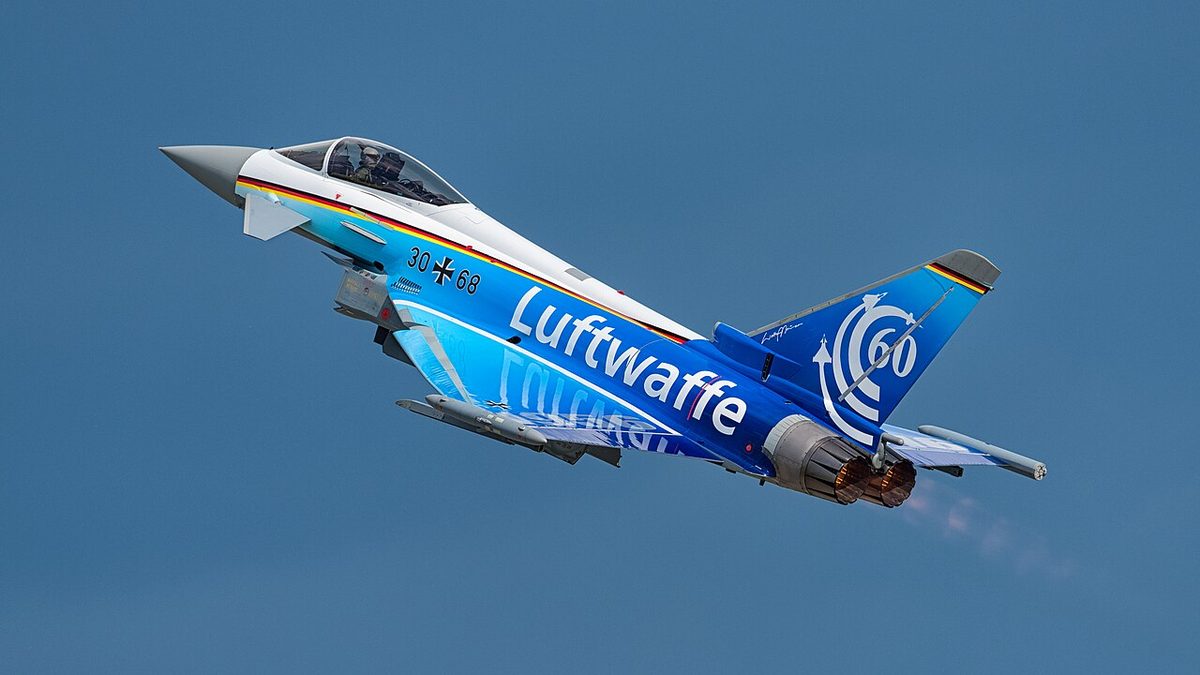
Interception visual signals
The interception visual signals are the same by day and by night. Three are made by the intercepting aircraft and answered by the intercepted aircraft:
| Series | Intercepting aircraft does | Meaning | Intercepted aircraft answers |
|---|---|---|---|
| 1 | Rocks its wings and flashes its navigation lights at irregular intervals from slightly above, ahead of and normally to the left of the intercepted aircraft, then, after acknowledgement, makes a slow level turn, normally to the left, onto the desired heading | You have been intercepted. Follow me. | Rocks its wings, flashes its navigation lights at irregular intervals and follows: understood, will comply |
| 2 | Makes an abrupt break-away manoeuvre: a climbing turn of 90° or more without crossing the line of flight of the intercepted aircraft | You may proceed. | Rocks its wings: understood, will comply |
| 3 | Lowers its landing gear, shows steady landing lights and overflies the runway in use | Land at this aerodrome. | Lowers its landing gear, shows steady landing lights and follows: understood, will comply |
If the intercepted aircraft is a helicopter, the interceptor takes position to its right and turns to the right. Weather or terrain may also require the positions and the direction of turn to be reversed. The Series 2 break-away is deliberately made away from the intercepted aircraft's track, so that it can never be mistaken for a turn to follow.
Three signals are started by the intercepted aircraft:
| Series | Intercepted aircraft does | Meaning |
|---|---|---|
| 4 | Raises its landing gear and flashes its landing lights while passing over the runway in use at a height between 1,000 ft (300 m) and 2,000 ft (600 m) above the aerodrome, then continues to circle the runway | Aerodrome you have designated is inadequate. |
| 5 | Switches all available lights on and off at regular intervals, in a way distinct from flashing | Cannot comply. |
| 6 | Flashes all available lights at irregular intervals | In distress. |
The interceptor acknowledges "cannot comply" and "in distress" with the Series 2 break-away. Raising the gear in Series 4 reverses the "I will land" of Series 3, and the height band keeps the aircraft clearly visible without looking like an approach.
Exam tip: irregular flashing of the navigation lights with wing rocking is Series 1, follow me. Regular switching of all lights is Series 5, cannot comply. Irregular flashing of all lights is Series 6, distress.
The signal area
A signal area is an area on an aerodrome used for the display of ground signals, typically a square edged in white and placed where pilots can see it from the air. It serves aircraft without radio, aircraft whose radio has failed, and aerodromes where no ATS unit is on watch. The tower's light signals, which do the same job for individual aircraft at a controlled aerodrome, are covered in radio communication failure.
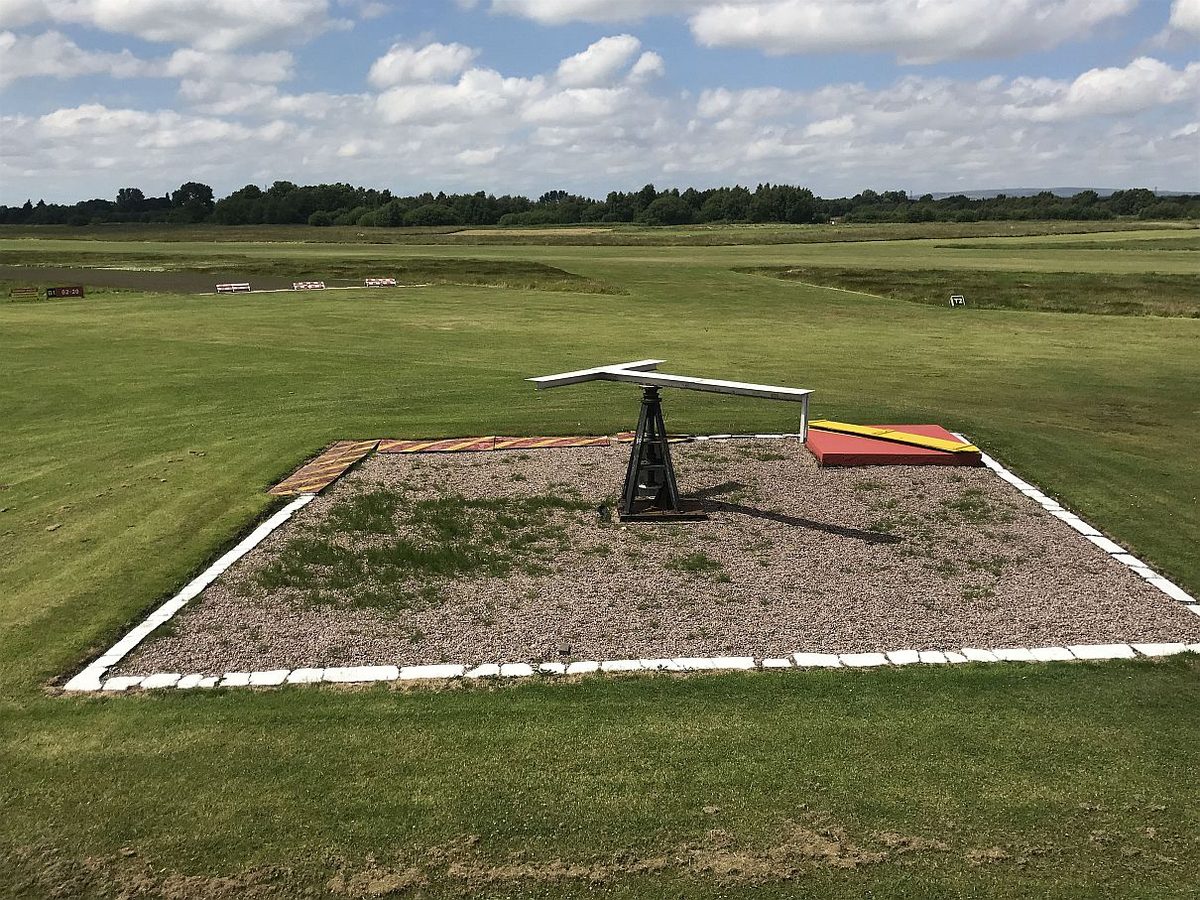
Landing direction indicators
Several devices show the direction in which to land and take off:
- The landing T is a horizontal T displayed in the signal area. Aircraft land and take off in a direction parallel with the shaft of the T, towards the crossarm, like a small aeroplane flying towards its own wings.
- A right-hand arrow in the signal area shows that turns in the circuit are to be made to the right; without it, or other instructions, the circuit is left-hand (see aerodrome traffic and circuits).
- The tetrahedron, found at some US airports, is a landing direction indicator whose small, pointed end points in the direction of landing. A small end pointing towards about 300° means landing on runway 30.
- The segmented circle, used at US airports, is a ring of segments that gives a central, visible location for the airport's visual indicators, such as the wind cone or tetrahedron. Traffic pattern indicators set beside it show where turns are to the right.
- The windsock, or wind direction indicator, streams downwind, so its open end points into the wind.
Landing direction indicators may be set by hand, and a tetrahedron may be tied down, so they can lag behind a change of wind. The FAA advises cross-checking them with the windsock before relying on them.
Warning: when arriving without radio information, look at the signal area before joining. It is where a landing prohibition, a right-hand circuit or glider flying is shown to aircraft that cannot be told.
Ground signals for restrictions
Other panels in the signal area restrict what may be done:
| Ground signal | Meaning |
|---|---|
| Red square panel with one yellow diagonal | Because of the bad state of the manoeuvring area, or for any other reason, special precautions must be observed when approaching to land or landing |
| Red square panel with two yellow diagonals (a yellow cross) | Landing is prohibited, and the prohibition is liable to be prolonged |
| Horizontal white dumb-bell | Aircraft must land, take off and taxi on runways and taxiways only |
| Double white cross | Glider flying is in progress |
The dumb-bell signal matters most at grass aerodromes, where aircraft would otherwise be free to taxi or land anywhere on the manoeuvring area. The landing prohibited signal, a red square with yellow diagonals, is one of the few ground signals that forbids rather than informs; a pilot who sees it does not land there. The complete list of signals, including those for aerodrome traffic by light and pyrotechnic, is in Appendix 1 to SERA and to Annex 2.
Frequently asked questions
What should a pilot do if intercepted by a military aircraft?
Follow the instructions of the intercepting aircraft, interpreting and responding to its visual signals; notify the ATS unit if possible; call the interceptor or the intercept control unit on 121.5 MHz, giving identity and the nature of the flight, and repeat on 243.0 MHz if there is no contact; and select transponder code 7700 unless ATS instructs otherwise. If radio instructions conflict with the interceptor's signals, comply with the interceptor while asking for clarification.
What does it mean when an intercepting aircraft rocks its wings?
Rocking the wings and flashing the navigation lights at irregular intervals, from a position slightly above, ahead and normally to the left of the intercepted aircraft, followed by a slow level turn, is the Series 1 signal meaning you have been intercepted, follow me. The intercepted aircraft answers by rocking its own wings, flashing its navigation lights at irregular intervals and following, which means understood, will comply.
How does an intercepted aircraft show that it cannot comply?
By regularly switching all available lights on and off, in a way distinct from flashing, which is the Series 5 signal meaning cannot comply. Irregular flashing of all available lights instead means in distress. On the radio the interception phrase is CAN NOT, pronounced KANN NOTT. To show that a designated aerodrome is inadequate, the aircraft raises its landing gear and flashes its landing lights while passing over the runway between 1,000 and 2,000 ft, then keeps circling.
What does a red square with yellow diagonals mean in the signal area?
A red square panel with a single yellow diagonal means that, because of the bad state of the manoeuvring area or for another reason, special precautions must be taken when approaching to land or landing. A red square with two yellow diagonals, forming a yellow cross, means that landing is prohibited and the prohibition is liable to be prolonged.
How do you read a landing T?
Aircraft land and take off in a direction parallel with the shaft of the T, towards the crossarm. It helps to picture the T as a small aeroplane seen from above, flying towards its own wings. The T is set to show the landing direction, normally into wind, and like any indicator set by hand it is worth checking against the windsock.
Test yourself on Interception and Visual Signals
The v1prep banks cover this topic in Air Law (010), with a worked explanation for every answer. EASA ATPL, PPL, IR and CPL, the FAA written tests and A320/B737 type ratings.
Start practising →Sources and further reading
- EASA Easy Access Rules for Standardised European Rules of the Air (SERA), SERA.11010 and SERA.11015
- ICAO Annex 2, Rules of the Air (Appendix 1 signals, Appendix 2 interception of civil aircraft)
- ICAO Annex 11, Air Traffic Services (consolidated text)
- FAA Aeronautical Information Manual, Chapter 5 Section 6, National Security and Interception Procedures
- FAA Aeronautical Information Manual, Chapter 4 Section 3 (4-3-4, visual indicators at airports without an operating control tower)
Library articles are written for study and exam preparation. They do not replace your aircraft's approved documentation, your operator's procedures or the regulations themselves.