Taxiing and Runway Incursion Prevention
Taxiing is the movement of an aircraft on the aerodrome surface under its own power. Runway incursion prevention is the set of procedures, clearances and crew habits that keep aircraft, vehicles and people off a runway's protected area unless they have been cleared to be there.
Taxiing is the movement of an aircraft on the surface of an aerodrome under its own power, between the stand and the runway. It looks like the easiest part of a flight, yet the aircraft is at its least agile, the crew sits metres ahead of the main wheels and far from the wingtips, and at a busy airport it may cross several runways on the way. Ground collisions and runway incursions are the typical events of this phase.
ICAO defines a runway incursion as "any occurrence at an aerodrome involving the incorrect presence of an aircraft, vehicle or person on the protected area of a surface designated for the landing and take-off of aircraft". The most serious are listed by ICAO Annex 13 among the examples of serious incidents, because a runway incursion can end in a collision at take-off or landing speed. The defences are partly physical, the markings, signs and lights described in aerodrome markings and signs, and partly procedural: clearances, readbacks and crew discipline.
Turning radius and wing growth
A nosewheel aircraft turns about a point on the line through its main gear. The further the nose wheels are turned, the closer that point moves to the inner main gear. Manufacturers publish a minimum turning radius for airport planning; for the A320 family it assumes a slow continuous turn, symmetric thrust, no differential braking and a dry surface.
On a large swept-wing aeroplane the turn is centred on a point outboard of the inner main gear, and the swept wing places the tips well aft of the flight deck. The outer wingtip therefore sweeps a wider circle than the pilot expects. The additional space it covers is called wing growth, and it is what brings wingtips into contact with parked aircraft, vehicles and jet bridges. The largest types steer their body gear to reduce it. Span also changes between variants: an A320 spans 34.10 m with wingtip fences and 35.80 m with sharklets, so stands and taxi routes planned for the older aircraft must be checked for the newer one.
The pilot cannot see the ground immediately ahead. On the A320 the eye is about 4.6 m (15 ft) above the ground, and with the seat correctly adjusted the nose hides the first 12.5 m (42 ft), a cut-off angle of 20°; a turn must begin before an obstacle reaches that obscured segment. The main gear, 12.64 m behind the nose gear, follows a tighter path than the nose wheels and cuts inside the turn, so the edge of the pavement on the inside of a tight corner needs watching.
Speed is the other variable. Airbus recommends less than 10 kt for turns of 90° or more. On long straight taxiways it suggests letting the aircraft accelerate to 30 kt and then making one smooth brake application down to 10 kt, rather than riding the brakes, because the wear of carbon brakes depends mainly on the number of applications. Steering authority differs by control: the A320 tiller turns the nose wheels up to 75° and the rudder pedals only 6°, while the 737 tiller gives 78°.
180-degree turns on the runway
Where a runway has no parallel taxiway, an aircraft may have to backtrack and turn through 180° on the runway, ideally on a turn pad. For a dry runway and the recommended technique, the A320 FCOM gives about 24 m and the A321 about 30 m, the difference coming from the A321's longer wheelbase (16.91 m against 12.64 m). Neither figure contains any margin, and Airbus's airport planning data give an even smaller theoretical minimum of 22.90 m for the A320, so the FCOM figure is the one to plan with.
Airbus's technique is a steady ground speed of 5 to 8 kt through the whole turn, and 5 kt on a wet or contaminated runway, keeping a divergence of about 25° from the runway axis, the captain turning left and the first officer right, so that the pilot at the controls sits on the inside of the turn.
Exam tip: Airbus's published turning figures, both the minimum turning radius and the runway width for a 180° turn, are for a dry surface and contain no margin. On a wet or contaminated runway allow extra width, and treat the manufacturer's figure as a minimum, not a target.
Exterior lights on the ground
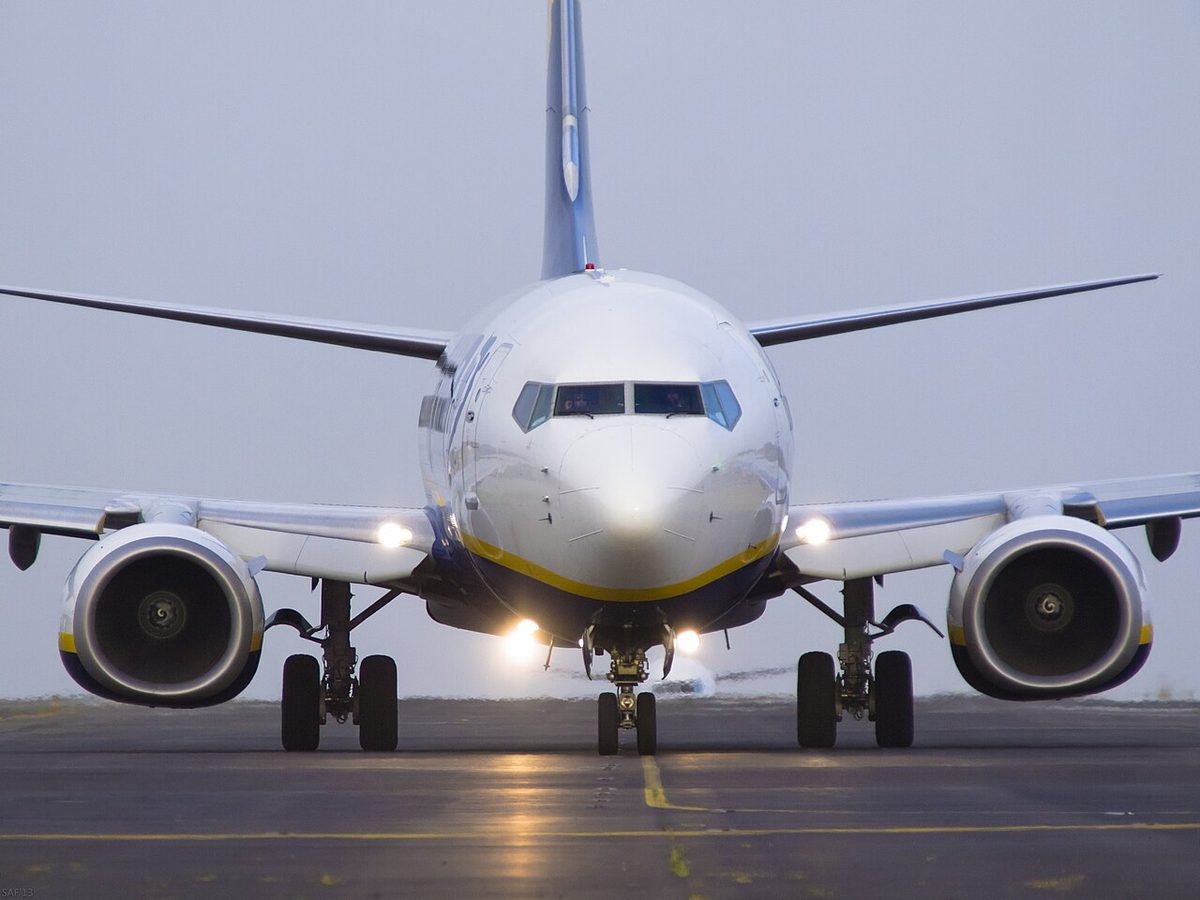
Lights tell others what an aircraft is doing. Under SERA, aircraft fitted with anti-collision lights display them by day as well as by night, on the aerodrome movement area as in flight, and at night an aircraft moving on the movement area also shows its navigation lights. On airliners the red beacon is switched on, by SOP, before engine start or pushback and off after the last engine is shut down, telling ground staff that engines are running or about to run.
- The taxi light, on the nose gear leg, lights the taxiway ahead. On the A320, and on 737s whose switch has an AUTO position, it goes out automatically when the gear retracts.
- The runway turnoff lights light the way for turns onto and off runways. On the 737 they sit in the wing roots and light the area in front of the main gear; on the A320, like the taxi light, they go out automatically when the gear retracts.
- Wing illumination lights, mounted on the fuselage, light the wing leading edge, and on the A320 the engine intake, so that the crew can check for ice.
- Strobes mark an aircraft on or about to use a runway. On the A320 the AUTO position keeps them off on the ground, so the SOP sets them ON to cross a runway; the 737 procedure switches them on when entering the departure runway.
The FAA's runway safety guidance summarises the use of lights to signal intent: taxi light on when moving, strobes and other exterior lights on when entering a runway, and landing lights on when cleared for take-off.
Taxiing with deflated tyres
A deflated tyre throws its share of the load onto the tyre beside it, and a tyre burst can damage the landing gear. The A320 limitations allow taxi with at most one deflated tyre per gear, with a maximum of 7 kt in turns, or with two deflated tyres on the same main gear, on one gear only, at a maximum of 3 kt; in both cases nosewheel steering is limited to 30°. If tyre damage is suspected after landing, the crew asks for an inspection before vacating the runway or taxiing. When parking with a flat nose tyre the parking brake is left on, to stop the aircraft yawing when it is released. Aircraft with overheated brakes taxi, if at all, with a fire vehicle following and two-way communication kept with it.
Active runways and holding points
The active runway is a runway in use for take-off or landing; in practice crews treat every runway as active unless it is known to be closed. It is protected by runway-holding positions, marked across the taxiway by two solid and two dashed yellow lines, solid side towards the aircraft that must hold, with a red mandatory instruction sign carrying the runway designator. Holding positions for Category II and III operations lie further from the runway, to keep aircraft clear of the ILS critical and sensitive areas (see low visibility operations).
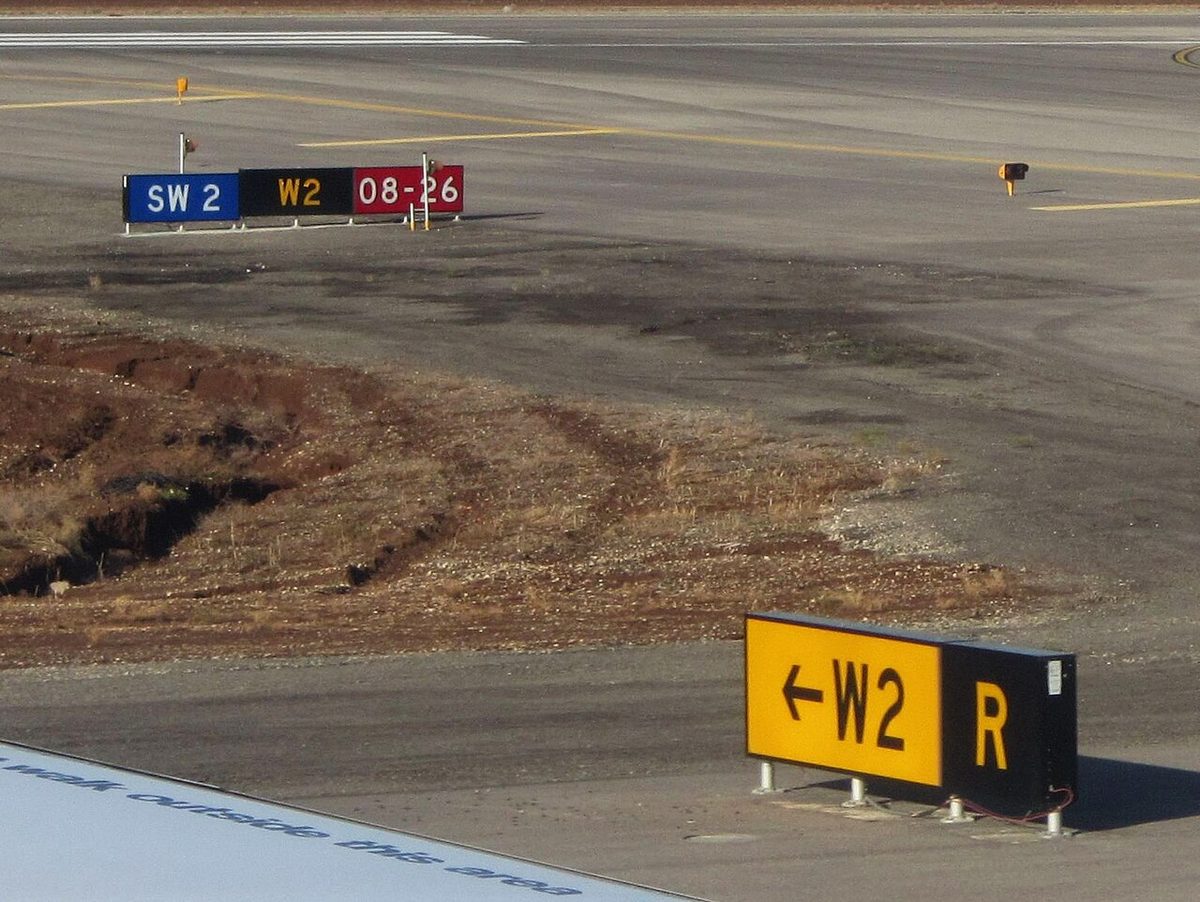
The rules at the runway holding point are strict:
- A lit stop bar, a row of red lights across the taxiway, is not crossed until the lights are switched off and a clearance received. ICAO requires stop bars at holding positions of runways used in RVR below 550 m, unless other aids or procedures prevent incursions.
- Runway guard lights, flashing yellow, warn of a runway ahead.
- A taxi clearance whose limit lies beyond a runway must include either a clearance to cross it or an instruction to hold short. Without one, the pilot holds short and asks. The FAA has required an explicit clearance for every runway crossing since 2010.
- Clearances and instructions to enter, land on, take off from, cross, backtrack on or hold short of a runway are read back in full; "roger" and "wilco" are never enough.
- A taxiing aircraft gives way to aircraft landing, taking off or about to take off.
- An aircraft leaving a runway has vacated it only when all of it is beyond the holding position marking, so it keeps rolling across the dashed lines rather than stopping on them.
Without a radio, a steady red light from the tower means stop (see aerodrome control phraseology).

Runway incursion causes and prevention
Most runway incursions begin with a crew that is unsure of its position or has misunderstood a clearance. Expectation bias plays a large part: pilots hear the clearance they expect, or read back the runway they planned for. Distraction is the other constant, which is why the FAA's sterile cockpit rule for airlines, 14 CFR 121.542, treats taxi as a critical phase of flight.
The defences are simple:
- Brief the expected taxi route before leaving the stand, with the airport chart out, including every runway crossing and every hot spot: a place with a history or risk of incursions, marked HS on the chart.
- Keep heads up while moving; do checklists and FMS changes when stopped or clear of runways.
- Read back every runway instruction with the designator, and query anything unexpected. "Standby" is not a clearance.
- Stop when unsure of position, hold clear of any runway and tell the controller. Stopping costs nothing.
- Before crossing a holding position and again when lined up, confirm the runway from the signs, the markings and the heading indicator.
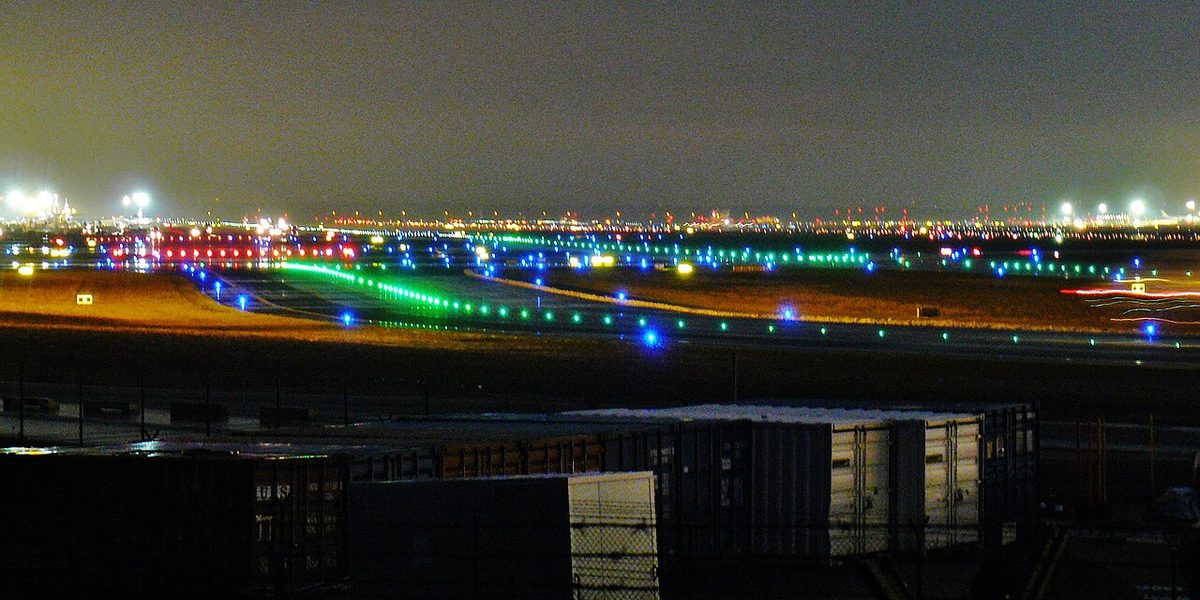
- Where they exist, as at many major US airports, obey runway status lights, red in-pavement lights that warn automatically that a runway is unsafe to enter or cross. A red light means stop and contact ATC, even with a clearance.
Aircraft alerting systems add a layer: a runway awareness and advisory system gives aural advisories during taxi, take-off, approach and landing. In low visibility, airports apply surface movement guidance procedures with stop bars, designated routes and, where needed, follow-me vehicles.
LAHSO and runway occupancy time
Land and hold short operations (LAHSO) are an FAA procedure in which a landing aircraft is cleared to land and to stop short of an intersecting runway, taxiway or other point, as in "runway 27, cleared to land, hold short of runway 18". The pilot must know the available landing distance to the hold-short point, and the clearance is read back in full, including the hold-short runway. The pilot in command may always decline with "unable", and the FAA says student pilots and pilots unfamiliar with LAHSO should not participate.
Runway occupancy time (ROT) is the time an aircraft occupies the runway, for an arrival from crossing the threshold until it has vacated, and it governs how closely arrivals can follow one another. The reduced 2.5 NM radar separation on final is allowed only with conditions that include an average ROT proven not to exceed 50 seconds and adequate braking action. Rapid exit taxiways exist to shorten it: they meet the runway at 25° to 45°, preferably 30°, and are designed for turn-off speeds on a wet runway of 93 km/h (about 50 kt) for code 3 and 4 runways and 65 km/h (about 35 kt) for code 1 and 2. Crews help by planning their exit, but never at the cost of a safe speed.
Wrong-surface landings and take-offs
A wrong-surface landing is a landing on a taxiway or on the wrong runway; its twin is a take-off from a taxiway or the wrong runway. A parallel taxiway at night or a runway that fits the mental picture invites the error, and expectation bias does the rest. The countermeasures are procedural: check the runway designator and the heading indicator against the runway's direction before take-off and on final. Some types also warn: the 737's runway awareness function calls "CAUTION ON TAXIWAY" when the aircraft is not on a runway at a ground speed above 40 kt.
On 27 August 2006 Comair Flight 5191, a Bombardier CRJ (CL-600-2B19) cleared to take off from runway 22 at Lexington, Kentucky, lined up in the dark on runway 26, which was about 3,500 ft long and unlit, and crashed beyond its end; 49 of the 50 people on board died. The NTSB found that the crew had not used the available cues and aids to identify their position on the airport or cross-checked that they were on the correct runway, with non-pertinent conversation during taxi contributing.
Warning: A take-off clearance does not prove that the aircraft is on the right runway. Confirm the runway, heading and length available before every take-off roll.
Frequently asked questions
What is a runway incursion?
ICAO defines a runway incursion as any occurrence at an aerodrome involving the incorrect presence of an aircraft, vehicle or person on the protected area of a surface designated for the landing and take-off of aircraft. It includes crossing a runway-holding position without a clearance, entering the wrong runway, and taking off or landing without a clearance. Most begin with a pilot who is unsure of position or has misunderstood a clearance.
What is wing growth when taxiing?
Wing growth is the extra ground space swept by the outer wingtip of a large swept-wing aircraft in a turn. The turn is centred on a point outboard of the inner main gear, and the swept wing puts the tip well aft of the pilot, so the tip describes a wider circle than the pilot expects. It matters near parked aircraft, vehicles, jet bridges and buildings.
What must a pilot read back when told to hold short of a runway?
An instruction to hold short of a runway, like one to enter, cross or backtrack on it, must be read back in full with the runway designator and the call sign, for example 'holding short of runway 27, G-KM'. 'Roger' or 'wilco' never replaces it. The readback lets the controller catch a misheard runway before it becomes an incursion.
Can a pilot refuse a LAHSO clearance?
Yes. Land and hold short operations are an FAA procedure in which a landing aircraft is told to stop short of an intersecting runway or other point. The pilot in command may always decline by replying 'unable', and ATC then issues another clearance. The FAA says student pilots and pilots unfamiliar with LAHSO should not take part. A pilot who accepts reads back the full clearance, including the hold-short point.
What speed should an A320 use for a 180-degree turn on a runway?
Airbus recommends a ground speed between 5 and 8 kt throughout the manoeuvre on a dry runway and 5 kt on a wet or contaminated one, turning while keeping about 25° of divergence from the runway axis. The FCOM puts the runway width needed on a dry surface at about 24 m for the A320 and 30 m for the A321, with no margin included.
Test yourself on Taxiing and Runway Incursion Prevention
The v1prep banks cover this topic in Operational Procedures (070), with a worked explanation for every answer. EASA ATPL, PPL, IR and CPL, the FAA written tests and A320/B737 type ratings.
Start practising →Sources and further reading
- FAA Aeronautical Information Manual, Chapter 4 Section 3, Airport Operations
- FAA Aeronautical Information Manual, Chapter 2 Section 3, Airport Marking Aids and Signs
- ICAO Doc 4444, Procedures for Air Navigation Services, Air Traffic Management (PANS-ATM), 16th edition, as published by Airservices Australia
- ICAO Annex 14, Aerodromes, Volume I, Aerodrome Design and Operations
- FAA Pilot's Handbook of Aeronautical Knowledge (FAA-H-8083-25), Chapter 14, Airport Operations
- NTSB, Aircraft Accident Report AAR-07/05, Attempted Takeoff From Wrong Runway, Comair Flight 5191
Library articles are written for study and exam preparation. They do not replace your aircraft's approved documentation, your operator's procedures or the regulations themselves.