Ground Handling, Pushback and Engine Start
Ground handling is the servicing of an aircraft between arrival and departure, from power, air, fuel and loading to marshalling and pushback. Engine start is the use of a starter, usually driven by compressed air on jets, to accelerate an engine until it can light up and run by itself.
Ground handling covers everything done to an aircraft between its arrival on the stand and its departure: disembarking and boarding, baggage and cargo, fuel, catering, cleaning, water and waste, electrical power and air, and finally moving the aircraft off the stand. Most of it is done by ground staff, not the crew, but the crew stays responsible for the aircraft and must know what is happening around it.
The phase ends with two routine tasks that carry real risk. During pushback a tug moves a heavy aircraft backwards with people and vehicles close by. During engine start a turbine can exceed its temperature limit within seconds. Clear communication, by headset, hand signals and radio, holds it all together. The figures below come from specific types; the manufacturer's and operator's procedures always govern.
The aircraft turnaround
The aircraft turnaround, or turnaround, is the sequence of tasks between on-blocks and off-blocks at a stand. Passengers leave, the cabin is cleaned and catered, bags and cargo are unloaded and reloaded, the aircraft is fuelled and its water and toilets serviced, and new passengers board. Many tasks run in parallel, and the slowest chain of them sets the turnaround time. The crew uses the time for the walk-round, the technical log, the flight documents and the cockpit preparation (see pre-flight preparation and routine checks).
Refuelling with passengers embarking, on board or disembarking is allowed only with kerosene-type fuel and with precautions such as supervision and two-way communication. With Avgas or wide-cut fuel it is not allowed at all, because those fuels give off ignitable vapour at ordinary temperatures (see refuelling safety and fuel emergencies).
Airliners usually park at a jet bridge, also called an air bridge or passenger boarding bridge, or use stairs on a remote stand. At many airports general aviation is looked after by a fixed-base operator (FBO), a business on the airfield that sells fuel and provides parking, hangarage, handling and often maintenance.
Ground support equipment
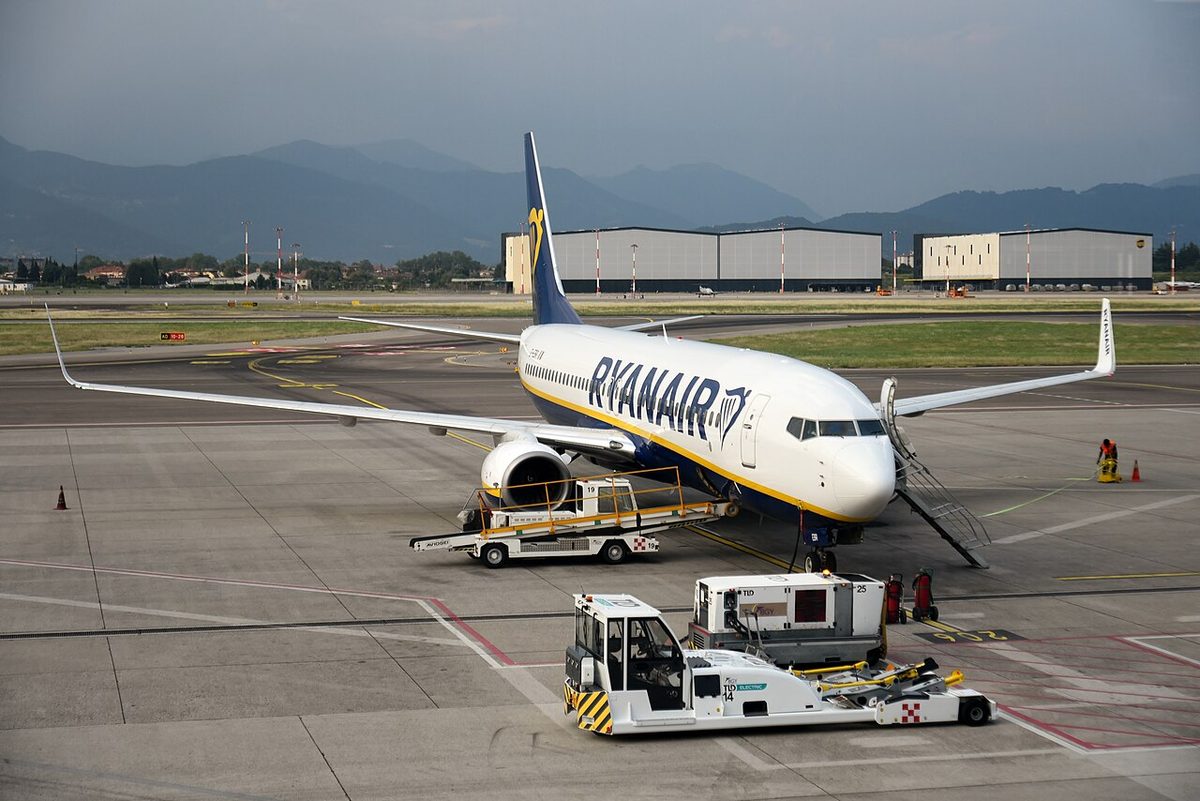
Ground support equipment (GSE) is the collective name for the vehicles and units that serve aircraft on the apron: tugs and tow bars, belt loaders and baggage carts, catering and fuel trucks, water and lavatory service units, stairs, de-icing vehicles, and the units that supply electrical power and air.
The ground power unit (GPU) supplies 115/200 V, 400 Hz, three-phase AC through the external power receptacle, so that the aircraft can be powered for pre-flight checks and servicing without wearing the APU or the battery. The aircraft connects ground power only when its voltage and frequency are within limits, and a protection unit controls the external power contactor.
Ground air and preconditioned air
Two different kinds of ground air are used, through two different connections:
- A high-pressure air start unit (ASU), or high-pressure ground air start unit, also called a ground pneumatic air cart or ground air start cart, blows compressed air into the aircraft's high-pressure ground connection, which feeds the bleed duct and the engine starters. It is used to start the engines when the APU is unserviceable, or to save APU running time.
- A low-pressure ground air conditioning unit delivers already conditioned air through a separate low-pressure connection to the cabin distribution system. Preconditioned air (PCA), supplied at many gates by a unit on the jet bridge, does the same job without a separate cart.
Type limitations keep them apart from the aircraft's own sources. On the A320, bleed air from the APU and from the HP air start unit must not be used at the same time, nor conditioned air from the packs and from the LP unit. A less obvious trap: with an LP cart connected and all doors closed, selecting the A320's DITCHING pushbutton ON closes the outflow paths and lets a pressure difference build up in the cabin.
Marshalling and follow-me guidance
A marshaller guides an aircraft onto or off a stand with the standard marshalling signals published in ICAO Annex 2 and SERA, given with bats or wands so the pilot can see them clearly. On congested stands, wing walkers watch the wingtip clearance. Many gates replace the marshaller with a visual docking guidance system, and apron safety lines mark where ground equipment must stay so that, if everything is behind them, the pilot can concentrate on the stand markings.
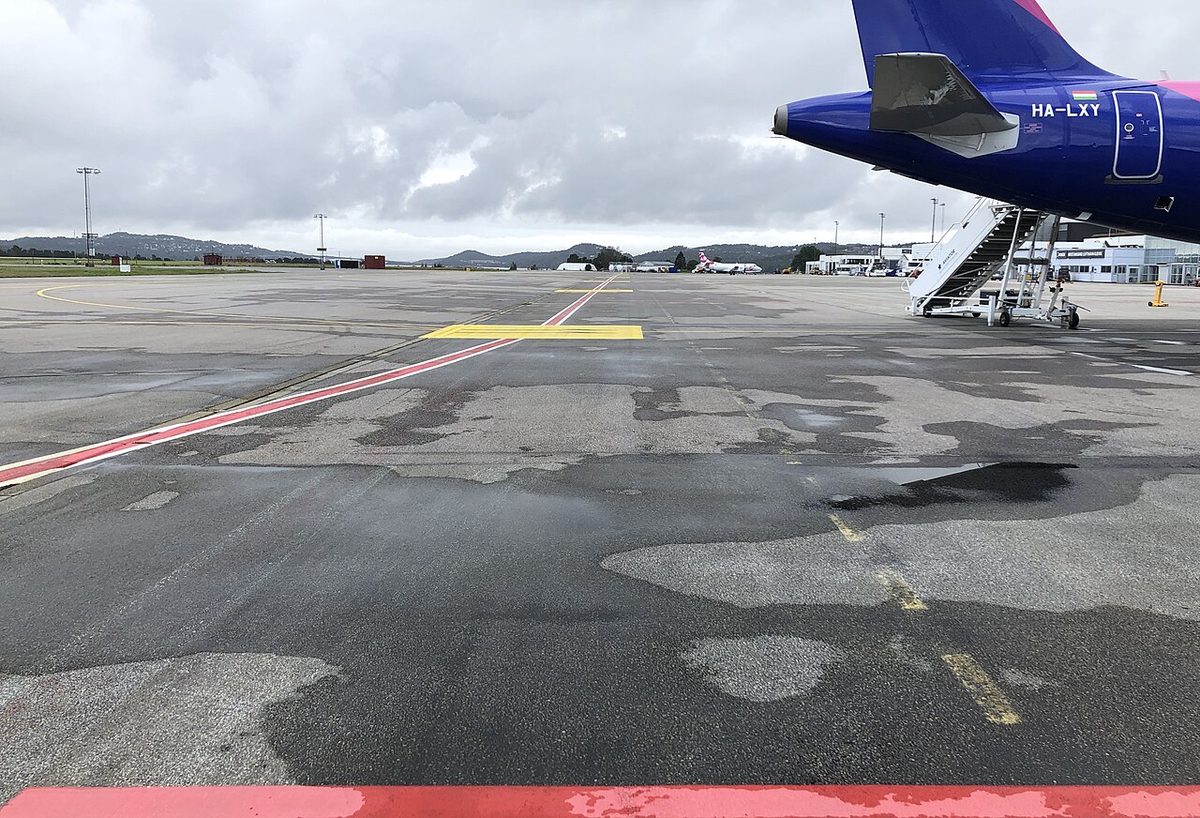
A follow-me vehicle leads an aircraft along its taxi route, typically at an unfamiliar or complex aerodrome, or in low visibility as part of the airport's surface movement guidance procedures (see taxiing and runway incursion prevention).
Chocks, gear pins and steering lockout
Wheel chocks are placed against the wheels once the aircraft stops. On the A320, if the chocks are not in place the crew checks that the parking brake is set with sufficient accumulator pressure. After arrival the parking brake is released once the chocks are in if any brake is above 300 °C, or 150 °C with brake fans running, so that hot brakes do not heat the surrounding structure for a long time; on a slippery apron it may stay on. The 737 procedure also releases the parking brake after chocks are in place.
A ground lock, or gear pin, is a pin or sleeve inserted in the landing gear mechanism so that the gear cannot collapse while the aircraft stands unpowered. Each carries a red warning flag. Before flight the pins, typically one per gear, are removed, stowed on board and the crew told; a forgotten pin prevents gear retraction. The walk-round confirms that they have gone.
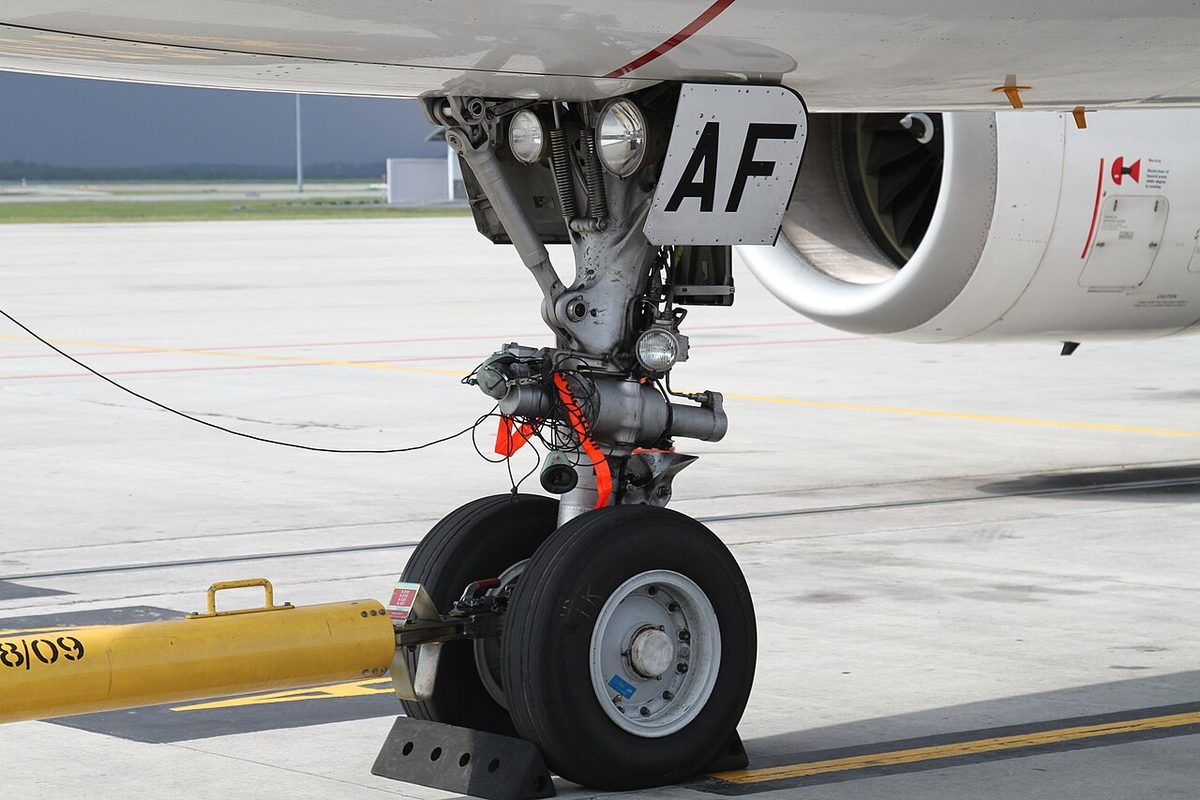
For towing, the nose wheel steering must be disconnected. A hydraulic steering system traps fluid in its actuators and would fight the tug, so a steering bypass valve lets the fluid flow between the two sides and the wheels castor freely. On the A320 ground staff move a lever on the nose gear towing box, after which the wheels can be turned up to 95° either way and an NW STRG DISC memo appears on the ECAM. On the 737 a nose gear steering lockout pin is installed for pushback. If it is not used, hydraulic system A must not be pressurised, because unwanted tow bar movement can occur.
Pushback and towing
A pushback moves an aircraft backwards off a nose-in stand. The crew obtains approval from ground or apron control, which may reply PUSHBACK APPROVED, STANDBY, or PUSHBACK AT OWN DISCRETION with an expected delay (see aerodrome control phraseology), and talks to the ground crew by headset through the interphone jack near the nose gear. The beacon is switched on before the aircraft moves. Under ICAO, flight time begins when the aeroplane first moves for the purpose of taking off, so a pushback counts.
The tug is connected either by a tow bar, a rigid bar attached to the nose gear, or by towbarless towing, in which the tug cradles the nose wheels. On the A320, towbarless pushback and towing are approved only with accepted tugs, with a maximum nose wheel steering angle of 85°. During pushback the 737 crew must neither hold nor turn the tiller and must not use the brakes to stop the aircraft, because either can damage the nose gear or the tow bar.
Powerback
A powerback uses reverse thrust to move the aircraft backwards off a stand without a tug. Only some types, operators and airports allow it, under their own procedures: reverse thrust close to the terminal drives air and debris towards the engine intakes, buildings and people, and the crew cannot see behind the aircraft. Where it is not approved, every departure from a nose-in stand needs a tug.
Engine start with ground air
Most jet engines are started by an air turbine starter: compressed air spins a small turbine that drives the high-pressure spool (N2) up to a speed at which fuel and ignition can be introduced, then disengages once the engine can accelerate by itself. The air comes from the APU, from a ground air start unit, or from another running engine; on the A320 that is also the order of preference. The packs are closed during the start, automatically on the A320 and by switch on the 737, so that the starter gets the full duct pressure.
On the 737 NG the crew turns the ENGINE START switch to GRD, which opens the start valve, waits for N1 rotation and 25% N2, then moves the start lever to IDLE; light-up must show as an EGT rise within 15 seconds, the starter cuts out at 56% N2, and the engine is stable at idle when the EGT start limit line disappears. In an automatic start, as on the A320, the FADEC opens the start valve and introduces ignition and fuel itself, and on the ground it aborts the start if it goes wrong.

Starters overheat, so their use is limited. On the A320 an automatic start of up to three attempts counts as one cycle, successive ground cycles need a 20-second pause, four failed cycles call for 15 minutes of cooling, and the starter must not run with N2 above 20%. On the 737 each attempt is limited to two minutes of starter use with at least 10 seconds between attempts. After start, an A320 engine runs at or near idle for at least two minutes before high thrust is set. If the ground crew reports fuel leaking from an A320 engine's drain mast during the start, the engine is run at idle for five minutes; a leak that has not stopped by then means shutdown and a maintenance investigation.
Crossbleed engine start
A crossbleed engine start uses bleed air from a running engine, routed through the crossbleed or isolation valve, to turn the starter of the other one. It is used when neither APU bleed nor ground air is available, for example after an APU failure at an outstation, and is the least preferred method on the ground. Thrust on the running engine must be raised to give enough duct pressure, so the crew makes sure the area behind the aircraft is clear of people, vehicles and other aircraft before doing so. On the A320 the X BLEED selector is set to OPEN for the start and back to AUTO afterwards; with the crossbleed valve open, both pack valves close during the start.
Aborted starts and induction fires
An aborted engine start is a start stopped because the engine is not behaving normally. The classic cases are:
- Hot start: too much fuel for the air, often because of a tailwind, residual heat from a previous run or slow rotation. EGT races towards the limit, and the only protection is to cut the fuel at once; an exceedance means a maintenance inspection.
- Hung start: the engine lights up but stops accelerating below idle, with an EGT high for the low rpm.
- No light-off, or wet start: fuel flows but EGT does not rise within the time limit. The fuel left in the engine is cleared by motoring it with fuel and ignition off before another attempt.
- On the 737, no oil pressure by the time the engine is stable at idle is also an abort condition.
On the 737 the aborted engine start recall item is a single action, the start lever to CUTOFF. On the A320, the FADEC aborts a ground automatic start by itself and then dry-cranks the engine to cool it, as long as the master lever stays ON. A tailpipe fire, fuel burning in the turbine during a start or shutdown on the ground, usually gives no cockpit indication; it has its own non-annunciated QRH procedure, called ENG TAILPIPE FIRE on the E190-E2.
Piston engines have their own start fire. An induction fire on start follows over-priming or pumping the throttle, which floods the carburettor intake with fuel that a backfire can ignite. The drill in most light-aircraft handbooks is to keep cranking so that the flames are drawn into the engine, with the mixture at idle cut-off and the throttle open.
Warning: Keep the headset link with the ground crew open during every start. They often see a fire or a leak before anything shows in the cockpit.
Frequently asked questions
What is the difference between an air start unit and a ground power unit?
A ground power unit is an electrical source: it supplies 115/200 V, 400 Hz three-phase AC through the aircraft's external power receptacle. An air start unit is a high-pressure pneumatic cart: it blows compressed air into the aircraft's high-pressure ground connection, feeding the bleed duct and the engine air turbine starters. Cabin air on the ground can come from a third source, a low-pressure conditioned air unit or preconditioned air from the gate.
What is a crossbleed engine start?
A crossbleed start uses bleed air from an engine that is already running to drive the starter of the other engine, through the crossbleed or isolation valve. It is used when neither APU bleed nor a ground air cart is available. Thrust on the running engine is increased to give enough duct pressure, so the area behind the aircraft must be clear. On the ground it is the least preferred of the three start sources.
What is the difference between a hot start and a hung start?
In a hot start the engine gets too much fuel for the air passing through it, so EGT rises rapidly towards or beyond the start limit; fuel must be cut off at once, and an exceedance needs a maintenance inspection. In a hung start the engine lights up but stops accelerating below idle, with a high EGT for the low rpm. Both are reasons to abort the start.
Why is the nose wheel steering disconnected for pushback?
A hydraulic steering system resists any attempt to turn the nose wheels from outside, so the tug could damage the nose gear or tow bar. Ground staff therefore disconnect it: on the A320 a lever on the nose gear lets the wheels turn up to 95° either way, and on the 737 a steering lockout pin is fitted or hydraulic system A is left unpressurised. The 737 crew must not hold or turn the tiller, or brake, during pushback.
What should a pilot do if flames appear at the intake while starting a piston engine?
Flames at the intake mean that excess fuel in the induction system, from over-priming or pumping the throttle, has caught fire. The usual drill is to keep cranking so the flames are drawn into the engine, with the mixture at idle cut-off and the throttle open. Stopping the engine leaves the fire burning under the cowling, and pumping the throttle adds fuel to it.
Test yourself on Ground Handling, Pushback and Engine Start
The v1prep banks cover this topic in Operational Procedures (070), with a worked explanation for every answer. EASA ATPL, PPL, IR and CPL, the FAA written tests and A320/B737 type ratings.
Start practising →Sources and further reading
- ICAO Annex 2, Rules of the Air (Appendix 1, signals, including marshalling signals)
- ICAO Annex 6, Operation of Aircraft, Part I, International Commercial Air Transport, Aeroplanes
- EASA Easy Access Rules for Air Operations (Regulation (EU) No 965/2012)
- FAA Airplane Flying Handbook (FAA-H-8083-3C), Chapter 2, Ground Operations
- FAA Aviation Maintenance Technician Handbook, Powerplant (FAA-H-8083-32B), Engine Starting Systems
- FAA Pilot's Handbook of Aeronautical Knowledge (FAA-H-8083-25), Chapter 7, Aircraft Systems
Library articles are written for study and exam preparation. They do not replace your aircraft's approved documentation, your operator's procedures or the regulations themselves.