Ice Protection and Ice Detection
Ice protection is the set of aircraft systems that stop ice forming (anti-icing) or remove it once it has formed (de-icing) on leading edges, engine intakes, propellers, probes and windscreens. Ice detection tells the crew, or the system itself, that ice is building.
Ice protection is the collective name for the systems that keep ice off the parts of an aircraft where it does most harm: wing and tail leading edges, engine intakes, propellers, air data probes and the windscreen. Some systems stop ice forming at all; others let it build and then break it away. Ice detection is the other half of the subject. Protection has to be switched on, or cycled, at the right moment, so the crew or the system must know when ice is forming.
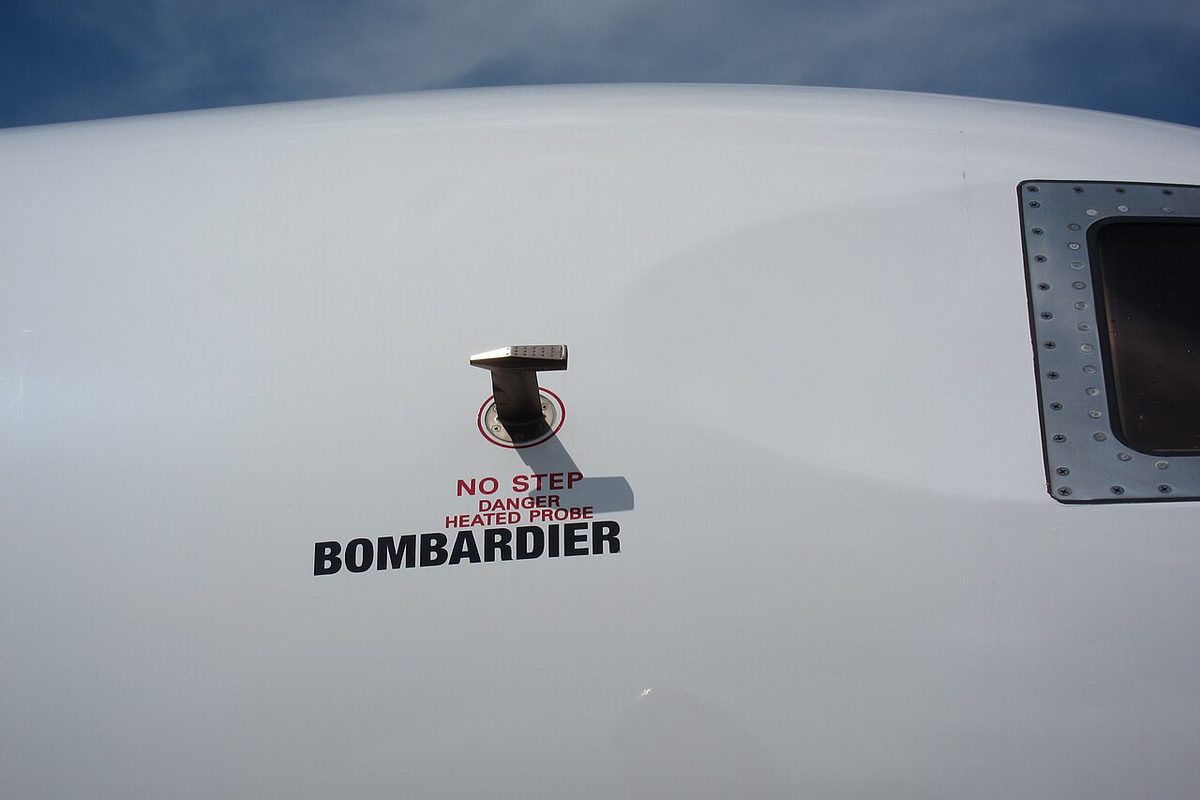
How ice forms, its types and the weather that produces it are covered in airframe icing, and fluid treatment on the ground before take-off in aircraft ground de-icing and anti-icing. This article covers the equipment used in flight as a whole and the ways ice is detected. Each family of systems has its own article: thermal anti-icing, de-icing boots and fluid systems, propeller ice protection and probe heat, window heat and rain protection.
Why ice protection is needed
Ice spoils an aerofoil in two ways: it changes the shape of the leading edge and it roughens the surface. Maximum lift falls, drag rises, the stalling speed goes up and the stall can arrive before a warning set for a clean wing (see stall). FAA AC 20-117 notes that ice, frost or snow as rough as medium or coarse sandpaper on the leading edge and upper surface can cut lift by as much as 30 % and raise drag by 40 %. Ice also blocks intakes and pressure heads, and ice that breaks away from an engine intake can be swallowed and damage the fan or compressor.
Ice does not collect evenly. The share of droplets that actually strike an object, its catch rate efficiency, is highest for objects with a small radius. Probes, aerials, thin tailplanes and struts therefore ice faster than a thick wing, and the same depth of ice is a larger fraction of their size. That is why the smallest items, the pitot heads and angle of attack sensors, are among the first to be heated, and why a tailplane may carry more ice than the wing.
ATPL systems texts list the areas that may need protection:
- engines: air intakes, inlet guide vanes and the nose cone or spinner, plus oil cooler and other ram air intakes;
- aerofoils: wing and tail leading edges, slats and propellers;
- instruments: pitot heads, angle of attack (alpha) probes, Q-feel probes, engine inlet pressure probes and total air temperature probes;
- flight deck windows;
- other items: aerials and water drain masts.
An aircraft allowed to fly in icing has been shown to operate safely in a defined icing envelope, for large aeroplanes Appendix C of CS-25 and 14 CFR Part 25, with supercooled large droplets added as Appendix O (see large aeroplane certification). EU rules such as CAT.OP.MPA.255 permit flight into expected or actual icing only in an aircraft certified and equipped for it. The FAA's equivalent is approval for flight into known icing (FIKI), which needs a complete system: wing and tail protection, propeller de-icing, heated pitot and stall warning, windscreen protection and an ice inspection light for night flight (see required instruments and equipment). An aircraft fitted only for inadvertent icing must leave the conditions at once.
Anti-icing versus de-icing
The two words describe different strategies, and confusing them leads to using a system at the wrong time.
- Anti-icing prevents ice from forming. Heat, electrical power or fluid is applied continuously, keeping the surface above freezing or stopping ice from sticking to it. It is switched on before, or on entering, icing conditions.
- De-icing removes ice that has already formed. It is applied intermittently: a thin layer is allowed to build and is then broken off by mechanical force or by heat that melts its bond with the surface.
The systems fall into three families: thermal (hot engine bleed air, electrical heating, and on older or smaller types exhaust heat or a combustion heater), pneumatic (inflatable boots) and liquid (a freezing point depressant fluid). Electrical heating can do either job: run continuously it anti-ices, cycled it de-ices.
| System | Anti-ice or de-ice | Typical use |
|---|---|---|
| Hot bleed air | Anti-ice | Wing leading edges or slats and engine intake lips on jets |
| Electrical heating, continuous | Anti-ice | Probes, windscreens, drain masts |
| Electrical heating, cycled | De-ice | Propeller blades, some turboprop intakes |
| Pneumatic boots | De-ice | Wings and tails of piston twins and turboprops |
| Freezing point depressant fluid (TKS) | Anti-ice | Wings, tails and propellers of light and business aircraft |
The FAA draws the same line: pitot heat, heated windshields, TKS and thermal wing anti-ice are anti-ice equipment, while pneumatic boots and electric propeller de-ice remove ice after it forms.
Exam tip: ATPL material gives two usage rules. Engine anti-ice is applied proactively, at an indicated outside air temperature of +10 °C or below with visible moisture, before any ice is seen. Airframe protection is applied at the onset of indicated icing, as shown by visible ice or an ice detector. Flight manuals refine both rules for each type.
Ice and rain protection on transport aircraft
Manufacturers group the systems under one heading, ice and rain protection. Boeing describes the 737 NG's anti-ice and rain systems as flight deck window heat, windshield wipers, engine anti-ice, wing anti-ice, and probe and sensor heat, using three methods: thermal anti-icing (TAI) with bleed air, electrical anti-icing and wipers. Jet transports rely almost entirely on anti-icing; boots and cycled heaters are found on propeller aircraft.
| Item | Airbus A320 | Boeing 737 NG | Embraer E190-E2 |
|---|---|---|---|
| Wing | Bleed air, slats 3, 4 and 5 (the outboard three) | Bleed air, the three inboard slats | Bleed air, the three outboard slats |
| Engine intakes | Bleed air from the same engine | Bleed air to the cowl lip | Bleed air to the cowl |
| Probes | Electric: pitots, static ports, AOA and TAT probes | Electric: pitots, TAT probe, alpha vanes; static ports unheated | Electric: four air data smart probes and two TAT probes |
| Windscreens | Electric | Electric | Electric |
| Horizontal tail | None | Not part of the wing anti-ice system | None |
Surfaces are left without protection by design, not by oversight. Airbus showed through testing and analysis that the A320's horizontal stabiliser needs no anti-ice within the certificated icing envelope, and the E190-E2 has none either. Such types are certified with ice assumed on the tail, and their control and stability margins are demonstrated in that state.
Purpose of ice detection
Engine anti-ice on a jet goes on by rule, whenever the temperature and moisture criteria are met, ice or no ice. Everything else waits for evidence: wing anti-ice on many jets, boots, and the decision to leave the conditions. That evidence has to come from somewhere, and the wing may be invisible at night, in cloud, or entirely from the flight deck, as a T-tail always is.
Ice detection answers three questions: is ice forming now, how fast, and has it stopped? Methods are either visual, in which the crew look at something designed to show ice, or automatic, in which a detector produces a signal. Automatic detectors work on one of two principles. Accretion detectors sense ice building on the detector itself. Inferential detectors sense the conditions for icing, liquid water and a sub-zero temperature, and infer that ice will form. The output may be advisory, a caption that tells the crew, or it may switch the anti-ice on directly.

Visual ice detection
The crew's own observation remains basic. First ice often shows on the windscreen wiper arms, the windscreen frame, the propeller spinner and the outside air temperature probe. Some cues, such as ice on the side windows or ice farther aft than usual, suggest supercooled large droplets and call for leaving the conditions (see airframe icing).
A visual ice indicator, or visual ice detector, gives the crew one unheated object in plain view on which ice will show. The A320's external visual ice indicator sits between the two windshields, where both pilots can see it, and has its own light for night use; ice on it is one of the cues that require wing anti-ice. The older Teddington ice detector is a visual ice detector mast: an aerofoil-shaped mast in the pilot's field of view, lit at night. With its heater off, ice accumulates on it as a direct indication; once seen, the heater is switched on to clear it.
Ice detection lights, also called ice formation spot lights, wing ice inspection lights or wing and engine scan lights, light up the areas where ice would first be seen. On transport aircraft they are typically mounted one on each side of the fuselage and aimed at the wing leading edges. The A320's WING lights illuminate the wing leading edge and the engine air intake for this purpose. On some aircraft these lights are the only aid to ice detection at night. On light aircraft approved for known icing, an ice light usually shines on the left wing's leading edge so the pilot can watch ice build and check that the boots are shedding it.
Automatic ice detectors
ATPL texts describe the main designs:
| Detector | Principle | How it signals ice |
|---|---|---|
| Smiths pressure-type | Accretion | A hollow tube with four holes in its leading face and two in its trailing face. Ice blocks the front holes, the pressure inside falls, and a relay gives the warning. A heater clears the ice. |
| Napier rotary | Accretion | A motor turns a serrated rotor next to a fixed knife-edge cutter, with a clearance under 0.002 in (0.05 mm). Ice on the rotor is shaved by the cutter, the torque rises, the motor turns slightly in its flexible mounting, and a microswitch gives the warning or starts the anti-ice. |
| Vibrating rod (Rosemount type) | Accretion | A short cylindrical probe vibrates axially at an ultrasonic resonant frequency, about 35 kHz in ATPL texts. Ice adds mass and lowers the frequency; at a set value the warning is given and a built-in heater sheds the ice for about six seconds before the cycle restarts. |
| Beta particle | Accretion | An emitter probe on the forward fuselage sends beta particles to a detector probe. Ice between them absorbs particles; a count corresponding to 0.4 mm of ice operates a relay and a flight deck warning. |
| Sangamo Weston | Inferential | A moisture head holds two heated resistance bulbs, the rear one shielded by the front one. In cloud the exposed bulb is wetted and cools faster; a thermal switch permits the warning only below freezing. |
The vibrating rod ice detector is the type commonly found on current transport aircraft. Because each cycle ends with the probe heated clean, the rate at which warnings repeat gives a measure of the accretion rate. An inferential detector can warn before any ice has formed, but it cannot confirm that ice is actually building.
Every detector reports conditions at its own location. It cannot see ice forming aft of the protected areas in supercooled large droplets, so the visual cues still matter even on aircraft with a detector.
Ice detection systems in service
On the Airbus A320 the ice detection system is advisory. Two vibrating probes on the forward lower fuselage, one each side, detect ice by the change in their resonant frequency; either one alone can trigger an alert.
- ICE DETECTED appears in flight at or above 1,500 ft with a TAT below 10 °C when at least one detector senses ice and the engine anti-ice pushbuttons are off. It prompts the crew to select engine anti-ice.
- SEVERE ICE DETECTED has the same gating but responds to heavy icing with wing anti-ice off. It prompts wing anti-ice, which the SOP then requires.
- ICE NOT DET, a green memo, appears when no ice has been detected for 190 seconds after engine anti-ice was selected on, telling the crew that the anti-ice may be switched off.
Nothing is switched automatically. Engine anti-ice is required whenever icing conditions exist or are anticipated, so crews do not wait for the detector; the alert catches a missed selection.
The Embraer E190-E2 takes detection further. Two ice detectors on the nose, connected to the aircraft's avionics, give an ICE CONDITION advisory, and each probe is heated for a few seconds after a detection. With the anti-ice selector in AUTO, engine and wing anti-ice come on by themselves when ice is detected and stay on until 2 minutes after ice is no longer detected (5 minutes on the first-generation E190). If one detector fails, the system, including automatic activation, still works, but the checklist calls for manual operation. If both fail with the outside air temperature at or below 10 °C, the crew select the anti-ice on and keep it on until 2 minutes after leaving icing conditions.
Detection is never the whole answer. The detector shows that ice is forming somewhere on the aircraft, while the flight manual defines when each system must be on, and the crew decide whether to stay in the conditions at all.
Frequently asked questions
What is the difference between anti-icing and de-icing?
Anti-icing prevents ice from forming. Heat, electrical power or fluid is applied continuously, and the system is switched on before or on entering icing conditions. De-icing removes ice that has already formed. It is applied intermittently, letting a thin layer build and then breaking it away. Hot-air wing anti-ice, probe heat and TKS fluid systems are anti-icing; pneumatic boots and cycled propeller heaters are de-icing.
How does a vibrating rod ice detector work?
A short probe in the airflow is made to vibrate at its resonant frequency, an ultrasonic frequency that ATPL texts give as about 35 kHz. Ice building on the probe adds mass and lowers that frequency. When it falls to a set value, the detector signals ice and heats the probe for a few seconds to shed the ice, and the cycle starts again. How often it repeats shows how fast ice is accreting.
What is an inferential ice detector?
An inferential detector does not sense ice itself. It senses the two conditions that make ice possible, liquid water and a sub-zero temperature, and warns when both are present. The classic example, the Sangamo Weston unit, uses two heated bulbs, one shielded by the other; in moisture the exposed bulb cools faster, and a thermal switch allows the warning only below freezing. It can warn before any ice forms.
What are wing inspection lights used for?
Wing inspection lights, also called ice detection lights or wing and engine scan lights, are fuselage-mounted lights that shine onto the wing leading edge, and on the A320 onto the engine air intake as well, so the crew can see ice forming at night. On some aircraft they are the only night-time aid to ice detection. An ice inspection light is part of the equipment normally needed for flight into known icing at night.
Does the A320 ice detection system switch the anti-ice on?
No. The A320 ice detectors are advisory. They trigger an ICE DETECTED alert, prompting engine anti-ice, or SEVERE ICE DETECTED, prompting wing anti-ice, but the crew select both manually. Engine anti-ice is required whenever icing conditions exist or are anticipated, so crews do not wait for the alert. The Embraer E-Jets differ: in the AUTO mode their anti-ice comes on by itself when ice is detected.
Test yourself on Ice Protection and Ice Detection
The v1prep banks cover this topic in Aircraft General Knowledge (021), with a worked explanation for every answer. EASA ATPL, PPL, IR and CPL, the FAA written tests and A320/B737 type ratings.
Start practising →Sources and further reading
- FAA Advisory Circular AC 91-74B, Pilot Guide - Flight in Icing Conditions
- FAA Aviation Maintenance Technician Handbook, Airframe (FAA-H-8083-31B), Chapter 15, Ice and Rain Protection
- FAA Pilot's Handbook of Aeronautical Knowledge (FAA-H-8083-25), Chapter 7, Aircraft Systems
- EASA Easy Access Rules for Large Aeroplanes (CS-25), Appendices C and O
- EASA Easy Access Rules for Air Operations (CAT.OP.MPA.255, Ice and other contaminants, flight procedures)
Library articles are written for study and exam preparation. They do not replace your aircraft's approved documentation, your operator's procedures or the regulations themselves.