Rules of the Air
The rules of the air are the general rules that every aircraft must follow in flight and on the movement area, whatever its flight rules. ICAO sets them in Annex 2, the European Union applies them as SERA and the United States in 14 CFR Part 91, covering collision avoidance, right of way, lights and special operations.
The rules of the air are the general rules that apply to every aircraft, whatever its flight rules, class of airspace or purpose: how to avoid other aircraft, who gives way to whom, which lights to show, and on what conditions special operations such as formation, aerobatic and towing flights may take place. They sit alongside the visual and instrument flight rules (see VFR, IFR and meteorological conditions) and the rules on cruising levels and minimum heights.
ICAO sets the rules in Annex 2 to the Chicago Convention. The European Union applies them, with additions, as the Standardised European Rules of the Air (SERA); the United States writes its own in 14 CFR Part 91. The principles match, but exam questions often turn on the differences in detail.
Annex 2 and SERA
ICAO Annex 2 (Rules of the Air) applies to aircraft bearing the nationality and registration marks of a Contracting State wherever they are, as long as it does not conflict with the rules of the State being overflown. Over the high seas it applies without exception: Article 12 of the Chicago Convention makes the rules established under the Convention the only rules there, and no State may notify a difference. Within its own territory each State applies national rules, notifies ICAO of its differences under Article 38 and publishes them in section GEN 1.7 of its AIP.
The rules may be broken only when absolutely necessary in the interests of safety, and the pilot-in-command has final authority over the disposition of the aircraft. The FAA expresses the same idea in 14 CFR 91.3: in an in-flight emergency requiring immediate action the pilot-in-command may deviate from any rule of Part 91 to the extent needed, and must send a written report only if the FAA asks for one.
SERA, Commission Implementing Regulation (EU) No 923/2012, applies to aircraft operated to, within or from the Union, and to aircraft registered in a Member State wherever they fly, unless it conflicts with the rules of the country overflown. SERA is not a copy of Annex 2: among the differences France notifies, SERA requires aircraft to give way to an aircraft whose manoeuvrability is impaired, lets one glider overtake another on either side, and requires a flight plan for a night flight leaving the vicinity of an aerodrome.
See and avoid
See and avoid is the oldest collision-avoidance rule and still the last line of defence. A note in Annex 2, repeated in SERA guidance material, stresses that vigilance for potential collisions must be kept on board every aircraft, whatever the type of flight or class of airspace, including on the movement area; the rules themselves forbid flying so close to another aircraft as to create a collision hazard. The FAA's 91.113(b) makes the duty explicit: when weather conditions permit, every pilot, whether operating under IFR or VFR, keeps watch so as to see and avoid other aircraft.
An ATC clearance does not remove this duty. A pilot flying in accordance with a clearance remains responsible for the safety of the aircraft, and an ACAS resolution advisory is followed even when it conflicts with an ATC instruction (see ACAS and TCAS). The need is sharpest in Class E, where an IFR flight may meet VFR traffic unknown to ATC, and in Class G, where nobody is separated.
The eye is a poor collision detector: an aircraft on a collision course keeps a constant relative bearing, so it sits motionless in the windscreen and stays tiny until the last seconds. The remedy is a deliberate scan of short eye movements of no more than 10°, looking at least a second at each area (see visual scanning and collision avoidance).
Right-of-way rules
The right-of-way rules decide which aircraft keeps clear. The aircraft with right of way maintains its heading and speed, giving the other pilot a predictable target, but remains responsible for avoiding a collision. The aircraft giving way must not pass over, under or in front of the other unless well clear and allowing for wake turbulence.
| Situation | ICAO Annex 2 and SERA |
|---|---|
| Approaching head-on | Both alter heading to the right |
| Converging at about the same level | The aircraft that has the other on its right gives way |
| Different categories converging | Power-driven heavier-than-air aircraft give way to airships, gliders and balloons; airships to gliders and balloons; gliders to balloons. Power-driven aircraft also give way to aircraft seen towing |
| Overtaking | The aircraft approaching from the rear within 70° of the other's plane of symmetry alters heading to the right and keeps clear until entirely past |
| Approaching to land | The lower aircraft has right of way but must not cut in front of, or overtake, one in the final stages of an approach; power-driven aircraft give way to gliders |
| Emergency | An aircraft aware that another is compelled to land gives way to it |
| On the manoeuvring area | A taxiing aircraft gives way to aircraft taking off, about to take off or landing |
The overtaking rule applies whether the aircraft are climbing, descending or level, and no later change in their relative positions releases the overtaking aircraft. On the ground the same logic holds: aircraft meeting head-on stop or, where practicable, both turn right.
The FAA's 14 CFR 91.113 follows the same pattern with its own order of categories. A balloon has right of way over all other categories, a glider over airships, aeroplanes and rotorcraft, and an airship over aeroplanes and rotorcraft. An aircraft towing or refuelling other aircraft has right of way over all other engine-driven aircraft. Giving way to the aircraft on the right applies only between aircraft of the same category.
Exam tip: the aircraft with right of way does not manoeuvre freely. It holds heading and speed and keeps looking, ready to act if a collision still threatens.
Aircraft navigation lights
SERA requires all aircraft in flight at night to display anti-collision lights and navigation lights. Aircraft fitted with anti-collision lights show them by day as well, in flight and when taxiing or being towed, and at night an aircraft moving on the movement area shows navigation lights.
The navigation lights, which the FAA calls position lights, are arranged like a ship's:
| Light | Colour | Horizontal coverage |
|---|---|---|
| Left (port) wingtip | Red | From dead ahead through 110° to the left |
| Right (starboard) wingtip | Green | From dead ahead through 110° to the right |
| Tail | White | 140° astern, 70° either side of the centreline |
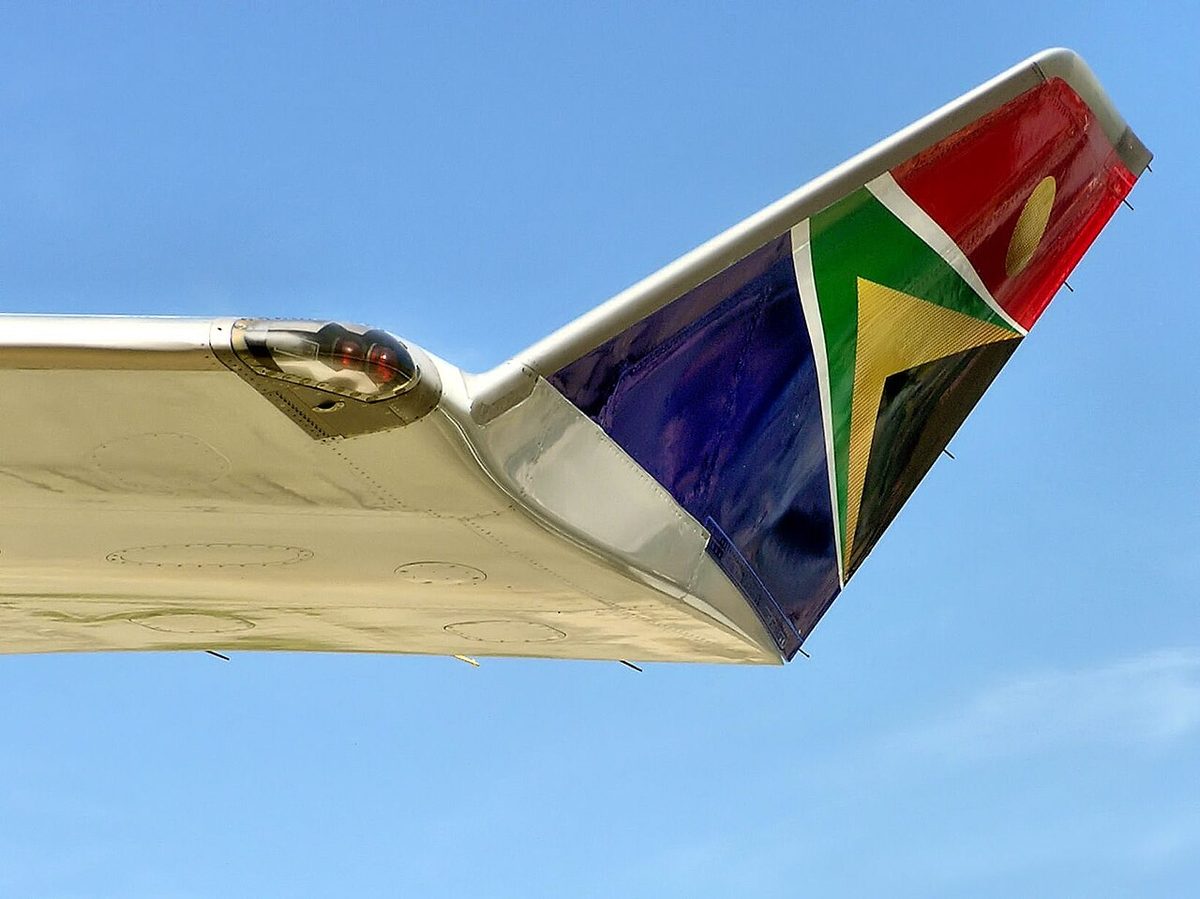
Red and green seen together mean an aircraft heading towards you. A red light out to the right at about your level is an aircraft crossing from right to left: if its bearing stays constant it is converging, and you give way. A green light to the left means the other aircraft must give way to you. A lone white light is an aircraft going away; if you are closing on it, you are the overtaking aircraft.
A pilot may switch off, or reduce the intensity of, flashing lights such as strobes if they impair the crew's performance or dazzle an outside observer; the steady navigation lights stay on. In the United States, 14 CFR 91.209 requires position lights from sunset to sunrise, and 91.205 lists position lights and an anti-collision light system among the equipment for night VFR (see aircraft exterior lighting).
Formation flight
Under Annex 2 and SERA, aircraft fly in formation only by prior arrangement among the pilots-in-command taking part. In controlled airspace the authority's conditions also apply: the formation operates as a single aircraft for navigation and position reporting, separation within it, including joining up and breaking away, is the responsibility of the flight leader and the other pilots-in-command, not of ATC, and each aircraft stays within 1 km (0.5 NM) laterally and longitudinally and 30 m (100 ft) vertically of the leader. SERA adds that one pilot-in-command is designated flight leader.
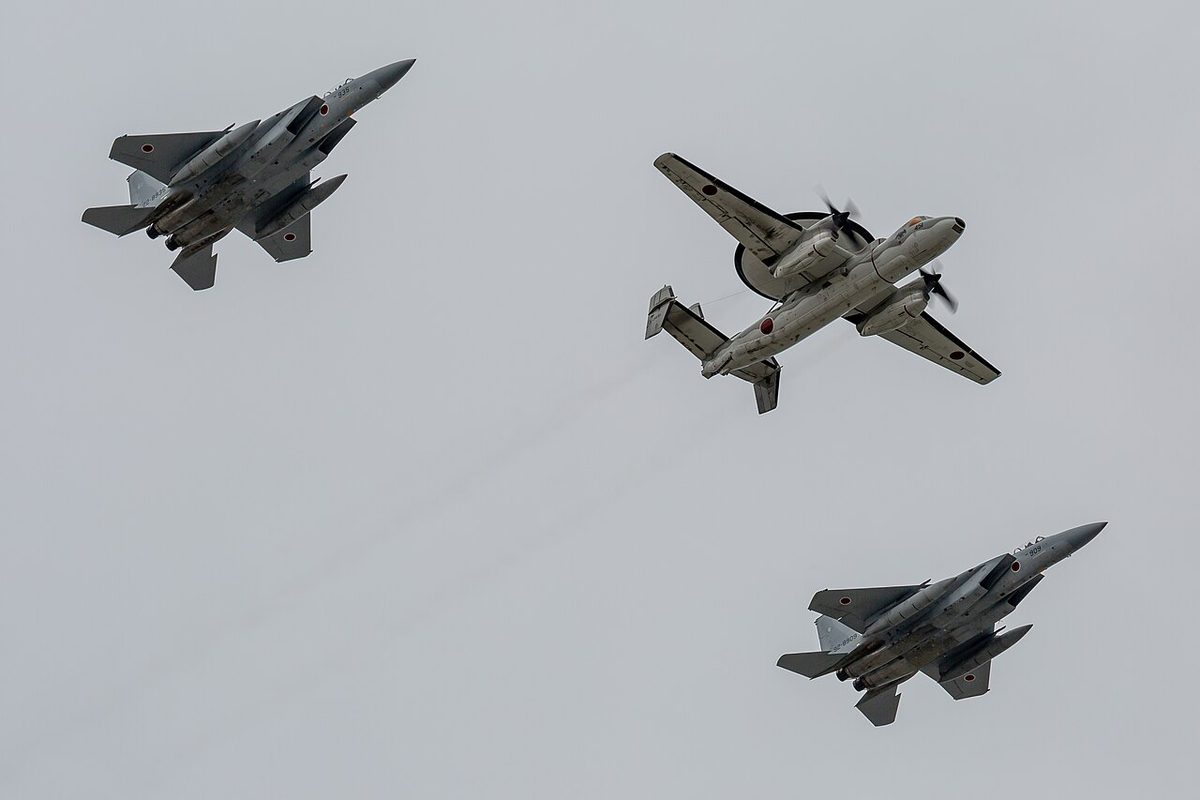
The FAA's 14 CFR 91.111 forbids flying so close to another aircraft as to create a collision hazard, allows formation flight only by arrangement with the pilot-in-command of each aircraft, and prohibits formation flight while carrying passengers for hire.
Aerobatic flight
Annex 2 allows aerobatic flight only under conditions prescribed by the appropriate authority, SERA only in accordance with Union or national legislation, and both only as indicated by the relevant information, advice or clearance from air traffic services, so heights, weather and areas are set nationally. French charts mark aerobatic areas with a looping-aircraft symbol; US sectionals mark an aerobatic practice area with the letter A in a magenta diamond.
The FAA defines aerobatic flight in 14 CFR 91.303 as an intentional manoeuvre involving an abrupt change in attitude, an abnormal attitude or abnormal acceleration not necessary for normal flight, and prohibits it:
- over a congested area of a city, town or settlement, or over an open-air assembly of persons;
- within the lateral boundaries of the surface areas of Class B, C, D or E airspace designated for an airport;
- within 4 NM of the centreline of a federal airway;
- below 1,500 ft above the surface;
- when flight visibility is less than 3 statute miles.
Parachutes are covered by 91.307. With anyone other than a crewmember on board, a manoeuvre that intentionally exceeds 60° of bank or 30° of pitch relative to the horizon requires every occupant to wear an approved parachute. Flight tests for a certificate or rating are exempt, as are spins and other manoeuvres required for a certificate or rating when given by an authorised instructor. A parachute with a synthetic canopy must have been packed within the preceding 180 days.
Towing and parachute operations
Towing, dropping or spraying from an aircraft, and parachute descents other than emergency descents, are governed like aerobatics: under the authority's conditions in Annex 2, Union or national legislation in SERA, and as indicated by air traffic services.
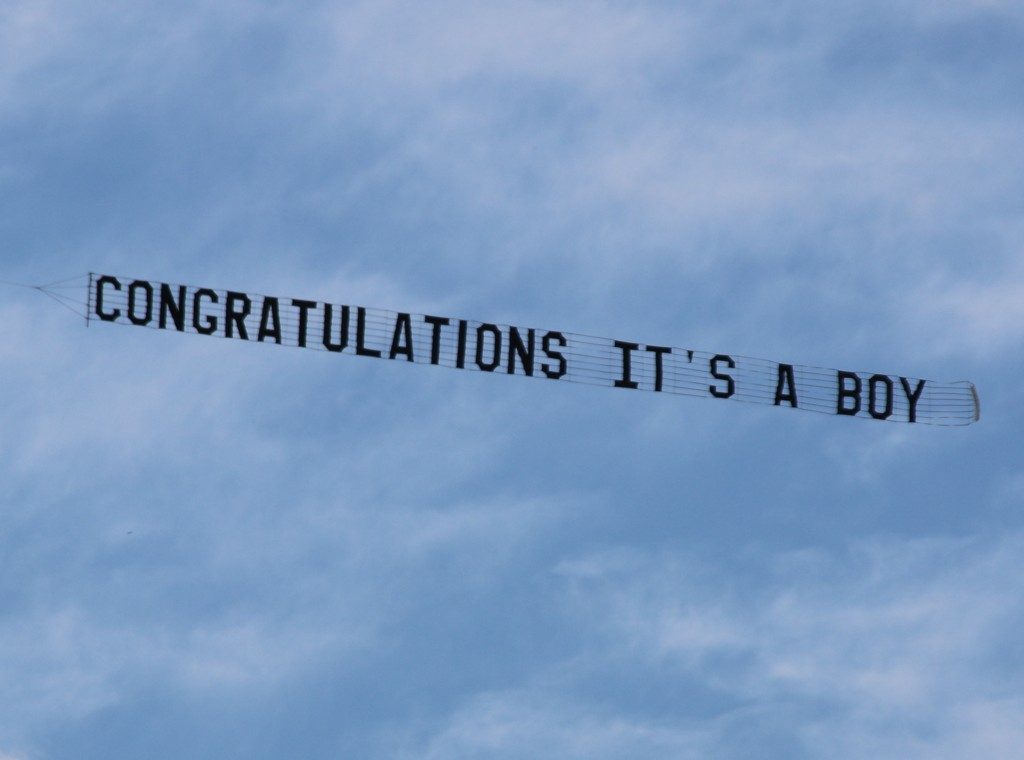
In the United States, a glider tow pilot needs, under 14 CFR 61.69, at least a private pilot certificate, 100 hours as pilot-in-command in the towing aircraft's category, class and, where required, type, a logbook endorsement and, within the preceding 24 months, three actual or simulated glider tows or three towed flights as glider pilot-in-command. Towing anything else, such as a banner, needs a certificate of waiver under 91.311. Under 91.15 the pilot-in-command may not allow an object to be dropped that creates a hazard to persons or property, although dropping with reasonable precautions against injury or damage is allowed.
Parachute operations fall under 14 CFR Part 105. In controlled airspace the jump aircraft must be in radio contact with ATC before the jump, and parachutists must meet cloud clearance and visibility minima. The AIM asks jump pilots to report altitudes above mean sea level or as flight levels and, at an airport without an operating tower, to broadcast on the common traffic advisory frequency before the jump. In Europe drop zones are marked on charts with a parachute symbol, and a zone activated at short notice is notified by NOTAM (see special use airspace).
Speed limits below FL100
ICAO and SERA set a speed limit of 250 kt IAS below 3,050 m (10,000 ft) AMSL. It applies to all flights in airspace Classes D, E, F and G and to VFR flights in Class C; there is no ICAO limit in Classes A and B, or for IFR flights in Class C. Where the transition altitude is below 10,000 ft, FL100 is used instead. The limit gives pilots relying on see and avoid time to act. The competent authority may exempt aircraft types that cannot keep to 250 kt for technical or safety reasons. Special VFR flights are limited further, to 140 kt IAS.
States may add limits: France applies 250 kt to IFR flights below 10,000 ft AMSL on ATS routes, SIDs, STARs or radar vectors, even in Classes A and C, unless ATC clears otherwise.
The FAA's 14 CFR 91.117 is simpler and stricter:
| Airspace | Maximum IAS |
|---|---|
| Below 10,000 ft MSL, all airspace including Class B | 250 kt |
| At or below 2,500 ft AGL within 4 NM of the primary airport of a Class C or D area | 200 kt, unless ATC authorises more |
| Beneath the lateral limits of Class B, or in a VFR corridor through it | 200 kt |
An aircraft whose minimum safe airspeed is higher may fly at that speed, and the US military is authorised to exceed 250 kt below 10,000 ft in active military operations areas.
Frequently asked questions
What are the basic right-of-way rules in the air?
When two aircraft converge at about the same level, the one that has the other on its right gives way. Aircraft meeting head-on both turn right. An overtaking aircraft, closing from behind within 70 degrees of the other's centreline, keeps clear by altering heading to the right. Powered aeroplanes give way to airships, gliders and balloons, and the lower of two aircraft approaching to land has priority. The aircraft with right of way holds its heading and speed.
Does a glider have right of way over a powered aeroplane?
Yes. Under ICAO Annex 2 and SERA, power-driven heavier-than-air aircraft give way to airships, gliders and balloons, and also to aircraft seen towing other aircraft or objects. The FAA's 14 CFR 91.113 gives a balloon right of way over all other categories and a glider over airships, aeroplanes and rotorcraft. Giving way to the aircraft on the right applies only between aircraft of the same category.
What is the 250 knot speed limit below 10,000 ft?
ICAO and SERA limit indicated airspeed to 250 kt below 10,000 ft AMSL, or below FL100 where the transition altitude is lower, for all flights in airspace Classes D to G and for VFR flights in Class C. Classes A and B have no ICAO limit. The FAA's 14 CFR 91.117 applies 250 kt to every aircraft below 10,000 ft MSL, with 200 kt close to Class C and D airports and beneath Class B.
What colour are aircraft navigation lights and where do they show?
The left (port) wingtip light is red and the right (starboard) light green, each shining from dead ahead through 110 degrees to its own side. A white tail light covers the remaining 140 degrees astern, 70 degrees either side of the centreline. A red light seen out to the right at about the same level therefore means an aircraft converging from the right, to which you must give way.
When must a parachute be worn for aerobatics in the United States?
Under 14 CFR 91.307, when anyone other than a crewmember is on board, every occupant must wear an approved parachute before the pilot intentionally exceeds 60 degrees of bank or 30 degrees of pitch relative to the horizon. The rule does not apply to flight tests for a certificate or rating, or to spins and other manoeuvres required for a certificate or rating when given by an authorised instructor. A synthetic parachute must have been packed within the preceding 180 days.
Which rules of the air apply over the high seas?
Over the high seas the rules established under the Chicago Convention, ICAO Annex 2, apply without exception, and no State may notify a difference there. Elsewhere Annex 2 binds aircraft of a Contracting State wherever they are, unless it conflicts with the rules of the State overflown, and inside its territory each State applies its own rules, such as SERA in the European Union.
Test yourself on Rules of the Air
The v1prep banks cover this topic in Air Law (010), with a worked explanation for every answer. EASA ATPL, PPL, IR and CPL, the FAA written tests and A320/B737 type ratings.
Start practising →Sources and further reading
- ICAO Annex 2, Rules of the Air
- EASA Easy Access Rules for Standardised European Rules of the Air (SERA)
- AIP France, GEN 1.7, Differences from ICAO Standards (Annex 2)
- 14 CFR 91.113, Right-of-way rules, except water operations
- 14 CFR 91.117, Aircraft speed
- 14 CFR 91.303, Aerobatic flight
- 14 CFR 91.307, Parachutes and parachuting
- FAA Aeronautical Information Manual, Chapter 3 Section 5 (3-5-4, Parachute jump aircraft operations)
Library articles are written for study and exam preparation. They do not replace your aircraft's approved documentation, your operator's procedures or the regulations themselves.