A320 Flight Controls: Laws and Protections
The A320 flight control laws are the relationships, set by the fly-by-wire computers, between sidestick inputs and the aircraft's response. Normal law adds envelope protections; after failures the computers reconfigure to alternate, direct or mechanical control, with fewer protections at each step.
A control law is the relationship, programmed into the flight control computers, between the pilot's sidestick input and the aircraft's response; it sets the handling qualities of the aeroplane. On the A320 the computers apply normal law whenever the system is healthy, and adopt degraded laws as sensors, computers or hydraulic systems fail, removing protections a layer at a time.
Knowing which law is active, and what it will and will not do, is basic airmanship on the type. In normal law, with valid sensor data, the aircraft cannot be overstressed or stalled by sidestick inputs; in the degraded laws it can. The computers and surfaces behind the laws are described in A320 flight controls: architecture and computers.
What a control law is
Normal law provides three-axis control, flight envelope protection and alleviation of manoeuvre loads. Its protections let the crew use full authority with an instinctive, immediate input, for example full aft stick in an escape manoeuvre, while minimising the risk of overcontrolling or overstressing the aircraft. They are designed to help the pilot flying in emergencies, not to be structural limit protections: they do not prevent damage from opposite rudder pedal inputs, for instance.
When failures make normal law unavailable, flight control law reconfiguration takes the aircraft through three levels: alternate law, with or without reduced protections; direct law; and the mechanical backup. In every reconfiguration law the roll law is direct, while the pitch law takes different forms.
Normal law flight modes
Normal law has three modes in pitch, each suited to a phase of flight.
The ground mode (ground law) is a direct relationship between sidestick and elevator deflection, with no automatic trim. The THS is set automatically to 0°, inside the green band, unless the crew have set a value for the take-off centre of gravity, which then has priority. During the take-off roll the maximum up-elevator is reduced from 30° to 20°. Laterally, the sidestick commands aileron and roll spoiler deflection, scaled with speed.
The flight mode is a load factor demand law with automatic trim and protection throughout the envelope. Stick deflection commands a load factor, independent of speed. With the stick at neutral and wings level the aircraft holds 1 g, corrected for pitch attitude, so the crew never need to trim for changes of speed or configuration, and in turns up to 33° of bank no back pressure is needed. Laterally the stick commands a roll rate, at most 15° per second; up to 33° of bank the aircraft holds its bank angle with the stick released, and the rudder co-ordinates turns automatically.
Automatic pitch trim freezes when the crew trim manually, below 50 ft radio height (100 ft with the autopilot engaged), below 0.5 g, and in high speed or high Mach protection. Above 1.25 g or 33° of bank, the THS is limited between its current setting and 3.5° nose down.
The flare mode, or flare law, replaces the flight mode at 50 ft radio height, when the THS is frozen. It is essentially a direct stick-to-elevator relationship, with some damping from load factor and pitch rate. The computers memorise the attitude at 50 ft as the initial reference and, from 30 ft, reduce it to 2° nose down over 8 s. A gentle nose-up action is therefore needed to flare.
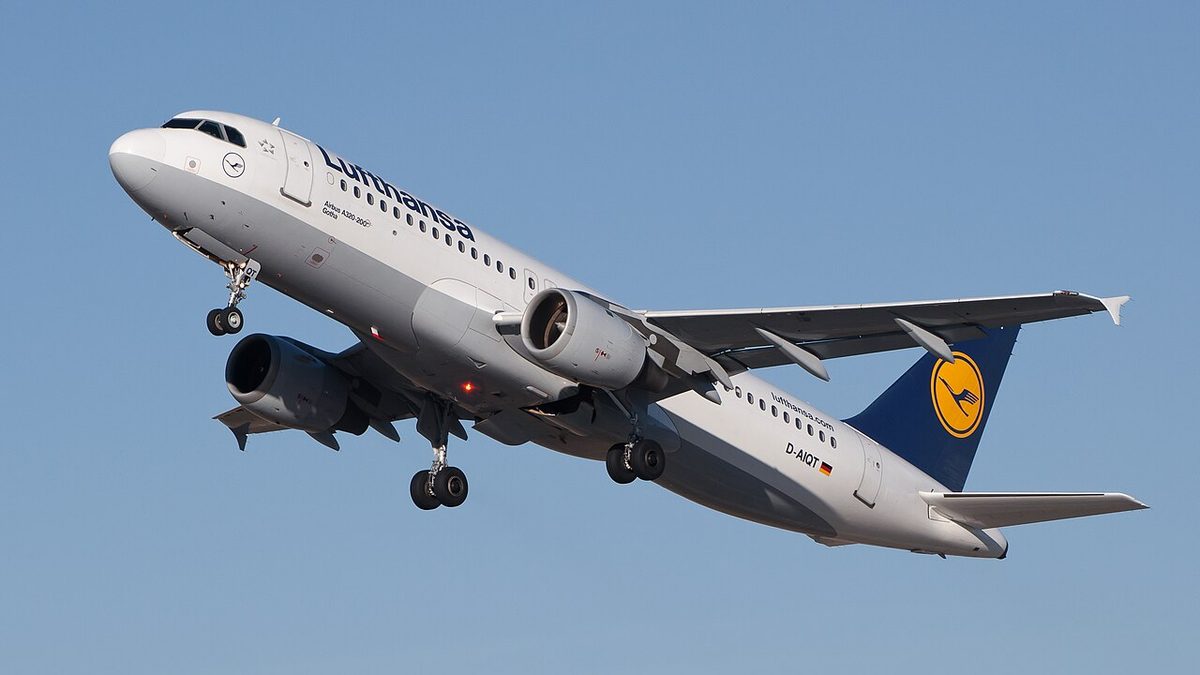
Normal law envelope protections
Normal law protects the flight envelope in pitch and roll, whatever the sidestick input. With the autopilot engaged all the protections remain, except pitch attitude protection.
| Protection | Normal law limit |
|---|---|
| Load factor | +2.5 g to −1 g clean; +2 g to 0 g with slats or flaps extended |
| Pitch attitude | 30° nose up in CONF 0 to 3, reducing to 25° at low speed; 25° in CONF FULL, reducing to 20°; 15° nose down |
| High angle of attack | Angle of attack demand above alpha prot; alpha max never exceeded |
| High speed | Nose-up demand at or above VMO/MMO; nose-down authority fades at about VMO + 16 kt or MMO + 0.04 |
| Bank angle | 67° maximum; 45° in high angle of attack protection; 40° in high speed protection |
Load factor limitation (load factor protection) applies in every configuration. Pitch attitude protection shows as green "=" marks on the PFD pitch scale; the flight director bars disappear beyond 25° nose up or 13° nose down and return between 22° up and 10° down.
Alpha protection begins when the angle of attack exceeds alpha prot, the amber and black strip on the speed scale. The sidestick then demands angle of attack instead of load factor, the aircraft holds alpha prot with the stick released, and nose-up trim stops; the THS is limited between its setting at entry and 3.5° nose down. Full aft stick gives alpha max, close to but below the 1 g stall, and no more; released, the aircraft returns to alpha prot. At take-off alpha prot equals alpha max for 5 s, and at high altitude alpha prot falls with Mach to protect against buffet. Between alpha prot and alpha max, alpha floor may set take-off and go-around thrust automatically; it is available from lift-off to 100 ft radio height on approach and is cancelled with the autothrust instinctive disconnect pushbutton once speed is safe. High angle of attack protection has priority over all other protections, and the crew leave it by easing the stick forward and adding thrust.
High speed protection acts at or above VMO (350 kt) or MMO (M 0.82), depending on acceleration and pitch attitude. A nose-up demand returns the aircraft towards the envelope after a slight overshoot; with the stick held fully forward the nose-down authority falls smoothly to zero at about VMO + 16 kt or MMO + 0.04. The THS is limited between its setting at entry and 11° nose up. The overspeed warning sounds at VMO + 4 kt or MMO + 0.006, and the autopilot disconnects at VMO + 15 kt or MMO + 0.04.
Bank angle protection rests on positive spiral static stability beyond 33°: released there, the aircraft rolls back to 33°. Full lateral stick gives 67° and no more, auto trim being inoperative meanwhile; in high speed protection the spiral stability returns the aircraft to wings level. Beyond 45° the autopilot disconnects and the flight director bars disappear. A steep turn beyond 33° needs both lateral and aft pressure.
Alternate law and its stabilities
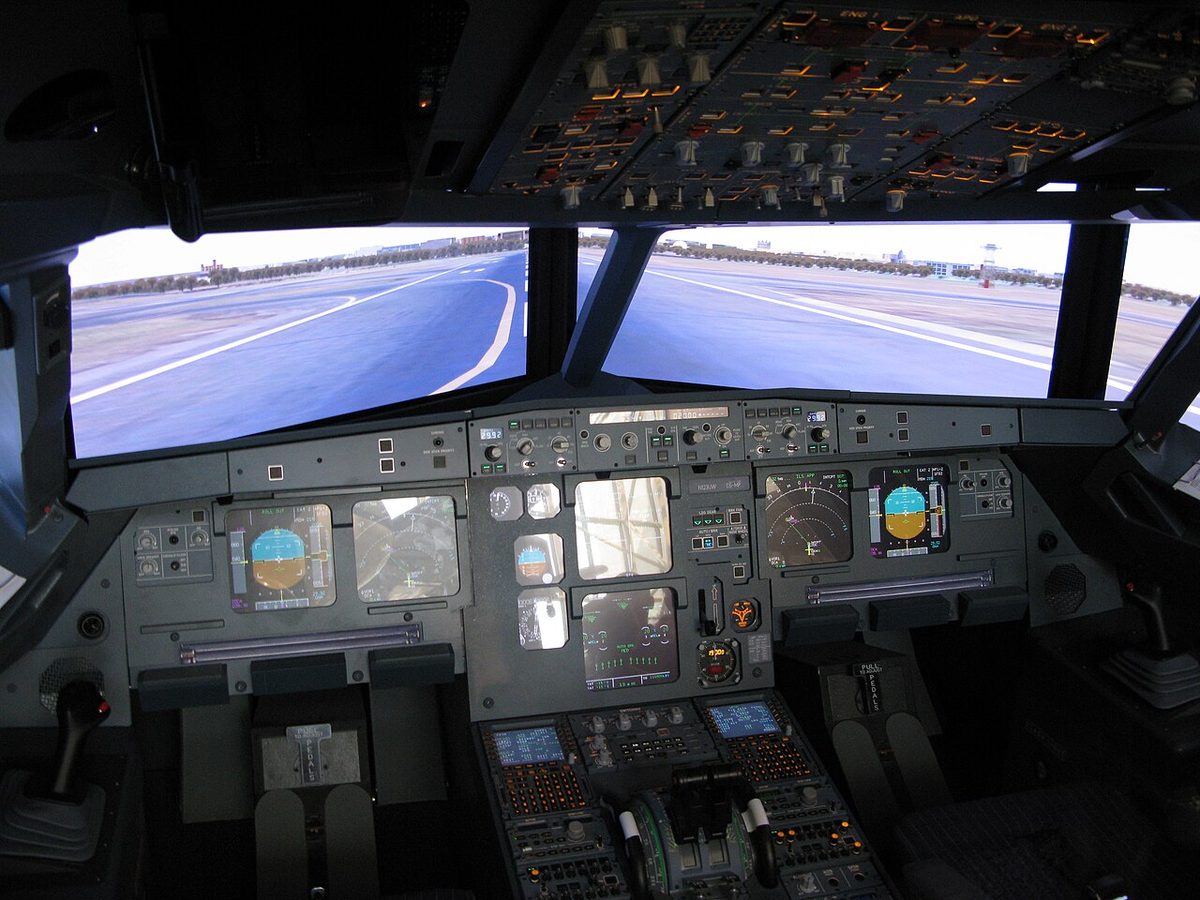
In alternate law the ECAM shows FLT CTL ALTN LAW (PROT LOST) with a maximum speed of 320 kt, and amber crosses replace the green protection symbols on the PFD. Pitch remains a load factor demand law in flight, with a load factor limitation similar to that of normal law. Pitch attitude protection, bank angle protection and alpha floor are lost, and the autopilot disconnects above VMO/MMO or beyond 45° of bank. Roll is in direct law, with yaw in alternate law, where only yaw damping remains, limited to ±5° of rudder, or in mechanical. The ground mode returns 5 s after touchdown. When the landing gear is selected down, the pitch law changes to its flare mode, which in alternate law is direct law.
Two stabilities replace the lost hard limits:
- Low speed stability, available in all configurations, introduces a gentle, progressive nose-down demand from about 5 to 10 kt above the stall warning speed, depending on weight and configuration. The pilot can override it.
- High speed stability introduces a nose-up demand above VMO or MMO to stop the speed increasing further. The pilot can override it too, and the overspeed warning remains.
A conventional stall warning is added: the cricket sound with a STALL synthetic voice and a red STALL STALL message on the PFD, at a margin above the stall. A red and black strip below the stall warning speed (VSW) appears on the speed scale whenever normal law is lost. Alternate law without reduced protection has the load factor limitation only, without the two stabilities.
Direct law
In direct law the ECAM shows FLT CTL DIRECT LAW (PROT LOST), MAX SPEED 320 kt/M 0.77 and MAN PITCH TRIM USE. Elevator deflection is proportional to stick deflection, with a maximum that varies with centre of gravity, a compromise between controllability with a forward CG and sensitivity with an aft one. There is no automatic trim, and the PFD shows USE MAN PITCH TRIM in amber below the FMA.
In roll, stick deflection maps directly to surface position, with gains set by the slat and flap configuration: the roll rate reaches about 30° per second clean and about 15° per second with slats extended. Only the ailerons and spoilers 4 and 5 are used, spoiler 3 replacing a failed spoiler 4, and all roll spoilers if the ailerons have failed. Yaw is mechanical, without yaw damping or turn co-ordination. No protection remains, but the overspeed and stall warnings still work.

Abnormal attitude law
The abnormal attitude law recovers the aircraft from an unusual attitude. It engages when the bank exceeds 125°; when pitch exceeds 50° nose up or 30° nose down with at least two valid and consistent air data computers, or 40° and 20° otherwise; when speed falls below 70 to 90 kt, depending on pitch attitude, or exceeds 440 kt; when Mach exceeds 0.91; or when the angle of attack exceeds 40°.
It combines pitch alternate law with no protection, not even load factor limitation, roll direct law and mechanical yaw. Automatic trim is lost, USE MAN PITCH TRIM is displayed and the ECAM shows the direct law message. Once the aircraft is back within the normal envelope, it stays for the rest of the flight in pitch alternate law without reduced protection, roll direct and yaw alternate, and the ECAM shows the alternate law message.
Law reconfiguration triggers
The law that results depends on which components fail. Typical examples:
| Failure | Pitch | Roll | Yaw |
|---|---|---|---|
| Both FACs | Alternate, reduced protection | Direct | Mechanical |
| Green and yellow hydraulics | Alternate, reduced protection | Direct | Mechanical |
| Both SFCC slat channels | Alternate, no protection | Direct | Alternate |
| Three IRs | Direct | Direct | Mechanical |
The mechanical backup is the last step, for a temporary loss of all electrical power or of five fly-by-wire computers. In any reconfiguration law at high altitude, Airbus advises descending to increase the margin to buffet: about 4,000 ft below the recommended maximum altitude greatly reduces stall warnings in turbulence.
Stall warning in degraded laws
In normal law the stall is prevented, not just announced: alpha max lies below the 1 g stall, so VSW is not shown. Once protection is lost, the aircraft can be stalled. Any stall indication, the aural warning, the red message or buffet, calls for the stall recovery memory items: nose-down pitch control to reduce the angle of attack, reducing thrust if pitch-down authority is lacking; wings level; then, once out of the stall, thrust increased smoothly, speedbrakes retracted and the flight path recovered smoothly, selecting flap 1 if clean below 20,000 ft. The crew must not wait for a warning that may never come: on Air France 447, an A330 in alternate law, the stall warning stopped when the measured airspeed fell below 60 kt (see stall).
A stall warning at liftoff has its own procedure, flown from memory with three simultaneous actions: thrust to TOGA, pitch attitude 15° and wings level. Unlike the stall recovery procedure, it does not start with a nose-down input.
Frequently asked questions
What are the flight control laws of the A320?
Normal law is the everyday law: the sidestick demands load factor in pitch and roll rate in roll, the aircraft trims itself and protections keep it inside the flight envelope. After failures it reconfigures to alternate law, with or without reduced protections, then direct law, in which stick deflection maps straight to surface deflection, and finally mechanical backup. An abnormal attitude law recovers the aircraft from extreme attitudes.
Can an A320 be stalled in alternate law?
Yes. In alternate law the high angle of attack protection is replaced by a low speed stability, a gentle nose-down demand that the pilot can override, and alpha floor is lost. A stall warning, crickets with a STALL voice and a red STALL STALL message, sounds at a margin from the stall. If the pilot keeps pulling, the aircraft can stall like a conventional aeroplane, and the stall recovery procedure applies.
What is the difference between alpha prot, alpha max and alpha floor?
Alpha prot is the angle of attack at which the high angle of attack protection starts: the sidestick then commands angle of attack instead of load factor and nose-up trim stops. Alpha max is the highest angle of attack the law allows even with full aft stick, close to but below the stall. Alpha floor is an autothrust function, triggered between the two, which sets take-off and go-around thrust.
Why does the A320 need a flare input in normal law?
At 50 ft radio height normal law changes to flare mode, essentially a direct stick-to-elevator relationship. The computers memorise the pitch attitude at 50 ft and, from 30 ft, reduce the reference to 2 degrees nose down over 8 seconds. Without a pilot input the nose would therefore drop slightly, so a gentle nose-up action on the sidestick is needed to flare, as on a conventional aeroplane.
What is the abnormal attitude law on the A320?
It is a law that engages if the aircraft reaches an extreme attitude or speed, for example more than 125 degrees of bank, more than 50 degrees nose up or 30 degrees nose down with valid air data, a speed above 440 kt or an angle of attack above 40 degrees. Pitch alternate law without protection, roll direct and mechanical yaw help recovery. Afterwards the aircraft remains in alternate law for the rest of the flight.
Test yourself on A320 Flight Controls: Laws and Protections
The v1prep banks cover this topic in the A320 type-rating bank, with a worked explanation for every answer. EASA ATPL, PPL, IR and CPL, the FAA written tests and A320/B737 type ratings.
Start practising →Sources and further reading
- Airbus, Safety innovation
- Airbus, Safety innovation
- Traverse, P. et al., Airbus Fly-by-Wire, A Total Approach to Dependability (ICAS 2006)
- FAA AC 120-109A, Stall Prevention and Recovery Training
- BEA, Final Report on the accident on 1 June 2009 to the Airbus A330-203, flight AF 447
- FAA Special Conditions, Airbus A350-900, Flight Envelope Protection, High-Incidence Protection and Alpha-Floor Systems
Library articles are written for study and exam preparation. They do not replace your aircraft's approved documentation, your operator's procedures or the regulations themselves.