A320 Air Conditioning
The A320 air conditioning system takes bleed air through two packs, mixes the cooled air with recirculated cabin air and distributes it to three temperature zones, the cockpit and the forward and aft cabin, each trimmed to its selected temperature by adding hot air.
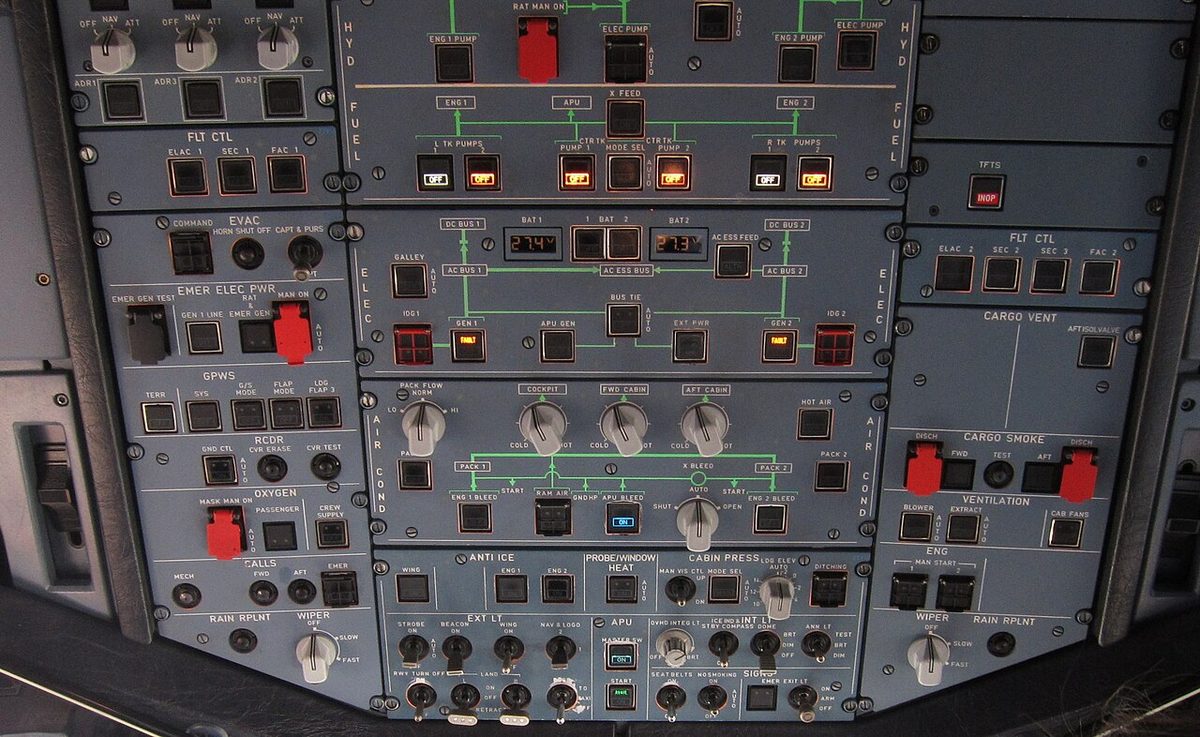
The A320 air conditioning system keeps the cockpit and cabin at a comfortable temperature and supplies the fresh air that also pressurises the fuselage. Bleed air from the engines or the APU is cooled in two packs, mixed with recirculated cabin air and delivered to three zones, each of which the crew can set to its own temperature. Most of this happens automatically: the crew select temperatures and a flow, and controllers do the rest.
Air conditioning questions in type rating exams concern the regulation logic and the failures. Why do both packs deliver the same temperature? What does trim air do? When does a pack valve close by itself, and when does ram air actually flow? The pack itself, the air cycle machine common to most jet transports, is described in air conditioning packs; the bleed supply in A320 bleed air and ice protection; and the cabin pressure control in A320 pressurisation.
System overview and zones
The system maintains a constant, selected temperature in three independently controlled air conditioning zones: COCKPIT, FWD CABIN and AFT CABIN. Air from the pneumatic system enters through two pack flow control valves and passes through two packs. In the mixing unit it is mixed with recirculated cabin air before being distributed to the zones. Normally engine 1 supplies pack 1 and engine 2 supplies pack 2; when the APU supplies bleed air, it feeds both packs through the open crossbleed valve.
Temperature regulation is done, depending on the aircraft, either by a zone controller and two pack controllers, or by two air conditioning system controllers (ACSCs). Each controller has two lanes: one is active and the other takes over if it fails, so the loss of one lane has no effect. The loss of both lanes of an ACSC loses its pack and closes the hot air valve and the associated trim air valves.

Packs and pack controllers
The two packs operate automatically and independently. Each pack flow control valve is pneumatically operated and electrically controlled; without air pressure a spring holds it closed. With the PACK pushbutton ON, the valve closes automatically when:
- the pressure upstream is below the minimum;
- the pack compressor outlet overheats;
- an engine start is in progress on the same side, or on either side if the crossbleed valve is open;
- the ENG FIRE pushbutton of that side is pressed;
- DITCHING is selected.
On the ground both pack valves reopen 30 seconds after the second engine's N2 passes 50 %, which avoids a second closure cycle during the second engine start.
Inside the pack the warm bleed air is first cooled in the primary heat exchanger, then compressed again by the compressor of the air cycle machine (ACM) and cooled again in the main heat exchanger. A water separator system dries it before it enters the turbine, where it expands and cools sharply; the turbine drives both the compressor and the cooling air fan. If the ACM seizes, the pack can still run in heat exchanger cooling mode, with reduced flow.
Each pack controller or ACSC regulates its pack's outlet temperature by modulating the pack bypass valve and the ram air inlet flap, which controls the cooling air through the heat exchangers. The ram air inlet flap closes to keep out foreign objects: during take-off when take-off power is set with the main gear struts compressed, and on landing as soon as the struts are compressed at 70 kt or more. It reopens 20 seconds after the speed falls below 70 kt.
The PACK pushbutton's amber FAULT light comes on when the pack valve position disagrees with the selection, or when the compressor outlet or pack outlet overheats, a pack overheat. On the BLEED page the pack outlet temperature turns amber above 90 °C and the compressor outlet temperature above 260 °C.
Pack flow selection
The PACK FLOW selector sets the flow according to the number of occupants and the ambient conditions:
| Position | Flow |
|---|---|
| LO | 80 % |
| NORM | 100 % |
| HI | 120 % |
HI flow is delivered automatically in single pack operation or when the APU supplies the bleed air, whatever the selection. If LO is selected and a zone's temperature demand cannot be satisfied, the system delivers normal flow. If the cooling demand cannot be met because the bleed pressure is too low, the ACSC asks both engine interface units to raise the engines' minimum idle; with the APU bleed valve open, it asks the APU's electronic control box for more flow. The APU can supply air conditioning and pressurisation up to 15,000 ft with both packs, or 22,500 ft with one.
Packs cost engine performance. Selecting the packs OFF, or using APU bleed, for take-off improves performance at TOGA thrust and lowers the exhaust gas temperature in a FLEX take-off; APU bleed may not be used if wing anti-ice will be needed. After take-off, pack 1 is selected ON after the thrust has been reduced to climb thrust, and pack 2 at least 10 seconds later for passenger comfort; selecting a pack before the thrust reduction would raise the EGT. If one pack is unserviceable, it is set OFF and the take-off may be made with the other pack supplied by its own engine's bleed, the take-off N1 being limited to the bleed ON value.
Mixing unit and recirculation
The mixing unit combines cold air from the packs with recirculated cabin air. It is also connected to the emergency ram air inlet and to the low-pressure ground connection, through which a ground air conditioning unit can supply the cabin. Conditioned air from the packs and from a ground unit must not be used at the same time. With passengers on board, Airbus recommends not exceeding 20 minutes without an air conditioning supply, because the cabin air quality would be significantly reduced.
Two cabin recirculation fans return cabin air to the mixing unit. Both are controlled by the CAB FANS pushbutton, and a failed fan shows FAN in amber on the COND page. Their distribution and the avionics ventilation are covered in A320 ventilation and cargo heating.
Zone temperature and trim air
Each zone has a temperature selector on the AIR COND panel, from 18 °C at COLD to 30 °C at HOT, with 24 °C at the 12 o'clock position. In cruise the cabin crew can change each cabin zone temperature by up to ± 2.5 °C from the forward attendant panel. Cockpit temperature is measured in the cockpit; cabin zone temperatures are sensed in the lavatory extraction circuit and the galley ventilation system.
The regulation is called optimised temperature regulation. The controllers identify the zone demanding the lowest temperature, and both packs deliver the outlet temperature that zone requires. Warm air is then added zone by zone:
- The hot air pressure regulating valve, controlled with the HOT AIR pushbutton and regulated by ACSC 1, takes hot bleed air from upstream of the packs.
- A trim air valve for each zone, controlled electrically by the zone controller or the ACSCs, adds that hot air to the zone's duct. ACSC 1 controls the cockpit trim air valve and ACSC 2 the two cabin valves.
Exam tip: trim air can only add heat. The packs therefore always supply the coldest air needed by any zone, and the warmer zones are trimmed up from it.
The system copes with failures in steps. If one trim air valve fails, only its zone loses optimised regulation. If the hot air valve fails open, there is no effect. It closes automatically if both lanes of either ACSC fail, if two or more trim air valves fail, or if the duct overheats: the HOT AIR FAULT light comes on at 88 °C, the hot air and trim air valves close, and the light goes off when the duct is below 70 °C and the crew select OFF. With the hot air valve closed, optimised regulation is lost: pack 1 controls the cockpit to its selected temperature and pack 2 the cabin to the mean of the forward and aft selections.
On aircraft that have them, foot warmers add comfort for the pilots: a heating panel on each pilot's rudder pedals, at about 20 °C, controlled by a separate FOOT WARMER switch on each side of the main instrument panel.
Ram air and emergency ventilation
The guarded RAM AIR pushbutton opens the emergency ram air inlet, the ram air valve that supplies outside air to the mixing unit. It is used to ventilate the cockpit and cabin to remove smoke, or if both packs have failed. It has no effect if DITCHING is selected, because ditching closes the openings below the flotation line, among them the ram air inlet and the pack valves.
Ram air does not flow at once. A check valve downstream of the inlet stays closed while the cabin differential pressure is above 1 psi, so ram air ventilation becomes effective only once the differential pressure has fallen below that value. With RAM AIR ON, DITCHING not selected and a differential pressure below 1 psi, the outflow valve opens about 50 % if pressure control is automatic; under manual control it does not open by itself. The RAM AIR ON memo appears in green on the upper ECAM display.
COND page and pack failures
The ECAM COND page shows the air conditioning zones with their duct temperatures, normally green and amber at 80 °C. Each trim air valve is shown by a green arrow, replaced by amber crosses if the valve fails. The hot air valve symbol turns amber, in line, if the valve is abnormally open, and the temperature unit is shown in cyan. The pack indications are on the BLEED page: outlet and compressor outlet temperatures, the bypass valve position (H for hot, open; C for cold, closed), the pack flow, which may read up to 30 % below the actual flow and turns amber when the pack valve is closed, and the ram air inlet flap.
With one pack lost, the remaining pack delivers HI flow automatically. After the loss of both packs, ventilation depends on the emergency ram air inlet, which is effective only at a low differential pressure. The CAB PRESS page also shows the packs, its PACK indication turning amber when a pack valve is closed with the associated engine running. The packs themselves sit in the air conditioning compartment, one of the A320's four unpressurised areas with the nose gear bay, the main gear bay and the tail cone.
Frequently asked questions
How many air conditioning zones does the A320 have?
Three: the cockpit, the forward cabin and the aft cabin. Each has its own temperature selector on the AIR COND panel, from 18 degrees C at COLD to 30 degrees C at HOT, with 24 degrees C at the 12 o'clock position. In cruise the cabin crew can adjust each cabin zone by up to 2.5 degrees C either way from the forward attendant panel.
What does the PACK FLOW selector do on the A320?
It sets the pack flow for the number of occupants and the ambient conditions: LO is 80 per cent, NORM 100 per cent and HI 120 per cent of normal flow. HI is selected automatically, whatever the selector position, in single pack operation or when the APU supplies the bleed air. If LO is selected and a zone's temperature demand cannot be met, the system automatically delivers normal flow.
How does the A320 control the temperature of each zone?
The controllers find the zone asking for the lowest temperature, and both packs deliver air at the outlet temperature that zone needs. The trim air valve of each zone then adds hot bleed air, supplied through the hot air pressure regulating valve, until its duct reaches the temperature its zone requires. This is called optimised temperature regulation. Trim air can only add heat.
When is the A320 RAM AIR pushbutton used?
The guarded RAM AIR pushbutton opens the emergency ram air inlet, which supplies outside air to the mixing unit to ventilate the cockpit and cabin for smoke removal or when both packs have failed. It does not open if DITCHING is selected, and air flows only once the cabin differential pressure is below 1 psi, when a check valve downstream of the inlet opens.
What happens if the A320 hot air valve fails closed?
The trim air valves lose their hot air and close fully, so optimised temperature regulation is lost. Pack 1 then controls the cockpit temperature to its selected value, and pack 2 controls the cabin to the mean of the forward and aft cabin selections. The hot air valve closes automatically after a duct overheat, the failure of both lanes of either controller, or the failure of two or more trim air valves.
Test yourself on A320 Air Conditioning
The v1prep banks cover this topic in the A320 type-rating bank, with a worked explanation for every answer. EASA ATPL, PPL, IR and CPL, the FAA written tests and A320/B737 type ratings.
Start practising →Sources and further reading
- EASA, Explanatory Note to ED Decision 2018/001/R, Part-FCL theoretical knowledge learning objectives (021 Airframe and Systems)
- FAA Aviation Maintenance Technician Handbook, Airframe (FAA-H-8083-31B), Chapter 16, Cabin Environmental Control Systems
- EASA Easy Access Rules for Large Aeroplanes (CS-25), CS 25.831 Ventilation
- 14 CFR 25.831, Ventilation
- EASA Type Certificate Data Sheet EASA.A.064, Airbus A318, A319, A320, A321
Library articles are written for study and exam preparation. They do not replace your aircraft's approved documentation, your operator's procedures or the regulations themselves.