A320 Pressurisation
A320 pressurisation is the automatic control of cabin pressure by two cabin pressure controllers acting on a single outflow valve, which hold the cabin altitude at a comfortable level within the fuselage's 9.0 psi differential pressure limit, backed by a manual mode and two safety valves.
The A320 pressurisation system keeps the cabin at a breathable and comfortable pressure while the aircraft flies far higher. The packs push conditioned air into the fuselage continuously; the system controls the cabin pressure by regulating how much of it leaves through a single outflow valve. In normal operation the crew have almost nothing to do: the controllers take the landing elevation from the flight management system and build the whole pressure schedule themselves.
Exam questions concern the architecture (how many controllers, motors and valves), the figures of each automatic mode, the switch to the other system and to manual control, the limits, the ditching function and the CAB PRESS page. The general principles are explained in pressurisation principles and control and pressurisation safety valves and warnings; the air supply in A320 air conditioning.
Pressurisation overview
The system has four functions:
- ground function: the outflow valve is kept open on the ground so that no pressure builds up;
- pre-pressurisation: a slight overpressure before take-off avoids a pressure surge at rotation;
- pressurisation in flight: the cabin altitude is controlled to suit each phase of the flight;
- depressurisation: any residual pressure is released after touchdown.
It consists of two cabin pressure controllers (CPCs), one residual pressure control unit (RPCU), one outflow valve whose actuator has three motors, one control panel and two safety valves.
The structural limits are:
| Limit | Value |
|---|---|
| Maximum positive differential pressure | 9.0 psi |
| Maximum negative differential pressure | −1.0 psi |
| Safety valve setting | 8.6 psi |
| Tolerance on the maximum differential and the safety valve setting | ± 0.1 psi (± 7 hPa) |
CPCs, RPCU and outflow valve
The CPCs receive data from the ADIRS, the FMGC, the engine interface units (EIUs) and the landing gear control and interface units (LGCIUs). The LGCIUs supply the ground or flight status used by the mode logic. In automatic mode one controller is active and the other on standby, linked by a cross-channel link. Control passes automatically to the other system 70 seconds after each landing and whenever the operating system fails. The crew can change over by setting the MODE SEL pushbutton to MAN for at least 10 seconds and then back to AUTO. The MODE SEL amber FAULT light, with its ECAM caution, comes on only when both automatic systems are faulty.
Each controller also contains a backup section for manual operation, supplied by an independent power supply located in the controller 1 position and fitted with its own pressure sensor.
The outflow valve is on the right-hand side of the fuselage, behind the aft cargo compartment and below the flotation line. Its actuator has three independent electric motors, two for automatic operation and one for manual operation, and any one of them can drive the valve.
The residual pressure control unit (RPCU) depressurises the aircraft on the ground if abnormal residual pressure remains. It opens the outflow valve when all of the following are true: the valve is not fully open; both CPCs have failed or manual mode is selected; the aircraft is on the ground; and all engines are shut down or all ADIRS show an airspeed below 100 kt. The concern is the doors: on each passenger door a red cabin pressure light flashes when both engines are stopped, the slides are disarmed and the cabin pressure is more than 2.5 hPa above ambient.
Automatic pressurisation modes
With the LDG ELEV selector at AUTO, the controllers use FMGS data, including the landing field elevation, to build an optimised pressure schedule. They then run through a sequence of modes:
| Mode | What the controller does |
|---|---|
| GROUND | Before take-off, and 55 seconds after landing, the outflow valve is fully open; at touchdown any remaining pressure is released at a cabin vertical speed of 500 ft/min |
| TAKE-OFF | Pre-pressurises the cabin at 400 ft/min until the differential pressure reaches 0.1 psi; climb mode begins at lift-off |
| CLIMB | Cabin altitude follows a fixed pre-programmed law that takes account of the aircraft's actual rate of climb |
| CRUISE | Holds the cabin altitude reached at level-off, or the landing field elevation if higher, up to a maximum of about 8,000 ft |
| DESCENT | Descends the cabin at no more than 750 ft/min, so that it reaches landing field pressure plus 0.1 psi shortly before landing |
| ABORT | If the aircraft does not climb after take-off, prevents the cabin altitude from climbing and sets the cabin pressure back to the take-off altitude plus 0.1 psi |
The system is optimised for high airfields: on the ground, in the climb and in the descent it supports an airfield pressure altitude of up to 14,100 ft, although the cruise cabin altitude remains limited to 8,000 ft. If FMGC data are not available, the controller uses the captain's barometric reference from the ADIRS and the landing elevation selected on the panel.
Exam tip: two rates are often confused. Pre-pressurisation before take-off is 400 ft/min; the residual pressure at touchdown is released at 500 ft/min. The maximum cabin descent rate is 750 ft/min.
Landing elevation and manual mode
The LDG ELEV selector is normally at AUTO. Turned away from AUTO, it sets the landing elevation manually anywhere from −2,000 ft to +14,000 ft. The scale on the knob is only indicative, so the crew set the value by reading it on the ECAM. The green MAN LDG ELEV memo appears whenever the selector is not at AUTO, and the CAB PRESS page then shows the landing elevation as MAN instead of AUTO. When FMGS data are unavailable, selecting the landing field elevation is all the crew need to do.
Manual mode is selected with the MODE SEL pushbutton at MAN. The crew then control the cabin altitude through the manual motor of the outflow valve, using the MAN V/S CTL toggle switch. The switch is spring-loaded to neutral: holding it UP drives the valve towards open, so the cabin climbs, and DN drives it towards closed. To obtain a precise cabin vertical speed, only short inputs should be applied.
Manual control has its own characteristics:
- the outflow valve moves slowly, and the ECAM may take up to 5 seconds to show a change in its position;
- on switching from AUTO to MAN, the cabin altitude indication may change slightly, because the backup pressure sensor has a lower resolution;
- the outflow valve does not open automatically at touchdown, so the crew must open it, although the RPCU may still open it on the ground under its own logic.
Safety valves and unpressurised areas
Two independent pneumatic safety valves are installed on the rear pressure bulkhead, above the flotation line. They prevent the cabin pressure from rising more than 8.6 psi above ambient or falling more than 1 psi below it. Because the differential pressure measurement is less accurate in manual mode, and because the differential falls as soon as a safety valve opens, the ECAM may show a safety valve open at an indicated differential pressure anywhere between 8.9 and 9.7 psi.
Not all of the fuselage is pressurised. The A320 has four unpressurised areas: the nose gear bay, the air conditioning compartment, the main gear bay and the tail cone, which houses the APU. The cockpit, cabin, avionics compartment and cargo compartments lie within the pressure hull.
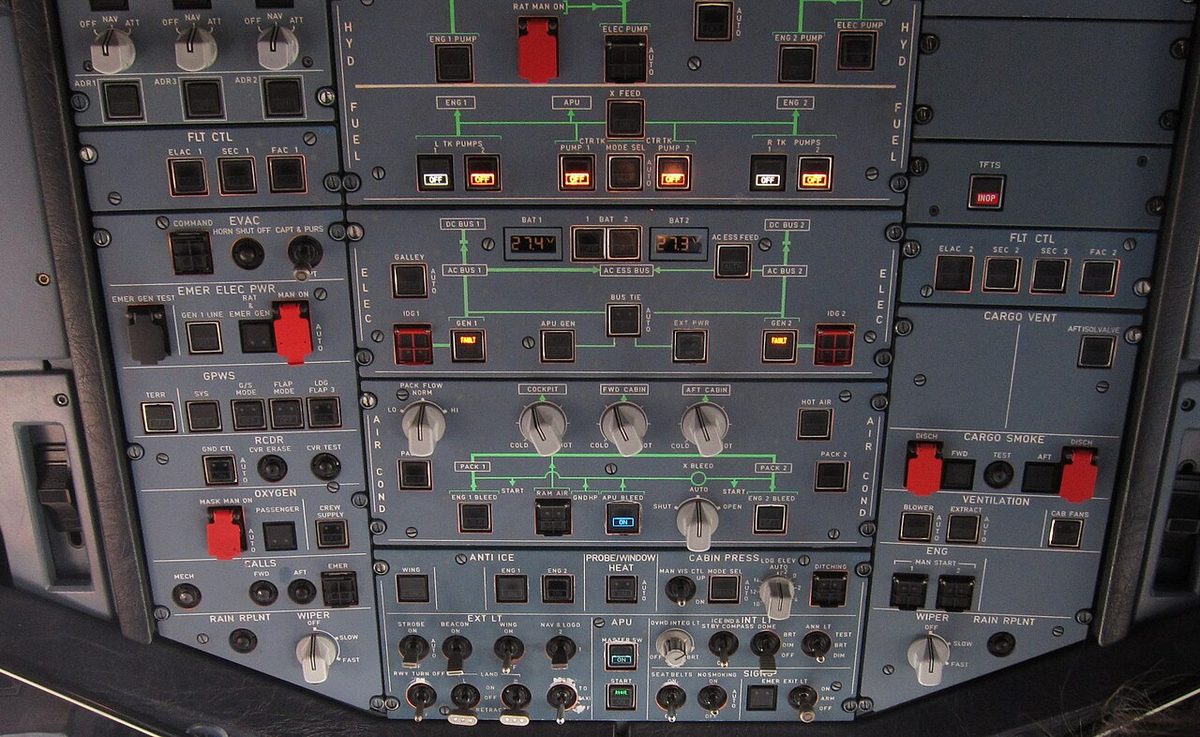
Ditching and the flotation line
The flotation line is the waterline the aircraft would float at after a ditching. The outflow valve lies below it and the safety valves above it. The guarded DITCHING pushbutton closes the valves below the flotation line:
- the outflow valve;
- the emergency ram air inlet;
- the avionics ventilation inlet and extract valves;
- the pack flow control valves;
- the forward cargo outlet isolation valve.
The cabin recirculation fans are not affected. If the outflow valve is under manual control when DITCHING is selected, it is not closed automatically and the crew must close it with the manual motor. On the ground, with a low-pressure air conditioning cart connected and all doors closed, selecting DITCHING lets a differential pressure build up in the cabin, because the openings that would vent it are shut.
The DITCHING selection also overrides the RAM AIR pushbutton: the emergency ram air inlet stays closed. Without ditching, selecting RAM AIR with a differential pressure below 1 psi makes the outflow valve open about 50 % under automatic control, but not under manual control.
CAB PRESS page and warnings
The ECAM CAB PRESS page shows the landing elevation (AUTO or MAN), the differential pressure, the cabin vertical speed and cabin altitude, the outflow valve and safety valve positions, the active system and the packs. Its thresholds are:
| Indication | Behaviour |
|---|---|
| Cabin vertical speed | Flashes at 1,750 ft/min, stops below 1,650 ft/min |
| Differential pressure | Flashes above 1.5 psi in flight phase 7 (stops at 1 psi); red at −0.4 psi or less, or 8.5 psi or more |
| Cabin altitude | Flashes at 8,800 ft, stops below 8,600 ft; red at 9,550 ft or more |
| Outflow valve | Abnormal (amber) if open more than 95 % in flight |
| SYS 1 / SYS 2 | Shown for the active system only; amber if faulty; MAN when manual mode is selected |
| PACK | Amber when the pack flow control valve is closed with the associated engine running |
The page also carries the avionics ventilation indications (VENT, BLOWER, EXTRACT, INLET, OUTLET), described in A320 ventilation and cargo heating. The DOOR/OXY page shows the cabin vertical speed during flight phases 5, 6 and 7; it pulses green when its absolute value exceeds 1,800 ft/min for more than 5.5 seconds and stops below 1,600 ft/min.
Above the CAB PRESS thresholds, other systems respond to cabin altitude directly. If it exceeds 11,300 ft (± 350 ft), the cabin signs come on whatever their switch positions, except the NO PORTABLE ELEC DEVICE signs, and so do the cabin lights, depending on the cabin system programming. With the MASK MAN ON pushbutton at AUTO and HI ALT LANDING off, the passenger oxygen mask doors open automatically above 14,000 ft cabin altitude. The handling of a loss of pressure is covered in decompression.
Frequently asked questions
What is the maximum cabin differential pressure on the A320?
The maximum positive differential pressure is 9.0 psi and the maximum negative differential pressure is minus 1.0 psi. The two safety valves are set to open at 8.6 psi, and they also stop the cabin pressure falling more than 1 psi below the outside pressure. The tolerance on the maximum differential pressure and the safety valve setting is plus or minus 0.1 psi (7 hPa).
What cabin altitude does the A320 hold in cruise?
In cruise the controller keeps the cabin at the altitude reached at level-off, or at the landing field elevation if that is higher, up to a maximum of about 8,000 ft. The system is also optimised for high airfields: on the ground, in the climb and in the descent it can work with an airfield pressure altitude of up to 14,100 ft.
How do you change over to the other A320 pressurisation system?
Set the MODE SEL pushbutton to MAN for at least 10 seconds and then back to AUTO; the standby cabin pressure controller then takes over. The changeover also happens automatically 70 seconds after each landing, so the two controllers alternate, and whenever the active system fails. The MODE SEL FAULT light comes on only when both automatic systems have failed.
What does the DITCHING pushbutton do on the A320?
It closes the openings below the flotation line: the outflow valve, the emergency ram air inlet, the avionics ventilation inlet and extract valves, the pack flow control valves and the forward cargo outlet isolation valve. The outflow valve is not closed automatically if pressurisation is in manual mode. On the ground with doors closed and a low-pressure air cart connected, it lets a differential pressure build up in the cabin.
What is the RPCU on the A320?
The residual pressure control unit opens the outflow valve on the ground if residual cabin pressure remains. It acts when the valve is not fully open, both controllers have failed or manual mode is selected, the aircraft is on the ground, and either all engines are shut down or all ADIRS show an airspeed below 100 kt. It protects people opening the doors after landing.
Test yourself on A320 Pressurisation
The v1prep banks cover this topic in the A320 type-rating bank, with a worked explanation for every answer. EASA ATPL, PPL, IR and CPL, the FAA written tests and A320/B737 type ratings.
Start practising →Sources and further reading
- EASA Easy Access Rules for Large Aeroplanes (CS-25), CS 25.841 Pressurised cabins
- 14 CFR 25.841, Pressurized cabins
- EASA, Explanatory Note to ED Decision 2018/001/R, Part-FCL theoretical knowledge learning objectives (021 Airframe and Systems)
- FAA Aviation Maintenance Technician Handbook, Airframe (FAA-H-8083-31B), Chapter 16, Cabin Environmental Control Systems
- FAA AC 61-107B, Aircraft Operations at Altitudes Above 25,000 Feet MSL and/or Mach Numbers Greater Than .75
- EASA Type Certificate Data Sheet EASA.A.064, Airbus A318, A319, A320, A321
Library articles are written for study and exam preparation. They do not replace your aircraft's approved documentation, your operator's procedures or the regulations themselves.