A320 APU
The A320 auxiliary power unit (APU) is a self-contained single-shaft gas turbine in the tail cone that drives a generator and supplies bleed air, giving the aircraft electrical and pneumatic power on the ground and backing up both systems in flight, under the control of its electronic control box.
The A320's auxiliary power unit (APU) is a self-contained gas turbine in the unpressurised tail cone that supplies the aircraft with pneumatic and electrical power. On the ground it supplies bleed air for engine starting and air conditioning, and electrical power through its own generator. For take-off it can take over the air conditioning so that the engines deliver more thrust, and in flight it backs up the electrical system and the air conditioning and can help to start an engine. It supplies no hydraulic power, and no thrust.
The APU is controlled almost entirely by its own computer, so type rating questions concern the start and shutdown sequences, the AVAIL logic, the altitude limits and the protections. The general principles are explained in auxiliary power unit (APU); the generator's place in the network in A320 electrical system.
APU overview
The basic element is a single-shaft gas turbine. It delivers shaft power to an accessory gearbox, which drives the generator and the starter, among others, and it produces bleed air for engine starting and the pneumatic system. The APU has its own integral, independent lubrication system for lubrication and cooling. Air reaches the compressor through an intake with an electrically operated flap.
The APU generator delivers the same output as each engine generator, up to 90 kVA, and can replace either or both of them at any time, on the ground or in flight. The generators are never connected in parallel, and the source priority is fixed: engine generators first, then external power if its pushbutton is ON, then the APU generator.
The APU may be started from the aircraft batteries, from the normal electrical network or from ground power, and starting is permitted throughout the normal flight envelope. On the ground it may run without a pilot on the flight deck.
Electronic Control Box
The electronic control box (ECB) is a full-authority digital electronic controller that performs most of the APU's logic in every mode. It:
- sequences and monitors the start;
- monitors speed and temperature;
- monitors the bleed air;
- sequences the shutdown and controls the automatic shutdown;
- controls the electric starter and the fuel flow.
Bleed airflow is controlled by inlet guide vanes (IGVs), positioned by an actuator powered by fuel pressure, which the ECB moves according to the aircraft's demand. When a zone temperature demand cannot be met with the APU bleed valve open, the air conditioning controller asks the ECB for more airflow. On aircraft fitted with a ground and auxiliary power control unit (GAPCU), that unit regulates the APU generator's voltage and frequency through the ECB.
The ECB sets the speed. In flight the APU runs at 100 %. On the ground it runs at 99 % for air conditioning when the ambient temperature is between −18 °C and 35 °C, and at 100 % for engine starting or outside that temperature range.
APU fuel supply
The APU is fed from the left fuel feed line, which normally carries pressure from the tank pumps. If no feed pressure is available, because the aircraft is on batteries only or the pumps are off, the dedicated APU fuel pump starts automatically. It is normally supplied by the AC ESS SHED bus, and by the AC STAT INV bus if that bus fails. Selecting the MASTER SW opens the APU fuel isolation valve; the APU FIRE pushbutton and the APU SHUT OFF pushbutton close the APU low-pressure fuel shutoff valve. Low fuel pressure appears as FUEL LO PR on the APU page. The tank feed sequence is described in A320 fuel system.
Start sequence
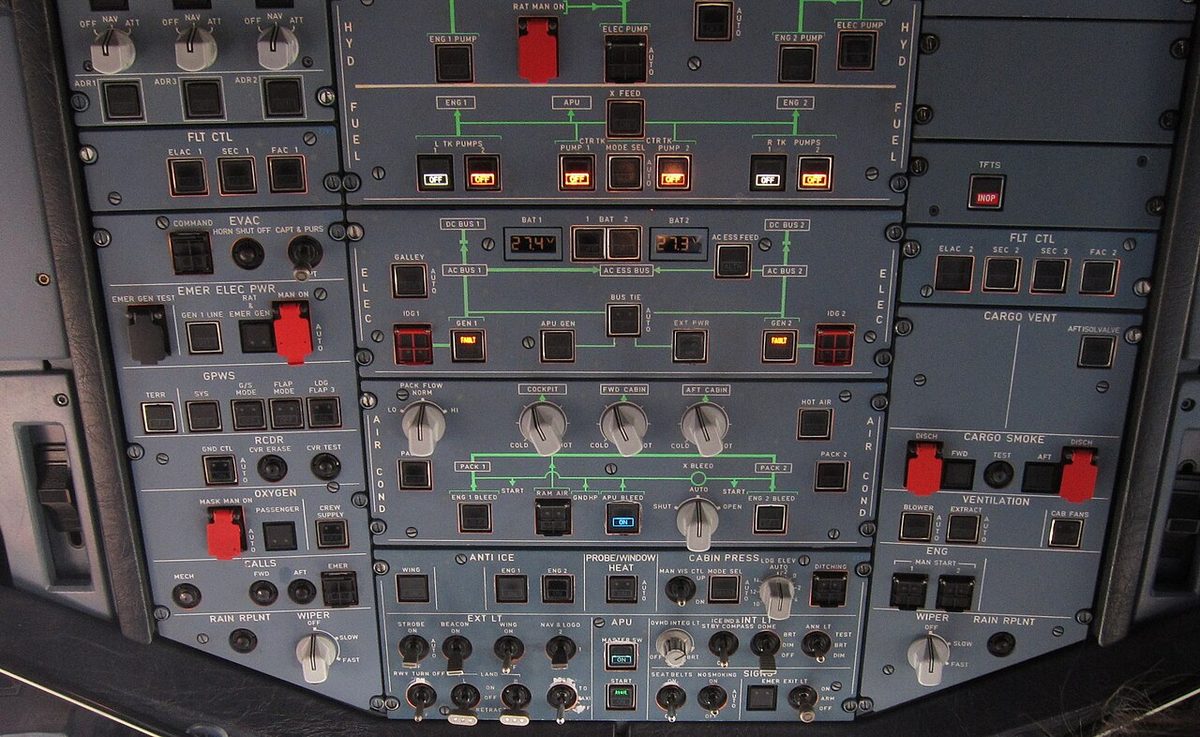
The APU panel has two pushbuttons, the MASTER SW and the START pushbutton.
Setting MASTER SW ON:
- supplies electrical power to the APU system, and the ECB performs a power-up test;
- opens the air intake flap and the APU fuel isolation valve;
- runs the APU fuel pump if no fuel tank pump is running;
- brings up the APU page on the ECAM if ground power or a main generator is supplying the aircraft.
The crew wait at least 3 seconds before pressing START, whose ON light shows that the start is in progress. Then:
| Step | Event |
|---|---|
| Air intake flap fully open | The starter is energised |
| 1.5 seconds later | Ignition on |
| N = 60 % | Starter de-energised and ignition off; the APU is self-sustaining |
| N above 95 % | Green AVAIL light: bleed air and electrical power available |
| 2 seconds after 95 %, or N above 99.5 % | The ON light goes out |
| 10 seconds later | The APU page disappears from the ECAM |
During the start the batteries are connected to the DC BAT BUS while the MASTER SW is ON and N is below 95 %; with the emergency generator running this connection is limited to 3 minutes. On the ground with batteries alone, the APU should be started within 30 minutes of selecting the batteries to AUTO, as after 35 minutes their charge is below 25 %. The APU start may also disturb the standby compass reading.
Exam tip: the starter and ignition stop at 60 %, AVAIL comes on above 95 %, and the APU bleed valve opens only at 95 % or more. After three consecutive start attempts the crew must wait 60 minutes.
Bleed and electrical supply
With AVAIL lit the APU can supply bleed air and electrical power. Selecting the APU BLEED pushbutton ON opens the APU bleed valve, provided there is no APU or left wing leak and N is at least 95 %; with the X BLEED selector at AUTO, the crossbleed valve then opens and the engine bleed valves close. The green APU BLEED memo confirms the selection. Airbus recommends selecting APU bleed once the APU is available, or 3 minutes after the start to reduce cabin odours, since that warm-up lets the seals reach their best performance. The pneumatic side is covered in A320 bleed air and ice protection.
In the normal procedures, APU BLEED is set OFF after engine start to avoid ingesting engine exhaust, and ON again just before engine shutdown at the gate, to keep engine exhaust fumes out of the air conditioning. For take-off, packs OFF or APU bleed ON improves performance with TOGA thrust and lowers the exhaust gas temperature in a FLEX take-off, but APU bleed is not authorised if wing anti-ice will be used. The APU bleed and an HP air start unit must never be used at the same time.
The APU GEN pushbutton connects the generator: its line contactor closes if the parameters are normal and the external power contactor is open. When the APU generator is the only source, both bus tie contactors close so that it feeds both AC buses.
Operating envelope
The APU's limits are several figures, not one:
| Limitation | Value |
|---|---|
| APU bleed to assist an engine start | Up to 20,000 ft |
| APU bleed for air conditioning and pressurisation, one pack | Up to 22,500 ft |
| APU bleed for air conditioning and pressurisation, two packs | Up to 15,000 ft |
| APU bleed for wing anti-ice | Not permitted |
| Maximum N | 107 % |
| Maximum EGT for start, below 35,000 ft | 1,090 °C |
| Maximum EGT for start, above 35,000 ft | 1,120 °C |
| Maximum EGT running | 675 °C |
| Start attempts | After three consecutive attempts, wait 60 minutes |
Two packs need more airflow than one, which is why their altitude limit is lower. Where a value of the aircraft's environmental envelope is more limiting than the APU's operational envelope, the aircraft value applies. During refuelling or defuelling the APU may be started or shut down, but not started after a failed start or an automatic shutdown, and it must be shut down normally if fuel is spilled.
Normal and emergency shutdown
Pressing the MASTER SW with the APU running starts the shutdown sequence. The ON and AVAIL lights go out. If APU bleed air was in use, the APU keeps running for a cooling period of 60 to 120 seconds, then decelerates, and the air intake flap closes at 7 % N. If the flap is not fully closed 3 minutes after the MASTER SW is switched off, a FLAP OPEN advisory appears. When securing the aircraft, the crew switch the APU off after the passengers have disembarked and wait until the flap is fully closed, about 2 minutes after AVAIL goes out, before switching the batteries off; switching them off earlier may cause smoke in the cabin on the next flight.
The ECB shuts the APU down automatically, with the ECAM alert APU AUTO (EMER) SHUT DOWN, for a fire (on the ground only), a closed air intake flap, overspeed or loss of overspeed protection, underspeed or no speed, no acceleration, a slow start, no flame, EGT overtemperature or loss of the EGT thermocouples, reverse flow, low oil pressure, high oil temperature, an oil system shutdown or a clogged oil filter, an inlet overheat, loss of DC power, overcurrent, or a sensor, IGV or ECB failure. In flight, a low oil pressure shutdown is delayed by 15.5 seconds.
For an emergency shutdown, the flight crew push the APU FIRE pushbutton, which shuts the APU down and isolates its fuel, bleed and generator. On the ground the ground crew can press the APU SHUT OFF pushbutton on the external power panel, in the nose landing gear bay: it closes the APU LP fuel shutoff valve and starts the same sequence as an automatic shutdown, but without the cooling period, and it silences the external horn. An APU fire on the ground also shuts the APU down automatically: the fire warnings come on in the cockpit, a horn sounds in the nose gear bay, the AVAIL light goes out, the FAULT light in the MASTER SW comes on, and the extinguisher discharges. The fire protection is covered in A320 fire and smoke protection.
ECAM APU page
The APU page appears when the MASTER SW is set ON (with ground power or a main generator supplying the aircraft) and disappears automatically about 10 seconds after the start is complete, or when the MASTER SW is switched off. It shows:
| Item | Indication |
|---|---|
| AVAIL | Green when N is above 95 % |
| APU bleed valve | In line green: not closed; cross line green: closed; cross line amber: closed with APU BLEED ON; amber XX: status not available |
| Bleed pressure | Relative pressure in green; amber XX if ADIRS 1 or 2 is unavailable or off, or ECB data are invalid |
| APU GEN | Same parameters as on the ELEC page; line contactor green when closed |
| FUEL LO PR | Amber when the APU fuel pressure is low |
| FLAP OPEN | Green when the air intake flap is fully open |
| N | Green; amber at 102 % or more; red at 107 % or more |
| EGT | Green; amber at EGT MAX − 33 °C or more; red at EGT MAX or more, when the automatic shutdown begins |
| LOW OIL LEVEL | Advisory on the ground with the APU stopped, when the ECB detects a low oil level |
EGT MAX is computed by the ECB and sent to the ECAM: during the start it depends on N, and with the APU running on the ambient temperature. If EGT MAX is 675 °C, the running limit, the EGT turns amber at 642 °C. The green APU AVAIL memo on the ECAM appears when N is above 99.5 %, or 2 seconds after it passes 95 %, depending on the aircraft configuration.
Frequently asked questions
What does the A320 APU supply?
Bleed air and electrical power. On the ground it supplies bleed air for engine starting and air conditioning, and its generator powers the electrical network. For take-off it may supply the air conditioning so that the engines give more thrust. In flight it backs up the electrical system and the air conditioning, and it can be used to start the engines. It supplies no hydraulic power.
What is the A320 APU start sequence?
MASTER SW ON powers the APU system: the ECB runs a power-up test, the air intake flap and the fuel isolation valve open, and the APU fuel pump runs if no tank pump is. After at least 3 seconds the crew press START. The starter engages when the flap is fully open, ignition follows 1.5 seconds later, and both stop at 60 % N. AVAIL comes on above 95 % N.
Up to what altitude can the A320 APU supply bleed air?
It depends on the use. APU bleed may assist an engine start up to 20,000 ft, and supply air conditioning and pressurisation up to 22,500 ft with one pack or 15,000 ft with both, because two packs need more airflow than the APU can deliver higher up. APU bleed may never be used for wing anti-ice. Starting the APU itself is permitted throughout the normal flight envelope.
How long does the A320 APU run after the MASTER SW is switched off?
If APU bleed air was being used, the APU keeps running for a cooling period of 60 to 120 seconds before it decelerates. The ON and AVAIL lights go out at once, and the air intake flap closes when the speed falls to 7 %. When securing the aircraft, the crew wait until the flap is fully closed, about 2 minutes after AVAIL goes out, before switching the batteries off.
How can the A320 APU be shut down in an emergency?
The flight crew push the APU FIRE pushbutton, which shuts the APU down and isolates its fuel, bleed and generator. On the ground the ground crew can press the APU SHUT OFF pushbutton on the external power panel under the nose, which closes the APU LP fuel valve and triggers the shutdown sequence without the cooling period. The ECB also shuts the APU down automatically for a fire on the ground and for faults such as overspeed or overtemperature.
Test yourself on A320 APU
The v1prep banks cover this topic in the A320 type-rating bank, with a worked explanation for every answer. EASA ATPL, PPL, IR and CPL, the FAA written tests and A320/B737 type ratings.
Start practising →Sources and further reading
- EASA Type Certificate Data Sheet EASA.A.064, Airbus A318, A319, A320, A321 (APU installations)
- EASA, Explanatory Note to ED Decision 2018/001/R, Part-FCL theoretical knowledge learning objectives (021 Airframe and Systems)
- EASA Easy Access Rules for Large Aeroplanes (CS-25)
- 14 CFR 25.1181, Designated fire zones; regions included
- FAA AC 20-128A, Design Considerations for Minimizing Hazards Caused by Uncontained Turbine Engine and Auxiliary Power Unit Rotor Failure
- FAA Aviation Maintenance Technician Handbook, Airframe (FAA-H-8083-31B)
Library articles are written for study and exam preparation. They do not replace your aircraft's approved documentation, your operator's procedures or the regulations themselves.