Cabin Air Distribution and Equipment Cooling
Cabin air distribution is the part of an aircraft's air conditioning that mixes pack air with filtered recirculated cabin air, adjusts its temperature for each zone and delivers it to the cabin, flight deck and cargo holds, while separate fans and valves ventilate and cool the avionics equipment.
The air conditioning packs produce cool, dry air, but that is only half the job. Cabin air distribution takes the pack output, mixes it with filtered cabin air, adjusts its temperature for each part of the aircraft and delivers it to the passengers, the flight deck and the cargo holds, then lets it leave through the outflow valve. Alongside it run the systems that ventilate the lavatories and galleys and cool the avionics, whose electronics depend on a steady flow of air.
For pilots the distribution system matters in three ways: it sets the comfort of a full cabin, its fans and valves appear in the smoke and fire procedures, and its failures, from a stuck trim air valve to an avionics ventilation fault, produce cautions that must be understood. The packs themselves are described in air conditioning packs.
Mix manifold and recirculation
Pack air enters a mixing unit, Airbus's term, or mix manifold, Boeing's; on the 737 NG the compartment that houses it is the air conditioning mix bay, where the cargo fire extinguisher bottles are also installed, on the forward wing spar. On the A320 the mixing unit combines cold pack air with recirculated cabin air and is also connected to the emergency ram air inlet and the LP ground air conditioning inlets. On the 737 NG the conditioned air is collected in the mix manifold and reaches the passenger cabin through sidewall risers and an overhead distribution duct; air from the left pack, taken upstream of the mix manifold, flows directly to the flight deck. Temperature sensors downstream of the packs and of the mix manifold detect overheats.
Recirculation fans augment the packs. They draw cabin air from the underfloor area, pass it through filters and return it to the mixing unit, so the packs can run at a reduced flow, which reduces engine bleed demand and fuel burn while the ventilation rate stays up. On the 737 NG, air from the passenger cabin and the electrical equipment compartment is drawn through the lining of the forward cargo compartment, filtered and returned to the mix manifold by two AC-powered fans with their own RECIRC FAN switches. Their logic is tied to the pack switches: in flight, for example, the right fan runs with both packs operating unless both PACK switches are in HIGH. The A320's CAB FANS pushbutton controls its two cabin recirculation fans, and a failed fan shows FAN in amber on the ECAM COND page.
Not all air is reused. Air from the lavatories and galleys carries odours, cooking fumes and moisture, so it is never recirculated: on the A320 an extraction fan, running continuously whenever electrical power is available, draws cabin air through the lavatories and galleys and exhausts it near the outflow valve.

HEPA filters and ozone converters
The recirculated air passes through high efficiency particulate air (HEPA) filters, which remove more than 99.97 per cent of particles of 0.3 microns and larger, including bacteria, viruses, dust, pollen, smoke particles and fungal spores. They are fitted in the recirculation circuit of types such as the A320 family and the 737 NG and MAX, and are changed at scheduled maintenance because a clogged filter reduces the flow.
Ozone is a second contaminant, but it arrives with the fresh air. Its concentration increases above about 40,000 ft, and in winter, when the tropopause is low, significant amounts can reach lower levels; above 50,000 ft normal concentrations exceed tolerable limits. The heat of compression breaks much of it down, and many jet transports also have an ozone converter, a catalytic converter in the air supply. Cabin ozone concentration is a certification standard in its own right (CS 25.832 and 14 CFR 25.832). Its effects on the body are covered in carbon monoxide and cabin air hazards.
Fresh air and air exchange rate
The cabin fresh air requirement sets how much outside air the packs must supply. ATPL texts quote the British Civil Airworthiness Requirements: 1 lb (0.45 kg) of fresh air per seat per minute in normal operation, and not less than 0.5 lb per seat per minute after the failure of any part of the duplicated air conditioning system. The supply must also be enough to pressurise the cabin at the maximum operating altitude. Ventilation air must be free of hazardous contamination; certification rules treat carbon monoxide above 1 part in 20,000 (50 ppm) as hazardous (CS 25.831).
The resulting cabin air exchange rate is high. ATPL texts state that a modern transport replaces its cabin air completely every 2 to 4 minutes, about 15 to 30 changes an hour, with roughly half fresh and half recirculated air depending on the type. Without that supply air quality falls quickly: with passengers on board, the A320 FCOM recommends not exceeding 20 minutes without air conditioning.
Exam tip: fresh air per BCAR as quoted in ATPL texts: 1 lb per seat per minute normally, 0.5 lb after a failure. HEPA filters: 99.97 per cent of particles of 0.3 microns. Toilet and galley air is never recirculated.
Zone temperature control
The cabin is divided into zones, each with its own temperature selector: on the A320 and 737 NG, the flight deck, the forward cabin and the aft cabin. Zone temperature control works by subtraction and addition. The packs deliver air at the temperature needed by the zone demanding the most cooling; every warmer zone then receives trim air, hot air taken upstream of the packs, in its own supply duct.
- A320: zone selectors run from 18 °C (COLD) to 30 °C (HOT), with 24 °C at the 12 o'clock position, and in cruise the cabin crew can adjust each cabin zone by ±2.5 °C from the forward attendant panel. Cabin zone temperatures are sensed in the lavatory extraction circuit and the galley ventilation system. A hot air pressure regulating valve, controlled by the HOT AIR pushbutton, feeds a trim air valve for each zone. A duct temperature of 88 °C is an overheat: the hot air and trim air valves close, and the FAULT light goes out once the duct is below 70 °C and OFF is selected. If the hot air valve fails closed, pack 1 controls the cockpit temperature and pack 2 the cabin, at the mean of the two cabin selections.
- 737 NG: the selectors range from about 18 °C (65 °F) to 30 °C (85 °F). Trim air modulating valves add heat to each zone, and an amber ZONE TEMP light marks a duct overheat, which closes that zone's trim air valve until TRIP RESET is pressed after the duct cools. If all the temperature selectors are OFF, the left pack holds 24 °C (75 °F) and the right pack 18 °C (65 °F).
ATPL texts add that warm air is distributed along the floor and walls to keep interior surfaces near cabin temperature, which prevents cold-wall draughts and reduces heat loss through the skin.
Gasper air, flight deck air and humidifiers
Gasper air is the individual supply to each seat, delivered through adjustable nozzles that passengers can open, close and aim. Boeing calls them gaspers and Airbus individual air outlets. ATPL texts describe gasper air taken from a zone supply duct upstream of the trim air, with a gasper fan to keep it flowing; on the E190-E2 it comes from the right pack and right recirculation fan through a gasper shutoff valve.
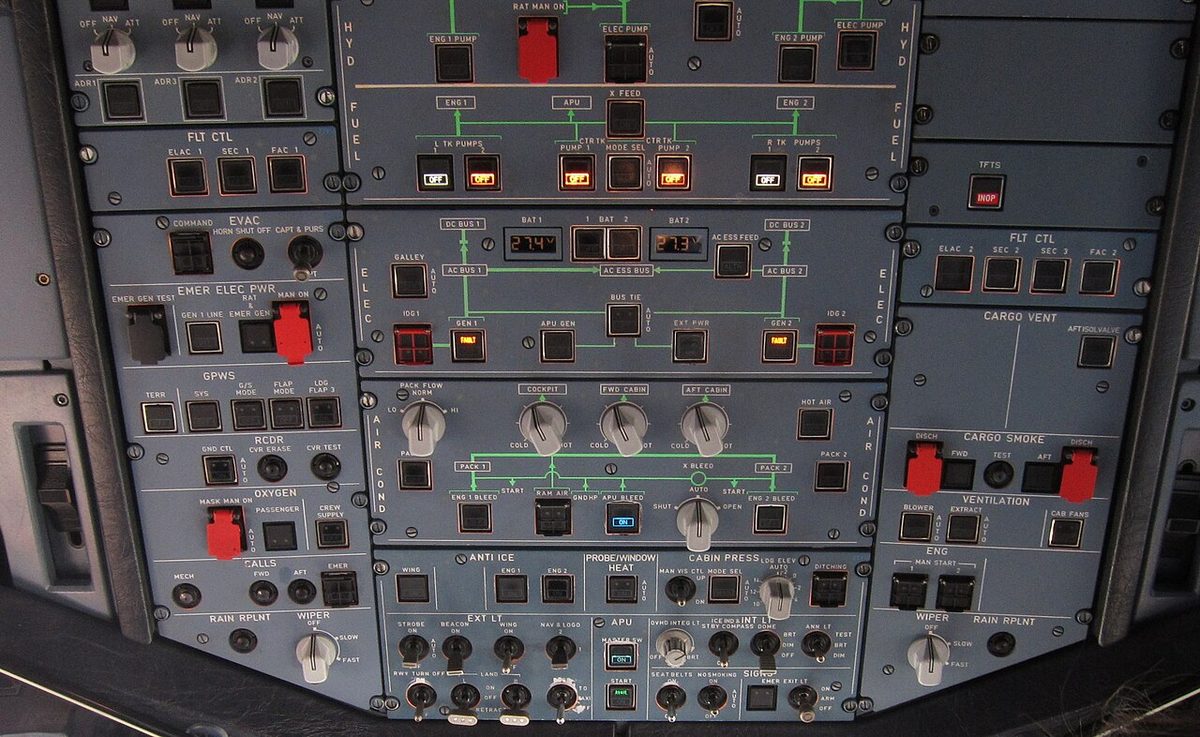
The flight deck has its own supply, with adjustable outlets at each pilot station and air directed onto the windows to keep them clear of mist. On the 737 NG the flight deck air branches into risers ending at floor, ceiling and foot-level outlets, and a dual-purpose valve behind each pilot's rudder pedals warms the pilots' feet and defogs the inside of the No. 1 windshields.
Air at cruising levels is extremely dry: at 40,000 ft its relative humidity is only 1 to 2 per cent, and on long flights the cabin falls to 5 to 15 per cent against an ideal of about 30 per cent given in ATPL systems texts. Most aircraft do not regulate humidity. Some long-haul aircraft carry a cabin humidifier, which atomises water from the aircraft's drinking water supply into the supply air, and the Boeing 787 has cabin humidification (see potable water and drain systems).
Cargo heating and ventilation
Cargo holds are usually pressurised, but not all are heated or ventilated. ATPL texts describe cargo compartment heating by a tapping from the pneumatic manifold or by warm air from the forward cabin, under its own temperature control, which matters above all for live animals. The 737 NG's lower cargo compartments are sealed and pressurised but have no fresh air circulation or temperature control of their own; in flight at higher differential pressures, warm exhaust air from the equipment cooling system is diffused into the lining of the forward compartment for extra heating.
The A320 provides cargo compartment ventilation with extraction fans that draw cabin air through the holds through inlet and outlet isolation valves. Forward cargo air leaves overboard through a skin venturi; in flight above 1 psi of differential pressure the fan stops and the pressure difference alone keeps the air moving. Aft cargo air leaves through the outflow valve. For heating, hot bleed air is mixed into the incoming cabin air by a cargo trim air valve, with selectable temperatures from about 5 °C to 26 °C; the trim air valve closes if the inlet reaches 70 °C, and the pressure regulating valve at 88 °C. If smoke is detected in a hold, its isolation valves close and its fan stops, so that the hold is cut off from the cabin air (see cargo and lavatory fire protection).
Avionics bay and equipment cooling
Electronic equipment turns electrical power into heat. The avionics bay, or avionics compartment, called the electrical and electronics bay (E&E bay) by Boeing, therefore has an equipment cooling system of its own.
- A320: an avionics equipment ventilation controller (AEVC) runs two electric fans, the blower and the extract, which circulate air continuously whenever the aircraft has electrical power; part of the air is drawn from the flight deck through its panels. Depending on the skin temperature the AEVC selects an open circuit on the ground, using outside air, or a closed circuit in flight, in which the air recirculates through a skin heat exchanger, with an intermediate configuration in flight when the skin is warm. If smoke is detected, the BLOWER and EXTRACT FAULT lights come on; with both pushbuttons at OVRD, air from the air conditioning cools the equipment and is then exhausted overboard. On the ground with engines stopped, a ventilation warning also sounds the external horn.
- 737 NG: a supply duct and an exhaust duct each have a normal and an alternate fan. An amber EQUIP COOLING SUPPLY or EXHAUST OFF light shows no airflow from the selected fan, and selecting the alternate fan should restore it within about 5 seconds. On the ground an overtemperature is signalled to the ground crew by the crew call horn in the nose wheel well. The overboard exhaust valve is open on the ground and at low differential pressure and closes at higher differentials.
- E190-E2: the forward electronics bay is cooled by flight deck air and the centre bay by cabin air, using three fans in parallel, one running and two on standby; the aft bay has no fan and relies on air flowing from the cabin.
The A320 also ventilates its batteries through a skin venturi that draws air around them and vents it overboard. Smoke in the equipment bay and its procedures are covered in in-flight fire, smoke and fumes.
Frequently asked questions
Is the air in an airliner cabin recirculated?
Partly. On most jet transports, recirculation fans draw cabin air from under the floor, pass it through HEPA filters and return it to the mixing unit, where it joins fresh air from the packs. ATPL texts put the mix at roughly half fresh and half recirculated, varying by type. Recirculation lets the packs run at a lower flow, saving engine bleed air and fuel. Air from lavatories and galleys is never recirculated; it is extracted and sent overboard.
What does a HEPA filter remove from aircraft cabin air?
A high efficiency particulate air (HEPA) filter removes more than 99.97 per cent of particles of 0.3 microns and larger. That includes dust, pollen, smoke particles, fungal spores, bacteria and viruses. On a jet transport the HEPA filters sit in the recirculation circuit, so the cabin air that is reused has been filtered before it rejoins the fresh air from the packs. Clogged filters reduce the flow and are changed at scheduled maintenance.
How often is the air in an airliner cabin replaced?
ATPL texts state that a modern transport aircraft replaces its cabin air completely every 2 to 4 minutes, about 15 to 30 changes an hour. The packs supply fresh air continuously, a similar quantity of cabin air leaves through the outflow valve, and filtered recirculated air keeps the total ventilation flow up. British airworthiness requirements quoted in ATPL texts set 1 lb of fresh air per seat per minute normally, and 0.5 lb after a failure.
What is trim air on an airliner?
Trim air is hot air, taken upstream of the packs, that is added to the supply duct of an individual temperature zone. The packs deliver air cold enough for the zone that needs the most cooling; every warmer zone then receives as much trim air as its controller requires to reach the selected temperature. On the A320 a hot air pressure regulating valve feeds the trim air valves, and on the 737 NG trim air modulating valves do the same job.
What is a gasper on a plane?
A gasper is a passenger's individual air outlet, the small nozzle above each seat that can be opened, closed and aimed. Boeing uses the word gasper; Airbus speaks of individual air outlets. The air is conditioned air taken from a supply duct, often with a fan to keep it flowing. On the E190-E2, for example, the gasper air comes from the right pack and right recirculation fan through a gasper shutoff valve.
How is the avionics bay cooled on an airliner?
Fans force cooling air through the electronic equipment and extract the warmed air. The A320 uses a blower fan and an extract fan, managed automatically by a controller that routes air through a skin heat exchanger or overboard depending on the skin temperature. The 737 NG has supply and exhaust ducts, each with a normal and an alternate fan. Loss of airflow gives a flight deck indication, and on the ground a horn can alert the ground crew.
Test yourself on Cabin Air Distribution and Equipment Cooling
The v1prep banks cover this topic in Aircraft General Knowledge (021), with a worked explanation for every answer. EASA ATPL, PPL, IR and CPL, the FAA written tests and A320/B737 type ratings.
Start practising →Sources and further reading
- EASA, Explanatory Note to ED Decision 2018/001/R, Part-FCL theoretical knowledge learning objectives (021 Airframe and Systems)
- EASA Easy Access Rules for Large Aeroplanes (CS-25), CS 25.831 Ventilation and CS 25.832 Cabin ozone concentration
- 14 CFR 25.831, Ventilation
- 14 CFR 25.857, Cargo compartment classification
- FAA Aviation Maintenance Technician Handbook, Airframe (FAA-H-8083-31B), Chapter 16, Cabin Environmental Control Systems
Library articles are written for study and exam preparation. They do not replace your aircraft's approved documentation, your operator's procedures or the regulations themselves.