Wet and Contaminated Runways
A wet runway has visible dampness or water up to 3 mm deep; a contaminated runway has a significant part of its surface covered by standing water, slush, snow, ice or frost. Both reduce tyre friction, and loose contaminants also add drag.
The runway surface decides how quickly an aeroplane accelerates, how hard it can brake and how well it can be steered. Flight manual performance assumes a clean, dry, paved surface. Water, slush, snow, ice and frost all reduce tyre grip, and deep loose contaminants also add drag that slows the take-off run.
Overruns and veer-offs on slippery runways remain among the most common serious accidents in commercial aviation (see runway excursion). Since 4 November 2021 runway surfaces worldwide have been reported under the ICAO Global Reporting Format (GRF), which links what the aerodrome observes to the performance data the crew uses. The FAA had already introduced the same idea under its Takeoff and Landing Performance Assessment (TALPA) programme.
- Runway surface definitions
- Reporting runway condition: GRF, RCAM and braking action
- Friction and braking coefficients
- Wheel slip and rolling friction
- Aquaplaning
- Contaminant drag and equivalent water depth
- Grooving and porous friction course
- Wet and contaminated runway performance
- Operating technique and crosswind
- Frequently asked questions
Runway surface definitions
- A dry runway has a surface free of visible moisture and is not contaminated within the area to be used. Older EU-OPS wording also counted grooved or porous runways kept "effectively dry" as dry. That concession no longer exists.
- A damp runway was once a separate category: not dry, but without a shiny appearance, and dry performance could be used. Under the GRF, any visible dampness is reported as wet, and the FAA's matrix likewise includes damp within wet.
- A wet runway is covered by visible dampness or water up to and including 3 mm deep. The FAA uses 1/8 in.
- A slippery wet runway is a wet runway whose friction has been found to be degraded, for example by rubber deposits or polishing.
- A contaminated runway has a significant part of its surface covered by one or more contaminants. EASA guidance takes "significant" to mean more than 25 per cent of at least one runway third, within the length and width in use. The contaminants are standing water (water deeper than 3 mm), slush, wet snow, dry snow, compacted snow, ice, wet ice and frost, alone or layered.
The snow terms are practical: dry snow will not readily form a snowball, wet snow packs into a firm one without releasing water, and slush is so waterlogged that water drains from a handful. Compacted snow has been pressed into a solid mass that tyres run on without further rutting.
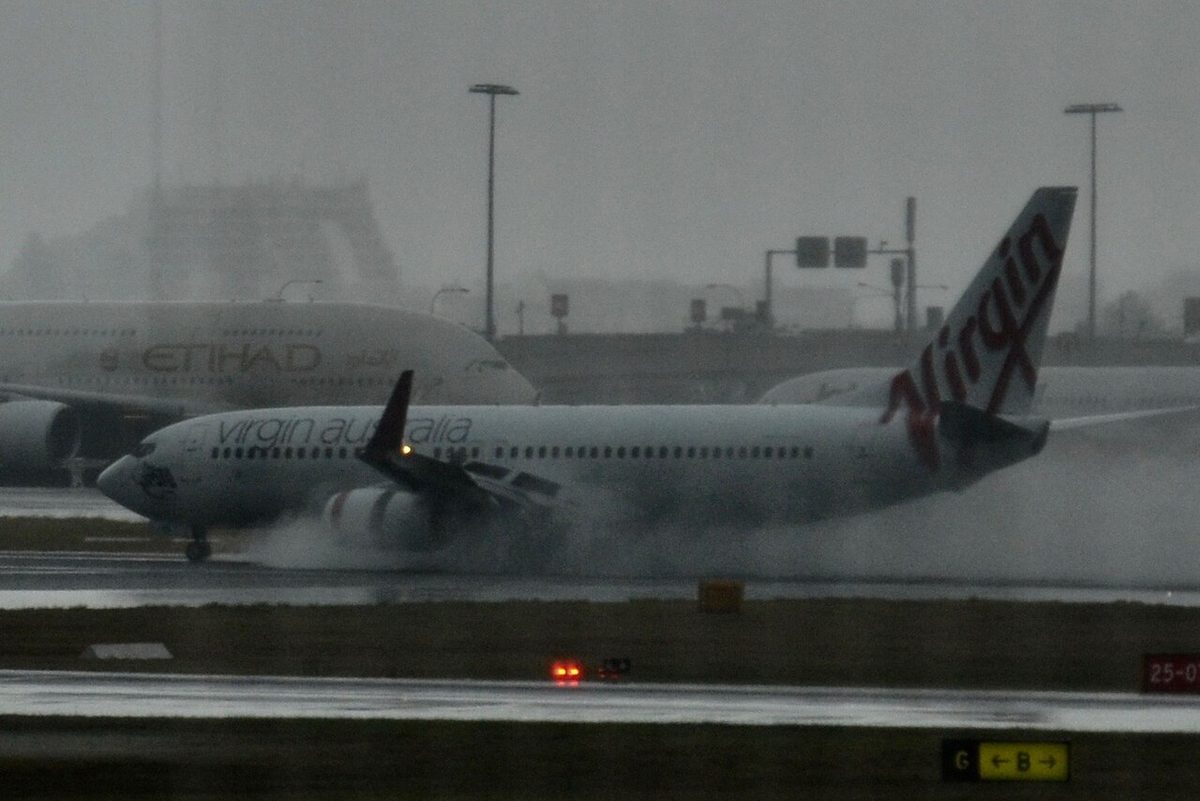
Reporting runway condition: GRF, RCAM and braking action
Trained aerodrome staff assess each third of the runway for contaminant type, depth and coverage, which is reported as 25, 50, 75 or 100 per cent. They then use the Runway Condition Assessment Matrix (RCAM) to assign a runway condition code (RWYCC) from 6 to 0. Pilot braking-action reports and other observations can lead the assessor to adjust the code. The results go into a Runway Condition Report (RCR), which reaches crews through the ATIS and the SNOWTAM. The SNOWTAM now describes contaminants in plain language, is issued in any season and is valid for no more than 8 hours.
| RWYCC | Typical surface (ICAO RCAM, abridged) | Braking action |
|---|---|---|
| 6 | Dry | – |
| 5 | Frost; wet (3 mm or less, including damp); slush, dry or wet snow 3 mm or less | Good |
| 4 | Compacted snow, OAT −15 °C and below | Good to medium |
| 3 | Slippery wet; dry or wet snow deeper than 3 mm; compacted snow above −15 °C; snow on compacted snow | Medium |
| 2 | Standing water or slush deeper than 3 mm | Medium to poor |
| 1 | Ice | Poor |
| 0 | Wet ice; water on compacted snow; dry or wet snow on ice | Less than poor |
The FAA's RCAM follows the same structure. Its depth threshold is 1/8 in, and it calls the lowest category NIL rather than less than poor. A field condition (FICON) NOTAM gives three codes, one for each third, for example 5/5/3. A NIL report closes the surface until the airport has treated it and assessed it again.
Exam tip: before the GRF, SNOWTAMs used numeric contaminant codes and were valid for 24 hours. Measured friction was also translated into braking action, with 0.40 and above counting as good and 0.25 and below as poor. That system has been withdrawn, although older question banks still test it. The FAA removed friction (Mu) reporting in AC 150/5200-30D.
Friction and braking coefficients
The coefficient of friction is the friction force divided by the force pressing the surfaces together. For an aircraft wheel, the braking coefficient is the retarding force at the tyre divided by the vertical load on that tyre. The certified value also includes the efficiency of the anti-skid system. It depends on the runway texture (the coarse macrotexture drains water and the fine microtexture grips through thin films), the tyre's tread and pressure, and speed.
On a dry runway the braking coefficient varies little with speed. On a wet runway it falls sharply as speed rises, because water has less time to escape from the tyre footprint. For this reason certification uses wet-runway friction curves that decrease with speed and tyre pressure (CS and 14 CFR 25.109).
A runway friction coefficient is the number a friction-measuring vehicle reports when it runs a standard test tyre at a set speed. Aerodromes use it to decide when rubber must be removed or the surface retextured. It does not correlate reliably with what an aeroplane achieves, especially on loose contaminants, so the GRF no longer passes measured friction to crews as braking action.
Wheel slip and rolling friction
Rolling friction is the resistance of a freely rolling wheel, which comes mainly from tyre deformation. Its coefficient is about 0.02 on a dry paved surface and considerably higher on grass or soft ground. During the take-off roll the rolling friction force falls as lift takes weight off the wheels.
The wheel slip ratio compares the wheel's surface speed with the aeroplane's ground speed. It is 0 for a freely rolling wheel and 1 (100 per cent) for a locked one. Braking friction rises with slip to a peak at roughly 10 to 20 per cent, then falls away towards the locked-wheel value. A locked tyre also loses almost all its side force, so the aeroplane can no longer be steered with the wheels. Anti-skid keeps each wheel near the peak. On slippery surfaces the peak is lower, so the achieved deceleration can fall well short of the autobrake setting.
Aquaplaning
Aquaplaning (hydroplaning) happens when water separates the tyre from the runway. It takes three forms:
- Dynamic aquaplaning occurs when the water pressure under the tyre builds up enough to lift the tyre onto a film of standing water. NASA research gave the rule of thumb that it starts at about 9√P knots for a rotating tyre, with P the tyre pressure in psi. A 200 psi tyre therefore starts to aquaplane at about 127 kt. For a tyre that is not yet rotating, as at touchdown, the figure is about 7.7√P, so the wheels may never spin up. Once dynamic aquaplaning has started it can continue below the onset speed.
- Viscous aquaplaning occurs on a very thin film over a smooth surface, such as paint markings or rubber deposits in the touchdown zone. It can happen at lower speeds and on only a damp surface.
- Reverted-rubber aquaplaning follows a long locked-wheel skid. Heat from the skid turns the water into steam and reverts the tread rubber to an uncured state. The tyre then rides on the steam and leaves whitish, steam-cleaned streaks on the runway. It can persist to very low speed.
Braking and directional control are both lost, and a crosswind can blow an aquaplaning aeroplane off the centreline. On many types wheel spin-up triggers the ground spoilers and autobrake, so aquaplaning at touchdown can delay both.
Contaminant drag and equivalent water depth
Loose contaminants such as water, slush and wet or dry snow produce contaminant drag, which comes in two forms. Displacement drag is the work the tyres do pushing contaminant aside. It grows with depth, density and speed until the tyres start to aquaplane, and then it falls off. Impingement drag comes from spray thrown up by the wheels striking the landing gear, flaps and fuselage. Spray can also be ingested by engines, which is why many nose-wheel tyres have chines to deflect it.
On take-off, contaminant drag reduces acceleration and lengthens the take-off and accelerate-stop distances. During a rejected take-off it helps deceleration and partly offsets the poor friction. As a result, deeper contaminant brings a large mass penalty but only a small further reduction in V1. Compacted snow and ice cause almost no drag but give very low friction.
Drag depends on the mass of contaminant displaced, so performance data often convert depth to an equivalent water depth by multiplying the depth by the contaminant's specific gravity. Slush typically has a specific gravity of about 0.5 to 0.8, so 13 mm of slush at 0.8 is equivalent to about 10 mm of water. The older European definition of contamination used the same idea: more than 3 mm of water, or slush or loose snow equivalent to it. Beyond the maximum depths in the flight manual there are no data, so take-off is not permitted.
Grooving and porous friction course
Runway grooving means sawing narrow transverse grooves across the pavement. The grooves give trapped water an escape path, which raises the speed at which dynamic aquaplaning starts and improves wet braking. A porous friction course (PFC) does the same job with an open-graded asphalt surface layer that drains water down through connected voids. Both lose effectiveness when rubber or dirt fills the grooves or pores, so aerodromes monitor and clean them.
Under CS and 14 CFR 25.109(d), a manufacturer may certify a higher wet braking coefficient for a grooved runway or PFC surface. That coefficient is either 70 per cent of the dry value or a specified wet curve with better anti-skid efficiency. Operators may use these data only where approved and where the surface is maintained to standard. A wet grooved runway is still reported as wet.
Wet and contaminated runway performance
Wet runway performance for large aeroplanes differs from dry in three ways:
- The accelerate-stop distance uses the wet braking coefficient.
- It may take credit for reverse thrust, which is not allowed on a dry runway.
- The take-off distance is measured to a 15 ft screen height instead of 35 ft, provided V2 is reached by 35 ft.
The lower screen permits the lower V1 that the longer stopping distance demands without a heavy mass penalty. For contaminated runways the manufacturer supplies data under CS 25.1591, or the FAA's AC 25-31 in the United States, and Part-CAT requires operators to take the reported surface condition into account. EASA contaminated take-off distances also use the 15 ft screen. Take-off with reduced (assumed-temperature) thrust is not permitted on contaminated runways. See take-off performance for the full method.

For landing at dispatch, EASA requires a turbojet to stop within 60 per cent of the landing distance available on a dry runway (70 per cent for a turboprop). For a forecast wet runway the available distance must be at least 115 per cent of that figure. For a contaminated runway it must be the greater of the wet figure and 115 per cent of the contaminated landing distance (CAT.POL.A.230 and 235). The FAA equivalent is 14 CFR 121.195, with the same 60 per cent and 115 per cent factors.
Because conditions change after dispatch, EASA requires an in-flight check of the landing distance at time of arrival, based on the latest RCR (CAT.OP.MPA.303), and the associated AMC adds a 15 per cent margin. In the United States this assessment is guidance rather than regulation: SAFO 19001, which replaced SAFO 06012 in 2019, and AC 91-79B recommend at least a 15 per cent margin, using data produced under AC 25-32. More detail is given under landing performance.
Operating technique and crosswind
Landing technique on a slippery runway differs from normal practice:
- Fly a stabilised approach and touch down firmly in the touchdown zone. Do not float.
- Lower the nosewheel promptly and confirm that the ground spoilers have deployed.
- Select full reverse early, while it is most effective, and use an autobrake setting suited to the reported code.
Slippery surfaces also reduce tyre side force, so manufacturers publish crosswind limits that fall with the RWYCC (see crosswind landing). If the aeroplane drifts downwind with reverse selected, the reverse thrust is adding to the drift. The usual recovery is to reduce reverse to idle and release the brakes. Once rudder and nosewheel steering have brought the aeroplane back to the centreline, the crew reapplies braking and reverse.
Runway contaminants and airframe icing often come together, so the aeroplane itself must also be clean before departure.
Warning: a braking-action report describes one aeroplane's experience at one moment. Treat a report worse than the published code as controlling, and divert rather than accept a landing distance with no margin.
Frequently asked questions
What is the difference between a wet and a contaminated runway?
A wet runway has visible dampness or water up to and including 3 mm deep. A runway is contaminated when a significant part of it, which EASA takes as more than 25 per cent of at least one runway third, is covered by standing water deeper than 3 mm, slush, snow, compacted snow, ice or frost. Wet surfaces mainly reduce braking. Loose contaminants also add drag that slows acceleration.
What does a runway condition code of 3 mean?
Under the ICAO Global Reporting Format a runway condition code of 3 corresponds to medium braking action. Typical surfaces are a slippery wet runway, dry or wet snow deeper than 3 mm, or compacted snow at temperatures above minus 15 degrees Celsius. Crews enter the code into the landing distance and crosswind data for that third of the runway.
How do you calculate aquaplaning speed?
The rule of thumb from NASA research is that dynamic aquaplaning begins at about 9 times the square root of the tyre pressure in psi, giving a speed in knots, for a tyre that is already rotating. For a tyre that is not yet turning, as at touchdown, the figure is about 7.7 times the square root of the pressure, so aquaplaning can start at a lower speed.
Why is the wet runway take-off distance measured to 15 ft instead of 35 ft?
A wet runway lengthens the accelerate-stop distance, so V1 has to be lower. With a lower V1 an engine failure leaves less speed in hand, and a 35 ft screen would impose large mass penalties. Certification rules therefore accept a 15 ft screen height on a wet runway, provided V2 is reached by 35 ft.
Is braking action NIL the same as less than poor?
They describe the same lowest category, runway condition code 0. ICAO and EASA use the phrase less than poor, while the FAA uses NIL. In the United States a NIL braking report or code 0 conditions lead the airport operator to close the affected surface until it has been treated and reassessed.
Test yourself on Wet and Contaminated Runways
The v1prep banks cover this topic in Performance (032), with a worked explanation for every answer. EASA ATPL, PPL, IR and CPL, the FAA written tests and A320/B737 type ratings.
Start practising →Sources and further reading
- EASA, Global Reporting Format for runway surface condition (briefing material)
- FAA AC 150/5200-30D, Airport Field Condition Assessments and Winter Operations Safety
- FAA AC 91-79B, Aircraft Landing Performance and Runway Excursion Mitigation
- FAA AC 25-31, Takeoff Performance Data for Operations on Contaminated Runways
- 14 CFR 25.109, Accelerate-stop distance (wet, grooved and porous friction course runways)
- UK CAA, Contaminated runway reporting system
- Horne and Dreher, Phenomena of Pneumatic Tire Hydroplaning, NASA TN D-2056
Library articles are written for study and exam preparation. They do not replace your aircraft's approved documentation, your operator's procedures or the regulations themselves.