A320 Takeoff Performance Calculation in 5 Minutes
LAST UPDATED: 28 SEP 2026
A line A320 pilot does a takeoff performance calculation before every flight, but most never explain it well in interviews. This guide cuts through the noise: what RTOW is, how V-speeds and FLEX TEMP get computed, what inputs matter, and the sanity checks that catch errors before they hurt you.
The tools
A320 operators typically use one of these:
- OPT (Onboard Performance Tool) — Airbus EFB application. Most common at modern operators. Pilots input weight/wind/runway/condition, OPT outputs V1/VR/V2/FLEX/limit weight. Auto-fills from current ATIS where available.
- PEP (Performance Engineering Programme) — Airbus desktop tool used by operators to generate the performance tables OPT uses, and used by dispatch for offline computations.
- Operator EFB apps — Lido/PEP, Jeppesen FliteDeck Pro, custom EFB suites. All produce the same numbers via different UIs.
- Paper RTOW charts — backup for when EFB fails. Slower but reliable.
Inputs the calculation needs
- TOW — actual takeoff weight from loadsheet
- Runway — TORA, TODA, ASDA, slope, surface condition (dry/wet/contaminated)
- Wind component — headwind/tailwind on takeoff runway (within limits)
- OAT — actual outside air temperature
- QNH — pressure altitude
- Configuration — Conf 1+F, Conf 2, or Conf 3 (per operator/load)
- Anti-ice — engine and/or wing anti-ice ON/OFF (affects available thrust)
- Packs — ON or OFF (most operators are PACKS ON for takeoff)
- Bleeds — APU bleed in use? (frees up engine bleeds at the cost of APU fuel burn)
- Obstacles — built into the runway analysis chart
What RTOW means
RTOW (Regulated Takeoff Weight) is the maximum allowable takeoff weight for a specific runway and conditions, given all regulatory and structural constraints. It's the limiting weight from the most restrictive of:
- Maximum certified Takeoff Weight (MTOW) — structural
- Field length limit — runway available vs runway required
- Climb limit — second segment climb gradient with one engine
- Obstacle limit — net flight path clears obstacles by 35 ft
- Tire speed limit — VR ≤ tire max
- Brake energy limit — abort energy capacity
If your actual TOW exceeds RTOW, you can't take off as-is. Options: lower configuration (Conf 3 for shorter field), reduce weight (offload fuel/cargo), wait for cooler weather, or use a different runway.
How V-speeds come out
Given the inputs, the tool computes:
- V1 — decision speed (the maximum speed for the first action to reject the takeoff, and the minimum speed from which it can be continued within the takeoff distance after an engine failure)
- VR — rotation speed (≥ V1, normally pre-set so V2 is achieved by 35 ft AGL)
- V2 — takeoff safety speed (≥ 1.13 × VS1G)
- FLEX TEMP — assumed temperature for FLEX takeoff (if requested)
- Configuration recommendation — Conf 1+F vs Conf 2 vs Conf 3 based on which is most efficient
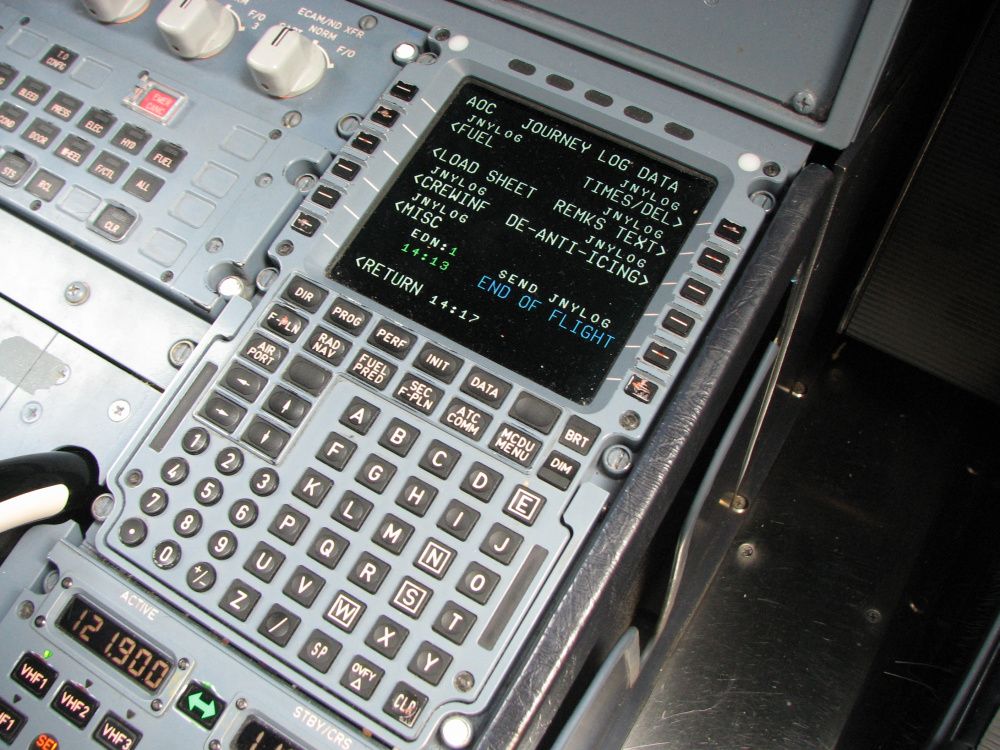
The pilot enters V1/VR/V2 into the MCDU PERF TAKEOFF page; the FMA and PFD speed tape reflect them.
FLEX TEMP determination
FLEX TEMP is the assumed temperature higher than actual OAT. The tool computes the maximum FLEX TEMP at which the aircraft still meets all CS-25 requirements at actual conditions (see our FLEX guide for full detail).
Practical reading of the output:
- FLEX TEMP at or above both OAT and TREF (the flat-rating temperature): FLEX is allowed. Use it.
- FLEX TEMP below OAT or TREF: no FLEX available. Use TOGA.
- Contaminated runway: FLEX prohibited regardless of margin. Use TOGA.
Many operators also require FLEX TEMP to be at least OAT + 5°C. That margin is an operator convention, not an Airbus limit.
Sanity checks
Spend 30 seconds checking the result against expectations:
- Does the limit weight make sense? — On a long runway in cool conditions, you should be MTOW-limited. On a short runway in hot weather, climb-limited. If the limit looks wrong, you input something wrong.
- V1 in the right ballpark? — Typically 130-150 KIAS for a normal A320 takeoff. If V1 is 110 or 170, recheck inputs.
- Configuration matches loading? — Heavy aircraft on short runway should be Conf 3. Light aircraft on long runway can be Conf 1+F.
- FLEX TEMP plausible? — On a 15°C day, FLEX 50 is normal. FLEX 70 should make you double-check inputs (above the ISA+53°C cap, 68°C at sea level).
- Wind direction/component matches what you actually have?
- Anti-ice/packs match what you've selected?
Interview-ready summary
If asked "walk me through how you'd compute takeoff performance," your answer:
"I'd use the OPT or operator EFB. Inputs: actual TOW from loadsheet, runway with TORA/TODA/ASDA/slope/condition from the AIP, wind component from ATIS, OAT and QNH, configuration per company SOP, anti-ice and pack settings. The tool outputs RTOW (the most restrictive of MTOW, field, climb, obstacle, tire, and brake limits), V-speeds, recommended configuration, and FLEX TEMP if margin allows. I'd verify the result against my expectations — V1 in the right range, limit reason makes sense, FLEX margin reasonable — then enter V1/VR/V2 into the MCDU. The PFD speed tape reflects them."
Drill performance in v1prep
v1prep covers ATPL Performance, A320 SOPs, and V-speed calculations across 16,000+ questions.
Practice the full bank →