Unreliable Airspeed
Unreliable airspeed is a condition in which one or more airspeed indications, and often altitude and Mach with them, are wrong or cannot be trusted, usually because a pitot or static source is blocked. The crew flies by attitude and thrust until a reliable source is identified.
Unreliable airspeed is the condition in which the speed shown to the crew is wrong or cannot be trusted. Because airspeed, altitude, vertical speed and Mach all come from the same pitot and static pressures, the fault rarely stays on one tape. It also reaches the autopilot, the autothrust, the flight envelope protections and the warning systems, all of which assume the air data is true.
The aircraft itself is usually undamaged and flies normally. The hazard lies in the response to false information: pulling up to stop an overspeed that does not exist, or failing to push when a genuine stall warning sounds. The defence is a memorised pitch and thrust setting that keeps the aircraft safe while the crew works out which source, if any, can be believed.
Causes
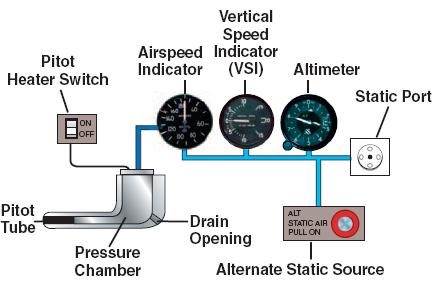
An airspeed indicator measures the difference between total (pitot) pressure and static pressure. Anything that corrupts either pressure corrupts the speed (see pitot-static system).
- Pitot blockage. Ice forms when probe heat is off or has failed. Ice crystal icing in and near deep convection can overwhelm heated probes at cruise altitude, as it did on Air France 447 (see airframe icing). Heavy rain, insects and their nests, leaves, and pitot covers left in place have all blocked probes.
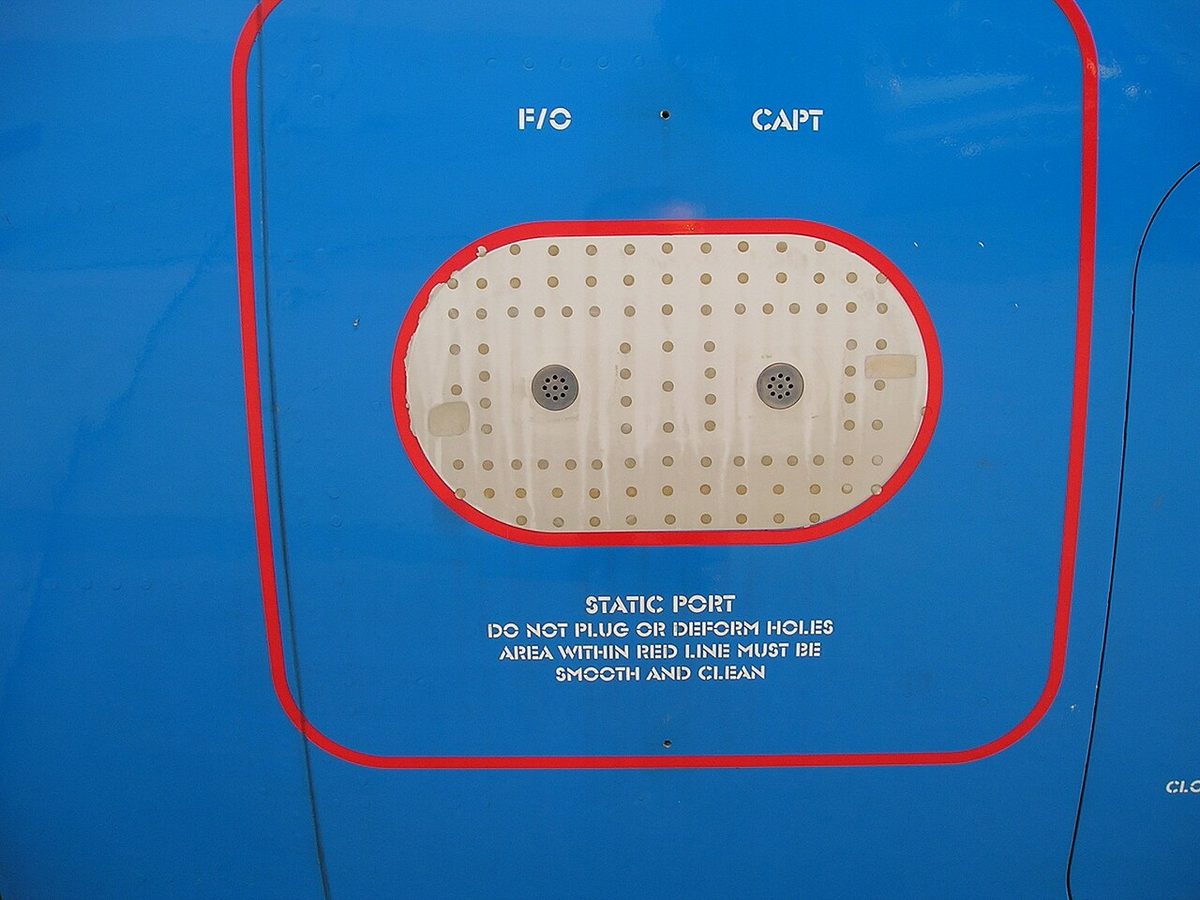
- Static port blockage. Masking tape left after washing or painting, ice, or water in the lines. A static fault is the more insidious one because it also corrupts altitude and vertical speed.
- System faults. Leaks after maintenance, a failed air data module, or damage to a probe or to the skin around a static port.
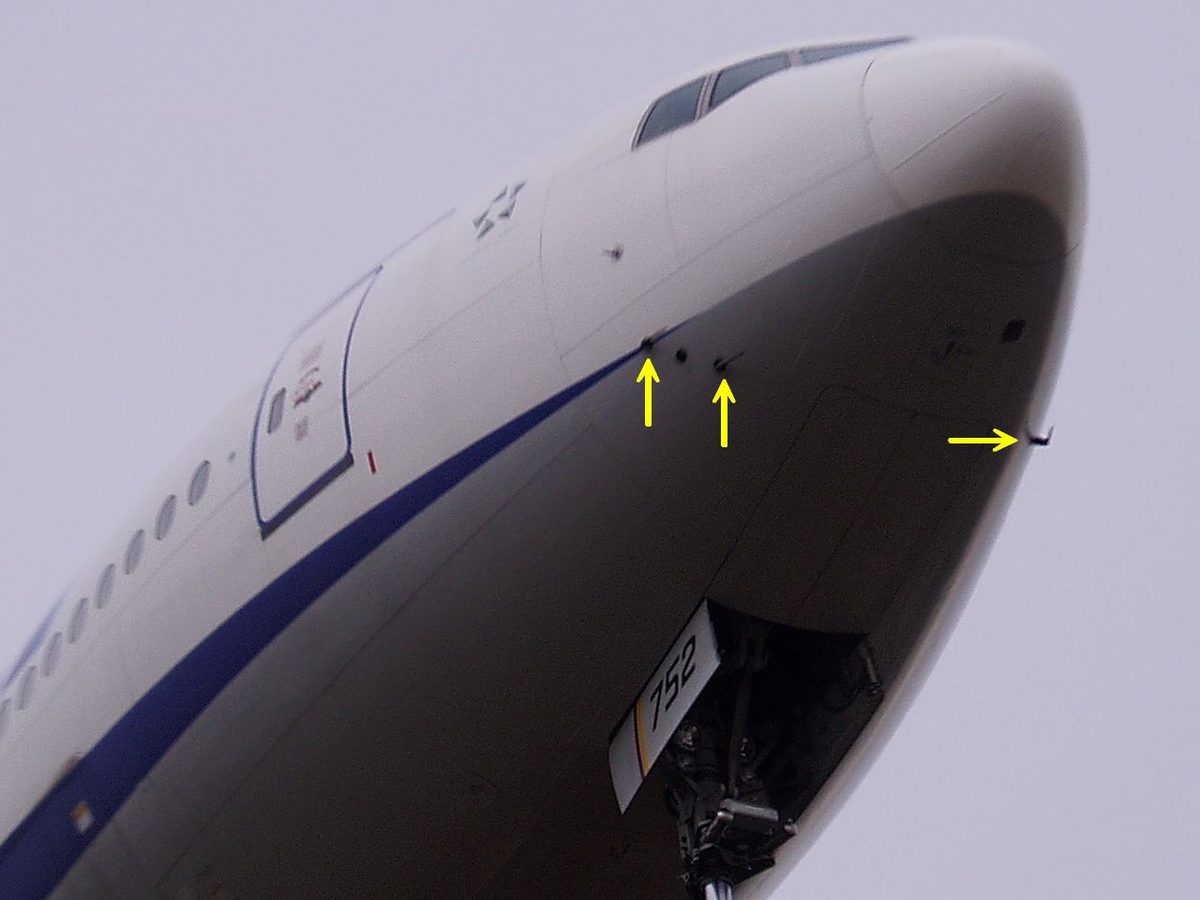
Airliners have redundancy. Each air data inertial reference unit (ADIRU) combines an air data part (ADR), which computes speed and altitude from the pressures, with an inertial part (IR), which provides attitude, heading and ground speed and is unaffected by pitot-static faults. The A320 has three pitot probes and six static ports feeding three ADIRUs. The 737 NG has three pitot probes and six static ports, two ADIRUs, and standby instruments fed directly from an auxiliary pitot probe and alternate static ports. Redundancy fails when a common cause, such as ice crystals or tape across one side, affects several sources the same way.
Recognition
Unreliable airspeed rarely announces itself. The cues include:
- disagreement between the captain's, first officer's and standby speeds, shown on the 737 NG as the amber airspeed disagree alert (IAS DISAGREE, more than 5 kt for 5 s) and, for altitude, ALT DISAGREE (more than 200 ft for 5 s);
- a speed that does not match the attitude and thrust, such as a rising speed in a steep climb at climb thrust;
- a speed that changes with altitude rather than with attitude and power;
- an overspeed warning and the stick shaker at the same time;
- erratic autopilot or autothrust behaviour, or their disconnection, and ECAM or EICAS air data alerts;
- aerodynamic noise and buffet that do not fit the indicated speed.
Knowing where each warning comes from settles conflicts. The overspeed warning is computed from air data and can be false. The stick shaker and the Airbus stall warning are driven by angle of attack, which does not depend on pitot or static pressure, so unless the angle-of-attack sensors themselves have failed, a stall warning should be believed. The Airbus procedure says plainly: respect the stall warning.
Blocked pitot versus blocked static
The instrument errors are a staple of ATPL and FAA examinations. The pitot pressure feeds only the airspeed indicator and Machmeter. The static pressure feeds those two and the altimeter and vertical speed indicator.
| Blockage | Airspeed in a climb | Airspeed in a descent | Altimeter and VSI |
|---|---|---|---|
| Pitot inlet and drain, static clear | Over-reads | Under-reads | Correct |
| Pitot inlet only, drain open | Falls towards zero | Falls towards zero | Correct |
| Static ports, pitot clear | Under-reads | Over-reads | Altimeter frozen, VSI zero |
A pitot blocked with its drain sealed turns the airspeed indicator into an altimeter, and the Machmeter over-reads in the climb in the same way. In level flight the indication simply freezes, so the fault shows only when speed or altitude changes. With a static blockage, the trapped pressure is too high in a climb and too low in a descent. The static case is the more dangerous: a descending aircraft is slower than indicated and closer to the stall. In an unpressurised aircraft, opening an alternate static source that vents into the cabin makes the altimeter and airspeed read slightly high.
Exam tip: remember PUDSOD, "pitot under-reads in descent, static over-reads in descent". The reverse applies in a climb.

Memory items and pitch and power
The first actions are memory items, flown before any diagnosis; on the A320 they apply when the safe conduct of the flight is affected. They remove the automatics, which are driven by the suspect data, and set a pitch and power combination that keeps the aircraft safely inside its envelope whatever the true speed.
| Airbus A320: Unreliable speed indication | Boeing 737 NG: Airspeed unreliable | |
|---|---|---|
| Automatics | AP, A/THR and FD off | Autopilot and autothrottle disengage; both F/D switches off |
| Pitch and thrust | 15° and TOGA below thrust reduction altitude; 10° and CLB above it up to FL100; 5° and CLB above FL100 | Gear up: 10° and 80% N1 with flaps extended; 4° and 75% N1 with flaps up |
| Configuration | Keep the flap setting (from CONF FULL select CONF 3); speedbrakes retracted; landing gear up | Not part of the recall items |
| Next | At or above MSA or circuit altitude, level off and troubleshoot | Probe heat check on; cross-check the Mach and airspeed indicators; QRH tables |
A known attitude with a known thrust gives a predictable speed for a given mass, altitude and configuration. That is the whole principle. Once the flight path is stable, the crew levels off at a safe altitude and uses the quick reference handbook (QRH) tables. The Airbus QRH gives pitch and thrust for climb, cruise, descent and approach by weight and altitude. Boeing's Performance-Inflight section gives pitch and N1.
Airbus describes the level-flight technique precisely. Hold the altitude. If the pitch is above the table value, the aircraft is slow, so increase thrust. If it is below, the aircraft is fast, so reduce thrust. When the pitch settles on the target, set thrust to hold it. The speedbrakes stay retracted and the stall warning is always respected. The type's procedure takes precedence over any summary here; see the guide to A320 memory items.
Finding a reliable source
With the aircraft stable, the crew compares every source. The odd one out is only a candidate. On the A320, two ADRs can be wrong in the same way and outvote the good one. ADR 3 and the standby instruments also share a pitot probe, so their agreement is not independent proof. On the 737 NG, the standby instruments take their pressures directly from the auxiliary pitot probe and alternate static ports, separately from the ADIRUs.
Independent references include:
- Ground speed cross-check. GPS or inertial ground speed, corrected for a wind known from before the failure or from the forecast, gives a coarse check on true airspeed. The FMS wind is no help, because it is calculated from the faulty airspeed.
- Attitude and thrust against the QRH tables. The inertial attitude is unaffected by pitot-static faults.
- GPS altitude and the radio altimeter. An ATC altitude readout is not independent. It comes from the aircraft's own transponder and the same static source.
- Angle-of-attack displays, where fitted, and the A320's back-up speed scale (BUSS).
Where fitted, the BUSS replaces the speed tape with a scale computed from angle of attack and slat and flap configuration. It appears when all three ADRs are switched off. GPS altitude then replaces barometric altitude and vertical speed is no longer shown. The crew flies within the green band. If the BUSS does not respond to pitch inputs, it is disregarded in favour of the pitch and thrust tables. Above FL250, if the faulty ADRs cannot be identified, the procedure keeps one ADR on and switches two off. Below FL250, if the speed is still unreliable, all three go off and the BUSS takes over.
Automation and envelope protection with bad air data
Automatic systems obey their inputs. An autopilot holding a speed from a pitot acting as an altimeter will pitch up as the indicated speed rises in the climb. An autothrottle will reduce thrust against a false overspeed. Disconnecting both is the first memory item for that reason.
On Airbus fly-by-wire aircraft, the flight control computers monitor the ADRs. When the air data can no longer be validated, the autopilot and autothrust disconnect and the flight controls revert to alternate law, losing the high angle of attack protection (see fly-by-wire and the guide to A320 flight control laws). The aircraft can then be stalled like any conventional aeroplane. Protections acting on two coherent but wrong ADRs are equally dangerous, which is why the A320 procedure switches ADRs off.
Accidents that shaped the procedures
| Accident | What was blocked | What happened |
|---|---|---|
| Birgenair 301, Boeing 757, Puerto Plata, 6 February 1996 | The captain's pitot probe, probably by mud or debris from an insect; covers had not been fitted during the last days of a 20-day stay on the ground | In the climb the captain's speed over-read. An overspeed warning was followed by the stick shaker; the captain believed the aircraft was too fast, and it stalled and struck the sea. All 189 on board died. |
| Aeroperú 603, Boeing 757, off Lima, 2 October 1996 | Static ports on the left side, covered with masking tape after cleaning | At night over the sea, speed and altitude were erratic and contradictory warnings sounded. The crew asked ATC for their altitude, but the controller's figure came from the aircraft's own transponder and was equally wrong. The aircraft struck the sea; all 70 died. |
| Air France 447, Airbus A330, South Atlantic, 1 June 2009 | Pitot probes, obstructed by ice crystals at FL350 | The autopilot and autothrust disconnected and the controls reverted to alternate law. Nose-up inputs took the aircraft to about 38,000 ft and into a stall held for about three and a half minutes of descent. All 228 died. |
The BEA found that the AF447 crew did not link the loss of speed indications to the unreliable airspeed procedure and never recognised the stall. The common thread is a crew reacting to the most alarming indication rather than to attitude and thrust. Since these accidents, training has placed more weight on manual flying and on unreliable airspeed scenarios (see upset prevention and recovery and stall).
Prevention
Most blockages are preventable on the ground:
- Probe heat. It is automatic on the A320 when at least one engine is running or the aircraft is in flight; the 737 NG crew selects it on before taxi, or it runs automatically on aircraft with an AUTO position.
- Covers and tape. Pitot covers are fitted during long parking and removed before flight. Static ports are masked for washing and painting only with conspicuous, flagged covers, and their removal is checked.
- Walk-round. Probes and ports are checked for covers, tape, insects and damage, and on the 737 NG for wrinkled skin around them.
- Take-off cross-check. Airbus reports an A320 take-off rejected at the 100 kt call because the captain's speed disagreed; leaves were found in the pitot probe and its line.
- Weather. Crews avoid areas of likely ice crystal icing near deep convection.
Terminology differs: Airbus calls the condition unreliable speed indication and Boeing airspeed unreliable. In the United States, 14 CFR 121.423 requires airline pilots to practise "manually controlled loss of reliable airspeed" in a Level C or higher simulator as part of extended envelope training. Under EASA rules, operators cover the scenario in conversion and recurrent training under ORO.FC.220 and ORO.FC.230. In every case the manufacturer's procedure and the operator's QRH govern.
Frequently asked questions
What causes unreliable airspeed?
Almost always a blocked or damaged pitot or static source. Pitot probes can be blocked by ice, including high-altitude ice crystals, heavy rain, insects and their nests, or covers left in place. Static ports can be covered by tape after washing or painting, or blocked by ice or water. Probe heat failures, damage to probes and leaks in the lines after maintenance can also corrupt the air data.
What happens to the airspeed indicator if the pitot tube is blocked?
If the pitot inlet and its drain hole are both blocked, the trapped pressure makes the airspeed indicator behave like an altimeter: it over-reads in a climb and under-reads in a descent. If only the inlet is blocked and the drain stays open, the pressure leaks away and the indication falls towards zero. The altimeter and vertical speed indicator are unaffected, because they use static pressure only.
What happens if the static port is blocked?
The altimeter freezes at the altitude where the blockage occurred and the vertical speed indicator returns to zero. The airspeed indicator under-reads in a climb and over-reads in a descent, which is dangerous because the aircraft is slower than indicated as it descends. The Machmeter errs in the same direction. Selecting an alternate static source, where one is fitted, restores the instruments with small errors.
What are the A320 unreliable speed memory items?
If the safe conduct of the flight is affected: autopilot, autothrust and flight directors off. Then pitch and thrust of 15° and TOGA below thrust reduction altitude, 10° and climb thrust above it up to FL100, and 5° and climb thrust above FL100. Keep the flap setting, or select CONF 3 if in CONF FULL, check speedbrakes retracted and landing gear up, and level off for troubleshooting at or above the safe altitude.
What are the Boeing 737 airspeed unreliable recall items?
On the 737 NG the recall items are to disengage the autopilot and autothrottle, set both flight director switches off, and set a gear-up pitch attitude and thrust: 10° and 80% N1 with flaps extended, or 4° and 75% N1 with flaps up. The checklist then has the crew check probe heat on, cross-check the airspeed indications and use the pitch and N1 tables in the QRH.
What caused the Air France 447 accident?
In June 2009 an A330 at FL350 over the Atlantic lost valid airspeed when ice crystals obstructed its pitot probes. The autopilot and autothrust disconnected and the flight controls reverted to alternate law. The crew did not recognise the unreliable airspeed situation or apply the procedure. Sustained nose-up inputs took the aircraft into a stall it never recovered from, and all 228 occupants died.
Test yourself on Unreliable Airspeed
The v1prep banks cover this topic in Operational Procedures (070), with a worked explanation for every answer. EASA ATPL, PPL, IR and CPL, the FAA written tests and A320/B737 type ratings.
Start practising →Sources and further reading
- BEA, Final Report on the accident on 1 June 2009 to the Airbus A330-203, flight AF 447
- Final Aviation Accident Report, Birgenair Flight ALW-301, Puerto Plata, Dominican Republic
- FAA Lessons Learned, Birgenair Flight 301, Boeing 757-200, TC-GEN
- Airbus Safety First, Unreliable Airspeed at Takeoff
- FAA Pilot's Handbook of Aeronautical Knowledge (FAA-H-8083-25), Chapter 8, Flight Instruments
- 14 CFR 121.423, Pilots, Extended Envelope Training
Library articles are written for study and exam preparation. They do not replace your aircraft's approved documentation, your operator's procedures or the regulations themselves.