Powered Flying Controls and Artificial Feel
Powered flying controls are flight controls in which hydraulic actuators, called power control units or servojacks, supply some or all of the force needed to move the control surfaces. Where they supply all of it the system is irreversible, and an artificial feel system gives the pilot control forces.
Powered flying controls move the control surfaces with hydraulic actuators instead of, or as well as, the pilot's muscle. The force needed to hold a surface grows with its size and with the square of the speed, and on a large or fast aeroplane it would soon exceed what a pilot can apply. CS 25.143 sets the forces a pilot may be expected to exert: 75 lbf in pitch, 50 lbf in roll and 150 lbf on the rudder pedals for a short application, and only 10, 5 and 20 lbf for a prolonged one. Aerodynamic balance and tabs can stretch manual control only so far (see control balance, tabs and trim); beyond that the controls must be powered.
Powering the controls brings two new problems. The pilot may lose the feel of the air load, which is the natural warning against overstressing the aeroplane, and the system must keep working, or fail safely, when hydraulic power is lost. Artificial feel, duplicated actuators, bypass valves and manual reversion are the answers.
Reversible and irreversible controls
A control system is reversible when a force at the cockpit moves the surface and a force at the surface moves the cockpit control. The pilot feels the aerodynamic load through the column, and it grows naturally with speed and deflection. Manual controls are reversible, although a trim tab within them is not: its screw or worm drive cannot be back-driven by the air load, so the trim setting does not drift.
A system is irreversible when loads on the surface cannot move the cockpit control. A fully powered control is irreversible because the surface is held by a hydraulic actuator whose trapped fluid cannot be compressed. Irreversibility also helps against flutter, because air loads cannot drive the surface about its hinge (see flutter and aeroelasticity).
| Manual | Power-assisted | Fully powered | |
|---|---|---|---|
| Who moves the surface | The pilot | The pilot and an actuator | The actuator alone |
| Reversible | Yes | Yes | No |
| Feel | Natural | Natural, reduced | Artificial |
| After hydraulic failure | Not applicable | Manual, heavier | Another actuator, or manual reversion on some types |

Power-assisted flying controls
In power-assisted flying controls the pilot's cables or rods still connect directly to the surface, and a hydraulic actuator in the linkage adds force. The pilot supplies part of the effort and the hydraulics the rest. Because the mechanical connection remains, large air loads still feed back to the cockpit: the system is reversible, natural feel is kept, and no artificial feel unit is needed. If the hydraulics fail the aeroplane can still be flown manually, only with heavier forces. Power assistance was used on older medium transports, as a stage between manual and fully powered controls.
Fully powered flying controls
In fully powered flying controls, also called fully power-operated flight controls, the actuator does all the work. The pilot's linkage moves only a control valve, so no surface load reaches the cockpit. Most jet transports use them, because they behave well at high speed, suit the autopilot and can be made failure-tolerant by duplication. A simple fully powered system has three essential parts: the hydraulic actuator, the servo or control valve that directs fluid to it, and an artificial feel unit, plus a follow-up that makes the surface deflection proportional to the input.
The signalling can be mechanical or electrical. On the Boeing 737 the wheel, column and pedals are linked mechanically to hydraulic PCUs powered by systems A and B, either of which can operate all the primary controls. On a fly-by-wire type such as the A320 the computers send electrical signals to a servo valve on each actuator, but the surfaces are still moved hydraulically.
Power control units and servojacks
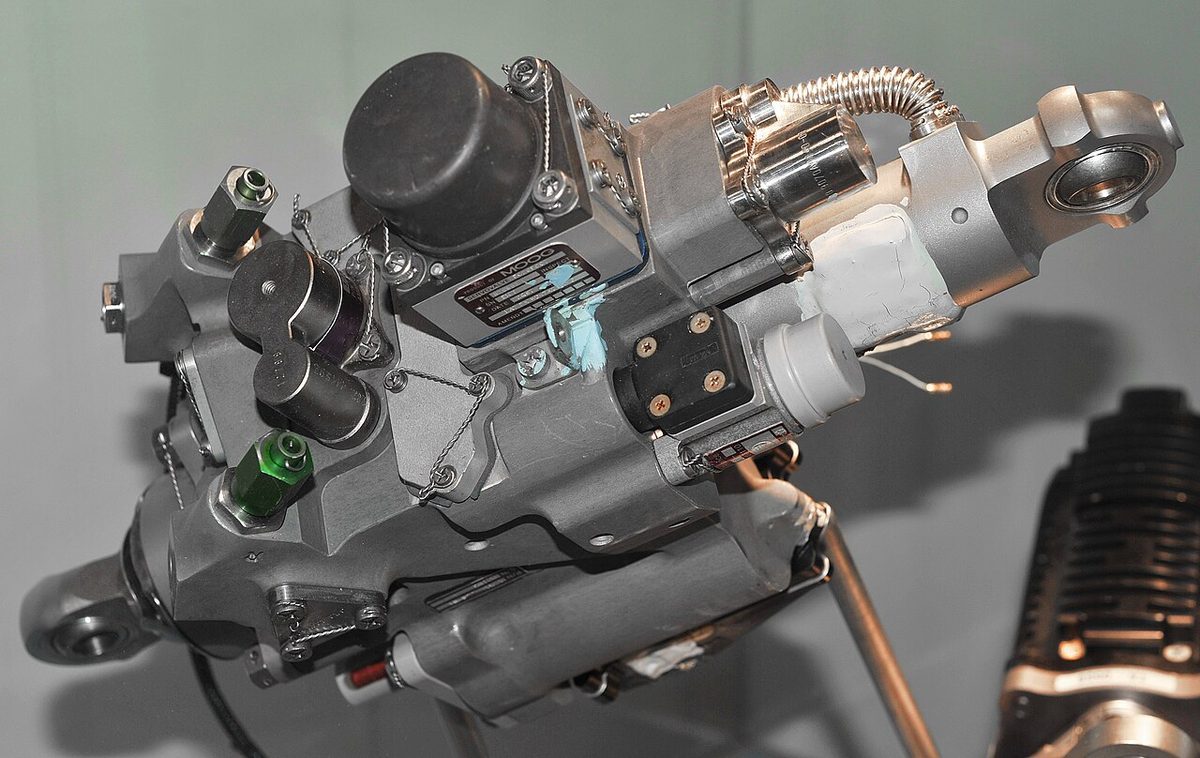
A power control unit (PCU), also called a powered flying control unit (PFCU) or, in Airbus terms, a hydraulic servojack, combines a jack with its control valve. When the pilot pulls the column back, the linkage moves the control valve's spool to one side. That opens one side of the jack to system pressure and the other to return. Pressure moves the jack, and with it the surface; in many installations the piston rod is anchored to the structure and the jack body moves. As the jack moves, the follow-up returns the valve towards neutral. When the surface reaches the commanded position the spool lands cover both ports, fluid is trapped on both sides of the piston, and the resulting hydraulic lock holds the surface firmly against air loads (see hydraulic valves and actuators).
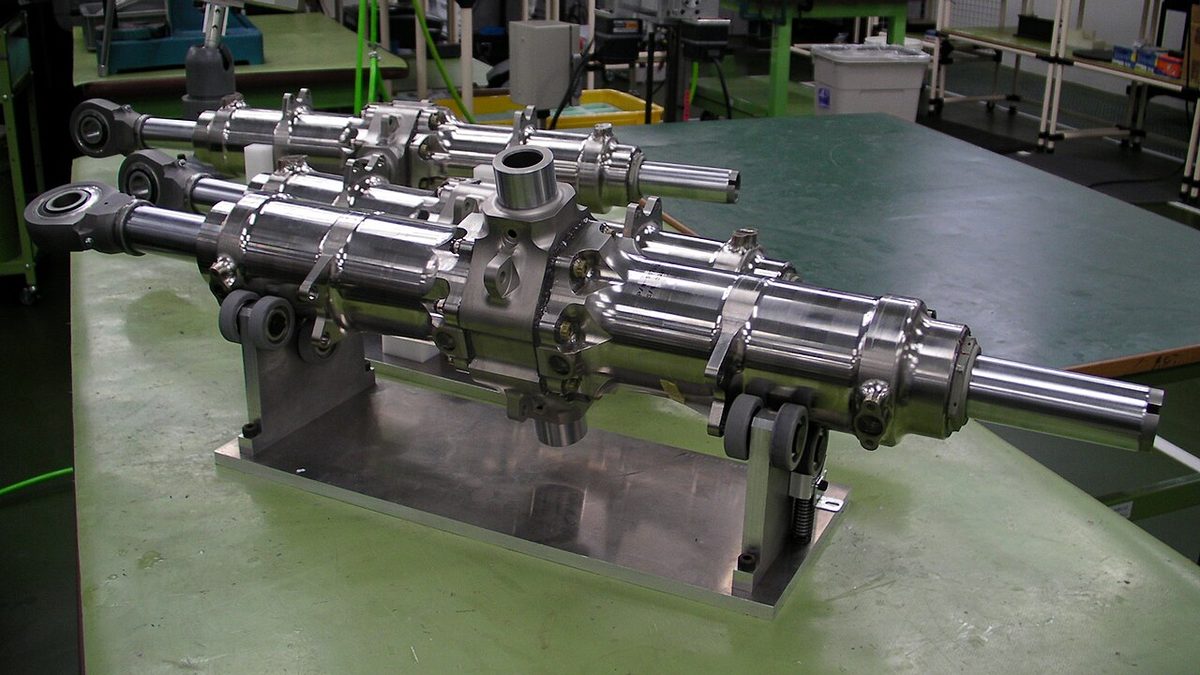
Critical surfaces have two or more units supplied by separate hydraulic systems, mounted side by side in parallel or in series, or the surface is split into sections each with its own actuator. Examples:
- Boeing 737. The main rudder PCU has two input rods, two control valves and two actuators, one on system A and one on system B, and a separate standby rudder PCU runs on the standby hydraulic system. A force fight monitor detects the two main actuators opposing each other, for example after one input jams or disconnects, and automatically pressurises the standby rudder PCU.
- Airbus A320. Two servojacks drive each elevator, with three modes: active, where the jack position is controlled electrically; damping, where the jack follows the surface; and centring, where it is held hydraulically at neutral. Normally one jack is active and the other damping, and if the active one fails the damped one takes over. Each aileron has two servojacks, of which only one works at a time.
- E190 E1. The rudder has an active and a standby PCU, either able to give full control, and the standby unit acts as a hydraulic damper for flutter protection.
Follow-up linkage
Without a follow-up the system would be on-off. The pilot's input would open the valve, fluid would flow for as long as it stayed open, and the surface would run to its stop. The follow-up linkage, or feedback linkage, connects the moving jack back to the valve so that every increment of surface movement cancels part of the input. Flow stops when the surface reaches the deflection that corresponds to the control position, so deflection is proportional to input and the pilot can fly smoothly. Electrically signalled actuators use position feedback in the same way, so that the computer knows how far the surface has moved.
Exam tip: the follow-up makes surface deflection proportional to the pilot's input. When the valve returns to neutral it traps fluid on both sides of the piston: that hydraulic lock is why a fully powered control is irreversible.
Manual reversion and bypass valves
Duplication only works if a dead actuator does not lock the surface. In each unit a spring-loaded PFCU bypass valve is held closed by system pressure. If that system fails, the spring opens a bypass channel connecting the two sides of the piston, so no hydraulic lock can form and the failed unit simply follows the working one. The A320 achieves the same with its damping mode: when neither elevator jack is controlled hydraulically both switch to damping, and when neither is controlled electrically both go to centring.
Manual reversion is the fallback when all hydraulic power to a surface is lost and the pilot moves it directly through the linkage. It is possible only where the design keeps a mechanical path to the surface and forces stay manageable. On the Boeing 737, if systems A and B both fail, the ailerons and elevators are flown manually, with heavy forces, while the rudder is powered by the standby hydraulic system; the standby yaw damper then helps by moving the rudder when the control wheel is turned. Fly-by-wire aircraft have no manual reversion of most surfaces. The A320's last resort, mechanical backup, uses the rudder pedals and the stabiliser trim wheel.
Artificial feel systems
An artificial feel system gives the pilot the control forces that an irreversible system removes. Without it, the pilot would have no sense of how much input was appropriate and could overstress the aeroplane, above all at high speed. The force it produces should rise with control deflection and with airspeed, as a manual control's would. The artificial feel unit is connected in parallel with the linkage to the control valve: it opposes the pilot's movement without affecting the valve, so the PCU responds to control position alone.
Spring box and Q-feel units
The simplest unit is a spring box feel unit: two opposing springs in a housing, one compressed whichever way the control moves. Its force is proportional to deflection only and does not change with speed.
A Q-feel unit adds dynamic pressure, Q, equal to ½ρV². In a Q-pot, pitot pressure acts on one side of a diaphragm or piston and static pressure on the other, so the pressure difference is Q and the resisting force grows with the square of the airspeed. A pure Q-pot would have to be very large, so modern units use the diaphragm to work a hydraulic spool valve, and hydraulic pressure on a piston provides the force. The pitot probes that feed such a system, Q-feel probes, are electrically heated against ice like other air data probes. Most systems combine springs and Q-feel.
The Boeing 737's elevator feel system shows how far this goes. An elevator feel computer simulates aerodynamic forces from airspeed, sensed by a dedicated elevator pitot system, and from stabiliser position. It uses system A or B pressure, whichever is higher, and the elevator feel and centring unit passes the force to the columns. An amber FEEL DIFF PRESS light, armed with the flaps up, shows excessive differential pressure in the computer. The elevator feel shift module increases system A pressure to the feel unit during a stall, roughly doubling column forces, and gives no indication in the flight deck. Roll feel comes from the aileron feel and centring unit.
Fly-by-wire types treat feel in their own ways: the A320's side-sticks are spring-loaded to neutral and receive no feedback from the surfaces, while types with conventional control columns give feel by back-driving them.
Artificial feel trim
With an artificial feel unit, the force the pilot holds comes from the feel unit, not from the surface, so trimming means moving the feel unit's datum. Artificial feel trim shifts the neutral point of the feel unit so that it gives zero force at the new control position, the equivalent of a trim tab on a manual control. On the A320 the rudder trim moves the neutral point of the rudder's artificial feel, and on the 737 the Mach trim actuator repositions the elevator feel and centring unit to adjust the column's neutral position as Mach number rises. Trim systems are covered in trim systems.
Note: artificial feel is a simulation. It warns the pilot only as well as it was designed to, and after a feel system failure the control forces may no longer match the speed. The checklist, not instinct, sets the speed and technique after such a failure.
Frequently asked questions
What is the difference between reversible and irreversible flight controls?
In a reversible system a force applied in the cockpit moves the surface, and an air load on the surface moves the cockpit control, so the pilot feels the aerodynamic load. Manual controls and power-assisted controls are reversible. In an irreversible system the surface is held by a hydraulic actuator, so air loads cannot move the cockpit control and the pilot feels nothing from the surface. Fully powered controls are irreversible and need artificial feel.
What is the difference between power-assisted and fully powered flying controls?
With power-assisted controls the pilot's linkage still connects directly to the surface and a hydraulic actuator adds force, so the pilot supplies part of the effort, feels natural loads and needs no artificial feel. With fully powered controls the pilot's input only moves a control valve and the actuator does all the work, so the system is irreversible and an artificial feel unit must provide control forces.
Why do fully powered flight controls need artificial feel?
Because the hydraulic actuator holds the surface against the air load, no force reaches the pilot's controls. Without feedback the pilot would have no sense of how much input is appropriate and could overstress the aeroplane, especially at high speed. Artificial feel gives a control force that rises with deflection and, in a Q-feel system, with dynamic pressure, imitating the forces of a manual control.
What is a Q-feel system?
A Q-feel system makes the artificial control force increase with dynamic pressure, Q, equal to half the air density times the true airspeed squared. A unit fed with pitot pressure on one side of a diaphragm and static pressure on the other senses Q directly. Because a pure Q-pot would have to be large, modern units use it to work a hydraulic valve that pressurises a piston resisting the pilot's input.
What happens when one power control unit loses hydraulic pressure?
Critical surfaces have two or more units on separate hydraulic systems. When one loses pressure, a spring-loaded bypass valve opens and connects both sides of its piston, so no hydraulic lock forms and the failed unit simply follows the working one. Without that bypass the dead unit would lock the surface. If all hydraulic power is lost, some types such as the Boeing 737 revert to manual control of the ailerons and elevators.
Test yourself on Powered Flying Controls and Artificial Feel
The v1prep banks cover this topic in Aircraft General Knowledge (021), with a worked explanation for every answer. EASA ATPL, PPL, IR and CPL, the FAA written tests and A320/B737 type ratings.
Start practising →Sources and further reading
- EASA Easy Access Rules for Large Aeroplanes (CS-25), CS 25.143 Controllability and manoeuvrability
- 14 CFR 25.143, Controllability and maneuverability, general
- FAA Aviation Maintenance Technician Handbook, Airframe (FAA-H-8083-31B)
- EASA, Explanatory Note to ED Decision 2018/001/R, Part-FCL theoretical knowledge learning objectives
- FAA Flight Standardization Board Report, Boeing 737
- Airbus, Safety innovation
Library articles are written for study and exam preparation. They do not replace your aircraft's approved documentation, your operator's procedures or the regulations themselves.