Passenger and Portable Oxygen
Passenger oxygen systems supply the cabin occupants with oxygen after a depressurisation, through continuous-flow masks that drop from overhead units and are usually fed by chemical oxygen generators. Portable cylinders and smoke hoods give the crew oxygen to move about the cabin, treat passengers and fight fires.
Passenger oxygen is the emergency supply that keeps the cabin occupants conscious between a loss of pressurisation and the moment the aircraft reaches an altitude where the cabin air can be breathed. It has to serve every seat at once, after long periods unused, without any action beyond pulling a mask to the face. Simplicity therefore wins over economy: passengers get continuous-flow masks, usually fed by single-use chemical oxygen generators, while the flight crew have their own gaseous system with demand regulators (see crew oxygen systems).
Alongside the fixed system, airliners carry portable oxygen: cylinders that let the cabin crew move about on oxygen and give first aid, and smoke hoods for anyone who must work in smoke. The operating rules that set how much oxygen is carried, and the emergency descent the supply is sized for, are covered in decompression.
Continuous-flow oxygen
In a continuous-flow oxygen system oxygen flows steadily to the mask whether or not the user is breathing in. It is simple and reliable but wasteful, because the flow does not follow the user's breathing. A continuous-flow regulator sets the flow. ATPL texts describe two kinds: a hand-adjustable regulator for crew use, and an automatic regulator for passengers, preset by an altitude-sensing element. The adjustable type has three main parts: a pressure gauge showing the cylinder contents, a flow indicator showing that oxygen is flowing, and a control knob calibrated in cabin altitude, which the user sets to the current cabin altitude.
The passenger oxygen mask is a light cup with a reservoir bag, attached by a tube to the supply. Oxygen collects in the bag between breaths, and the mask admits cabin air to make up the rest of each breath. The passenger therefore breathes a mixture of oxygen and cabin air. That is enough at altitude for the few minutes of a descent, but it means the masks give no protection from smoke. The 737 procedures warn against using passenger oxygen when smoke or an abnormal heat source is present and the cabin altitude is below 14,000 ft, and the E190-E2's passenger masks, of the diluter type, likewise give no smoke protection.
Continuous flow is also the usual system in light aircraft. A nasal cannula may be used only up to 18,000 ft under FAA guidance; above that a mask is needed. In the United States, 14 CFR 91.211 requires the flight crew to use oxygen after 30 minutes at cabin altitudes above 12,500 ft up to 14,000 ft and continuously above 14,000 ft, and every occupant to be provided with oxygen above 15,000 ft.
Passenger service units and mask deployment
The passenger masks are stowed in the passenger service unit (PSU), the overhead panel above each row of seats, and in further units in the lavatories, galleys and at each cabin crew station. For aeroplanes first certificated after 8 November 1998 and operated above 25,000 ft, EASA requires the units to be deployable automatically and at least 10 per cent more numerous than the seats.
Certification rules for high-flying transport aeroplanes require the masks to be presented automatically before the cabin altitude exceeds 15,000 ft. In practice a pressure switch releases the doors at about 14,000 ft cabin altitude: electrically in chemical systems, pneumatically in gaseous ones. The masks drop to a half-hung position in front of the passengers. Nothing flows until a mask is pulled down towards the face; a mask that is not pulled delivers nothing. The flight crew can also release the masks manually at any time.
| Type | Automatic release | Manual control and indication |
|---|---|---|
| Airbus A320 | 14,000 ft (+250/−750 ft), or 16,000 ft with HI ALT LANDING selected | Guarded MASK MAN ON pushbutton; SYS ON light; manual release tool to open the doors, for example after an electrical failure |
| Boeing 737 | 14,000 ft, by a pressure switch | Guarded PASS OXYGEN switch to ON; amber PASS OXY ON light with OVERHEAD master caution; masks can be dropped by hand if a compartment fails to open |
| Embraer E190-E2 | 14,000 to 14,750 ft | OVRD for manual deployment; NO SMKG and FSTN BELTS signs come on automatically |
The A320's HI ALT LANDING setting raises the trigger for operations at high-elevation airfields, where the cabin altitude can approach 14,000 ft on the ground. Pressing MASK MAN ON is part of the A320 emergency descent procedure if the cabin altitude exceeds 14,000 ft, to confirm that the masks are released; on the 737 the crew select the passenger oxygen switch ON in the rapid depressurisation procedure. After the system has operated, maintenance resets it; on the A320 the TMR RESET pushbutton extinguishes the SYS ON light.
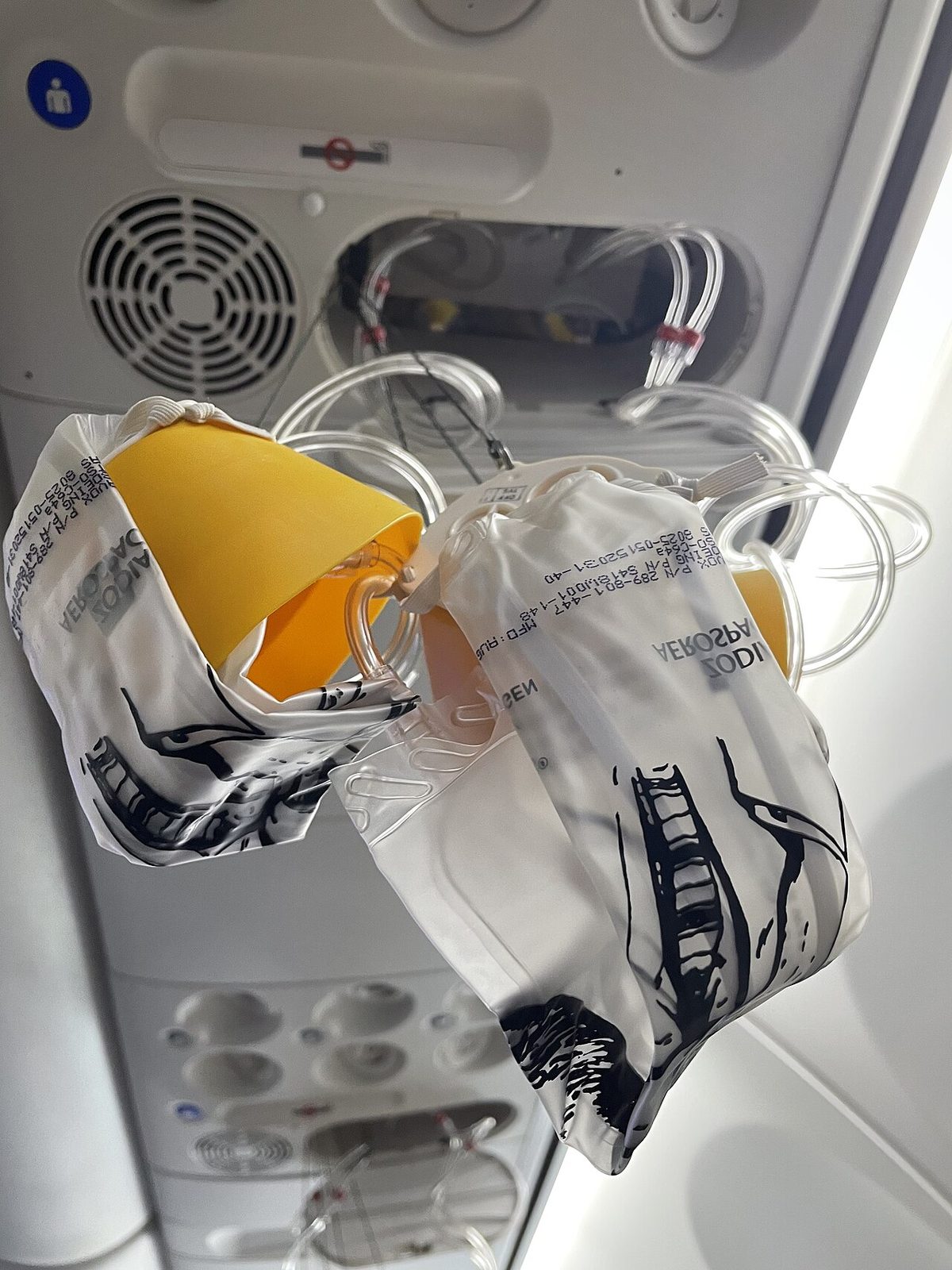
Chemical oxygen generators
Most airliners feed their passenger masks from chemical oxygen generators, one in each PSU and each of the other mask units. The generator is a self-contained canister with a core of sodium chlorate and iron. Pulling a mask pulls a lanyard that fires a percussion cap or an electrical igniter, and the heat starts a reaction that releases oxygen: NaClO₃ + Fe → NaCl + FeO + O₂. A filter at the outlet removes contaminants and cools the oxygen to no more than 10 °C above cabin temperature; the delivery pressure is low, around 10 psi, with a relief valve set at 50 psi.
Each generator feeds a group of masks: two, three or four on the A320; on the 737, four in each PSU and two above each cabin crew station and in each lavatory. On the 737, pulling one mask brings down all the masks of that unit and starts oxygen to all of them. The core is shaped so that the flow is greatest at the start, when the aircraft is still high, and tapers off as the descent brings it into denser air.
Three properties must be understood:
- It cannot be stopped. Once started the reaction runs until the core is exhausted. There is no valve and no reset.
- It gets hot. The reaction is exothermic and the surface of the canister can reach about 232 °C (450 °F). A smell of burning, some smoke and a rise in cabin temperature can be part of normal generator operation, as the A320 documentation points out.
- Its duration is fixed. Generators are sized for an emergency descent: common durations are about 12, 15 or 22 minutes, the longer ones for routes where terrain delays the descent. EASA and FAA rules require at least a 10-minute supply for every passenger.
| Type | Passenger generator duration |
|---|---|
| Airbus A320 | About 13, 15 or 22 min, depending on the option fitted |
| Boeing 737 | About 12 min on most variants |
| Embraer E190-E2 / E195-E2 | 12 min / 22 min |
A used generator is marked by heat-sensitive tape or paint that changes colour, typically to black, and every fired generator must be replaced. Carried loose, a generator is a serious fire hazard. In 1996 ValuJet Flight 592 was lost to a fire in its cargo hold after chemical oxygen generators had been carried there without being declared or packed as dangerous goods (see dangerous goods). On some newer installations the lavatory masks are supplied from a small gaseous bottle instead of a generator, as on the E190-E2.

Gaseous passenger systems
Some aircraft, such as the Boeing 747-400, supply the passenger masks from banks of high-pressure gaseous oxygen cylinders. The oxygen is piped through the cabin at a pressure set by automatic regulators; the mask doors are released pneumatically, and pulling a mask opens a check valve to start the flow.
| Gaseous system | Chemical generators | |
|---|---|---|
| Supply | Central cylinders, piped to every unit | Self-contained generator in each unit |
| Control | Flow set by automatic regulators | Fixed flow profile; runs to exhaustion once started |
| After use | Recharged | Each fired generator replaced |
| Drawbacks | Weight, plumbing, leaks, high-pressure stored energy | Heat; fire hazard if mishandled |
High-pressure cylinders are heavy and store a great deal of energy. On 25 July 2008, Qantas Flight 30, a Boeing 747-438, was depressurised when one of its passenger oxygen cylinders in the cargo hold failed and tore a hole in the fuselage; the crew descended to 10,000 ft and diverted to Manila, and nobody was injured.
Portable oxygen cylinders
Portable oxygen cylinders, also called portable oxygen sets or walk-around bottles, are carried in the cabin and on the flight deck. They let cabin crew move about on oxygen after a depressurisation, when the fixed masks would hold them in one place, and they supply first-aid oxygen to passengers who need it after the descent or in a medical emergency (see in-flight medical emergencies).
A typical cylinder holds 120 litres of oxygen at about 1,800 psi, in a carrying bag with straps, and is fitted with a pressure gauge, a pressure regulator, an on-off valve and two continuous-flow outlets. On the 737, one outlet gives 2 litres per minute for walking about and the other 4 litres per minute for first aid; at 4 litres per minute a 120-litre cylinder lasts about 30 minutes. Larger 310-litre bottles are also used, some with manifolds to supply several users. The E190-E2's 310-litre bottles have the same 2 and 4 litre settings and a minimum dispatch pressure of 1,200 psi.
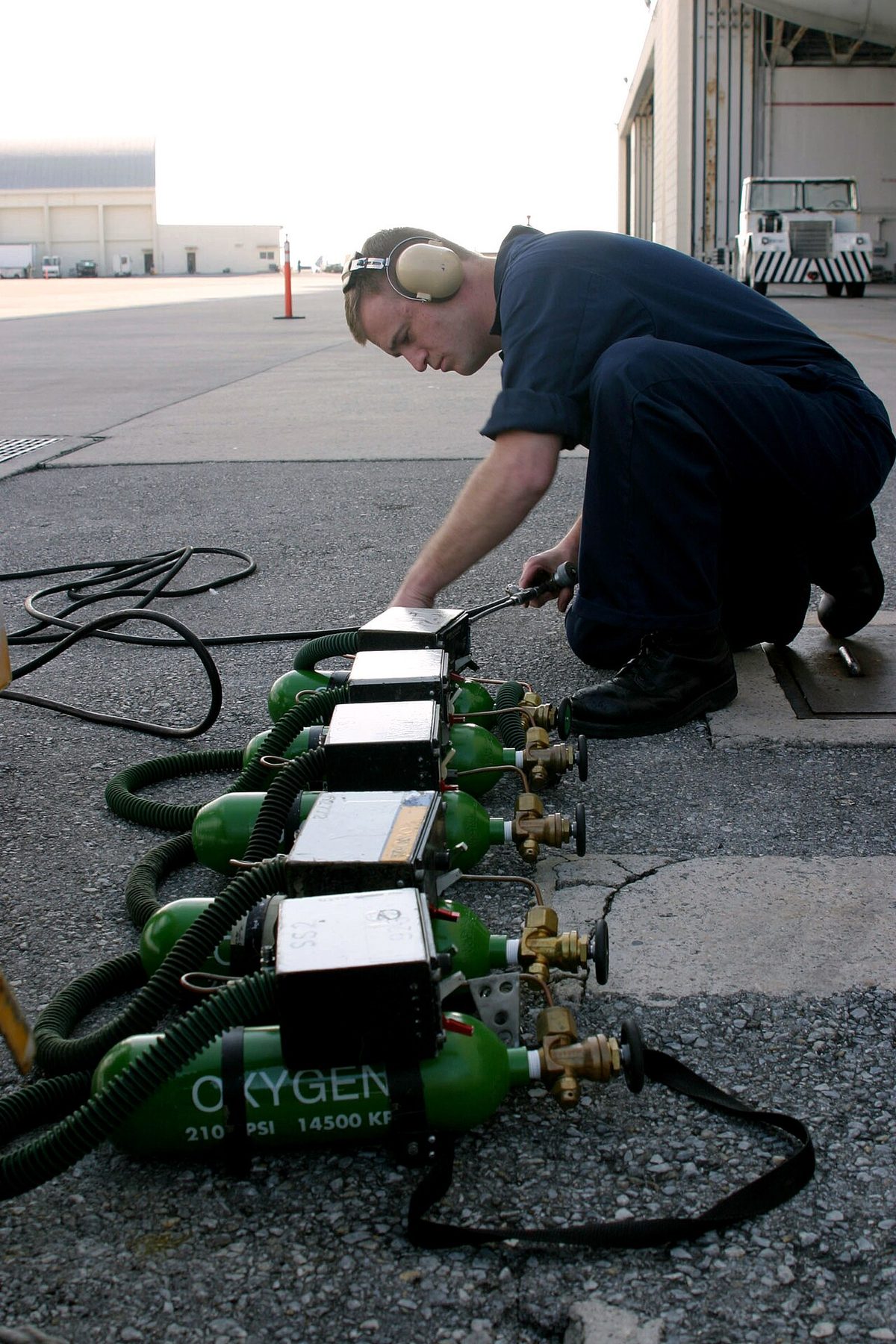
The operating rules set a minimum. On pressurised aeroplanes operated above 25,000 ft that require cabin crew, EASA requires undiluted first-aid oxygen for at least 2 per cent of the passengers, never fewer than one person, for the remainder of the flight after a depressurisation while the cabin altitude is between 8,000 and 15,000 ft. The average flow must be at least 3 litres per minute per person, measured STPD, with equipment able to deliver at least 4 litres per minute. The FAA's 121.333 is similar. Above 25,000 ft EASA also requires each required cabin crew member to have oxygen immediately to hand, from spare outlets or portable units. In an unpressurised aircraft flying above 10,000 ft with no fixed installation, portable sets provide all the oxygen on board.
Smoke hoods (PBE)
A crew member fighting a fire needs protection for the eyes as well as the lungs, and must be free to move. Protective breathing equipment (PBE), usually a smoke hood, meets both needs. It encloses the whole head, with a rubber neck seal, and has its own oxygen supply lasting at least 15 minutes. It is required on pressurised aeroplanes and on unpressurised aeroplanes of more than 5,700 kg or more than 19 passenger seats: at each flight crew station, near each cabin crew station, and portable units beside the hand fire extinguishers (see in-flight fire, smoke and fumes).
Hoods differ in how they make their oxygen. ATPL texts describe two common airline types: the Cabox, with a chemical oxygen generator and a quick-start cord that must be checked intact before flight, and the Dräger, with a self-generating system started by a start cord and needing no preflight check. The A320's flight deck PBE regenerates the wearer's breath chemically through an oronasal mask, and a serviceability indicator on its container shows when it must not be used. The A320's hood works for at least 15 minutes, the E190-E2's supplies 15 minutes and can be used up to 25,000 ft, and the 737's devices give about 15 to over 20 minutes depending on the type fitted. Once started, a chemical hood cannot be stopped, and the wearer knows the oxygen is running out when breathing becomes harder.
Smoke hoods are for crew only. Donning one quickly, communicating through it and knowing its limits all need training, which crews receive in recurrent emergency training. Passengers rely on getting out of the smoke, not on breathing through it.
Exam tip: passenger masks drop at about 14,000 ft cabin altitude and must be presented before 15,000 ft; flow starts only when a mask is pulled. A chemical generator cannot be stopped, runs hot and lasts about 12 to 22 minutes. Portable bottles: 2 L/min walk-around, 4 L/min first aid. PBE: at least 15 minutes, crew only.
Frequently asked questions
At what altitude do the oxygen masks drop on a plane?
The passenger masks are released automatically when the cabin altitude reaches about 14,000 ft, by a pressure switch that opens the doors of the overhead units. Certification rules for high-flying transport aeroplanes require the masks to be presented before the cabin altitude exceeds 15,000 ft. The flight crew can also release them manually at any time, for example with the A320's MASK MAN ON pushbutton or the 737's passenger oxygen switch.
How long do airline oxygen masks last?
Most passenger masks are fed by chemical oxygen generators that run for a fixed time once started, typically about 12 to 22 minutes: about 12 minutes on most 737s and the E190-E2, 13, 15 or 22 minutes on the A320 depending on the option fitted. That covers an emergency descent to an altitude where the cabin air can be breathed. EASA and FAA rules require at least a 10-minute supply for every passenger.
How does a chemical oxygen generator work?
A canister holds a core of sodium chlorate and iron. Pulling a mask pulls a lanyard that fires a percussion cap or an electrical igniter, and the heat starts a reaction that releases oxygen, leaving sodium chloride and iron oxide. Flow is greatest at the start and tapers off as the core is used. The reaction cannot be stopped, the case can reach about 232 °C, and a smell of burning in the cabin is normal.
Do passenger oxygen masks protect against smoke?
No. Passenger masks are continuous-flow masks that let cabin air mix with the oxygen, so a passenger breathing through one still inhales smoke. Boeing's 737 procedures warn against using passenger oxygen when smoke or an abnormal heat source is present and the cabin altitude is below 14,000 ft. Crew members who must work in smoke use smoke hoods, also called protective breathing equipment, which seal around the neck and have their own oxygen supply.
What is a portable oxygen bottle used for on an airliner?
Portable oxygen cylinders let cabin crew move about the cabin on oxygen after a depressurisation, and supply first-aid oxygen to passengers who need it after the descent or during a medical event. A typical cylinder holds 120 or 310 litres at about 1,800 psi and has a low-flow outlet of 2 litres per minute for walking about and a high-flow outlet of 4 litres per minute for first aid.
Test yourself on Passenger and Portable Oxygen
The v1prep banks cover this topic in Aircraft General Knowledge (021), with a worked explanation for every answer. EASA ATPL, PPL, IR and CPL, the FAA written tests and A320/B737 type ratings.
Start practising →Sources and further reading
- FAA Aviation Maintenance Technician Handbook, Airframe (FAA-H-8083-31B), Chapter 16, Cabin Environmental Control Systems
- EASA Easy Access Rules for Air Operations (CAT.IDE.A.230, CAT.IDE.A.235 and CAT.IDE.A.245)
- 14 CFR 121.333, Supplemental oxygen for emergency descent and for first aid, turbine engine powered airplanes with pressurized cabins
- 14 CFR 91.211, Supplemental oxygen
- EASA Easy Access Rules for Large Aeroplanes (CS-25)
- ATSB AO-2008-053, Oxygen cylinder failure and depressurisation, Boeing 747-438 VH-OJK, 25 July 2008
- FAA Aeronautical Information Manual, Chapter 8 Section 1 (8-1-2 Effects of Altitude)
Library articles are written for study and exam preparation. They do not replace your aircraft's approved documentation, your operator's procedures or the regulations themselves.