Crew Oxygen Systems
The crew oxygen system supplies the flight crew with breathing oxygen after a loss of cabin pressure or in smoke and fumes, usually from a high-pressure gaseous cylinder through a mask-mounted regulator that can dilute the oxygen with cabin air, deliver it pure or supply it under positive pressure.
The crew oxygen system gives the flight crew breathing oxygen when the cabin air can no longer sustain them: after a loss of pressurisation, or when smoke or fumes contaminate the flight deck. The passengers need oxygen only for the minutes of an emergency descent, but the pilots must stay fully capable through the descent, a diversion and perhaps a long fight against smoke. Their system is built accordingly. On most transport aeroplanes it draws on a rechargeable cylinder of gaseous oxygen, and each crew station has a quick-donning mask whose regulator can supply diluted oxygen, pure oxygen or oxygen under positive pressure.
The settings NORMAL, 100% and EMERGENCY feature in airline memory items and checklists, and the equipment is examined in both EASA ATPL and FAA tests. The physiology behind it is covered in hypoxia and hyperventilation, the emergency in decompression, and the passengers' equipment in passenger and portable oxygen.
Aviator's breathing oxygen
Aircraft oxygen systems are replenished only with aviator's breathing oxygen (ABO): oxygen of at least 99.5 per cent purity, dried to no more than 7 parts per million of water. Medical and industrial grades are not dried to the same standard. In an aircraft system that moisture corrodes cylinders and fittings, can freeze in valves and regulators at the low temperatures of altitude, and gives the oxygen a bad smell that may make people unwilling to breathe it. In the United States aviator's breathing oxygen is supplied to specification MIL-O-27210.
Oxygen does not burn, but it makes everything else burn more fiercely. Oil or grease in contact with oxygen can ignite spontaneously, without a spark, so tools, gloves and fittings used for oxygen work are kept free of them and only approved lubricants, such as graphite, are used. Smoking is banned near oxygen equipment, and servicing areas are ventilated because oxygen is heavier than air and collects in pits and bilges. Cylinders are colour-coded: green in American and European practice, black with a white neck in British practice.
Gaseous crew oxygen system
A gaseous oxygen system stores oxygen as a compressed gas, typically at about 1,800 psi. The Boeing 737 supplies its flight crew from a single cylinder at up to 1,850 psi, the A320's cylinder is in the left-hand lower fuselage, and the E190-E2 carries a rechargeable 77 cu ft cylinder at a nominal 1,850 psi at 21 °C in the forward cargo compartment. A pressure-reducing valve lowers the cylinder pressure to a working pressure, typically 80 to 100 psi, for the lines that run to each crew station. A shut-off valve isolates the distribution: on the A320 the CREW SUPPLY pushbutton opens a solenoid valve in flight and closes it, with a white OFF light, when the aircraft is secured.
The flight deck shows cylinder pressure as the measure of the oxygen remaining. Because the gas is sealed in a fixed volume, its pressure also rises and falls with temperature, so minimum dispatch pressures are tabulated against temperature. On the A320 the minimum for two crew is 731 psi at a reference temperature of 20 °C, 806 psi at 50 °C and 656 psi at −10 °C, rising to 959 psi with one observer and 1,215 psi with two. That minimum covers the preflight checks, use by one pilot alone on the flight deck, the unusable quantity, normal leakage, and the more demanding of two cases:
- Depressurisation: an emergency descent of 13 minutes for everyone on the flight deck, then 107 minutes at FL100 for the two pilots, with the regulators at NORMAL.
- Smoke: 15 minutes of 100 per cent oxygen for everyone on the flight deck at a cabin altitude of 8,000 ft.
The 13 plus 107 minutes make the two hours that EASA requires for the flight crew of aeroplanes certified to fly above 25,000 ft; for those certified to 25,000 ft or below the minimum is 30 minutes. Under FAA Part 121 the flight crew supply must also last at least two hours. The A320 figures assume a sealed mask, and for bearded crew members the duration may be shorter. On the E190-E2 the oxygen pressure readout is green from 1,150 psi, enough for dispatch with three crew members on the flight deck, and cyan from 842 psi, enough for two; amber means no dispatch.
Quick-donning masks
A quick-donning oxygen mask is one that can be put on with one hand within five seconds. EASA requires them for the flight crew of aeroplanes certified to operate above 25,000 ft, because the time of useful consciousness at airliner cruising levels can be less than a minute. Each mask is stowed in a box at its crew station, connected to the oxygen supply and to the audio system.
The pilot squeezes the red grips, or the inflation lever, and pulls the mask out. That single movement opens the stowage box doors, starts the oxygen flow and the mask microphone, and inflates the pneumatic harness so that its straps spread wide and slip over the head. Releasing the grips lets the harness deflate and close around the head. On the A320, an OXY ON flag on the stowage box shows that the mask is supplied, and pressing the RESET control slide after use shuts off the oxygen and the mask microphone. Masks are either oronasal, covering the nose and mouth, or full-face, with a visor that protects the eyes as well; the A320 has three or four full-face masks.
The regulator is usually mounted on the mask itself. In the Emergency Regulating Oxygen System (EROS) described in ATPL texts, combined masks and regulators are stowed in a panel-mounted box whose internal shut-off valve stops the flow while the mask is stowed; the regulator controls protrude through the box doors, and the flow indicator is visible whether the doors are open or closed.
Wearing the mask in flight is regulated too. Under 14 CFR 121.333, above FL250 one pilot at the controls must wear and use a mask unless each pilot has a quick-donning mask. With quick-donning masks, neither pilot of a typical airliner need wear one at or below FL410; above FL410 one pilot must wear and use a mask at all times.
Diluter-demand regulators
The diluter-demand regulator is the standard flight crew regulator. Two principles give it its name.
- Demand: oxygen flows only while the user breathes in. Inhaling lowers the pressure in the mask, the pressure difference across a diaphragm opens the demand valve, and the valve closes again at the end of the breath, so no oxygen is wasted between breaths.
- Dilution: the oxygen is mixed with cabin air drawn in through an air inlet. An air metering valve controlled by an aneroid capsule sets the proportion: plenty of air at low cabin altitudes, less as the cabin altitude rises, and none at about 32,000 ft cabin altitude, where the regulator delivers pure oxygen. The pilot does not adjust it.
The oxygen diluter selector, marked N (or NORMAL) and 100%, overrides the dilution. At 100% the air inlet is closed and the pilot breathes pure oxygen at any cabin altitude, which protects against smoke, fumes and any contamination of the flight deck air but uses the oxygen faster. On the A320 the N/100% selector locks at 100% when the mask is pulled out, and must be pushed up from underneath to select N; on the E190-E2, too, 100% is the default position. Procedures differ too. The 737 depressurisation memory items put the masks on with the regulators at 100 per cent, while the A320 emergency descent procedure sets the diluter back to N once the masks are on, because left at 100 per cent the oxygen may not last the whole descent profile.

Pressure-demand and emergency settings
At very high cabin altitudes even pure oxygen at ambient pressure is not enough. At about 40,000 ft, breathing 100 per cent oxygen gives only the equivalent of breathing air at 10,000 ft. A pressure-demand regulator therefore delivers oxygen at a pressure above ambient, forcing enough into the lungs; FAA material gives diluter-demand equipment as usable to about 40,000 ft and pressure-demand equipment above that. Pressure breathing reverses the normal effort of breathing: the wearer has to push to exhale.
Airline masks provide positive pressure automatically when the cabin altitude is high. On 737s with automatic pressure-breathing masks it starts above 27,000 ft cabin altitude; on the A320 the overpressure supply starts automatically above 30,000 ft cabin altitude, and only when the N/100% selector is at 100%.
The crew can also select overpressure themselves. The EMERGENCY setting supplies 100 per cent oxygen under positive pressure at all cabin altitudes. Any leak around the seal then blows outwards, so smoke, fumes or ash cannot be drawn in, and in a full-face mask the overpressure also clears misting of the visor. On the A320, pressing the EMERGENCY knob gives overpressure for a few seconds and turning it gives continuous overpressure. EMERGENCY uses the oxygen fastest of all the settings and is selected only when conditions require it, for example in dense smoke, or before a halon extinguisher is discharged on the flight deck, for which the 737 procedure calls for masks at 100 per cent with EMERGENCY selected. A TEST function delivers a burst of high positive pressure to check the mask, regulator and seal.
| Setting | What the regulator delivers | Typical use |
|---|---|---|
| NORMAL (N) | Air and oxygen on demand, richer as cabin altitude rises; pure oxygen from about 32,000 ft | Depressurisation, when the supply must last |
| 100% | Pure oxygen on demand, air inlet closed | Smoke and fumes, doubt about the air, most memory items |
| EMERGENCY | Pure oxygen under positive pressure | Dense smoke, a poor seal, misting, halon on the flight deck |
| TEST | A burst of high positive pressure | Preflight check of mask and regulator |
Flow and discharge indicators
Each crew station has an oxygen flow indicator. It shows only that oxygen is flowing, not how much, nor whether the wearer is getting enough. It takes different forms on different types: a yellow blinker on the A320's stowage box, a yellow cross on the 737 and a yellow star on the E190-E2. It is used in the preflight mask test. On the A320, pressing and holding the RESET/TEST slide should make the blinker turn yellow briefly and then go black; holding it and pressing the EMERGENCY knob should keep the blinker yellow with the flow audible through the loudspeakers. Ground staff on the interphone are warned first, because the test is loud in their headsets. FAA material sums up the general checks of an oxygen system as PRICE: pressure, regulator, indicator, connections and emergency.
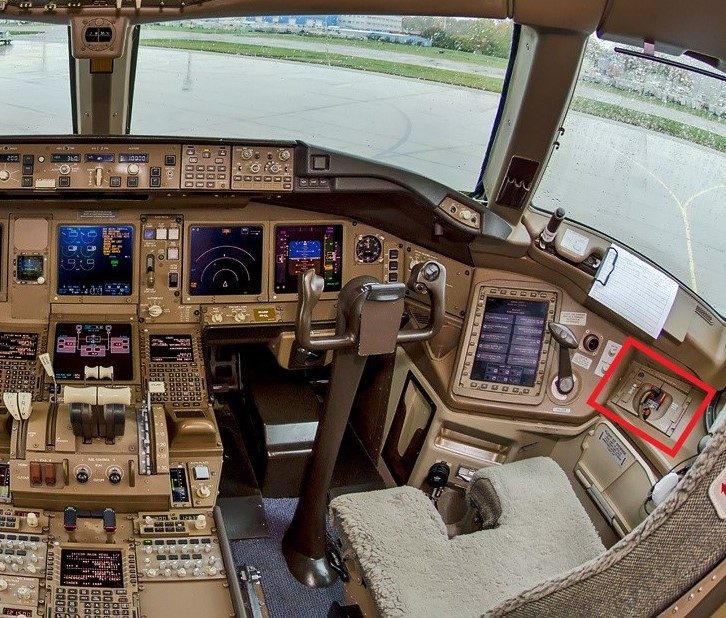
A cylinder heated in a fire could burst, so each is protected by a bursting disc that releases the oxygen overboard if the pressure exceeds a preset value. The A320's cylinder has two overpressure safety systems that vent through a safety port, and the E190-E2's discharges at 2,700 psi at 21 °C. The vent line ends at an overboard discharge indicator on the fuselage skin, normally a green disc. If the disc is missing or broken on the walk-round, the cylinder has discharged: the crew oxygen is no longer available, and the cylinder must be inspected and refilled before flight.
Smoke goggles
In smoke the eyes need protection as much as the lungs. A full-face mask protects both. Where the masks are oronasal, smoke goggles are stowed at each crew station and worn with the mask; on the 737 a smoke vent valve on the mask passes oxygen into the goggles to stop them misting. The smoke, fire and fumes procedures start with the masks on at 100 per cent, with goggles where they are separate, and crew communication established through the mask microphones (see in-flight fire, smoke and fumes).
Exam tip: diluter-demand: oxygen only on inhalation, diluted with cabin air by an aneroid air metering valve, pure oxygen from about 32,000 ft cabin altitude. 100% closes the air inlet; EMERGENCY adds positive pressure; pressure-demand is needed above about 40,000 ft. Quick-donning means one hand, five seconds, and EASA requires it on aeroplanes certified above 25,000 ft.
Frequently asked questions
What is a quick-donning oxygen mask?
It is a flight crew oxygen mask that can be put on with one hand within five seconds. Squeezing its release grips pulls it from the stowage box, starts the oxygen and the mask microphone, and inflates the harness so it slips over the head; releasing the grips lets the harness grip the head. EASA requires such masks for the flight crew of aeroplanes certified to operate above 25,000 ft; under FAA Part 121, above FL250 one pilot must wear a mask unless both have quick-donning masks.
What is the difference between NORMAL and 100% on a crew oxygen mask?
At NORMAL the diluter-demand regulator mixes cabin air with the oxygen, adding more oxygen as the cabin altitude rises until it delivers pure oxygen at about 32,000 ft cabin altitude. It is the most economical setting. At 100% the air inlet is closed, so the pilot breathes pure oxygen at any altitude, which is required in smoke or fumes but empties the cylinder faster. The A320 emergency descent procedure therefore returns the masks to NORMAL to save oxygen.
What does the EMERGENCY setting on an oxygen mask do?
It delivers 100 per cent oxygen at a pressure slightly above ambient, at any cabin altitude. Any leak around the seal then blows outwards, so smoke, fumes or ash cannot be drawn into the mask, and on full-face masks the overpressure also clears misting of the visor. It uses the oxygen fastest of all settings, so crews select it only when conditions require, for example in thick smoke or when halon is discharged on the flight deck.
Why do aircraft use aviator's breathing oxygen?
Aviator's breathing oxygen is at least 99.5 per cent pure and, unlike medical or industrial oxygen, is dried to no more than 7 parts per million of water. Moisture in an aircraft system would corrode cylinders and fittings, could freeze in valves and regulators at the low temperatures of altitude and would give the oxygen a bad smell. Separately, oil and grease must never touch oxygen equipment, because they can ignite in it without a spark.
What does the green disc on the fuselage next to the oxygen cylinder show?
It is the overboard discharge indicator. If the crew oxygen cylinder is overpressurised, for example by heat, a bursting disc releases its contents overboard through a line that ends at this disc, which is blown out. A missing or ruptured green disc on the walk-round therefore shows that the cylinder has discharged, and the crew oxygen must be inspected and replenished before flight.
Test yourself on Crew Oxygen Systems
The v1prep banks cover this topic in Aircraft General Knowledge (021), with a worked explanation for every answer. EASA ATPL, PPL, IR and CPL, the FAA written tests and A320/B737 type ratings.
Start practising →Sources and further reading
- FAA Aviation Maintenance Technician Handbook, Airframe (FAA-H-8083-31B), Chapter 16, Cabin Environmental Control Systems
- FAA Pilot's Handbook of Aeronautical Knowledge (FAA-H-8083-25), Chapter 7, Aircraft Systems
- EASA Easy Access Rules for Air Operations (CAT.OP.MPA.285 and CAT.IDE.A.235)
- 14 CFR 121.329, Supplemental oxygen for sustenance, turbine engine powered airplanes
- 14 CFR 121.333, Supplemental oxygen for emergency descent and for first aid, turbine engine powered airplanes with pressurized cabins
- FAA AC 61-107B, Aircraft Operations at Altitudes Above 25,000 Feet MSL and/or Mach Numbers Greater Than .75
- EASA, Explanatory Note to ED Decision 2018/001/R, Part-FCL theoretical knowledge learning objectives (021 Airframe and Systems)
Library articles are written for study and exam preparation. They do not replace your aircraft's approved documentation, your operator's procedures or the regulations themselves.