Decompression and Emergency Descent
Decompression, or depressurisation, is an uncontrolled loss of cabin pressure in a pressurised aircraft, which lets the cabin altitude climb towards the altitude at which the aircraft is flying. Its main hazard is hypoxia, countered by immediate use of oxygen and an emergency descent.
Decompression, also called depressurisation, is an uncontrolled loss of pressure in the cabin of a pressurised aircraft. As air escapes, the cabin altitude climbs towards the altitude at which the aircraft is actually flying. At airliner cruising levels the outside air cannot keep a person conscious for long, so the response is immediate and practised: oxygen masks on, then an emergency descent to an altitude where everyone on board can breathe without supplemental oxygen.
Decompressions are rare but heavily examined, because the time available is so short. Certification standards set how the crew is warned and how the masks are presented; operating rules set how much oxygen must be carried. The physiology is covered in hypoxia and hyperventilation, and normal operation of the system in pressurisation.
Types of depressurisation
The rate of pressure loss depends mainly on the size of the opening relative to the cabin volume, and on the differential at the time. Three categories are recognised:
| Type | Speed | Typical causes | What the occupants notice |
|---|---|---|---|
| Slow (gradual) | Minutes | A leaking door seal, a faulty outflow valve or controller, loss of bleed air, a mis-set selector | Little or nothing at first; ear discomfort; the symptoms of hypoxia |
| Rapid | A few seconds; the lungs can vent faster than the cabin | Loss of a window or door, a rupture in the fuselage | Bang, rush of air, flying dust and debris, sudden mist, cold, ear and sinus pain |
| Explosive | Under about 0.5 s; faster than the lungs can vent | A large opening in a small cabin | As for rapid, with a risk of lung injury |
A slow decompression is the most insidious, because hypoxia can erode the crew's judgement before anyone realises that the cabin is climbing. In a leak, the pressurisation controller first closes the outflow valve further to compensate. The cabin altitude starts to rise only when the leak exceeds what the packs can supply.
In a rapid or explosive decompression the air in the cabin expands and cools suddenly, so its moisture condenses into a mist. Gas trapped in the middle ear, the sinuses, the gut and even the teeth expands at the same time, and the breath must never be held. Many large aircraft have vent or blow-out panels between the cabin and the cargo holds, so that a sudden loss of pressure in one compartment does not collapse the floor between them. After any significant exposure, occupants may also suffer decompression sickness, caused by nitrogen coming out of solution in the body as the pressure falls; joint pain is the classic symptom, and the treatment is oxygen, landing and medical assessment.
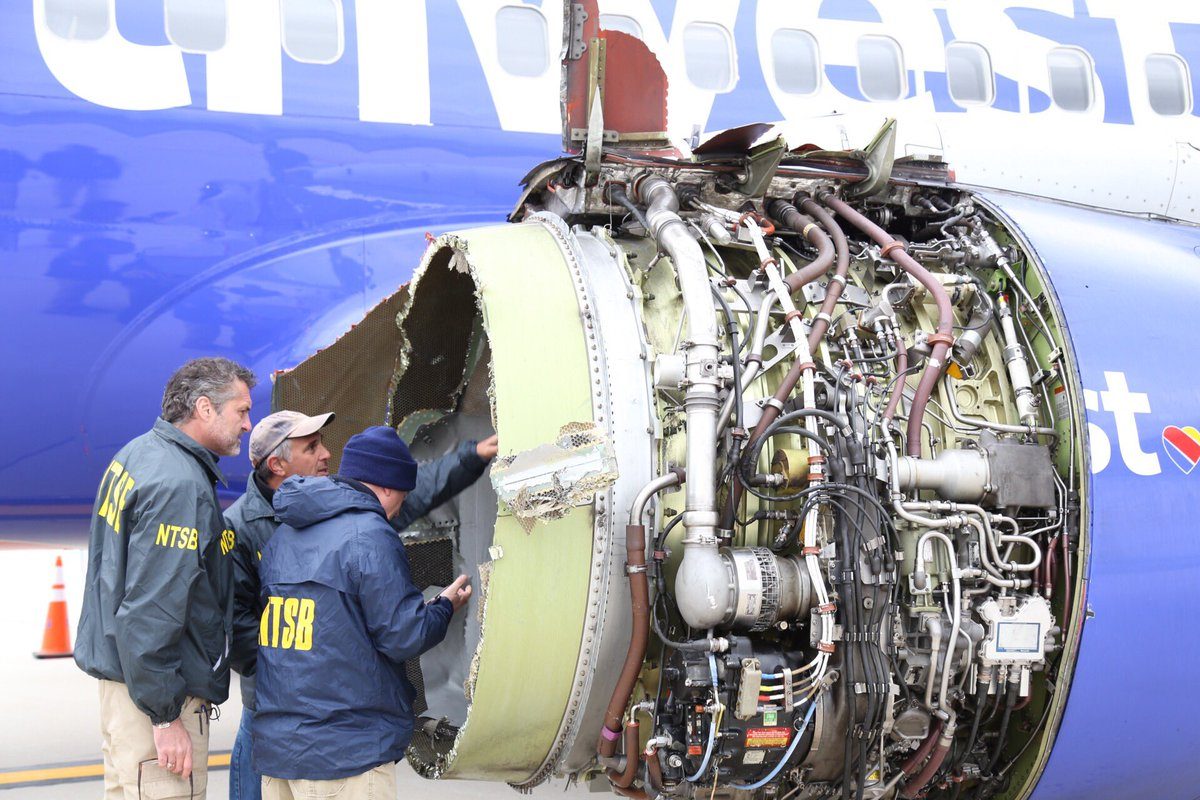
Southwest Airlines Flight 1380 shows a rapid decompression in a large airliner. On 17 April 2018 the Boeing 737-700 was climbing through FL320 after leaving New York LaGuardia when a fan blade in the left engine broke off at a fatigue crack. A fragment of the fan cowl struck the fuselage near a cabin window, the window departed and the cabin depressurised rapidly. The crew made an emergency descent and diverted to Philadelphia. One passenger was fatally injured and eight suffered minor injuries.
Recognising depressurisation
Transport aeroplane certification rules, 14 CFR 25.841 and the equivalent EASA CS-25 provision, require a warning to the flight crew when the cabin pressure altitude exceeds 10,000 ft. An aural or a visual signal satisfies the rule, alongside the normal indications of cabin altitude, cabin rate of climb and differential pressure. On aeroplanes certificated for high-altitude operation, passenger masks must be presented automatically before the cabin altitude exceeds 15,000 ft, and many types deploy them at about 14,000 ft. Masks dropping in the cabin is therefore a late cue, never the first one.
The Boeing 737's cabin altitude warning is an intermittent horn, and its checklist makes one rule absolute: if that horn sounds in flight, the oxygen masks go on first and diagnosis comes afterwards. The loss of Helios Airways Flight 522 on 14 August 2005 shows why. The Boeing 737-300's pressurisation mode selector had been left in MAN after unscheduled maintenance, and the crew did not notice it during the preflight procedure, the before start checklist or the after take-off checklist. As the aeroplane climbed through about 12,040 ft the cabin altitude warning sounded, but the crew took it for the take-off configuration warning and did not put on their masks. Hypoxia incapacitated the pilots, the aeroplane flew on until its fuel was exhausted, and it struck hilly terrain near Grammatiko, about 33 km north-west of Athens airport, killing all 121 people on board.
Emergency descent procedure
The memory items and their order belong to the aircraft manufacturer. The quick reference handbook, the flight crew operating manual and the operator's SOPs take precedence over any general description, including this one (see A320 memory items). In outline, most procedures work through the same stages:
- Protect the crew. Oxygen masks on, then establish communication between the pilots through the masks. Nothing takes priority over this. Many procedures then set the masks to 100 per cent; the A320 procedure sets the diluter to N once the masks are on.
- Assess. If the cabin altitude can still be controlled, for example by selecting the standby or manual pressurisation mode, the descent may not be needed. If it cannot, continue.
- Protect the passengers. Seat belt signs on, and passenger oxygen released manually if the cabin altitude exceeds, or is about to exceed, about 14,000 ft. Boeing 737 crews use the passenger oxygen switch; A320 crews press MASK MAN ON.
- Descend. Select a lower altitude and a heading, close the thrust levers and extend the speedbrakes. Unless structural damage is suspected, descend at a high speed, at or near MMO/VMO in many procedures (the A320 procedure calls for maximum or appropriate speed). If it is suspected, fly at or near the speed at which the failure occurred, avoid high load factors and use the speedbrakes with care.
- Communicate. Declare a MAYDAY, squawk 7700 unless ATC has already assigned a code (see transponder and SSR), and tell the cabin crew. Where regional contingency procedures apply, as in oceanic airspace, the crew turn away from the assigned route or track before descending. ATC may broadcast an emergency descent warning to other traffic.
- Level off at 10,000 ft or the minimum safe altitude, whichever is higher (see minimum safe altitudes).
The pilot flying flies the descent while the pilot monitoring runs the checklist and handles ATC and the cabin. Speed matters because the oxygen supplies are sized around a quick descent. The FAA's two-hour minimum supply for each pilot, for example, is defined as enough for a constant-rate descent from the aeroplane's maximum certificated altitude to 10,000 ft in 10 minutes, followed by 110 minutes at 10,000 ft. Over high terrain the minimum safe altitude may be well above 10,000 ft, and operators plan escape routes accordingly.
Warning: the time of useful consciousness at airliner cruising levels is often less than a minute, and FAA AC 61-107B advises assuming it is roughly halved after a rapid decompression. There is no time to diagnose before the mask is on.
Supplemental oxygen requirements
Supplemental oxygen is oxygen carried to keep crew and passengers adequately oxygenated when the cabin altitude is too high. In a pressurised aeroplane it is needed only if pressurisation fails, so the rules size the supply around the descent. EASA sets the requirements for commercial air transport in CAT.IDE.A.235; the FAA does so in 14 CFR 121.329 and 121.333.
| Requirement | EASA (CAT.IDE.A.235) | FAA (Part 121) |
|---|---|---|
| Flight crew on duty | Whole time above 13,000 ft cabin altitude, and above 10,000 ft after the first 30 min; at least 2 h if certified above 25,000 ft | Above 10,000 ft up to 12,000 ft after 30 min, and whole time above 12,000 ft; at least 2 h per pilot on flight deck duty |
| Quick-donning masks | Flight crew, when operated above 25,000 ft | Each flight crew member, above FL250 |
| Passengers | 10% for time above 10,000 ft up to 14,000 ft after 30 min; 30% at 14,000–15,000 ft; 100% above 15,000 ft, never less than 10 min | Same percentages; above FL250, never less than a 10-minute supply for the passenger cabin |
| Dispensing units | Automatically deployable, and at least 10% more units than seats, for aeroplanes first certificated after 8 November 1998 and operated above 25,000 ft | High-altitude certification requires automatic presentation before 15,000 ft cabin altitude |
Above 25,000 ft EASA also requires spare outlets or portable oxygen units so that each required cabin crew member has oxygen immediately to hand. Aeroplanes not certified above 25,000 ft that can descend safely within 4 minutes at every point on the route may carry a reduced passenger supply.
The FAA adds rules on wearing masks. Above FL250 one pilot at the controls must wear a mask, unless both pilots have quick-donning masks that can be put on with one hand within five seconds. That exception applies up to FL410 for aeroplanes with more than 30 passenger seats or a payload over 7,500 lb, and up to FL350 for smaller ones. Since a 2020 amendment, the pilot left alone at the controls when the other leaves the flight deck must put on a mask only above FL410; the earlier threshold was FL250.
Exam tip: cabin altitude warning at 10,000 ft; passenger masks presented before 15,000 ft; oxygen for every passenger above 15,000 ft cabin altitude; quick-donning crew masks above 25,000 ft (EASA) or FL250 (FAA).
Passenger masks and chemical oxygen generators
Passenger masks are continuous-flow masks with a reservoir bag, stowed in the overhead passenger service units, lavatories and cabin crew stations. On many types they are fed by a chemical oxygen generator: a canister containing a core based on sodium chlorate. Pulling a mask towards the face pulls a lanyard that fires a small charge, and the heat starts a reaction that releases oxygen. Once started it cannot be stopped, the canister becomes very hot, and oxygen flows until the core is exhausted, typically after somewhere between about 12 and 22 minutes depending on the generator fitted.
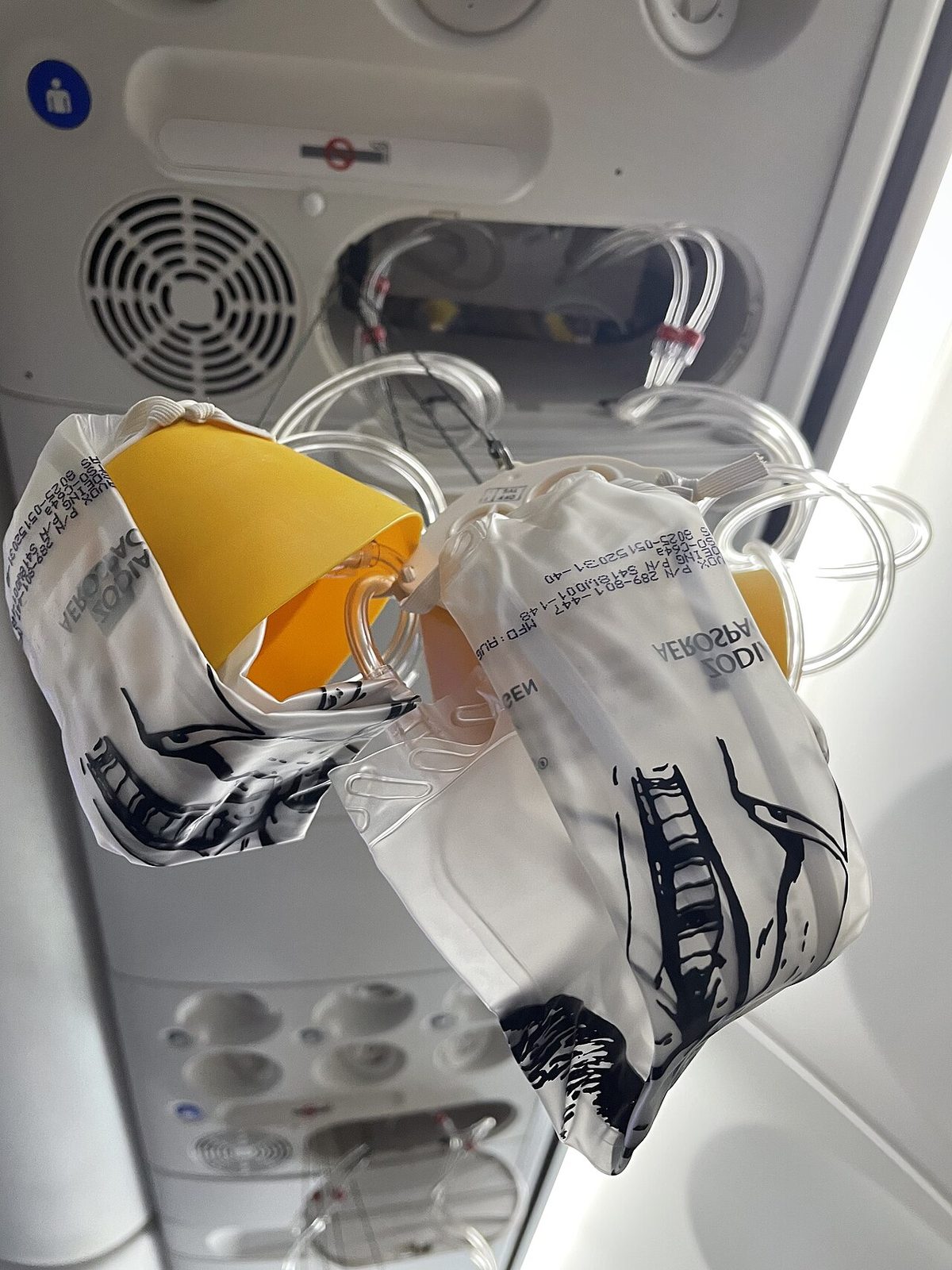
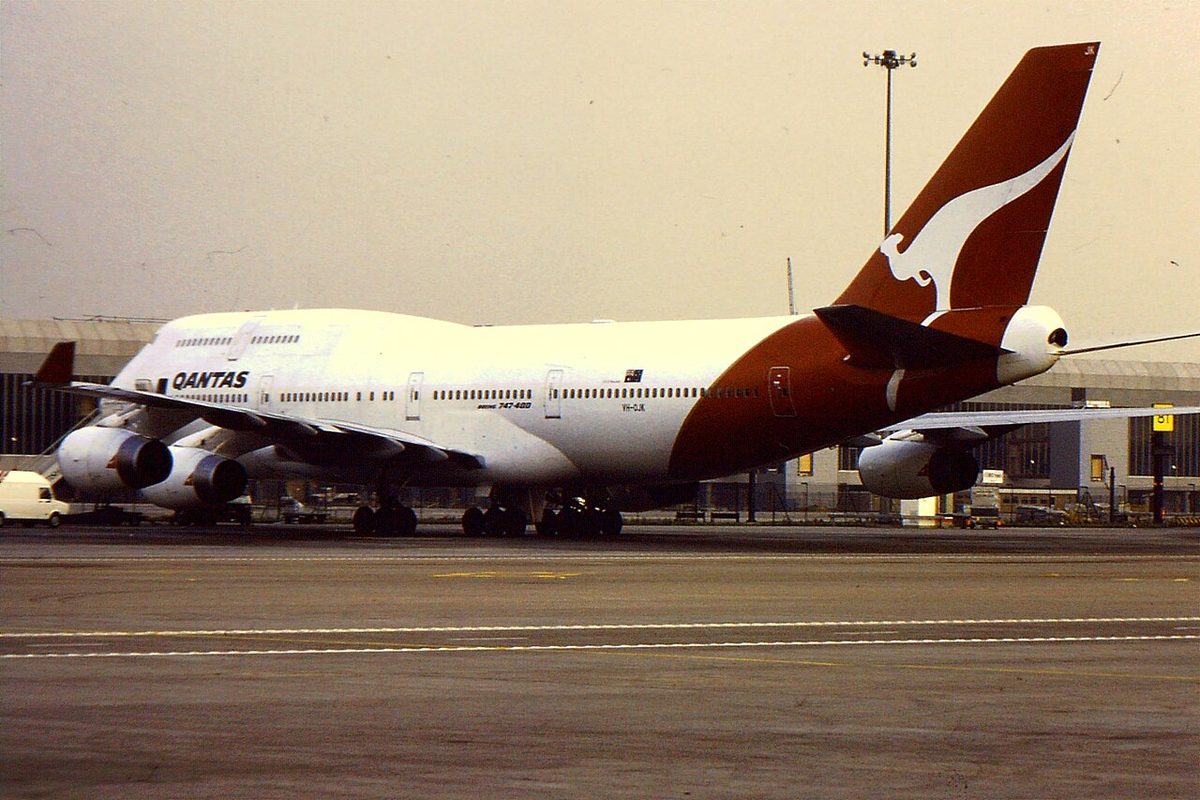
Some aircraft, such as the Boeing 747-400 below, feed the passenger masks from banks of high-pressure gaseous cylinders instead. The flight crew normally have their own gaseous supply, with quick-donning diluter-demand masks at each flight crew station that can deliver diluted oxygen, 100 per cent oxygen or oxygen under positive pressure (see oxygen systems).

Qantas Flight 30 involved such a gaseous system. On 25 July 2008 the Boeing 747-438 VH-OJK had been airborne about 55 minutes from Hong Kong to Melbourne when one of the passenger oxygen cylinders in the cargo hold failed suddenly. Its discharge tore a hole about 2 m long and 1.5 m high in the fuselage, and the cylinder was propelled up through the cabin floor beside the second main cabin door. The captain made an emergency descent to 10,000 ft and diverted to Manila, and nobody was injured. The ATSB found no record of any comparable rupture of an aviation oxygen cylinder.
First-aid oxygen
First-aid oxygen is a separate supply of undiluted oxygen for passengers who, for physiological reasons, still need oxygen after a depressurisation, once the aeroplane has descended. It is not supplemental oxygen: it treats individuals rather than protecting everyone during the descent.
Under EASA CAT.IDE.A.230 it is required on pressurised aeroplanes operated above 25,000 ft when a cabin crew member is required. The supply must last for the remainder of the flight after a depressurisation, while the cabin altitude is between 8,000 ft and 15,000 ft, for at least 2 per cent of the passengers and never fewer than one person, at an average flow of at least 3 litres per minute per person measured at standard temperature and pressure, dry (STPD). The FAA's 121.333 is similar: a supply meeting the certification standard of 25.1443(d) for 2 per cent of the occupants for the entire flight after depressurisation, following descent from cabin altitudes above FL250. It is usually administered by the cabin crew from portable equipment.
After the descent
Once level, the crew check each other and the cabin. The cabin crew report injuries and damage and give first-aid oxygen to anyone who needs it. The passenger generators will soon be exhausted, so the aeroplane stays low.
A diversion usually follows. Fuel burn at 10,000 ft is far higher than at cruise, so range shrinks sharply; EASA fuel planning therefore considers a depressurisation at the most critical point of the route, and ETOPS critical fuel considers the same scenario (see fuel planning and fuel reserves).
Anyone with joint pain, skin symptoms or neurological signs after the event should be assessed for decompression sickness on landing, and every fired generator must be replaced before the aircraft flies again.
Frequently asked questions
What happens during a rapid decompression on a plane?
The cabin loses pressure within seconds, usually through a failed window, door or section of fuselage. Occupants may notice a loud bang, a rush of air, flying debris, a sudden mist and pain in the ears. The passenger oxygen masks drop, the flight crew put on their own masks at once, and the aircraft makes an emergency descent to about 10,000 ft or the minimum safe altitude, whichever is higher.
What is the difference between rapid and explosive decompression?
In a rapid decompression the cabin empties in a few seconds, slowly enough for the lungs to vent faster than the cabin does. An explosive decompression is faster than the lungs can decompress, usually taken as under about half a second, and can damage the lungs. Explosive decompression is more likely in small cabins such as business and military jets than in a large airliner.
At what altitude do oxygen masks drop on a plane?
Certification rules for high-flying transport aircraft require passenger masks to be presented automatically before the cabin pressure altitude exceeds 15,000 ft, and many types are set to deploy them at about 14,000 ft. The flight crew can also release them from the flight deck. A separate warning alerts the pilots when the cabin altitude exceeds 10,000 ft, well before the masks drop.
How long do airline passenger oxygen masks last?
Most passenger masks are fed by chemical oxygen generators that, once started, run until exhausted, typically for somewhere between about 12 and 22 minutes depending on the unit fitted. That is enough to cover an emergency descent to an altitude where cabin air can be breathed normally. EASA and FAA rules require at least a 10-minute supply for every passenger.
What is first-aid oxygen on an aircraft?
First-aid oxygen is a supply of undiluted oxygen carried for passengers who, for physiological reasons, still need oxygen after a depressurisation and descent. EASA and the FAA require it on pressurised aeroplanes flying above 25,000 ft, sized for at least 2 per cent of the occupants and at least one person, for the rest of the flight. It is usually administered by the cabin crew from portable equipment.
Test yourself on Decompression and Emergency Descent
The v1prep banks cover this topic in Operational Procedures (070), with a worked explanation for every answer. EASA ATPL, PPL, IR and CPL, the FAA written tests and A320/B737 type ratings.
Start practising →Sources and further reading
- 14 CFR 121.333, Supplemental oxygen for emergency descent and for first aid, turbine engine powered airplanes with pressurized cabins
- 14 CFR 121.329, Supplemental oxygen for sustenance, turbine engine powered airplanes
- EASA Easy Access Rules for Air Operations (CAT.IDE.A.230 and CAT.IDE.A.235)
- 14 CFR 25.841, Pressurized cabins
- FAA AC 61-107B, Aircraft Operations at Altitudes Above 25,000 Feet MSL and/or Mach Numbers Greater Than .75
- FAA Lessons Learned, Helios Airways Flight 522, Boeing 737-300, Grammatiko, 14 August 2005
- NTSB DCA18MA142, Southwest Airlines Flight 1380, left engine failure and depressurization, 17 April 2018
- ATSB AO-2008-053, Oxygen cylinder failure and depressurisation, Boeing 747-438 VH-OJK, 25 July 2008
Library articles are written for study and exam preparation. They do not replace your aircraft's approved documentation, your operator's procedures or the regulations themselves.