In-Flight Fire, Smoke and Fumes
An in-flight fire is a fire on board an aircraft in flight; smoke or fumes are often its first sign. Because an aircraft cannot stop and evacuate, the crew must protect themselves, find and isolate the source, fight any fire and land as soon as possible, all at the same time.
Fire is the emergency that leaves least time. On the ground the occupants can escape a fire by evacuating; in flight it has to be contained until the aircraft is on the ground, which may be many minutes away. The crew's work therefore runs on three tracks at once: protect the people fighting it, find and isolate the source, and get the aircraft down.
Smoke and fumes are usually the first sign, and they are a hazard in their own right. They can incapacitate the crew, hide the instruments and fill the cabin long before any flame is seen. Two accidents are often quoted in training: Swissair Flight 111 in 1998, where a fire spread unseen above the flight deck ceiling, and ValuJet Flight 592 in 1996, where undeclared chemical oxygen generators burned in the cargo hold. The lesson drawn from both is the same: once a fire is suspected, preparing to land comes first.
Fire classes
Combustion needs three things, fuel, oxygen and heat, known as the fire triangle. Removing any one puts the fire out: shutting off the fuel deals with an engine fire, smothering removes oxygen, and cooling agents remove heat. Halons do something more, interrupting the chemistry of the flame itself.
Extinguishers are chosen for the kind of fire likely at each location. FAA guidance on hand extinguishers (AC 20-42D) uses the US fire classes:
| Class | What is burning | Suitable hand-held agents | Unsuitable |
|---|---|---|---|
| A | Ordinary combustibles: paper, fabric, wood, rubber, many plastics | Water or water-glycol; halon and halon replacements | – |
| B | Flammable liquids and greases | Halon, carbon dioxide; dry powder and foam on the ground | Water, which spreads the burning liquid |
| C | Energised electrical equipment | Halon, carbon dioxide (both non-conductive) | Water, which conducts |
| D | Combustible metals such as magnesium | Special dry powder | Water |
The European standard EN 2 letters the classes differently: its Class C is flammable gases, and electrical fires have no class of their own. The pictograms on the extinguisher label are therefore the safer guide.
Smoke, fire and fumes procedure
Every transport type has a smoke, fire and fumes procedure, with memory items or a quick reference checklist and a separate paper procedure for events that the warning system cannot detect. The structure is broadly common:
- Oxygen masks on, 100 per cent, with smoke goggles where separate, and crew communication established through the mask microphones.
- Fly the aircraft. One pilot flies, using the autopilot if available; the other runs the procedure.
- Declare the emergency and start the diversion. If the source cannot be found and isolated quickly, the aircraft is landed as soon as possible, and the approach is planned while the procedure continues.
- Identify and isolate the source. The cabin crew report where the smoke is and what it looks and smells like; the flight crew check for system warnings and shed electrical or air conditioning sources in the order the checklist gives.
- Fight any fire with the extinguishers available, then remove the smoke once the source is isolated.
Airbus, for example, names smoke as one of the few situations in which the crew may interrupt a procedure to reassess, because smoke can grow faster than a checklist can be read. The cabin crew are briefed early for a possible evacuation after landing.
Avionics and electrical smoke
Electrical fires are sustained by electrical power, so removing the power usually removes the cause, while an extinguisher only deals with the symptom. In a light aircraft the first action for acrid electrical smoke is therefore the master switch off. Vents are then used as the flight manual directs, the extinguisher is used if there are flames, and if electrical power is needed for the landing, essential items are restored one at a time so that the faulty circuit shows itself. Landing without electrics in visual conditions is acceptable.
Transport aircraft watch the equipment bay with smoke detectors in the ventilation ducts. On the A320, smoke detected for more than 5 seconds in the avionics extraction duct gives an AVIONICS SMOKE caution, a SMOKE light on the GEN 1 LINE pushbutton and FAULT lights on the ventilation BLOWER and EXTRACT pushbuttons. With both set to OVRD, cooling air comes from the air conditioning and is exhausted overboard. If the smoke persists, the procedure sets the smoke configuration, which sheds about 75 per cent of the electrical equipment and switches GEN 1 LINE off so that AC BUS 1 is fed from generator 2. The fuel pumps are connected upstream of the generator 1 line contactor so that the engines stay fed.
Cabin fires: galley, lavatory and seats
In the cabin the cabin crew are the fire fighters, typically working as a team: one fights the fire, another brings more extinguishers and protective equipment, and another keeps the flight deck informed. For a galley oven or other electrical appliance the logic of an electrical fire applies: its power is switched off first.
Lavatories are closed, unattended spaces where a fire can grow before anyone sees it. The fatal Air Canada Flight 797 lavatory fire in 1983, whose origin was never determined, led to two requirements for aircraft with 20 or more passenger seats: a smoke detector in each lavatory and an automatic extinguisher in each waste bin. The bin extinguisher is a small halon bottle whose fusible plug melts in a fire and releases the agent through a spray ring.
A deep-seated fire in seat foam or fabric may flare up again after halon has put the flames out, because halon does not cool. The drill is to follow up with water to cool the material right through and to keep the seat under observation for the rest of the flight.

Lithium battery fires
Passengers carry many lithium batteries in phones, laptops and power banks (see dangerous goods). A damaged, crushed or faulty cell can enter thermal runaway, overheating and releasing flammable electrolyte, and the heat spreads to neighbouring cells, so a battery pack can reignite repeatedly after the flames are out.
FAA guidance for a lithium battery fire in a portable electronic device follows from this:
- use a halon, halon replacement or water extinguisher to put out the flames;
- then douse the device with water or another non-alcoholic liquid to cool it and stop further cells from running away;
- do not cover it or pack it in ice, which insulates it and makes further runaway more likely;
- do not pick up or move a device that is burning or smoking;
- keep it under observation until landing.
IATA guidance for operators adds that the electrical or mechanical controls of a seat must not be used to recover a device lost in it, because the mechanism can crush the battery. A lithium battery fire is reported to the flight deck at once, and the commander plans to land.
Smoke and fumes removal
Once the source has been isolated, the smoke still has to be cleared. Each type has its own smoke removal procedure, which may use maximum air conditioning flow, dedicated extraction, the pressurisation outflow valve, a descent, or emergency ram air ventilation. The procedure is applied as written, because improvised changes to air flow can drive smoke towards the flight deck instead of away from it. After halon has been used in a confined space, ventilation is increased to clear the agent and its decomposition products, which are harmful to breathe.
Fumes without visible smoke, such as oil or chemical smells from the air conditioning, follow the same logic: masks on if anyone is affected, isolate the likely source, and land if the fumes persist.
Fire extinguisher types
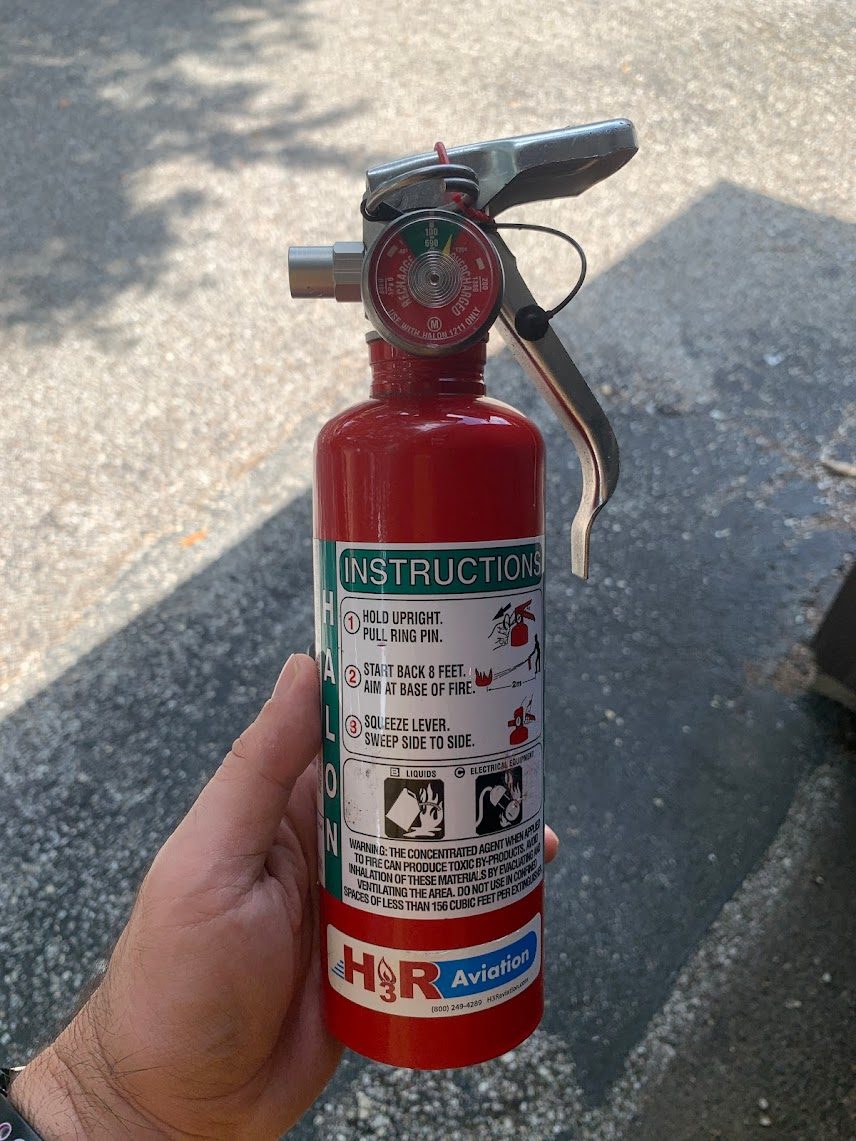
Portable fire extinguishers, also called hand-held fire extinguishers, are carried on the flight deck, in the cabin and in each galley not on the main deck. Transport aeroplanes also have fixed systems for engines, APU, cargo holds and lavatory bins (see engine failure and engine fire).
| Agent | Use on aircraft | Limitation |
|---|---|---|
| Halon 1211 (BCF) | Hand extinguishers in cabin and flight deck; effective on liquid and electrical fires, no residue | Fumes and decomposition products harmful in a closed space; ozone-depleting, so only recycled stock is used and replacements are coming in |
| Halon 1301 | Fixed systems for engines, APU and cargo holds | Discharged from the flight deck through fixed piping |
| Water or water-glycol | Cabin fires in paper, fabric and similar; glycol keeps it liquid to about −20°C | Never on electrical or liquid fires |
| Dry chemical (dry powder) | Ground use, for example wheel and brake fires | Not on the flight deck or in pressurised cabins: blinds and fouls equipment |
| Carbon dioxide | Mainly ground use, electrical and liquid fires | Displaces oxygen; can asphyxiate and cause cold burns |
| Aqueous film-forming foam (AFFF) | Airport fire vehicles: fuel spills and fuel fires | Ground use only |
Under EASA rules the number of cabin hand fire extinguishers grows with the seats: one for 7 to 30 passenger seats, two for 31 to 60, three for 61 to 200, four for 201 to 300, and one more for each further 100 up to eight for over 600. At least one extinguisher in a cabin of 31 to 60 seats, and at least two above 60, must contain Halon 1211 or an equivalent agent, and at least one halon or equivalent extinguisher is kept on the flight deck. The US rule, 14 CFR 121.309, uses the same scale.
PBE and portable emergency equipment
Protective breathing equipment (PBE), often a smoke hood, lets a crew member work in smoke. It must protect the eyes, nose and mouth and supply oxygen for at least 15 minutes, from the aircraft's supply or its own chemical generator. It is required on pressurised aeroplanes and on unpressurised aeroplanes of more than 5,700 kg or more than 19 passenger seats: at each flight crew station, near each cabin crew station, and portable units beside the hand extinguishers. A chemical hood cannot be stopped once started, and the wearer notices the supply running out as increasing resistance to breathing. Crews practise with it in recurrent training, which includes actual fire fighting and exercises in a smoke-filled environment at least every three years.
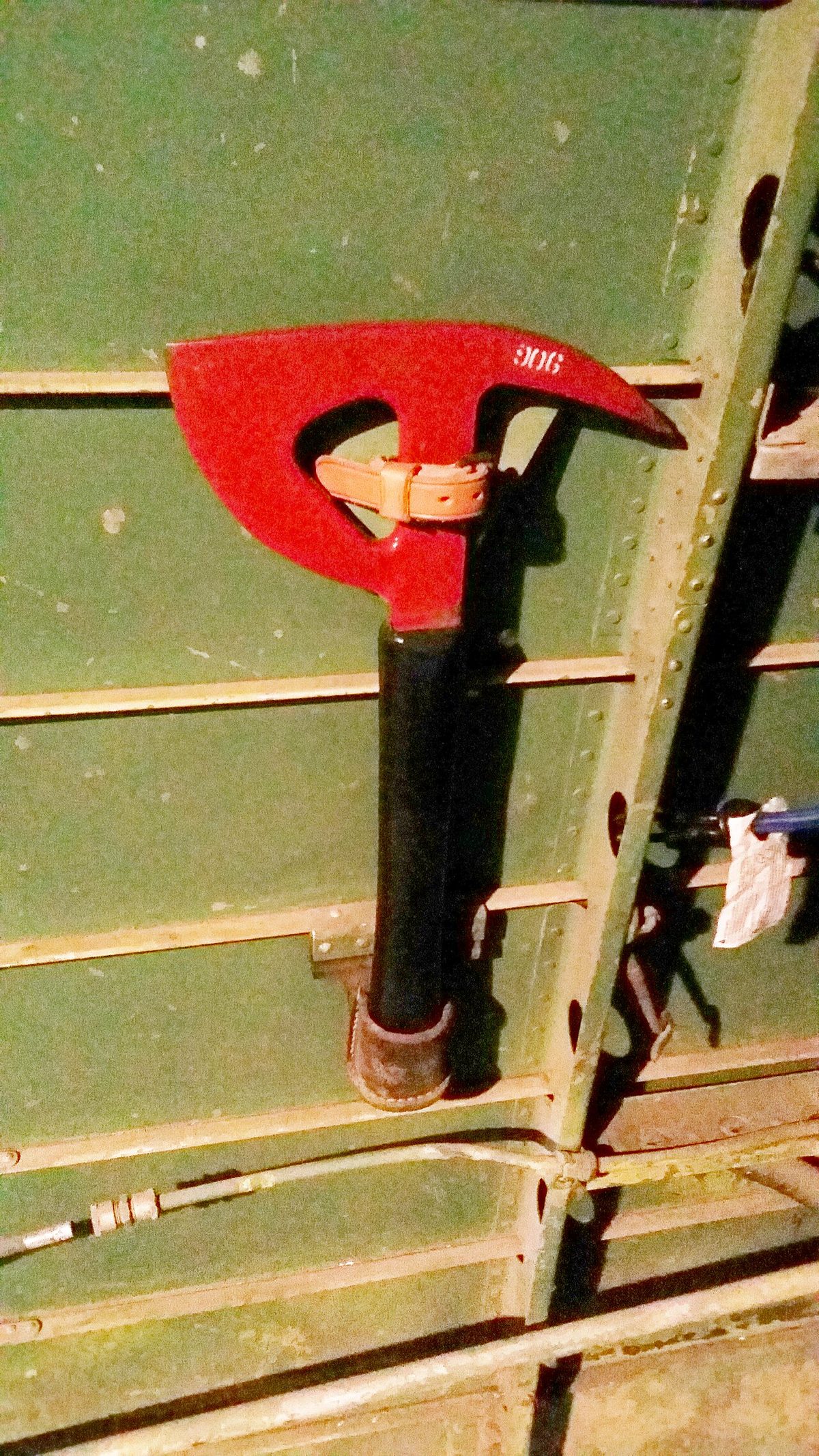
A crash axe or crowbar must be carried on the flight deck of aeroplanes with a maximum take-off mass above 5,700 kg or more than 9 passenger seats, and above 200 seats a second one in or near the rearmost galley. Any stowed in the cabin must be out of sight of passengers. It is used to reach a fire behind panels or linings and to force jammed exits.
Other portable emergency equipment supports the fire fight and the evacuation that may follow: portable oxygen bottles, torches, fire-resistant gloves where fitted, and megaphones, one for 61 to 99 passenger seats and two for 100 or more. The fixed detection and extinguishing systems of holds and lavatories are covered in cargo and lavatory fire protection.
Exam tip: PBE lasts at least 15 minutes; dry powder is never used on the flight deck; water is for Class A fires only; a crash axe is required above 5,700 kg or 9 seats, with a second above 200 seats, hidden from passengers.
Frequently asked questions
What should pilots do first if smoke appears in the cockpit?
Protect themselves first. The pilots put on their oxygen masks, with 100 per cent oxygen selected and smoke goggles if they are separate, and establish communication through the mask microphones. Only then do they fly the aircraft and work through the smoke, fire or fumes procedure: identify and isolate the source, fight any fire, and plan a landing at the nearest suitable aerodrome. Incapacitation by smoke is the fastest way to lose the aircraft.
What are the classes of fire used for aircraft extinguishers?
FAA guidance uses four classes. Class A fires burn ordinary combustibles such as paper, fabric and plastics; Class B fires burn flammable liquids and greases; Class C fires involve energised electrical equipment; Class D fires burn combustible metals such as magnesium. Water suits Class A only, while halon and similar clean agents also work on Class A but chiefly on liquid and electrical fires, which is why they are the usual cabin and flight deck extinguishers.
How do you put out a lithium battery fire on a plane?
Knock the flames down with the cabin extinguisher, usually halon or a halon replacement, then cool the device with water or another non-alcoholic liquid to stop further cells from overheating. Halon does not cool, so a battery can reignite once it disperses. The device should not be picked up or moved while it is burning or smoking, and it is watched for the rest of the flight. The flight crew are told at once and plan to land.
Why is dry powder not used in an aircraft cabin?
A dry chemical extinguisher throws out a dense cloud that blinds anyone nearby, and its residue can put serviceable electrical and avionic equipment out of action. For that reason it must not be used on the flight deck or in any compartment not separated from it, and it is not used in the cabins of pressurised aircraft. Its place is on the ground, for example on wheel and brake fires.
How long does protective breathing equipment last?
Crew protective breathing equipment, or smoke hood, must protect the eyes, nose and mouth and supply oxygen for at least 15 minutes. Chemical units cannot be stopped once started. The wearer notices the supply running out as increasing resistance to breathing, and must then move to clean air or put on a fresh hood.
Test yourself on In-Flight Fire, Smoke and Fumes
The v1prep banks cover this topic in Operational Procedures (070), with a worked explanation for every answer. EASA ATPL, PPL, IR and CPL, the FAA written tests and A320/B737 type ratings.
Start practising →Sources and further reading
- EASA Easy Access Rules for Air Operations (Regulation (EU) No 965/2012), CAT.IDE.A.245 to 255, crew protective breathing equipment, hand fire extinguishers, crash axe and crowbar
- FAA AC 20-42D, Hand Fire Extinguishers for Use in Aircraft
- FAA SAFO 09013, Fighting Fires Caused by Lithium Type Batteries in Portable Electronic Devices
- 14 CFR 121.309, Emergency equipment
- 14 CFR 25.854, Lavatory fire protection
- EASA Easy Access Rules for Large Aeroplanes (CS-25)
- FAA Airplane Flying Handbook (FAA-H-8083-3C), Emergency Procedures
Library articles are written for study and exam preparation. They do not replace your aircraft's approved documentation, your operator's procedures or the regulations themselves.