In-Flight Medical Emergencies
An in-flight medical emergency is an illness or injury of a passenger or crew member on board that needs care beyond routine assistance. Cabin crew give first aid with the on-board kits and oxygen, while the commander, often advised by a ground-based medical service, decides whether to continue or divert.
An in-flight medical emergency is an illness or injury on board that needs more than routine care: a passenger who collapses, a child with a seizure, a burn from a hot drink, a crew member who suddenly cannot work. Most are handled entirely in the cabin. A few become a decision for the commander, who must weigh the patient's needs against the risks of an unplanned landing at an unfamiliar aerodrome.
The aeroplane is a poor place to be ill. Help is hours away, the cabin altitude is several thousand feet, the equipment is limited to what the regulations require, and the only trained people may be the cabin crew and whatever doctors or nurses happen to be travelling. The system therefore rests on four elements: first aid by trained cabin crew, the on-board kits and oxygen, ground-based medical advice by radio or satellite link, and the commander's authority to divert.
Handling a medical emergency
The cabin crew are the first responders. They assess the patient, give first aid and oxygen, move other passengers if needed and tell the flight crew what is happening. Many operators have the crew ask over the public address system for any medical professional on board, who can use the emergency medical kit and advise.
On the flight deck the first rule does not change: fly the aeroplane. The autopilot usually stays engaged, one pilot keeps flying and the other gathers information from the cabin: the nature of the problem, the patient's age and condition, vital signs if they can be measured, the first aid given and its effect, any medication the patient takes, and whether a qualified person is helping. With that information the crew contact the medical advisory service, check the options and decide.
A medical emergency is a real emergency in law as well as in practice. Under 14 CFR 91.3, for example, the pilot in command may deviate from any rule of Part 91 to the extent the emergency requires. On the radio a passenger taken ill is normally an urgency, announced with PAN PAN spoken three times, or a distress with MAYDAY if the person's life is in immediate danger (see distress and urgency communications). ATC then gives priority and asks for an ambulance or medical team to meet the aircraft.
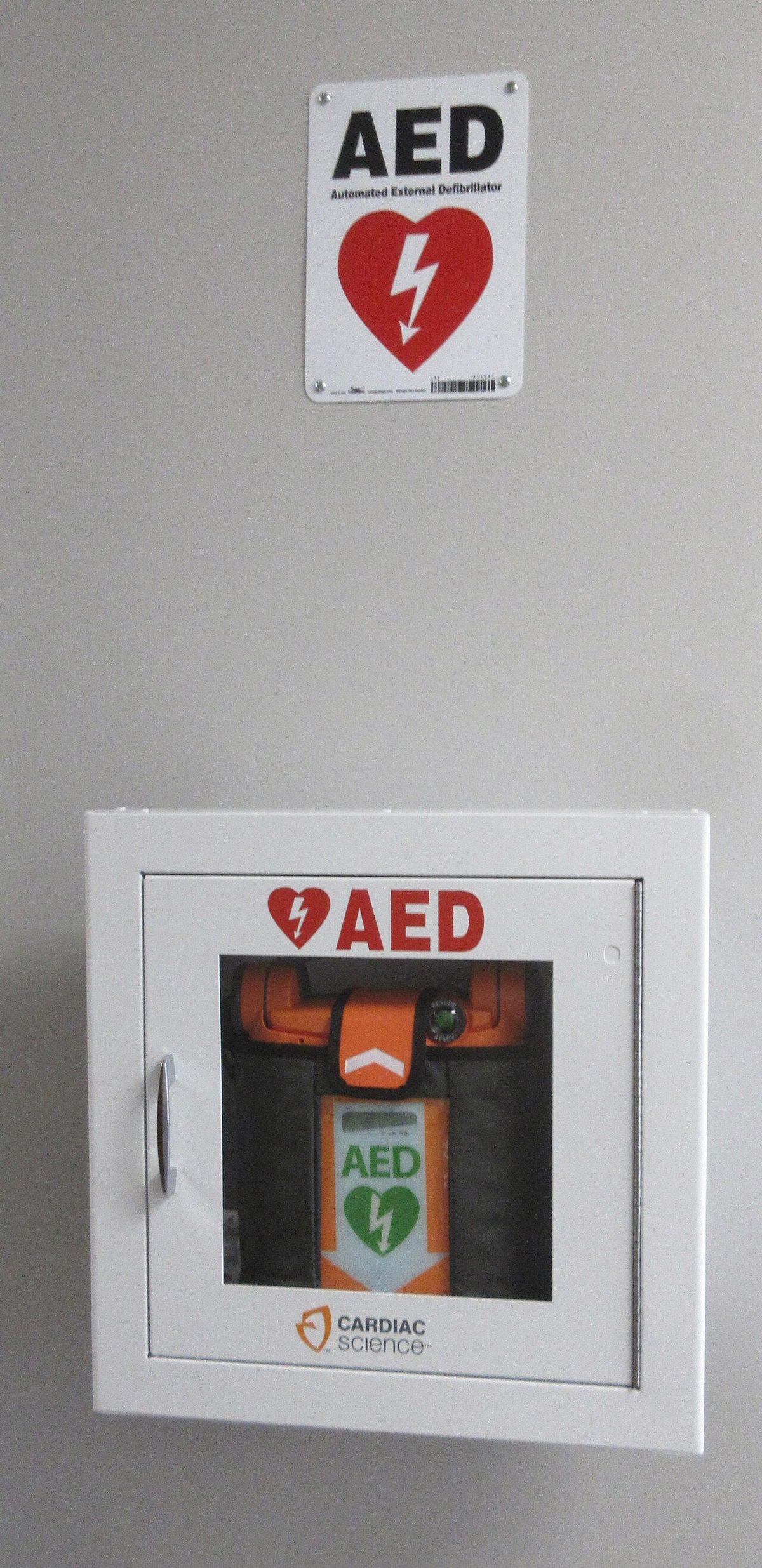
Some conditions leave very little time. After a heart attack the most common rhythm disturbance is ventricular fibrillation, in which the heart stops pumping. Brain cells begin to die after about 2 minutes without oxygen, and untreated cardiac arrest is fatal within about 4 minutes. Chest compressions and assisted breathing can sustain the patient until a defibrillator delivers a shock that may restore a normal rhythm.
Other problems are common and mostly benign. An anxious passenger may hyperventilate, breathing faster or deeper than the body needs, with light-headedness and tingling around the mouth and fingers. The symptoms resemble hypoxia, so wherever hypoxia is possible the rule is to give oxygen first. If the symptoms persist, the patient is helped to slow the breathing rate, for example by talking; rebreathing into a bag is appropriate only once hypoxia has been ruled out (see hypoxia and hyperventilation).
First aid and emergency medical kits
The regulations require three kinds of medical equipment on commercial aeroplanes.
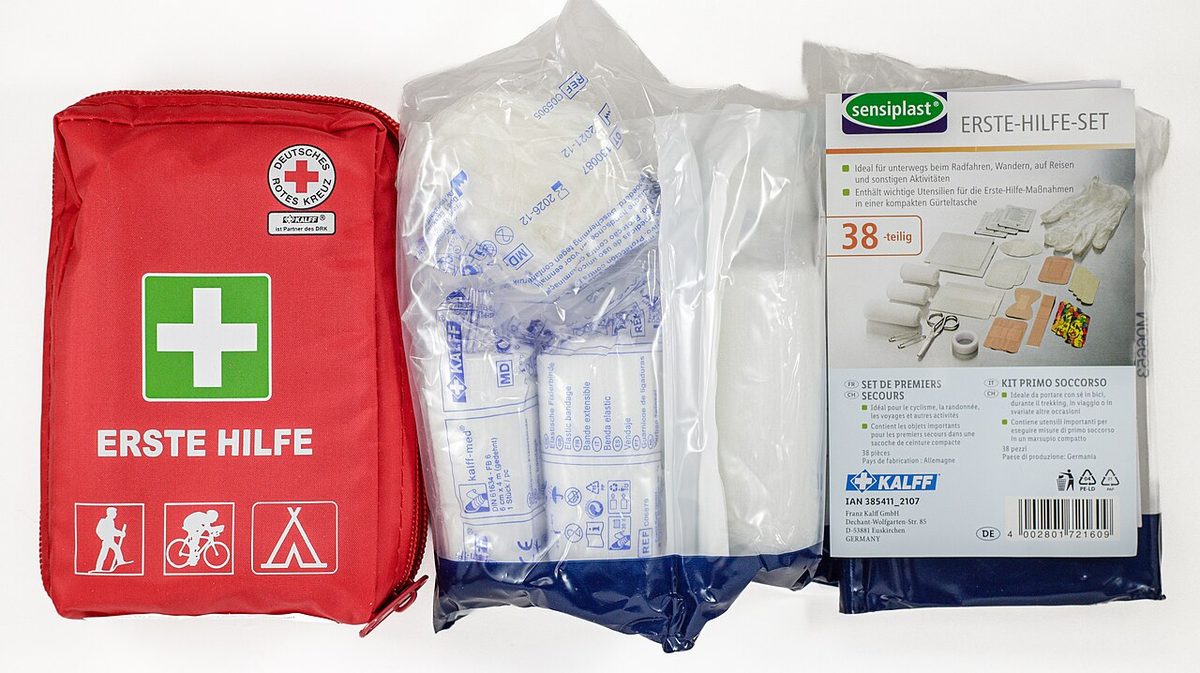
First aid kits hold dressings, bandages and basic items for the cabin crew. Under EASA rule CAT.IDE.A.220 their number depends on the passenger seats installed, not on the passengers carried:
| Passenger seats installed | First aid kits (EASA) |
|---|---|
| 0 to 100 | 1 |
| 101 to 200 | 2 |
| 201 to 300 | 3 |
| 301 to 400 | 4 |
| 401 to 500 | 5 |
| 501 or more | 6 |
An aeroplane with 250 passenger seats therefore needs three. The kits are distributed through the cabin so that the cabin crew can reach one quickly wherever the patient is.
The emergency medical kit contains drugs and instruments for use by doctors or other qualified people. EASA rule CAT.IDE.A.225 requires one on aeroplanes with a maximum operational passenger seating configuration of more than 30 when any point on the planned route is more than 60 minutes' flying time at normal cruising speed from an aerodrome where qualified medical assistance could be expected. Because it holds drugs, it must be dust and moisture proof and carried where no unauthorised person can reach it, for example on the flight deck.
First-aid oxygen is undiluted oxygen for passengers who, for physiological reasons, need it after a depressurisation. Under EASA CAT.IDE.A.230 it is required on pressurised aeroplanes operated above 25,000 ft when a cabin crew member is required. It must last for the remainder of the flight after a depressurisation, while the cabin altitude is between 8,000 ft and 15,000 ft, for at least 2 per cent of the passengers and never fewer than one person, at an average flow of at least 3 litres per minute per person (STPD), with at least two dispensing units. In practice the cabin crew give it from portable bottles. The smaller 120-litre bottles on the Boeing 737 NG have a 2 litre per minute outlet for walking around the cabin and a 4 litre per minute outlet for first aid, which empties the bottle in about 30 minutes. The same oxygen helps a passenger who feels faint or breathless in normal flight (see decompression).
The FAA rules differ in detail. Under 14 CFR 121.803 a Part 121 passenger aeroplane carries approved first aid kits, one for up to 50 passenger seats, two for 51 to 150, three for 151 to 250 and four above 250; an aeroplane that needs a flight attendant also carries an emergency medical kit, and if its maximum payload capacity is more than 7,500 lb, an automated external defibrillator (AED). The FAA's first-aid oxygen rule, 14 CFR 121.333, covers 2 per cent of the occupants, never fewer than one person, for the entire flight after a depressurisation at cabin altitudes above 8,000 ft.
Ground-based medical advice
Many airlines use a medical advisory service, such as MedLink, in which doctors on the ground advise the crew. The crew reach it by satellite communications or HF radio. The doctor asks for the information the cabin has gathered, advises on treatment and gives an opinion on whether the patient needs to be on the ground soon.
That opinion is advice. The commander decides, because only the flight crew can weigh the whole picture:
- how urgent the medical need is, and what care is available at each possible aerodrome;
- the aerodrome itself: runway length, weather, approach aids, fire cover and handling;
- fuel, landing mass and performance, including whether an overweight landing or fuel jettison would be needed;
- the time to each option, and which way to turn after a problem over water or remote terrain, the question the critical point, or equal-time point, is calculated to answer (see point of equal time and point of no return).
A closer aerodrome with modest facilities may be better than a distant major hospital, or the reverse. Landing early to deal with a problem before it becomes critical, a precautionary landing, is good judgement, never a mark against the crew. If the flight diverts, the crew brief the cabin, request the ambulance and plan for early disembarkation of the patient.
Afterwards the crew report the event through the operator's system. A natural death on board is not in itself an aircraft accident: in US terms it is reportable to the NTSB only if the operation of the aircraft caused it, but carriers still require reports to operations, the medical service and the authorities at the arrival airport.
Injuries caused by the flight are different. Under ICAO Annex 13 an injury is serious if, among other criteria, it needs hospitalisation for more than 48 hours starting within 7 days, fractures any bone except simple fractures of fingers, toes or nose, or causes second or third degree burns or burns over more than 5 per cent of the body. A person seriously injured on board through the operation of the aircraft, for example in turbulence, a decompression or an evacuation, makes the occurrence an accident. This is why turbulence injuries to unbelted passengers and cabin crew, the leading cause of non-fatal injuries in US airline operations, appear so often in accident statistics.
Crew incapacitation and crew meal policy
A medical emergency on the flight deck is more dangerous than one in the cabin. The most common cause of in-flight crew incapacitation is acute gastroenteritis from food poisoning or contaminated water, which accounts for almost half of cases. Its onset can be insidious, and a pilot may not realise how impaired he or she has become.
The defence is the crew meal policy. Pilots choose different meals, so that one contaminated dish cannot disable both, and stagger their meal times. A gap of about 90 minutes between eating and flying is also recommended, long enough for the first symptoms of food poisoning to appear, and some airlines apply it to crew meals in flight. The same logic applies before the flight: a licence holder must not fly while aware of any decrease in medical fitness.
Subtle incapacitation is detected by the two-challenge rule: a pilot who fails to respond to two clear challenges, such as a missed standard callout, is presumed incapacitated. The other pilot then takes control with "I have control", engages the autopilot, and calls the cabin crew to secure the incapacitated pilot away from the controls and give first aid. A cabin crew member may sit in the observer's seat to help with checklists and radios. The remaining pilot declares an emergency, diverts to the nearest suitable aerodrome and lands with medical services waiting (see fitness to fly and pilot incapacitation).
Frequently asked questions
What happens when someone falls ill on a plane?
The cabin crew assess the person, give first aid and oxygen, and tell the flight crew. A doctor or nurse among the passengers may be asked to help. The commander, often after consulting a ground-based medical advisory service by satellite communications or HF radio, decides whether the flight can continue or should divert. If it diverts, ATC gives priority and arranges medical services to meet the aircraft.
When must an airliner carry an emergency medical kit?
Under EASA rule CAT.IDE.A.225, an aeroplane with a maximum operational passenger seating configuration of more than 30 must carry an emergency medical kit, for use by doctors or other qualified people, when any point on the planned route is more than 60 minutes' flying time at normal cruising speed from an aerodrome where qualified medical assistance could be expected. The kit must be dust and moisture proof and carried where no unauthorised person can reach it, for example on the flight deck.
How many first aid kits must an aircraft carry?
Under EASA rule CAT.IDE.A.220 the number depends on the passenger seats installed, not on the passengers carried: one kit for up to 100 seats, two for 101 to 200, three for 201 to 300, four for 301 to 400, five for 401 to 500 and six for 501 or more. An aeroplane with 250 passenger seats therefore needs three. The kits are distributed through the cabin so that the cabin crew can reach one quickly.
Why do pilots eat different meals?
Acute gastroenteritis from food poisoning or contaminated water is the most common cause of in-flight crew incapacitation, accounting for almost half of cases. If both pilots ate the same contaminated meal, both could become ill at once. Crews therefore choose different meals and stagger their meal times. A gap of about 90 minutes between eating and flying is also recommended, long enough for the first symptoms of food poisoning to appear, and some airlines apply it to crew meals in flight.
Is a passenger medical emergency a MAYDAY or a PAN PAN?
A passenger taken ill is normally an urgency, announced with PAN PAN spoken three times, which gets priority handling. If the person's life is in immediate danger the commander may declare distress with MAYDAY. PAN PAN MEDICAL is something else: it identifies a medical transport protected under the Geneva Conventions, not an ill passenger on an airliner.
Test yourself on In-Flight Medical Emergencies
The v1prep banks cover this topic in Operational Procedures (070), with a worked explanation for every answer. EASA ATPL, PPL, IR and CPL, the FAA written tests and A320/B737 type ratings.
Start practising →Sources and further reading
- EASA Easy Access Rules for Air Operations (CAT.IDE.A.220, CAT.IDE.A.225 and CAT.IDE.A.230)
- 14 CFR 121.803, Emergency medical equipment
- 14 CFR 121.333, Supplemental oxygen for emergency descent and for first aid, turbine engine powered airplanes with pressurized cabins
- 14 CFR 91.3, Responsibility and authority of the pilot in command
- ICAO Annex 13, Aircraft Accident and Incident Investigation (ICAO Store)
Library articles are written for study and exam preparation. They do not replace your aircraft's approved documentation, your operator's procedures or the regulations themselves.