Distress and Urgency Communications
Distress and urgency communications are the radiotelephony procedures used when the safety of an aircraft or of someone on board is threatened. MAYDAY signals distress, serious or imminent danger requiring immediate assistance; PAN PAN signals urgency, a safety concern that does not need immediate assistance.
Distress and urgency communications are the radiotelephony procedures used when the safety of an aircraft, or of someone on board, is threatened. Two spoken signals open them: MAYDAY for distress and PAN PAN for urgency. Each claims priority over routine traffic, tells the controller to act at once and starts a chain of actions that can end with fire and rescue services waiting at the runway or a search aircraft overhead.
ICAO sets out the procedures in Annex 10, Volume II; SERA applies them in the EU, and the FAA's Aeronautical Information Manual follows the same pattern with minor differences. Examinations test the definitions, the message order, the frequencies and codes, and the phrases for relaying a call, imposing silence and ending distress traffic. A crew under stress falls back on what it has learned by heart.
Distress, urgency and safety signals
ICAO defines two emergency conditions:
- Distress: a condition of being threatened by serious and/or imminent danger and of requiring immediate assistance.
- Urgency: a condition concerning the safety of an aircraft or other vehicle, or of some person on board or within sight, which does not require immediate assistance.
The distress signal is the spoken word MAYDAY and the urgency signal PAN PAN, each preferably spoken three times at the start of the first message. A third signal, SECURITE, spoken three times, is the safety signal. In Morse code the same meanings are carried by the groups SOS (three short, three long, three short) for distress, XXX for urgency and TTT for safety, and an aircraft in distress may flash SOS with a light. Because these groups carry fixed meanings, SOS, PAN, XXX and TTT may not be used in aircraft registration marks.
The signals slot into a fixed order of priority for messages in the aeronautical mobile service:
| Priority | Category | Examples |
|---|---|---|
| 1 | Distress calls, distress messages and distress traffic | MAYDAY |
| 2 | Urgency messages, including medical transport messages | PAN PAN |
| 3 | Communications relating to direction finding | QDM requests |
| 4 | Flight safety messages | ATC clearances and instructions |
| 5 | Meteorological messages | Weather reports and forecasts |
| 6 | Flight regularity messages | Servicing, schedules, crew arrangements |
The commander chooses the signal, and the choice may change. A rough-running engine that still gives power, a twin that holds its level after an engine shutdown, an alternator failure with the battery good for half an hour, or a passenger with a suspected heart attack are classic urgency cases. An engine failure with a forced landing ahead, a fire, or a calculated landing fuel below final reserve are distress. An urgency is upgraded to MAYDAY the moment the danger becomes grave and immediate.

Exam tip: the dividing word is immediate. If the aircraft needs help now, it is distress; if safety is affected but help is not yet needed, it is urgency.
The MAYDAY message
After the distress signal, the message contains, as far as possible in this order:
- the name of the station addressed, time and circumstances permitting;
- the aircraft identification;
- the nature of the distress condition;
- the intention of the person in command;
- present position, level and heading;
followed by any other useful information. A light aircraft might transmit: "MAYDAY MAYDAY MAYDAY, Paris Information, G-ABCD, engine failure, forced landing in a field, 10 miles south of Chartres, 2,000 feet, heading 180, two persons on board." The sequence puts what has happened and what the pilot intends to do ahead of the position, because a controller with a surveillance display may already see where the aircraft is. When time is short, any order that gets the essentials across is acceptable.
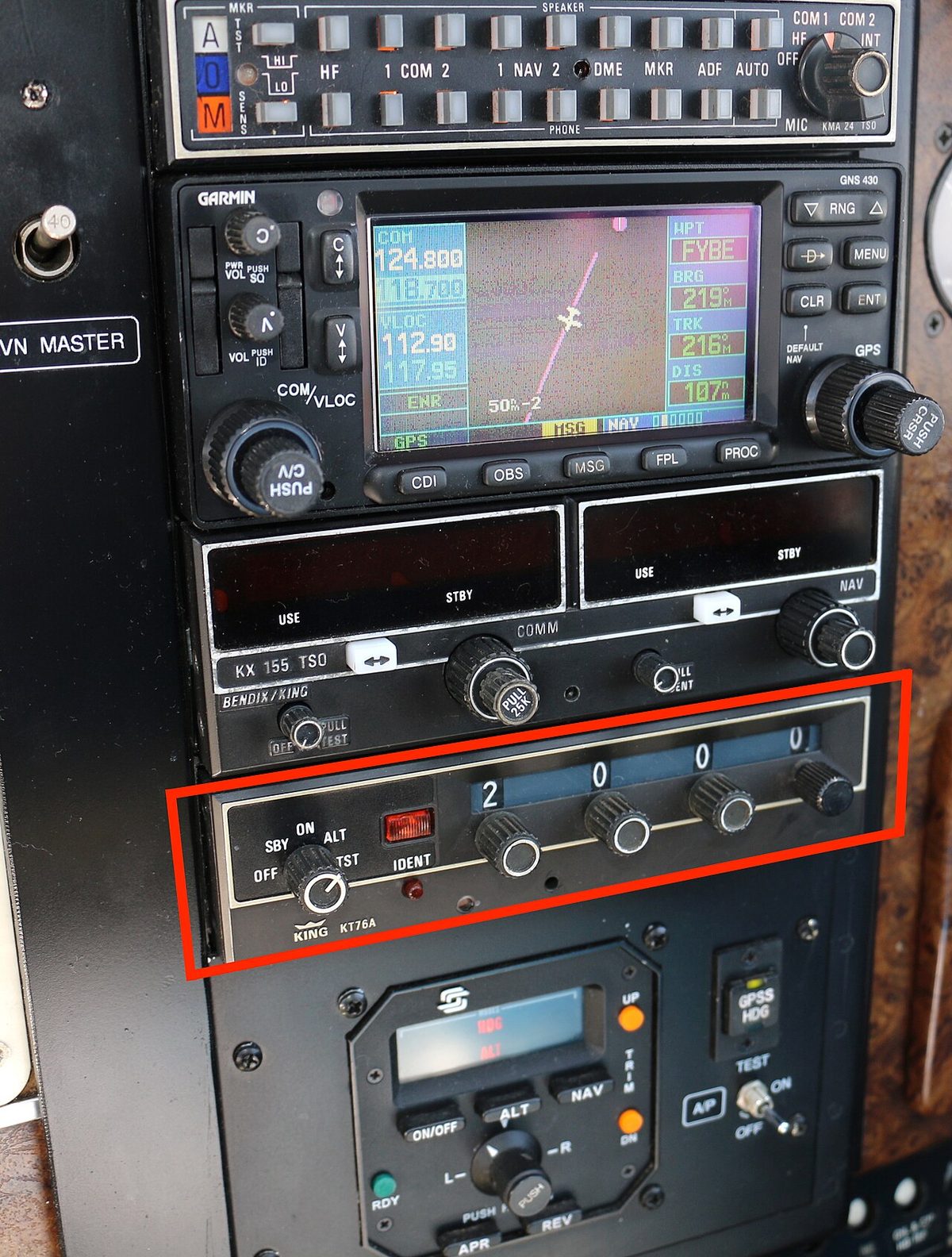
The call is made on the frequency in use at the time, where the controller already knows the aircraft's identity and position. The emergency frequency 121.5 MHz is used when no contact can be made on the frequency in use, or when it is otherwise more appropriate. Distress traffic normally stays on the frequency where it began unless a transfer to another would bring better assistance. The crew also selects the transponder code 7700 (see transponder and SSR), which triggers an emergency indication on every secondary surveillance display in range; a crew already identified on a discrete code may keep it, since the controller already knows who is in trouble. Distress and urgency messages are passed by voice rather than by CPDLC, because a data link message can be delayed or unread.
The station addressed, or the first station to acknowledge, must acknowledge the message at once, take control of the distress traffic or clearly transfer that responsibility, make sure the information reaches the ATS unit concerned and the aircraft's operator, and warn other stations off the frequency. Once the immediate handling is settled, the controller will usually ask for the number of persons on board and the fuel endurance, the two figures on which search and rescue planning depends.
The FAA's version, in AIM Chapter 6, uses the same MAYDAY and PAN-PAN calls spoken three times. Its list asks for the fuel remaining in time and the souls on board as part of the message, advises staying on the frequency in use if already in contact with ATC, and notes that 121.5 MHz is guarded by most facilities.
PAN PAN and PAN PAN MEDICAL
An urgency message follows the same order as a distress message, with the nature of the urgency condition in third place. It has priority over all communications except distress, and other stations must take care not to interfere with it, but it does not impose radio silence.
PAN PAN MEDICAL is narrower than it sounds. The prescribed form is PAN PAN spoken three times followed by the single word MEDICAL, pronounced as the French médical, and it identifies a medical transport protected under the 1949 Geneva Conventions and their additional protocols. The message gives the call sign or other means of identification, the position, the number and type of medical transports, the intended route, the estimated time en route and times of departure and arrival, and other information such as flight altitude, radio frequencies guarded and SSR modes and codes. A passenger taken ill on a normal flight is an ordinary urgency or, if life is in immediate danger, a distress.
Fuel has its own wording. MINIMUM FUEL is an advisory that the flight is committed to one aerodrome and can accept no further delay; it is not an emergency and gives no priority. Under SERA.11012 and ICAO Annex 6, a crew must declare MAYDAY MAYDAY MAYDAY FUEL when the calculated usable fuel on landing at the nearest aerodrome where a safe landing can be made is less than the planned final reserve (see fuel planning and fuel reserves).
MAYDAY RELAY
A station that hears distress traffic but is not involved keeps silent and keeps listening, because it may be needed. If the distress message has plainly not been acknowledged, for instance a weak call from a low-flying aircraft that the ground station cannot hear, a station able to help must pass it on. The relay begins MAYDAY RELAY, spoken three times, followed by the station addressed, the relaying station's own identification and the original message as accurately as it was heard: the identity of the aircraft in distress, its position, the nature of the emergency and its intentions.
The prefix matters. A plain MAYDAY would suggest that the relaying aircraft is in distress, and PAN PAN would downgrade the emergency. The relaying crew does not select 7700, which would point the controller at the wrong aircraft.
Imposing radio silence
Distress traffic has absolute priority, and a single careless transmission can block the message that matters. The aircraft in distress, or the station controlling the distress traffic, may impose silence on all stations in the area or on one station that is interfering, using the words STOP TRANSMITTING, MAYDAY. Only those two stations may use the MAYDAY signal in this way. A station told to stop transmitting does exactly that: it sends no acknowledgement, because even a "roger" occupies the frequency.
Stations that are aware of the distress traffic but cannot help stay off the frequency and keep listening until the distress traffic is ended. The maritime service has its own silence phrases, such as SILENCE FINI; they are not used in aeronautical radiotelephony.
Cancelling distress traffic
A distress does not lapse quietly. When the aircraft is no longer in distress, its crew must transmit a message cancelling the distress condition, normally on the frequency where it was declared, because until then other traffic is being held off and the rescue services remain committed. The crew then returns to its assigned code or to the conspicuity code.
The station that controlled the distress traffic ends it with a message to all stations: "MAYDAY, ALL STATIONS, ALL STATIONS, ALL STATIONS, this is Paris Control, 1247, G-ABCD, DISTRESS TRAFFIC ENDED." It contains the controlling station's name, the time, the identity of the aircraft that was in distress and the closing words. It lifts the radio silence and releases the frequency for normal working; it does not mean that the aircraft has landed.
Emergency frequencies: 121.5 and 243.0 MHz
121.5 MHz is the international VHF aeronautical emergency frequency. Aircraft used for commercial air transport must be able to communicate on it, aircraft on the North Atlantic routes monitor it, and it serves VHF direction finding, homing on emergency locator transmitters and calls to and from intercepting aircraft. When European voice channels were converted to 8.33 kHz spacing, 121.5 MHz, like the search and rescue frequency 123.1 MHz, kept 25 kHz spacing so that any aircraft could still be heard. Not every station keeps a continuous watch on it; France, for example, notifies ICAO that it provides 121.5 MHz at some international aerodromes only where considered necessary, which is why the working frequency comes first. The UHF equivalent used by military aircraft is 243.0 MHz. 121.5 MHz is reserved for distress and urgency traffic and is never used for routine messages; beacon and search frequencies are covered in emergency beacons and search and rescue signals.
Emergency descent broadcasts
After a decompression the crew dons oxygen masks and makes an emergency descent (see decompression). It declares a MAYDAY and selects 7700 unless ATC has already assigned a code, and where regional contingency procedures apply, as in oceanic airspace, it turns away from the assigned route or track before descending. The pilot of the descending aircraft should, if possible, broadcast the aircraft's altitude at intervals so that other traffic can keep clear.
The controller warns other traffic with an emergency descent broadcast addressed to all aircraft in the affected volume: "EMERGENCY DESCENT AT (significant point or location), ALL AIRCRAFT BELOW (level) WITHIN (distance) OF (significant point or navigation aid) LEAVE IMMEDIATELY", followed as necessary by specific instructions on direction, heading or track.
Interception communications
An aircraft intercepted by a military or state aircraft must, under SERA.11015 and the matching ICAO rules, follow the instructions of the intercepting aircraft, interpreting and responding to its visual signals, notify the ATS unit if possible, attempt radio contact by a general call on 121.5 MHz giving its identity and the nature of the flight, repeating it on 243.0 MHz if there is no contact and it is practicable, and select 7700 unless ATS instructs otherwise. If instructions received by radio from any source conflict with the interceptor's signals, the intercepted aircraft complies with the interceptor while asking for clarification. The visual signals are covered in interception and visual signals.
Where the two crews have no common language, ICAO provides a short vocabulary of phrases for use between the intercepting and the intercepted aircraft, each spelled out for pronunciation. It is deliberately small and phonetically distinct: the intercepted aircraft accepts an instruction with WILCO, understood, will comply, and declines one with CAN NOT, pronounced KANN NOTT, unable to comply. Ordinary ATC words such as UNABLE are not part of the set.

Warning: 7700, 7600 and 7500 each tell ATC something different: emergency, radio failure and unlawful interference. Selecting the wrong one, even briefly while changing codes, starts the wrong response on the ground.
Frequently asked questions
What is the difference between MAYDAY and PAN PAN?
MAYDAY is the distress signal, for a condition of serious and/or imminent danger requiring immediate assistance, such as a fire or an engine failure with a forced landing ahead. PAN PAN is the urgency signal, for a condition affecting the safety of the aircraft or of a person on board or within sight that does not need immediate assistance. Distress has absolute priority; urgency ranks second, above all other traffic.
What is the correct order of a MAYDAY message?
After MAYDAY, preferably spoken three times, the message gives the name of the station addressed, time and circumstances permitting, the aircraft identification, the nature of the distress condition, the intention of the person in command, then present position, level and heading, followed by any other useful information such as persons on board and endurance. An urgency message follows the same order after PAN PAN.
Which frequency should a MAYDAY call be made on?
On the frequency in use at the time. The station already working the aircraft knows who and where it is and can act without delay. The international aeronautical emergency frequency, 121.5 MHz, is used when no contact can be made on the frequency in use or when it is otherwise more appropriate. Distress traffic normally stays on the frequency where it began unless a transfer would bring better help.
What does MAYDAY RELAY mean?
MAYDAY RELAY, spoken three times, prefixes a distress message passed on by a station that is not itself in distress, typically an aircraft that hears a MAYDAY which the ground station has clearly not received. The prefix stops anyone mistaking the relaying aircraft for the one in trouble. The relay repeats the original message as accurately as it was heard, and the relaying crew keeps its own transponder code.
When is PAN PAN MEDICAL used?
PAN PAN, PAN PAN, PAN PAN, followed by the word MEDICAL, pronounced as the French médical, identifies a medical transport protected under the 1949 Geneva Conventions and their additional protocols. It is not the call for a passenger taken ill on an airliner; that situation is an ordinary urgency, announced with PAN PAN spoken three times, or a distress if the life of the person is in immediate danger.
How is a MAYDAY cancelled?
The aircraft that declared the distress must transmit a message cancelling it, normally on the same frequency, because priority, radio silence and the rescue services stay committed until it does. The station that controlled the distress traffic then transmits to all stations its own name, the time, the identity of the aircraft and the words DISTRESS TRAFFIC ENDED, which releases the frequency for normal working.
Test yourself on Distress and Urgency Communications
The v1prep banks cover this topic in Communications (090), with a worked explanation for every answer. EASA ATPL, PPL, IR and CPL, the FAA written tests and A320/B737 type ratings.
Start practising →Sources and further reading
- ICAO Annex 10, Aeronautical Telecommunications, Volume II, Communication Procedures including those with PANS status
- ICAO Doc 4444, Procedures for Air Navigation Services, Air Traffic Management (PANS-ATM), 16th edition, as published by Airservices Australia
- EASA Easy Access Rules for Standardised European Rules of the Air (SERA), SERA.11012 and SERA.11015
- FAA Aeronautical Information Manual, Chapter 6 Section 3, Distress and Urgency Procedures
- FAA Aeronautical Information Manual, Chapter 5 Section 6, National Security and Interception Procedures
- SKYbrary, Emergency Transponder Codes
- AIP France, GEN 1.7, Differences from ICAO Standards, Recommended Practices and Procedures (Annex 10, 121.5 MHz)
Library articles are written for study and exam preparation. They do not replace your aircraft's approved documentation, your operator's procedures or the regulations themselves.