Radio Communication Failure
A radio communication failure is the loss of two-way voice contact between an aircraft and air traffic services, whether the receiver, the transmitter or both have failed. Standard procedures let the controller predict the aircraft's route, level and timing until it lands.
A radio communication failure, usually called lost comms, is the loss of two-way voice contact between an aircraft and air traffic services. The receiver, the transmitter, both, the audio system or simply a wrong frequency may be to blame; to the controller the result is the same, an aircraft that no longer answers. Because other traffic must still be kept clear of it, the rules tell the pilot exactly what to do, so that the aircraft's route, level and timing can be predicted without a word being exchanged.
The procedures differ in detail between ICAO, the European Union and the United States, and the EU version changed on 1 May 2025, when Regulation (EU) 2024/404 introduced SERA.14083 with a single 20-minute period and a new code, 7601. Examinations test all of it: the codes, the timings, the FAA's route and altitude rules and the tower's light signals.
Two-way communication requirements
The two-way radio communication requirement is the rule that an aircraft must keep a listening watch on, and be able to talk to, the appropriate air traffic services unit. Under ICAO and SERA a controlled flight maintains a continuous air-ground voice watch on the appropriate frequency and establishes two-way communication as necessary; the same applies to VFR flights in the classes of airspace, and in the radio mandatory zones, where the authority requires it. In the United States two-way radio communication must be established before entering Class C or D airspace, a clearance is needed for Class B (see airspace classification), and two-way radio is on the list of equipment required for IFR flight.
When the radio fails, these requirements can no longer be met and the failure procedures take over. They are not a courtesy: ATC protects airspace, and keeps separation from other traffic, on the assumption that the pilot is following them, and an aircraft that improvises becomes unpredictable.
Recognising a communication failure
Most apparent failures are not failures of the radio. Before declaring one, a crew checks the frequency selected, volume and squelch, the audio panel's transmit and receive selections, headset and microphone plugs, circuit breakers, whether the station is open and whether the aircraft is within range. The usual next steps are to call again, go back to the previous frequency, try the unit's other published frequencies and 121.5 MHz, and ask another aircraft to relay. Where fitted, CPDLC or satellite voice may restore contact. The FAA's AIM adds calling a flight service station or the long-range radio operators, and listening to the voice feature of navigation aids, on which ATC may transmit.
If contact cannot be restored, the pilot selects 7600, the code for loss of two-way radio communication described in transponders and SSR. The code tells every surveillance display at once that the silence is a radio problem, and in surveillance airspace it lets the controller see what the aircraft does next. A controller who suspects that only the transmitter has failed may ask the pilot to acknowledge by operating IDENT or changing code.
Stuck microphone
A stuck microphone is a transmit switch jammed in the transmit position, or a transmit selection left on, so that the aircraft's carrier blocks the frequency. Nobody else can be heard, including the controller, and everyone on frequency may hear the conversation on that flight deck. The crew concerned often notices nothing except that the frequency seems unusually quiet, which is why an unexplained silence should prompt a check of both pilots' transmit switches and the audio panel before anything else. The FAA's AIM describes frequency blockage by an unintentionally keyed transmitter and, where the assigned frequency is completely blocked, the use of the procedures for restoring contact with ATC on another frequency. Data link offers a way round the problem: EUROCONTROL's Maastricht centre can uplink a CPDLC instruction asking a crew to check for a stuck microphone.
Transmitting blind
A blind transmission is a message sent from one station to another when two-way contact cannot be established but the receiving station is believed to be able to hear it. SERA.14085 and ICAO Annex 10 Volume II give two cases, each with its own standard phraseology:
- Unable to establish contact on the designated frequency by any means: transmit the message twice, prefixed TRANSMITTING BLIND.
- Receiver failure, with the transmitter believed to work: transmit reports at the scheduled times or positions on the frequency in use, prefixed TRANSMITTING BLIND DUE TO RECEIVER FAILURE, follow the message with a complete repetition, and give the time of the next intended transmission.
The prefix tells the ground station that no reply will be heard, and the repetition protects against a clipped or blocked first attempt. A flight receiving an air traffic service also includes its intentions. A pilot whose transmitter has failed, but who can still hear, simply listens: instructions can still be received, and acknowledged by transponder or by manoeuvre when the controller asks.
ICAO and SERA procedures
The total communications failure procedure is what the pilot flies once voice contact, and data link where available, cannot be restored. It starts with the same question for every flight: can the flight continue in visual meteorological conditions?
In VMC
A flight in VMC, VFR or IFR, continues in VMC, lands at the nearest suitable aerodrome and reports its arrival by the most expeditious means to the appropriate ATS unit. At a controlled aerodrome the pilot watches the tower for light signals. An IFR flight may instead complete the flight under the IFR procedure below if the pilot considers that advisable.

In IMC
An IFR flight in IMC, or one for which continuing in VMC is not feasible:
- keeps the last assigned speed and level, or the minimum flight altitude if higher, for the period described below, and then adjusts level and speed in accordance with the filed flight plan;
- if being radar vectored, or offset by RNAV without a specified limit, rejoins the current flight plan route no later than the next significant point, respecting the minimum flight altitude;
- proceeds along the current flight plan route to the navigation aid or fix serving the destination and, if necessary, holds over it;
- begins descent at, or as close as possible to, the last expected approach time received and acknowledged or, if none was, the estimated time of arrival from the current flight plan;
- flies a normal instrument approach for that aid or fix and lands, if possible, within 30 minutes of the ETA or the last acknowledged expected approach time, whichever is later.
In the ICAO text that SERA followed until 2025, the period in step 1 depends on the environment. Where no surveillance is used, it is 20 minutes after the aircraft fails to report over a compulsory reporting point. Where radar or ADS-B is used, it is 7 minutes after the latest of three events: reaching the last assigned level or minimum flight altitude, setting 7600, or failing to report over a compulsory reporting point.
The 2025 SERA changes
SERA.14083, applicable in the EU from 1 May 2025, replaced the two periods with a single 20 minutes in both procedural and surveillance airspace, after which speed and vertical profile follow the filed flight plan as amended by modification and delay messages. EASA made the change in anticipation of an amendment to ICAO Annex 2, so States outside the EU may still apply the 7-minute period. SERA also introduced code 7601: an IFR flight that loses communication, is in VMC and decides to continue in VMC to land at the nearest suitable aerodrome sets 7601, so that ATC knows at once that it will leave the IFR procedure. An IFR flight continuing under the IFR procedure keeps 7600.
The United Kingdom and Switzerland, outside the EU, did not adopt 7601 when it was introduced, and the UK kept its existing procedures. The code, the period and any local variation must therefore be checked in the AIP of the State being flown in.
Exam tip: ICAO: 7 minutes with surveillance, 20 minutes without, then the filed flight plan level and speed. EU SERA since 1 May 2025: 20 minutes in both, and 7601 for an IFR flight continuing in VMC. Land within 30 minutes of the later of ETA and EAT.
FAA procedure: route and altitude (AVEF)
In the United States, 14 CFR 91.185 applies. If the failure occurs in VFR conditions, or VFR conditions are met after it, the pilot continues under VFR and lands as soon as practicable. Otherwise the route is chosen by the rule remembered as AVEF (lost communications route rule):
| Letter | Route |
|---|---|
| A, assigned | The route assigned in the last ATC clearance received |
| V, vectored | If being radar vectored, direct from the point of failure to the fix, route or airway specified in the vector clearance |
| E, expected | Without an assigned route, the route ATC has advised may be expected in a further clearance |
| F, filed | Without an assigned or expected route, the route filed in the flight plan |
The altitude, recalled as MEA, is the highest of the minimum altitude for IFR operations (see minimum safe altitudes), the altitude ATC advised may be expected in a further clearance, and the altitude assigned in the last clearance. The comparison is made for each route segment, so the aircraft climbs where the minimum altitude rises and may descend again when it falls, but never below the assigned altitude. An expected altitude applies only from the time or point stated: a pilot told "expect 9,000 ten minutes after departure" who loses the radio four minutes after take-off keeps the assigned altitude, or a higher minimum, until the ten minutes have run and then climbs.
At the clearance limit, if it is a fix from which an approach begins, the pilot starts descent, or descent and approach, as close as possible to the expect-further-clearance (EFC) time if one was received, or otherwise to the ETA calculated from the filed or amended estimated time en route. If the clearance limit is not such a fix, the pilot leaves it at the EFC time, or on arrival if none was received, proceeds to a fix from which an approach begins and times the descent to the ETA. For VFR arrivals in Class D, 14 CFR 91.129 allows a pilot whose radio has failed to land if the weather is at or above basic VFR minimums, visual contact with the tower is maintained and a clearance to land is received, normally by light signal.
| ICAO | EU SERA | FAA | |
|---|---|---|---|
| Code | 7600 | 7600, or 7601 for IFR continuing in VMC | 7600 |
| In VMC | Continue VMC, land at nearest suitable aerodrome | As ICAO | Continue VFR, land as soon as practicable |
| Level in IMC | Last assigned or minimum, for 7 or 20 minutes, then flight plan | Last assigned or minimum, for 20 minutes, then flight plan | Highest of minimum, expected and assigned, by segment |
| Route | Current flight plan route | As ICAO | Assigned, vectored, expected, filed |
Light gun signals
Light gun signals let a control tower direct an aircraft that cannot hear it, using a narrow beam of green, red or white light aimed at the aircraft. The pilot of an aircraft with a radio failure near a controlled aerodrome watches the tower continuously. ICAO and SERA use the following meanings:
| Signal | Aircraft in flight | Aircraft on the ground |
|---|---|---|
| Steady green | Cleared to land | Cleared for take-off |
| Steady red | Give way to other aircraft and continue circling | Stop |
| Series of green flashes | Return for landing; clearances to land and taxi will follow | Cleared to taxi |
| Series of red flashes | Aerodrome unsafe, do not land | Taxi clear of the landing area in use |
| Series of white flashes | Land at this aerodrome and proceed to the apron | Return to starting point on the aerodrome |
| Red pyrotechnic | Notwithstanding any previous instructions, do not land for the time being |
In flight the pilot acknowledges by day by rocking the wings, except on the base and final legs of the approach, and by night by flashing the landing lights on and off twice or, if none are fitted, the navigation lights. On the ground the acknowledgement is moving the ailerons or rudder by day and the same light signal by night.
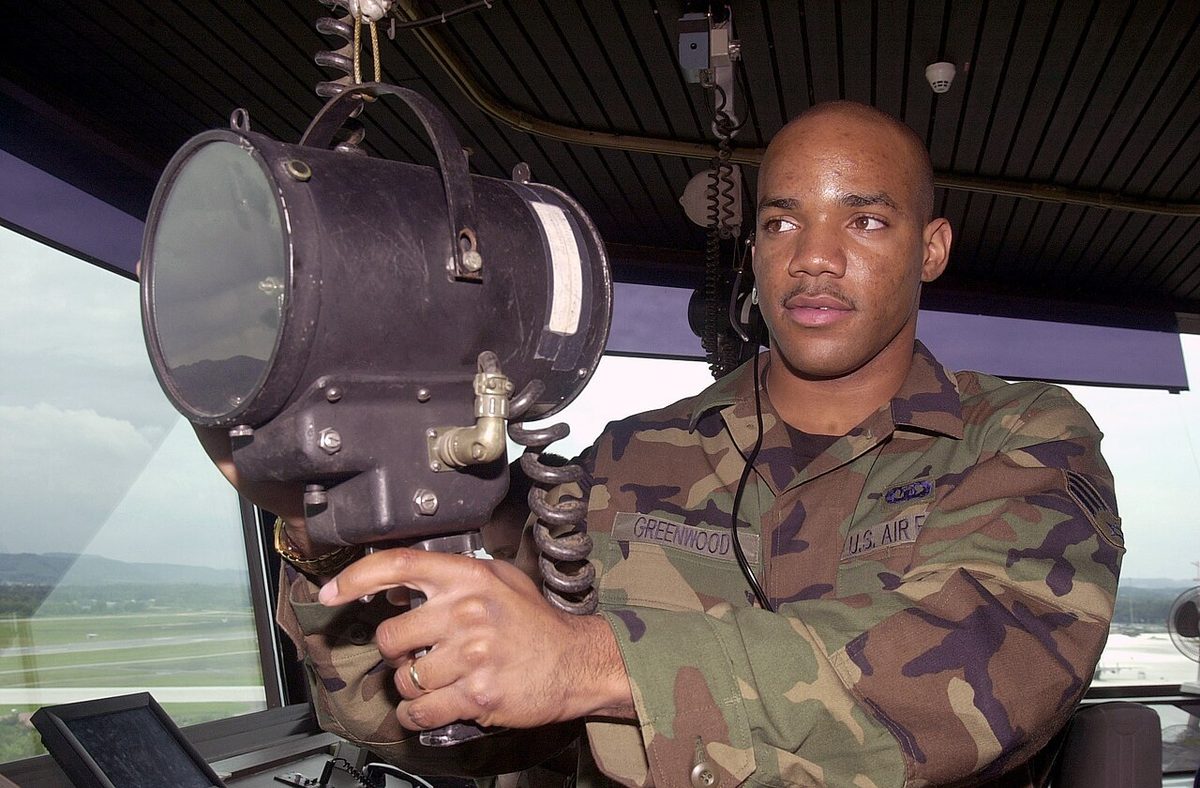
The FAA's table is almost the same. It gives flashing white a meaning only on the ground, return to the starting point on the airport; it adds alternating red and green, meaning exercise extreme caution; and it has a column for vehicles and personnel on the airport. On both sides of the Atlantic, red flashes are a firmer prohibition than steady red.
Warning: a series of green flashes in flight means return for landing, not cleared to land. Wait for the steady green.
Frequently asked questions
What should a pilot do if the radio fails in flight?
First check the obvious causes, such as frequency, volume, squelch, headset plugs and the audio panel, and try the previous frequency, 121.5 MHz and a relay through another aircraft. If contact cannot be restored, squawk 7600 and follow the published procedure. In VMC, continue in VMC, land at the nearest suitable aerodrome and report arrival. In IMC, fly the IFR procedure, and transmit blind in case the transmitter still works.
What is squawk 7601?
7601 is a transponder code introduced in EU airspace by SERA.14083, applicable from 1 May 2025. An IFR flight that loses radio contact, is in visual conditions and decides to continue in VMC to the nearest suitable aerodrome sets 7601 instead of 7600, so ATC knows it will not follow the IFR procedure. It is not an ICAO code; the United Kingdom and Switzerland did not adopt it when it was introduced.
What is the 20-minute rule for lost communications?
After a radio failure in IMC, an IFR flight keeps its last assigned speed and level, or the minimum flight altitude if higher, for a fixed period before adjusting to the filed flight plan. In the ICAO procedure the period is 7 minutes where radar or ADS-B is used and 20 minutes where it is not. Since 1 May 2025, EU SERA applies 20 minutes in both environments; elsewhere, check the AIP.
What does AVEF mean in lost communications?
AVEF is the memory aid for the route to fly after an IFR radio failure under 14 CFR 91.185. Fly the route Assigned in the last clearance; if being radar Vectored, go direct to the fix, route or airway given in the vector clearance; otherwise the route ATC said to Expect; and failing all of those, the route Filed. The altitude is the highest of the minimum IFR altitude, the expected and the assigned altitude.
What does a steady green light from the tower mean?
To an aircraft in flight a steady green light means cleared to land; to an aircraft on the ground it means cleared for take-off. A series of green flashes means return for landing in flight, with the landing clearance to follow, and cleared to taxi on the ground. A steady red means give way and keep circling in flight, and stop on the ground.
What does transmitting blind mean?
A blind transmission is a message sent without being able to confirm that it is received. A pilot who cannot establish contact sends each message twice, prefixed TRANSMITTING BLIND. A pilot whose receiver has failed prefixes TRANSMITTING BLIND DUE TO RECEIVER FAILURE, transmits at the usual times or positions, repeats each message in full and gives the time of the next intended transmission.
Test yourself on Radio Communication Failure
The v1prep banks cover this topic in Communications (090), with a worked explanation for every answer. EASA ATPL, PPL, IR and CPL, the FAA written tests and A320/B737 type ratings.
Start practising →Sources and further reading
- EASA, Commission Implementing Regulation (EU) 2024/404 amending SERA
- UK CAA Regulatory Library, SERA.14085 Use of blind transmission
- UK CAA Regulatory Library, SERA Appendix 1, Signals for aerodrome traffic
- 14 CFR 91.185, IFR operations, two-way radio communications failure
- 14 CFR 91.129, Operations in Class D airspace
- FAA Aeronautical Information Manual, Chapter 6 Section 4, Two-way Radio Communications Failure
- FAA Aeronautical Information Manual, Chapter 4 Section 2, Radio Communications Phraseology and Techniques
- OPSGROUP, EU Updates Lost Comms and Emergency Descent Rules (May 2025)
Library articles are written for study and exam preparation. They do not replace your aircraft's approved documentation, your operator's procedures or the regulations themselves.