Pressurisation Principles and Control
Pressurisation keeps the air pressure inside an aircraft's cabin higher than the pressure outside at altitude, so that the cabin altitude stays low enough for normal breathing. Air flows in continuously from the packs, and a controller positions an outflow valve to regulate how fast it escapes.
Cabin pressurisation keeps the air pressure inside an aircraft higher than the pressure outside, so that crew and passengers can fly at altitudes where the outside air would not keep them conscious. Air flows into the cabin continuously from the air conditioning packs and leaves through an outflow valve; a controller sets the valve's opening, and with it the pressure in the cabin, expressed as the cabin altitude.
The system is almost entirely automatic, yet it is heavily examined, because its numbers and its logic explain both normal flight and the failures that lead to a depressurisation. This article covers the principles and normal control; the valves that protect the structure and the warnings of a pressurisation failure are in pressurisation safety valves and warnings, and the emergency itself in decompression.
Why pressurise
Jet aircraft operate most efficiently at high altitude, where drag is lower and the weather is mostly below them. At cruising levels, though, the outside pressure is far too low for the human body: the partial pressure of oxygen cannot sustain normal function and hypoxia follows (see hypoxia and hyperventilation). ATPL texts put the limit at about 10,000 ft, below which most people are unaffected, and pressurisation systems are designed to hold a cabin altitude of about 8,000 ft or less in cruise. Newer types such as the Boeing 787 and Airbus A350 achieve lower cabin altitudes, around 6,000 ft.
The pressurised volume, the pressure hull, normally includes the passenger cabin, the flight deck and most cargo compartments, closed by forward and aft pressure bulkheads. The landing gear bays, tail cone, radome, wing interior, engine pylons and air conditioning bays lie outside it.
Pressurisation has a structural cost. The differential pressure between inside and outside creates hoop stresses in the fuselage skin, applied once every flight, so the fuselage accumulates fatigue at stress concentrations such as window and door corners; the de Havilland Comet accidents of 1954 showed the consequences. Designers therefore keep the maximum differential to the lowest practical value.
Light pressurised aircraft follow the same principle with smaller numbers. Their cabin air comes from bleed or turbocharger compressor air, and FAA material gives their maximum differentials as roughly 3.5 to 6.5 psi. A 5.0 psi differential holds an 8,000 ft cabin only up to about 23,000 ft, which is why such aircraft usually cruise in the low twenties.
Cabin altitude and differential pressure
Cabin altitude, or cabin pressure altitude, is the altitude in the standard atmosphere that corresponds to the pressure in the cabin; it is what the cabin altimeter indicates. Cabin differential pressure, ΔP, is the difference in absolute pressure between the inside and the outside, normally given in psi.
| Pressure altitude | ISA pressure |
|---|---|
| Sea level | 14.7 psi (1013.25 hPa) |
| 8,000 ft | about 10.9 psi |
| 10,000 ft | 10.11 psi |
| 20,000 ft | 6.75 psi |
| 30,000 ft | 4.36 psi |
| 35,000 ft | 3.46 psi |
| 40,000 ft | 2.72 psi |
The table explains the numbers in the exam. An 8,000 ft cabin at FL400 needs a differential of about 10.9 − 2.7 ≈ 8.2 psi. Conversely, an aircraft at FL350 with an 8 psi differential has a cabin pressure of about 11.5 psi, a cabin altitude of roughly 6,700 ft.
Each type has a structural maximum. The A320's maximum positive differential is 9.0 psi, its safety valves are set at 8.6 psi, and its maximum negative differential is 1.0 psi. The 737 NG's relief valves limit the differential to 9.1 psi, and ATPL texts give 9.4 psi for the Boeing 787. A negative differential, with the outside pressure higher than the cabin's, can arise when the aircraft descends faster than the cabin can be repressurised, for example in an emergency descent; relief valves prevent it from growing large enough to damage the structure.
The crew monitor three values: cabin altitude, cabin vertical speed (the rate of change of cabin altitude) and differential pressure. The 737 NG combines the first and last in one CABIN ALT/DIFF PRESS indicator. Certification rules require a warning when the cabin altitude exceeds 10,000 ft.
Outflow valve control
The control principle is simple. A roughly constant mass flow of air enters the cabin from the packs, and the outflow valve varies the rate at which it is discharged. Closing the valve keeps more air in, so cabin pressure rises and the cabin altitude falls; opening it does the reverse. On the A320 the valve is on the right-hand side of the fuselage behind the aft cargo compartment, below the flotation line; on the 737 NG it is the exit for most of the air circulated through the cabin.
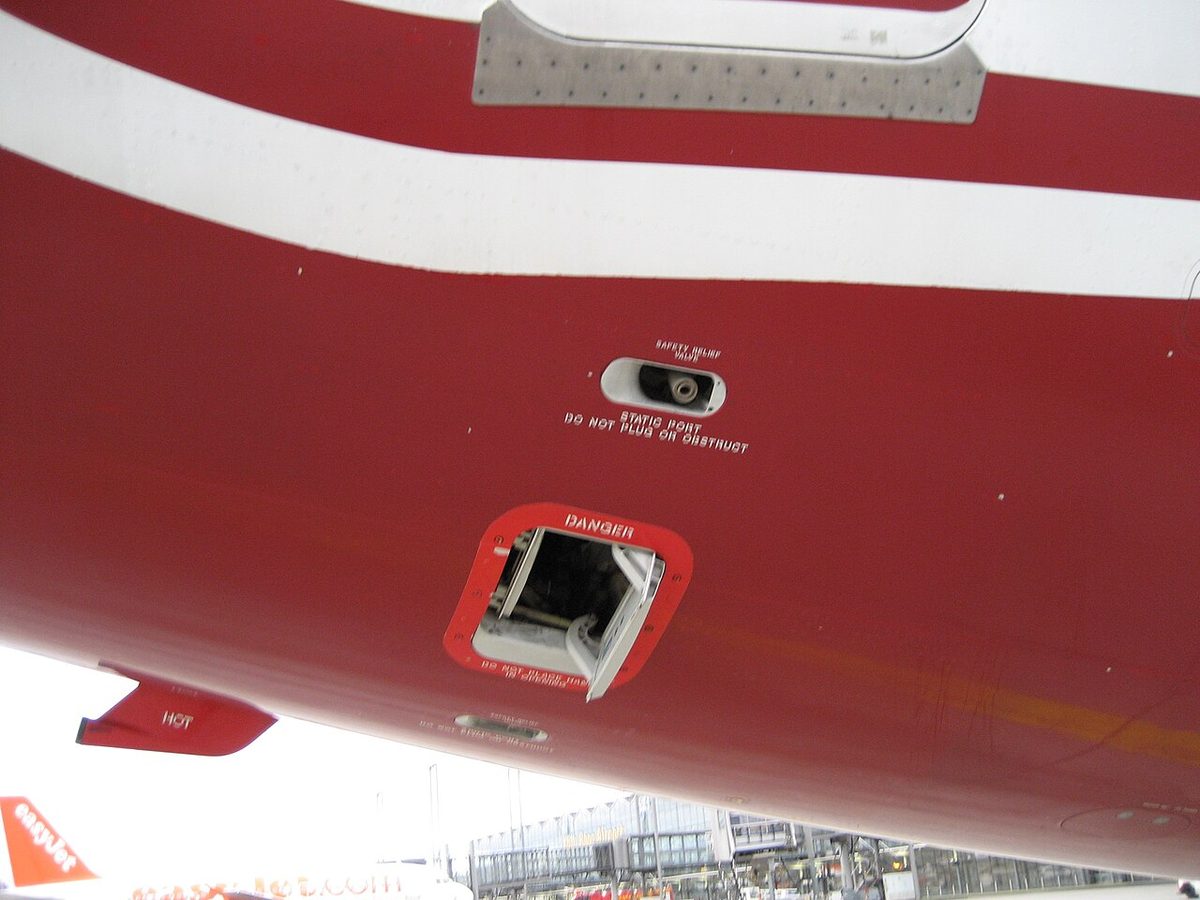
Two consequences are often examined. In a slow leak, the controller compensates by closing the outflow valve further, and the cabin altitude starts to rise only when the leak exceeds what the packs can supply. In the descent, the outflow valve must open progressively: as the differential falls, a wider opening is needed to discharge the same flow, and a valve left at its cruise position would hold the differential and let the cabin descend almost as fast as the aircraft.
Pressure controllers have evolved from pneumatic through electro-pneumatic to electronic. Automatic controllers are duplicated, one active and one standby, and use static pressure, cabin pressure, air/ground logic, the selected cruise and landing altitudes and, for pre-pressurisation, thrust lever position and door status. ATPL texts describe outflow valves driven by two AC motors for automatic control and a DC motor for manual control.
- A320: two cabin pressure controllers (CPCs), one active and one on standby, take inputs from the ADIRS, FMGC, engine interface units and landing gear control interface units. Control transfers automatically 70 seconds after each landing or when the active system fails. The outflow valve actuator has three motors, two automatic and one manual. With the LDG ELEV selector at AUTO the controllers build their schedule from FMGS data; without it, the crew select the landing elevation.
- 737 NG: two identical automatic controllers alternate as the primary from one flight to the next, using ADIRU data, throttle position from the stall management computers and air/ground signals. The crew set the planned cruise altitude on the FLT ALT selector and the landing field altitude on the LAND ALT selector. An amber AUTO FAIL light with ALTN means a single controller failure and transfer to the other; AUTO FAIL alone means both have failed.
- E190-E2: one cabin pressure controller with two channels, master and standby, which swap roles after each flight.
Pressurisation schedule
The pressurisation schedule is the programme the controller follows from the stand to landing. The A320's is typical:
| Mode | What the controller does |
|---|---|
| Ground | Outflow valve fully open before take-off and from 55 s after landing |
| Take-off | Pre-pressurises at 400 ft/min until ΔP reaches 0.1 psi |
| Climb | Cabin altitude follows a pre-programmed law based on the aircraft's rate of climb |
| Cruise | Holds the level-off cabin altitude or the landing elevation, whichever is higher, at most 8,000 ft |
| Descent | Descends the cabin at no more than 750 ft/min, to reach landing field pressure + 0.1 psi shortly before landing |
| Abort | If the aircraft does not climb after take-off, returns the cabin to take-off altitude + 0.1 psi |
The 737 NG enters its cruise mode when the aircraft is within 0.25 psi of the selected FLT ALT and then holds the lowest cabin altitude its differential limits allow: 7.45 psi for a selected FLT ALT of 28,000 ft or below, 7.80 psi up to 37,000 ft and 8.35 psi above, giving 8,000 ft at the 41,000 ft maximum certified ceiling. If the aircraft descends before reaching the selected cruise altitude, the OFF SCHED DESCENT light comes on and the controller programmes the cabin to land at the take-off field elevation.
Isobaric and proportional control
Two control laws make up the classic schedule described in ATPL texts. In the climb, proportional control makes the cabin rate of climb proportional to the aircraft's, but much smaller: typically 300 to 500 ft/min for the cabin while the aircraft climbs at 1,500 to 3,000 ft/min, so the cabin reaches its target at about the time the aircraft levels off.
In cruise, isobaric control holds the cabin altitude constant whatever the aircraft's altitude, within the maximum differential; the differential simply changes with flight level. Once the maximum differential is reached, the cabin can no longer be held: above that altitude the controller maintains the maximum differential and the cabin altitude climbs with the aircraft.
Exam tip: isobaric = constant cabin altitude; the limit on it is the maximum differential pressure. A lower cabin altitude at a given flight level always means a higher differential.
Cabin rate of climb and descent
The cabin rate of change, or cabin vertical speed, is set for comfort. Typical schedules give about 500 ft/min in the climb and about 300 ft/min in the descent. The descent is slower because the middle ear equalises less easily as the pressure rises: air must be pushed back in through the Eustachian tube, which a cold can block (see barotrauma). ATPL texts also quote 0.16 psi per minute, about 11 hPa per minute, as the maximum comfortable rate of pressure change, roughly 300 ft/min near sea level.
These are comfort values, not certification limits: CS 25.841 and 14 CFR 25.841 require the crew to be shown the rate of change but set no maximum. Controllers therefore allow faster rates when needed, such as the A320's 750 ft/min in descent. Abnormal rates are flagged: the A320's ECAM cabin vertical speed flashes at 1,750 ft/min, and the 737 NG's AUTO FAIL light comes on at a cabin rate of 2,000 sea-level ft/min if the controller is not responding properly.
In light pressurised aircraft the pilot sets a cabin rate controller directly: before descent, a cabin altitude slightly above the destination elevation and a comfortable rate, typically 300 to 500 ft/min.
Pre-pressurisation on take-off
On the ground the outflow valve is driven fully open, signalled by the air/ground logic, so that the cabin cannot be pressurised with people working at the doors. Before take-off the controller closes it partly to establish a small differential: pre-pressurisation. It makes the transition to pressurised flight gradual, avoids a pressure surge at rotation and keeps engine fumes out during the take-off roll.
- A320: pre-pressurises at 400 ft/min until ΔP reaches 0.1 psi, then starts the climb law at lift-off.
- 737 NG: at higher power settings on the ground the controller modulates the outflow valve towards closed, slightly pressurising the cabin.
- E190-E2: a TAXI mode, once the doors are closed and N2 is above 60 per cent, targets +0.11 psi, and the take-off mode +0.15 psi.
After landing the process reverses. The A320 releases any remaining pressure at a cabin rate of 500 ft/min at touchdown and opens the outflow valve fully 55 seconds after landing; if both controllers have failed or manual mode is selected, a residual pressure control unit opens it on the ground once the engines are shut down or the speed is below 100 kt. Landing with the cabin still pressurised stresses the structure and can prevent the doors from being opened.
Manual control and ditching
If both automatic systems fail, the crew position the outflow valve themselves with manual pressurisation control.
- A320: with MODE SEL at MAN, the spring-loaded MAN V/S CTL switch drives the outflow valve through its manual motor, UP towards open and DN towards closed, and only short inputs should be used. In MAN the outflow valve does not open automatically at touchdown. Selecting MAN for at least 10 seconds and back to AUTO changes over to the other automatic system.
- 737 NG: with the mode selector at MAN, the outflow valve switch drives the valve through a separate DC motor powered by the standby system, faster than in AUTO, with full travel in up to 20 seconds; manual control remains available on battery power alone. The FCOM cautions that a small movement of the valve can cause a large change in cabin rate.
Manual mode is unforgiving if forgotten: the loss of Helios Airways Flight 522 in 2005 began with a pressurisation mode selector left in MAN after maintenance (see decompression).
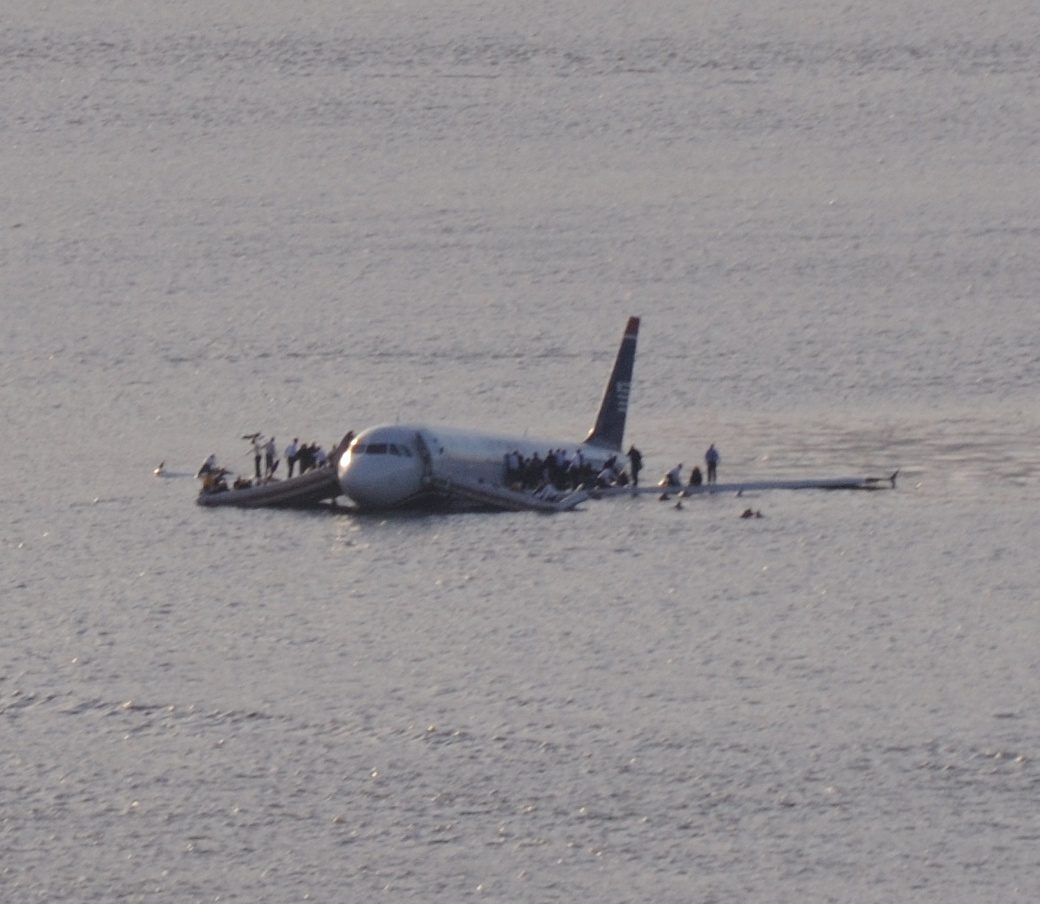
For a ditching, the openings in the lower fuselage must be closed. ATPL texts describe a ditching control that closes all discharge valves to minimise water entry. The A320's DITCHING pushbutton closes the outflow valve, the emergency ram air inlet, the avionics ventilation inlet and extract valves, the pack flow control valves and the forward cargo outlet isolation valve; the safety valves sit above the flotation line. It does not close the outflow valve if that is under manual control, and on the ground, with an LP air cart connected and the doors closed, selecting it lets a differential pressure build up. On the E190-E2 the ditching procedure switches the packs and bleeds off.
Thrust recovery from outflow
The air leaving the cabin still carries energy. Some outflow valves are shaped so that in cruise the escaping air leaves rearwards through a thrust recovery nozzle, giving a small forward thrust. The gain is small on any one flight, but over long flights it adds up to a meaningful fuel saving.
Frequently asked questions
What is cabin altitude?
Cabin altitude is the pressure altitude inside the cabin: the altitude in the standard atmosphere at which the outside pressure equals the cabin pressure. It is what the cabin altimeter shows. An airliner cruising at 37,000 ft typically holds a cabin altitude of 8,000 ft or less, so the occupants breathe as they would at that height. Oxygen rules and cabin altitude warnings are written in terms of cabin altitude, not the altitude at which the aircraft is flying.
What is the maximum cabin differential pressure of an airliner?
It depends on the type. The A320's maximum positive differential is 9.0 psi, with its safety valves set at 8.6 psi, and its maximum negative differential is 1.0 psi. The Boeing 737 NG's relief valves limit the differential to 9.1 psi, and ATPL texts give 9.4 psi for the Boeing 787, which holds a cabin of about 6,000 ft. A higher differential allows a lower cabin altitude at the same flight level but needs a stronger, heavier fuselage.
How does the outflow valve control cabin pressure?
The packs deliver a roughly constant mass flow of air into the cabin, and the outflow valve controls how fast it escapes. Closing the valve keeps more air in, so cabin pressure rises and the cabin altitude falls; opening it lets more out, so the cabin altitude rises. The pressure controller positions the valve to follow its schedule, holding the cabin altitude in cruise and setting comfortable rates in the climb and descent. On the ground it is driven fully open.
Why is the cabin pressurised slightly before take-off?
Pre-pressurisation makes the transition to pressurised flight gradual. With a small differential already established, there is no pressure surge when the aircraft rotates and the controller starts its climb schedule, and engine fumes are kept out during the take-off roll. The A320 pre-pressurises at a cabin rate of 400 ft/min until the differential reaches 0.1 psi; the 737 NG's controller moves the outflow valve towards closed at higher power settings on the ground.
How fast does the cabin climb and descend on an airliner?
Typical pressurisation schedules give a cabin rate of about 300 to 500 ft/min in the climb and about 300 ft/min in the descent, slower going down because the middle ear equalises less easily as pressure rises. These are comfort values: the certification rules require the crew to see the cabin rate of change but set no maximum. Some controllers allow faster rates when needed; the A320 permits up to 750 ft/min in its descent mode.
What does the ditching button do on an airliner?
It closes the valves and openings in the lower fuselage so that water enters the floating aircraft more slowly. On the A320 the DITCHING pushbutton closes the outflow valve, the emergency ram air inlet, the avionics ventilation inlet and extract valves, the pack flow control valves and the forward cargo outlet isolation valve. The outflow valve is not closed if it is under manual control, and the safety valves are already above the flotation line.
Test yourself on Pressurisation Principles and Control
The v1prep banks cover this topic in Aircraft General Knowledge (021), with a worked explanation for every answer. EASA ATPL, PPL, IR and CPL, the FAA written tests and A320/B737 type ratings.
Start practising →Sources and further reading
- 14 CFR 25.841, Pressurized cabins
- EASA Easy Access Rules for Large Aeroplanes (CS-25)
- EASA, Explanatory Note to ED Decision 2018/001/R, Part-FCL theoretical knowledge learning objectives (021 Airframe and Systems)
- FAA Pilot's Handbook of Aeronautical Knowledge (FAA-H-8083-25), Chapter 7, Aircraft Systems
- FAA Aviation Maintenance Technician Handbook, Airframe (FAA-H-8083-31B), Chapter 16, Cabin Environmental Control Systems
- FAA AC 61-107B, Aircraft Operations at Altitudes Above 25,000 Feet MSL and/or Mach Numbers Greater Than .75
Library articles are written for study and exam preparation. They do not replace your aircraft's approved documentation, your operator's procedures or the regulations themselves.