Southwest Airlines Flight 1380
- Date
- Phase of flight
- Climb
- Location
- Philadelphia, Pennsylvania, United States (emergency landing at Philadelphia International Airport)
- Aircraft
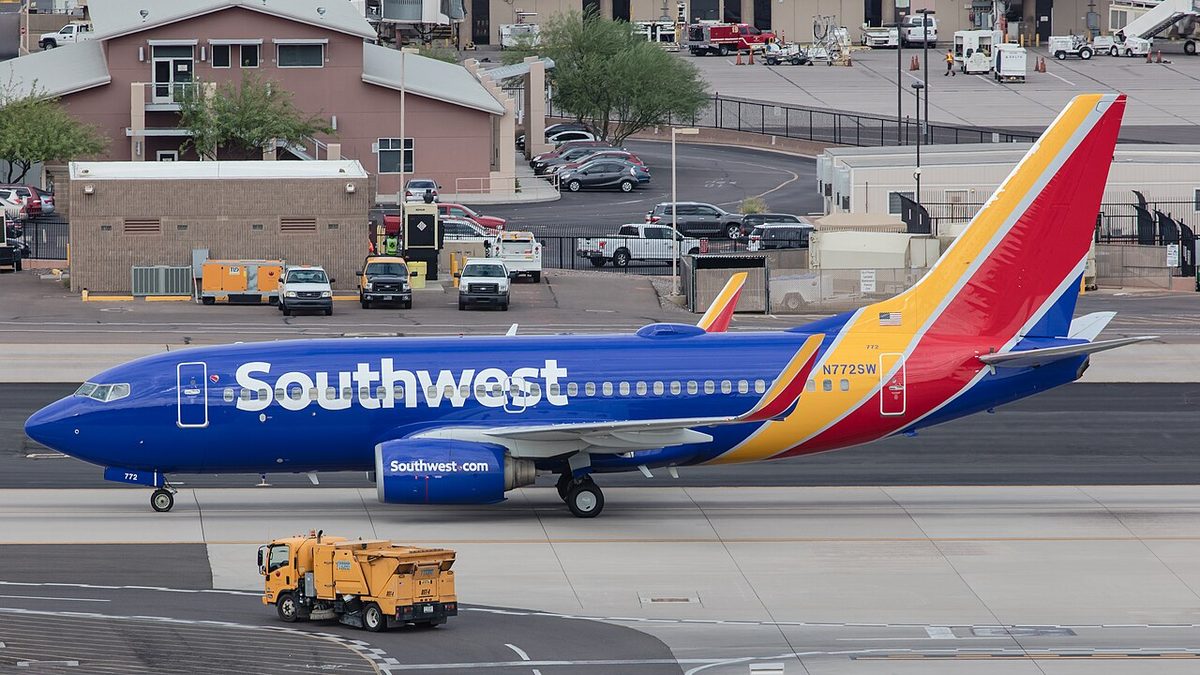
- Boeing 737-7H4 (737-700)
- Registration
- N772SW
- Operator
- Southwest Airlines
- Flight
- Southwest Airlines 1380
- Occupants
- 149
- Fatalities
- 11 passenger killed; 8 passengers received minor injuries
- Investigating body
- National Transportation Safety Board (United States)
- Final report
- NTSB/AAR-19/03
- Report date
- Report title
- Left Engine Failure and Subsequent Depressurization, Southwest Airlines Flight 1380, Boeing 737-7H4, N772SW, Philadelphia, Pennsylvania, April 17, 2018
On 17 April 2018 a fan blade on the left engine of Southwest Airlines flight 1380, a Boeing 737-700, broke off at FL320 because of a fatigue crack. Fan cowl debris struck the fuselage near a cabin window, the window departed, the cabin depressurised and a passenger was killed; the crew landed at Philadelphia.
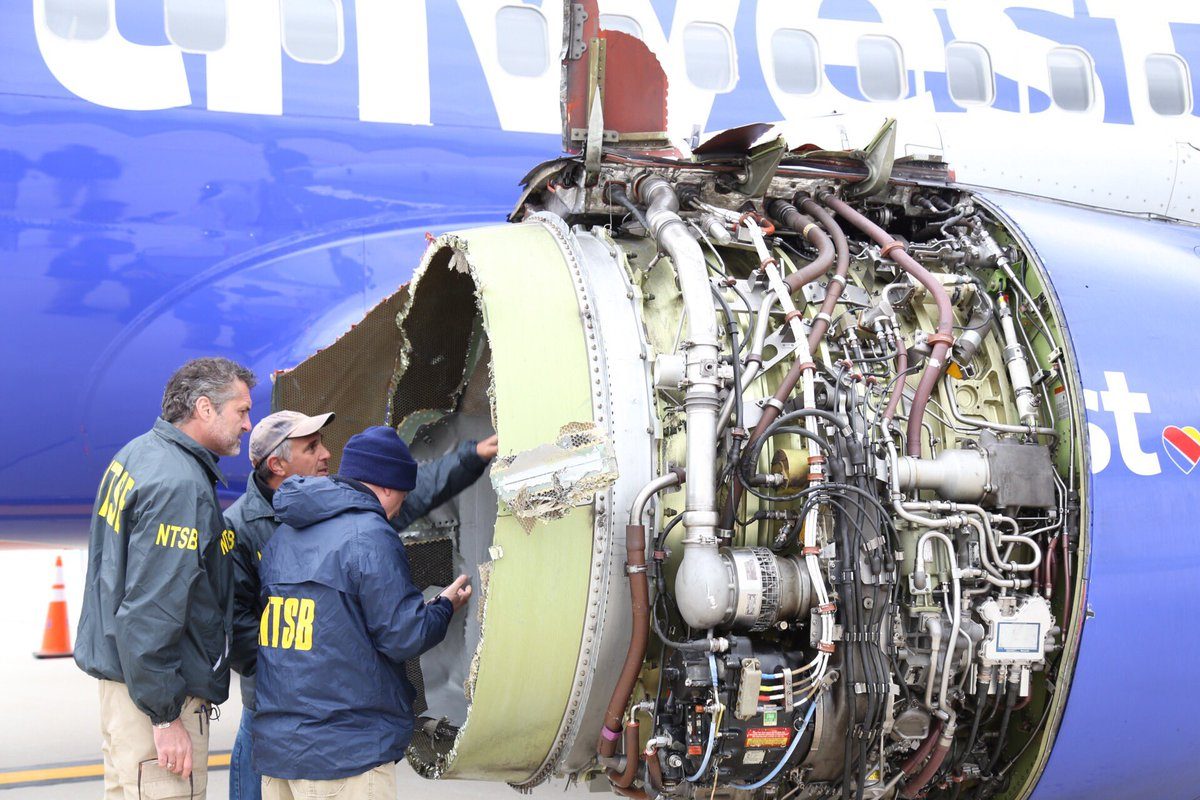
On 17 April 2018 Southwest Airlines flight 1380, a Boeing 737-700 flying from New York LaGuardia to Dallas Love Field, was climbing through FL320 when a fan blade broke off inside its left engine. Pieces of the engine inlet and fan cowl tore away and struck the wing, fuselage and tailplane. One fragment hit the fuselage beside a cabin window, the window left the airplane, and the cabin depressurised within seconds. The passenger seated next to it was fatally injured.
The crew made an emergency descent and landed at Philadelphia about 17 minutes after the failure. The National Transportation Safety Board (NTSB) adopted its final report, AAR-19/03, on 19 November 2019. It traced the blade failure to a fatigue crack that inspections had missed, and found that the way the engine and nacelle behaved after the blade release had not been predicted when the engine and airplane were certificated.
The accident is a lesson in engine and airframe certification, in rapid decompression, and in how a crew balances checklists against the need to fly a damaged airplane and land. Times below are eastern daylight time (EDT), as in the report.
The flight
N772SW was delivered new to Southwest in July 2000 and had flown 63,521 hours and 37,021 cycles. Its two CFM International CFM56-7B24 engines each have 24 wide-chord titanium fan blades. The left engine had been installed on the airplane in November 2012.
The captain, aged 56, had about 11,715 hours, 10,513 of them on the 737, and had flown the A-7 and F-18 for the US Navy. The first officer, aged 44, had about 9,508 hours, 6,927 on the 737, and had flown in the US Air Force. It was the second day of a four-day trip. There were three flight attendants and 144 passengers, and every passenger seat was taken. The first officer was pilot flying.
The flight took off at 10:43 and was cleared to FL380.
The accident
Just after passing FL320, at 11:03:33, fan blade No. 13 of the left engine fractured at its root. The crew heard a loud bang and felt heavy vibration. The left engine's fan and core speeds dropped and the airplane began an uncommanded roll to the left.
| Time (EDT) | Event |
|---|---|
| 11:03:33 | Fan blade failure in the left engine, just above FL320 |
| 11:03:39 | Cabin altitude warning horn |
| 11:03:44 | Left roll reaches 41.3°; the first officer rolls the wings back towards level |
| 11:03:58 | Both thrust levers to idle; emergency descent begins |
| 11:04:09 | Left engine start lever to cutoff |
| 11:04:54 | Captain reports "an engine fire descending" to ATC |
| 11:05:52 | Cleared direct to Philadelphia (PHL) |
| 11:08:12 | Emergency declared passing 17,000 ft |
| 11:09:30 | Captain takes control at 13,600 ft |
| 11:11:46 | Descending through 10,000 ft |
| 11:15:04 | Flight attendant reports the window and the injured passenger |
| 11:20:30 | Landing on runway 27L at PHL |
Within about three seconds of the blade release, fragments of the fan cowl had struck the fuselage and the window beside seat 14A had departed. The cabin altitude, about 5,773 ft before the failure according to Boeing's calculation, rose past 10,000 ft and set off the warning horn six seconds after the bang. The passenger oxygen masks are designed to drop automatically at a cabin altitude of 14,000 ft, and all 48 seat-set oxygen generators were found activated.
From 11:03:42 the cockpit voice recorder captured about two minutes of unintelligible communications. The pilots put on their oxygen masks, with some initial confusion about the switch that selects the mask microphone, and were communicating through them by 11:04:54. The emergency descent began 25 seconds after the failure, reaching a peak descent rate of 5,228 ft/min. Airspeed stayed between 280 and 300 kt down to 17,000 ft.
When the controller asked where the crew wanted to go, the captain asked for the closest airport. The controller suggested Harrisburg (MDT), but most of that transmission was not captured on the cockpit recording; the captain replied that they were looking at Philadelphia, which the first officer had identified on a map. At the time of the failure the airplane was 29 NM from MDT and 57 NM from PHL.
At 11:09:30 the captain took over as pilot flying (company procedures required the captain to conduct the landing after an engine shutdown), and the first officer began the Engine Fire or Engine Severe Damage or Separation checklist. Because of the vibration the captain flew slower than the VMO target of the Emergency Descent checklist, which also advises limiting speed when structural integrity is in doubt.
In the cabin, two flight attendants, helped by two passengers, brought the passenger in seat 14A back inside, and passengers with medical training began CPR. The first officer's first interphone call to the cabin went unheard because of the noise. When a flight attendant reached him at 11:15:04 and reported that a window was out and a passenger injured, the captain decided to shorten the approach. Unsure of how the damaged airplane would handle, she chose flaps 5 instead of the flaps 15 recommended for a single-engine landing, and planned an approach speed of 180 kt, 20 kt above the flaps 15 speed. The airplane landed on runway 27L at 11:20:30 at about 171 kt, using reverse thrust on the right engine, and stopped on a high-speed taxiway next to a fire truck. The passengers left by airstairs.
The investigation
A fatigue crack in the fan blade dovetail
Each CFM56-7B fan blade has a dovetail root that slides into the fan disk. The dovetail is shot-peened to add a compressive surface layer that resists fatigue, then coated. Blade No. 13 fractured about 0.04 inch outboard of that coating. Its fracture surface showed a low-cycle fatigue crack with multiple origins on the convex side, six crack arrest lines and a final ductile overstress region. The material and microstructure met the specification.
The blade set had accumulated 32,636 cycles since new and 10,712 cycles since its last overhaul in October 2012. Crack growth analysis estimated about 20,000 cycles from initiation to failure, which placed the start of the crack before that overhaul. The overhaul included a fluorescent penetrant inspection, which did not find it. The blades had since been relubricated seven times, with a visual inspection each time, the last 1,704 cycles before the accident. CFM found that normal operating stresses in the dovetail were higher than the peak stresses originally predicted, and blades from the engine showed relaxed residual stresses in their shot-peened areas.
A similar event had occurred before. On 27 August 2016, Southwest flight 3472, another 737-700, lost a fan blade from the same engine type while climbing through FL310 and landed safely at Pensacola. After that accident CFM introduced an eddy current inspection at overhaul and an ultrasonic inspection that can be done on the wing at relubrication. By August 2019 these methods had found 15 cracked blades on other engines.
Why the cowl came apart
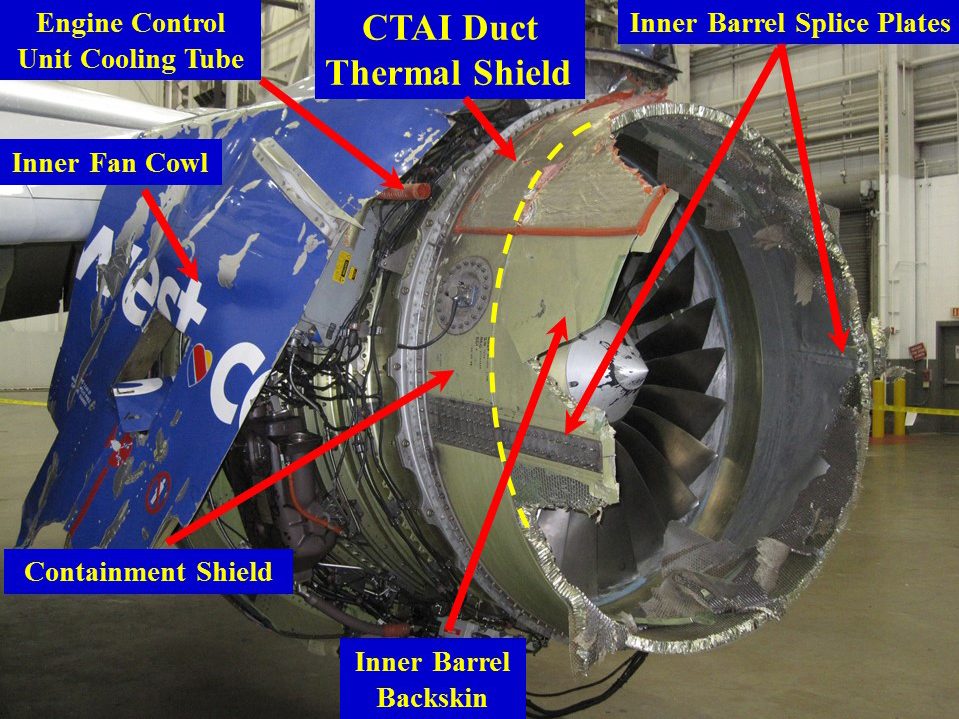
Certification tests had shown that the CFM56-7B fan case could contain a released blade, and Boeing had analysed how the inlet and fan cowl would respond. The accident went beyond those assumptions:
- blade fragments travelling forward into the inlet had a steeper trajectory than in the certification tests, and together with a displacement wave through the fan case they caused portions of the inlet to break away;
- the blade struck the fan case at the six o'clock position, near a radial restraint fitting at the bottom of the inboard fan cowl, whereas the certification test had released a blade at twelve o'clock;
- the fitting carried large loads into the fan cowl, a load path not accounted for in its design, and cracks severed the three latches joining the two cowl halves, so large sections of both halves departed.
Marks on the fuselage near row 14 matched the inboard fan cowl aft latch keeper. The NTSB concluded that, given the certification tests and analyses of the time, these events could not have been predicted. Modelling tools developed since then allow manufacturers to analyse such events far better.
The window and the cabin
This was the first known complete loss of a passenger window in the Boeing 737 fleet. The outer pane, certified by test in 1967, was designed for pressure loads, and the regulation did not require it to withstand impact. The NTSB's timeline study found that the window departed between 0 and 3.2 seconds after the blade failure.
Checklists and decisions
The Engine Fire or Engine Severe Damage or Separation checklist began about six minutes after the failure, while the crew flew the airplane, descended and talked to air traffic control. The crew had already carried out its two most urgent items, thrust lever to idle and start lever to cutoff, within 36 seconds of the failure. Three other applicable checklists (One Engine Inoperative Landing, Cabin Altitude Warning or Rapid Depressurization, and Emergency Descent) were not called for as such, although key items were performed. The crew also received four frequency changes and repeated questions about fuel, occupants and the nature of the emergency.
The NTSB found that this approach "allowed the crew to appropriately balance the procedural requirement of executing checklists with the high workload associated with maintaining airplane control and accomplishing a safe and timely descent and landing". It judged the choice of Philadelphia appropriate: the time to descend was about the same for either airport, and PHL had four runways, the longest 12,000 ft, the highest rescue and firefighting index (E) and was on Southwest's network.
At landing none of the flight attendants was in her jumpseat. The airplane was full, two passengers from row 14 had to be reseated, and one of them occupied an aft jumpseat. The NTSB noted that, had an evacuation been needed, the flight attendants were not in position to open their exits.
Probable cause and contributing factors
The NTSB determined that the probable cause of this accident was "a low-cycle fatigue crack in the dovetail of fan blade No. 13, which resulted in the fan blade separating in flight and impacting the engine fan case at a location that was critical to the structural integrity and performance of the fan cowl structure. This impact led to the in-flight separation of fan cowl components, including the inboard fan cowl aft latch keeper, which struck the fuselage near a cabin window and caused the window to depart from the airplane, the cabin to rapidly depressurize, and the passenger fatality."
The NTSB found that flight crew qualifications, medical conditions, the airplane's airworthiness before the failure and Southwest's maintenance were not factors.
Safety recommendations and what changed
The NTSB issued seven recommendations:
| Number | To | Subject |
|---|---|---|
| A-19-17 | FAA | Require Boeing to find the critical fan blade impact locations on the CFM56-7B fan case and redesign the 737NG fan cowl structure |
| A-19-18, A-19-19 | FAA | Install the redesigned fan cowl on new 737NGs and retrofit the fleet |
| A-19-20 | FAA | Require airplane and engine makers to analyse all critical fan blade impact locations and their effect on the nacelle |
| A-19-21 | FAA | Guidance on reseating passengers after an in-flight loss of seating capacity |
| A-19-22 | Southwest Airlines | Teach flight attendants the importance of being secured in a jumpseat for emergency landings |
| A-19-23 | EASA | The same certification change as A-19-20 |
Inspection requirements tightened quickly. On 20 April 2018, three days after the accident, CFM issued a service bulletin, and the FAA and EASA issued emergency airworthiness directives, requiring ultrasonic inspections of fan blades, starting with engines that had 30,000 or more cycles since new. The requirements were extended to all blades with more than 20,000 cycles and made repetitive, and from late 2018 the interval was 1,600 cycles. The relubrication interval was also reduced to 1,600 cycles, and in August 2019 CFM called for fan blades to be removed before 55,000 cycles. The NTSB found that eddy current inspection at overhaul and ultrasonic inspection at relubrication should allow cracked blades to be found before they fail.
Lessons for pilots
Oxygen first, then fly. A cabin altitude warning demands immediate masks and communication: on Southwest's checklist the memory items were to don masks and set 100 %, then establish crew communication. The confusion over the mask microphone switch is a reminder to know the audio panel as well as the mask itself.
Exam tip: On the 737 the cabin altitude warning sounds when cabin altitude reaches 10,000 ft (the switch tolerance is ±1,000 ft), and the passenger oxygen masks deploy automatically at a cabin altitude of 14,000 ft. See decompression and hypoxia.
Adapt the emergency descent to the damage. The standard descent is at VMO with speedbrakes. With heavy vibration and unknown structural damage the captain flew slower, as the checklist allows when structural integrity is in doubt. The NTSB noted that speedbrakes could have shortened the descent, but could also have worsened handling with a damaged engine and wing.
Note: US rules quoted in the report require flight crew oxygen above a 12,000 ft cabin altitude, and between 10,000 and 12,000 ft for any period over 30 minutes; the Emergency Descent checklist targets 10,000 ft or the lowest safe altitude, whichever is higher.
Checklists serve the flight, not the other way round. The crew recognised the two urgent engine items without a checklist and flew the airplane first. The NTSB supported their prioritisation while stating that performing required checklists according to standard operating procedures remains critical. Asking controllers for a single frequency, as this captain did, can reduce workload. See standard operating procedures and checklists.
"Nearest suitable" is measured in time and capability. Southwest defined the nearest airport as nearest "in point of time", and suitability included runways, rescue services and company support. A more distant airport can be the right answer when it is no slower to reach and better equipped.
Configuration for an unknown airplane. The captain chose flaps 5 and a higher speed so that the airspeed would not get too slow on an airplane whose handling had changed; the cost was a touchdown at about 171 kt on a 12,000 ft runway. Controllability checks at a safe height help to inform such a choice. See engine failure and engine fire.
Keep the cabin crew in the loop and in their seats. Direct contact with the flight attendants was only established about five and a half minutes before landing. A short, early briefing (nature of the emergency, time to landing, whether to expect an evacuation) helps the cabin prepare, and the NTSB stresses that flight attendants must be secured in their jumpseats for an emergency landing.
The NTSB determined that the probable cause was "a low-cycle fatigue crack in the dovetail of fan blade No. 13, which resulted in the fan blade separating in flight and impacting the engine fan case at a location that was critical to the structural integrity and performance of the fan cowl structure". The resulting separation of fan cowl components, including the inboard fan cowl aft latch keeper, caused a cabin window to depart, the cabin to rapidly depressurise, and the passenger fatality.
Train this on v1prep
The theory behind this accident and the questions that test it, each with a worked explanation.
Question banks
- ATPL Human Factors494 questions with worked explanations
- B737 Air Systems124 questions with worked explanations
- B737 Engines126 questions with worked explanations
In the Library
- Decompression and Emergency DescentCovers loss of cabin pressure, the emergency descent procedure, and the supplemental and first-aid oxygen requirements for crew and passengers.
- Hypoxia and HyperventilationCovers respiration and gas exchange, the types, stages and prevention of hypoxia, and how to recognise and correct hyperventilation.
- Engine Failure and Engine FireCovers engine failure after V1 and after take-off, the engine fire and severe damage drills, single-engine approach and landing, and loss of thrust on all engines, including in-flight relight.
- Standard Operating Procedures and ChecklistsWhy SOPs exist, how normal, abnormal and supplementary procedures differ, how cockpit flows, challenge-and-response and read-and-do checklists are used and disciplined, and the place of memory items, touch drills and the QRH.
Frequently asked questions
What caused the Southwest 1380 engine failure?
The NTSB found that fan blade No. 13 in the left CFM56-7B engine broke off at its root because of a low-cycle fatigue crack in the dovetail, the part that fits into the fan disk. The crack started because normal operating stresses in the dovetail were higher than predicted. It was most likely not detectable with the inspection methods used at the blade set's last overhaul and later relubrications.
How did the window break on Southwest flight 1380?
The released fan blade struck the fan case near the bottom of the engine, sending loads into the fan cowl through a radial restraint fitting. The cowl failed and large parts broke away. One of them, the inboard fan cowl aft latch keeper, struck the fuselage by the window next to seat 14A, and the window departed the airplane within about three seconds of the blade failure, causing a rapid depressurisation.
How many people died on Southwest flight 1380?
One passenger, seated in 14A next to the window that departed the airplane, was fatally injured. Eight other passengers received minor injuries. There were 149 people on board: 144 passengers and 5 crew, comprising two pilots and three flight attendants. The Boeing 737-700 landed safely at Philadelphia International Airport about 17 minutes after the engine failure.
Why did Southwest 1380 divert to Philadelphia rather than Harrisburg?
At the time of the failure the airplane was 29 NM from Harrisburg and 57 NM from Philadelphia. The NTSB found the descent time to either airport would have been about the same, and that Philadelphia had four runways, the longest 12,000 ft, and the highest level of rescue and firefighting cover. It concluded that the crew's choice of Philadelphia was appropriate.
What changed after Southwest flight 1380?
The FAA and EASA issued emergency airworthiness directives on 20 April 2018 requiring ultrasonic inspections of CFM56-7B fan blades, with repeat inspections later required every 1,600 cycles, and the blade relubrication interval was cut to 1,600 cycles. The NTSB recommended a redesigned 737NG fan cowl, certification rules requiring analysis of critical fan blade impact locations, and guidance on reseating passengers when seats are lost.
Sources and further reading
Crash Investigations pages summarise official investigation reports for study and exam preparation. The investigating body's report is the authoritative account and prevails wherever it differs from this page. Under ICAO Annex 13, an investigation exists to prevent accidents, not to apportion blame or liability.