Boeing 787 Flight Controls
The Boeing 787 flight control system is a fly-by-wire system flown with a conventional control wheel, column and rudder pedals. Electronic flight control computers command hydraulic and electric surface actuators through roll-rate and yaw-rate control laws, with envelope protection and autopilot backdrive of the pilots' controls.
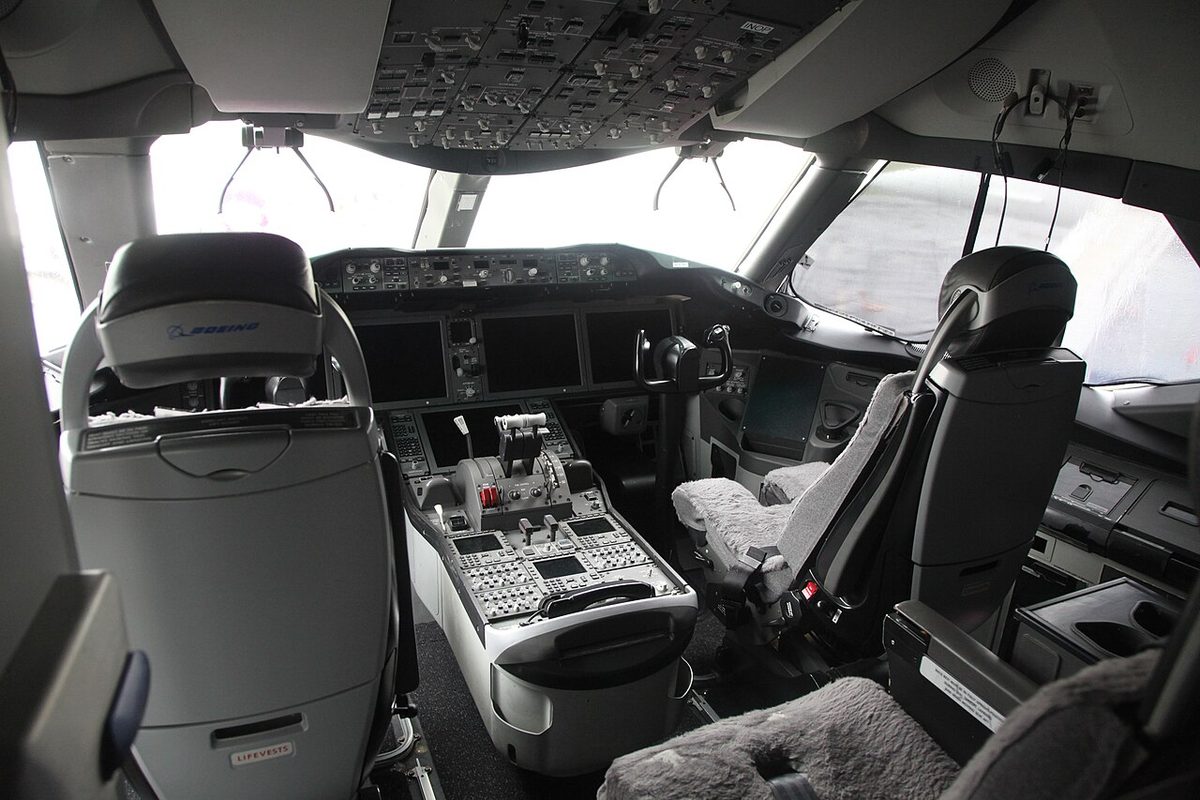
The Boeing 787 is a fly-by-wire aircraft flown with a control wheel. Pilot inputs on the wheel, column and rudder pedals are measured electrically and passed to flight control computers, which drive the surfaces through hydraulic and electric actuators. The 787 keeps conventional controls in front of each pilot, and the autopilot moves them through backdrive actuators.
The FAA treats the 787 and the 777 as separate type ratings with commonality, and its Flight Standardization Board (FSB) report rates the flight control design differences between them at level A, self-instruction. The original 2011 report summarises the handling as roll-rate and yaw-rate command with the same handling as the 777. What the FSB singles out for training is the flight control modes, the envelope protection and the fly-by-wire speed stability characteristics.
This article relies on the FSB reports, the FAA Master Minimum Equipment List (MMEL) and the EASA type-certificate data sheet (TCDS). The 787 flight crew operations manual is not public, so details such as control law gains or protection limits are not given here. The general principles are in fly-by-wire.
Fly-by-wire with a control wheel
Each pilot has a control wheel on a column and rudder pedals. The MMEL lists six position transducers on each of these controls, the wheel, the column and the pedals, plus two alternate control wheel position transducers; one transducer of each set may be inoperative for dispatch provided the direct mode rate sensors work.
The original FSB differences table describes the 787 control laws, compared with the 777, as:
- Roll: roll rate command, same handling;
- Yaw: yaw rate command, same handling.
Two requirements concern how the fly-by-wire system behaves. The FSB report requires initial training in fly-by-wire speed stability characteristics and aircraft trimming, and initial and recurrent checking in the proper management of the speed and attitude stability functions of the flight controls in normal operations. The EASA certification basis includes a special condition on control surface position awareness, and the MMEL lists a flight controls synoptic display.
Flight control computers and modes
The MMEL lists three flight control modules (FCMs), left, centre and right, together with a PRIMARY FLIGHT COMPUTERS DISC light, a primary flight control system (PFCS) interface and an actuator delta pressure function. Its provisos link the modules to the high-lift system: with the centre or right FCM inoperative, the flap/slat hydraulic control module solenoid coils are treated as inoperative, and with the right FCM inoperative the cruise flap function as well. In each case the remaining FCMs must be power cycled and operate normally.
The EASA TCDS, in the equipment lists of the 787-9 and 787-10 certification basis, names among the flight control items FCE cabinets and an FCE battery, aileron and flaperon REUs, a spoiler REU, an elevator REU and an EMCU for the spoiler and stabiliser trim actuators; the data sheet does not spell these abbreviations out. The original FSB report states that the attitude shown on the primary displays is provided by data from the Flight Control Electronics, using voted pitch and roll from the four inertial measurement units of the earth reference system.
The FSB requires flight training in the flight control modes, in initial and recurrent training alike, but neither report names or describes the modes, and the other public documents used here do not either. The MMEL lists four direct mode rate sensors, one of which may be inoperative for dispatch provided the control wheel, column and rudder pedal position transducers all work.
Primary surfaces: elevators, rudder, ailerons, flaperons and spoilers
The original FSB report describes 787 roll control as a "different mix" of surfaces from the 777 with the "same roll effect". The surfaces the sources name are:
| Axis | Surfaces and actuation | Source |
|---|---|---|
| Pitch | Elevators; stabiliser for trim | TCDS; FSB 2011 |
| Roll | Ailerons and flaperons | TCDS; FSB 2011 |
| Yaw | Rudder, rudder pedals with six transducers, rudder trim | MMEL |
| Speedbrakes | 14 spoilers | MMEL |
A flaperon is a surface that can act both as an aileron and as a flap. The spoilers are numbered 1 to 14. Spoilers 4, 5, 10 and 11 are moved by electro-mechanical actuators (EMAs), and the other ten by hydraulic actuators, so the spoilers do not all depend on hydraulic power. The speedbrake lever has four position transducers and an ARMED detent for the automatic speedbrake function. Background on these surfaces is in roll control, adverse yaw and spoilers.
The system also includes modal suppression accelerometers (MSAs), whose number the MMEL gives by model: two aft on the 787-8, two aft and two forward on the 787-9, and four aft and forward on the 787-10. EASA's certification basis for the 787-10 includes a special condition on the aeroelastic stability requirements of the flaps-up vertical modal suppression system.
High-lift devices
The 787 has leading-edge slats and trailing-edge flaps, positioned by the flap lever, which has four position transducers. The EASA TCDS also records equivalent safety findings titled Krueger Flaps for the 787-9 and 787-10 and "Leading Edge Seal Krueger Flap Actuation" for the 787-8, so a Krueger flap forms part of the leading-edge high-lift system. Flaps and slats are moved through a flap/slat hydraulic control module (HCM), and the MMEL lists 24 flap position and skew sensors and four slat position sensors. The 787-10 certification tables also name a slat electric motor controller.
Several back-up paths exist. The MMEL lists a flap secondary mode, a slat secondary mode and an alternate flap/slat control with an ARM switch and ALTN light. The original FSB report calls the alternate flap operation an "alternate mode" with minor differences from the 777.
| Item | 787-8 | 787-9 and 787-10 |
|---|---|---|
| Normal landing flaps | 25 and 30 | 25 and 30 |
| Additional take-off flaps | None | 10, 17 and 18 (placard shows their speeds) |
Cruise flaps, the trailing edge variable camber function, is new compared with the 777: the original FSB report describes it as a new performance enhancement system with its own EICAS message, and the MMEL also lists a flap variable camber trim unit (VCTU) power control. Flap load relief, by contrast, is described as functionally equivalent to the 777's but with different threshold sensing. More on flaps in general is in high-lift devices.
Trim and the stabiliser
The original FSB differences table describes the 787 stabiliser trim as electrically actuated, with an electrical back-up trim control. The MMEL lists two control wheel pitch trim switches, alternate pitch trim switches, two stabiliser control channels, three stabiliser position transducers and three stabiliser load transducers. Two further trim differences from the 777 are listed: aileron trim has been eliminated, and the trim indication sits on the primary EICAS display. Rudder trim remains; the MMEL lists a rudder trim switch high-rate function.
The EASA TCDS records, for all three models, equivalent safety findings on trim systems and on out-of-trim characteristics, and the FSB report pairs fly-by-wire speed stability with aircraft trimming in its training requirement.
Envelope protection
The FSB report lists the envelope protection items pilots must receive in initial flight training:
- bank angle indications and protection;
- thrust asymmetry protection;
- enhanced underspeed (stall) protection, called Enhanced Stall Protection (ESP) in the original report;
- overspeed protection.
Thrust asymmetry compensation (TAC) is described in the original report as embedded in the flight control law and yaw-rate based, available full time with no TAC switch. Bank angle protection appears as an MMEL item of its own, and the MMEL lists two stick shaker systems. The FSB accepts a demonstration of the overspeed protection in place of training in tuck and Mach buffet. In the EASA certification basis, speed protection appears in an equivalent safety finding titled "Dive Speed Definition, with Speed Protection System", alongside a finding on flight control system failures and a special condition on design manoeuvre requirements.
Exam tip: the 787 is fly-by-wire with a control wheel, not a sidestick. Its envelope protection covers bank angle, thrust asymmetry, underspeed (stall) and overspeed, and its thrust asymmetry compensation is part of the flight control law, with no TAC switch.
Autopilot backdrive
The EASA TCDS lists autopilot backdrive actuators for the control wheel, the control column and the rudder pedals, and the MMEL lists three autopilot backdrive actuator systems. With the autopilot engaged, these actuators move the pilots' wheel, column and pedals as the autopilot flies. The MMEL links backdrive to protection: with the wheel backdrive actuator inoperative and deactivated, bank angle protection is considered inoperative. Autopilot principles are covered in autopilot.
What pilots train for
The FSB report sets out what is special about the 787 for pilots:
- Flight control modes: in initial and recurrent flight training.
- Envelope protection: the aircraft's response to bank angle, thrust asymmetry, underspeed and overspeed protection, in initial training.
- Fly-by-wire speed stability characteristics and aircraft trimming: in initial training.
- Partial flap landing: because flap extension failure is extremely remote by system design, a partial flap approach and landing is demonstrated in checks rather than a no-flap landing.
From the 777-300ER to the 787-8, the FSB rates the flight control design differences at level A. The engine-failure manoeuvres, engine failure at V1, the engine-inoperative ILS, the go-around marked "TAC off" and the one-engine manual landing, are rated at level D (a level 6 or 7 flight training device or a level A or B full flight simulator), each with the remark "TAC off". The original 2011 report noted that steep turns and approaches to stalls would be demonstrated in training but not typically checked in a 787 programme.
Frequently asked questions
Is the Boeing 787 fly-by-wire, and does it have a sidestick?
It is fly-by-wire, but without sidesticks: each pilot has a conventional control wheel and column and rudder pedals. Their movements are measured by position transducers, six each for the wheel, column and pedals according to the MMEL. The original FAA FSB report describes roll-rate and yaw-rate command laws with the same handling as the 777, and the autopilot moves the controls through backdrive actuators.
What envelope protection does the Boeing 787 have?
The FAA FSB report lists bank angle indications and protection, thrust asymmetry protection, enhanced underspeed (stall) protection and overspeed protection as special emphasis items in initial flight training. The original report calls the stall feature Enhanced Stall Protection. Training in tuck and Mach buffet is not applicable to the 787, and a demonstration of the overspeed protection is an acceptable substitute.
What are the normal landing flap settings on the 787?
Flaps 25 and flaps 30, for the 787-8, 787-9 and 787-10 alike, according to the FAA FSB report. For take-off, the 787-9 and 787-10 add flap settings 10, 17 and 18, which the 787-8 does not have, with a flap placard showing their speeds. Because flap extension failure is extremely remote by design, checks demonstrate a partial flap approach and landing rather than a no-flap one.
What is thrust asymmetry compensation on the 787?
Thrust asymmetry compensation (TAC) counters the yaw after an engine failure. The original FAA FSB report describes it on the 787 as embedded in the flight control law and yaw-rate based, available full time, with no TAC switch, which is a difference from the 777. The current FSB report lists thrust asymmetry protection among the envelope protection items trained in initial flight training.
What are cruise flaps on the 787?
Cruise flaps is the name the MMEL gives, in brackets, to the 787's trailing edge variable camber function. The original FAA FSB report describes the cruise flaps system as a new performance enhancement system with its own EICAS message. It is separate from flap load relief, which the FSB describes as functionally equivalent to the 777's but with different threshold sensing.
Test yourself on Boeing 787 Flight Controls
The v1prep banks cover this topic in the 787 type-rating bank, with a worked explanation for every answer. EASA ATPL, PPL, IR and CPL, the FAA written tests and A320/B737 type ratings.
Start practising →Sources and further reading
- FAA Flight Standardization Board Report, Boeing 787, Revision 7 (8 May 2019)
- FAA Flight Standardization Board Report, Boeing 787 (original report, 25 August 2011)
- FAA Master Minimum Equipment List, Boeing 787, Revision 19 (20 May 2025)
- EASA Type-Certificate Data Sheet EASA.IM.A.115, Boeing 787-8, 787-9 and 787-10, Issue 30
- FAA Flight Standardization Board Report, Boeing 777, Revision 12 (draft), 787-8 to 777-300ER differences
- Boeing AERO magazine, Q4 2007, M. Sinnett, 787 No-Bleed Systems: Saving Fuel and Enhancing Operational Efficiencies
Library articles are written for study and exam preparation. They do not replace your aircraft's approved documentation, your operator's procedures or the regulations themselves.