B737 Warning Systems
The Boeing 737 warning systems alert the crew through red warning, amber caution and blue advisory lights, a master caution system with two system annunciator panels on the glareshield, distinct aural signals such as the clacker and the warning horns, the stick shaker, and the ground proximity warning system with its callouts.
The Boeing 737 has no central alerting display. It warns its crew with coloured lights near the pilots' line of sight, a master caution system that gathers the overhead cautions into two annunciator panels on the glareshield, distinct sounds for distinct hazards, the stick shaker and the ground proximity warning system (GPWS). Each alert tells the crew how urgent the problem is and where to look; the non-normal checklist then tells them what to do.
This article follows the 737 NG flight crew operations manual (FCOM), with 737 MAX differences at the end. The general principles are in flight deck layout and master warnings and GPWS and TAWS; the Airbus approach is in A320 ECAM and warning system.
Master caution and annunciator panel
The lights follow a colour code:
| Colour | Meaning |
|---|---|
| Red | Immediate attention: engine, wheel well, cargo or APU fire, autopilot or autothrottle disengagement, landing gear unsafe |
| Amber | Timely attention: caution |
| Blue | Information: electrical power available, valve position, equipment status, cabin or ground calls; some show bright while a valve moves, then dim |
| Green | Fully extended configuration, such as landing gear and leading edge devices |
The two red master FIRE WARN lights come on for a fire warning or test in an engine, the APU, the main wheel well or a cargo compartment, with the fire bell and, on the ground, the remote APU fire horn. Pushing one extinguishes both, silences the bell and horn and resets the system (B737 fire protection).
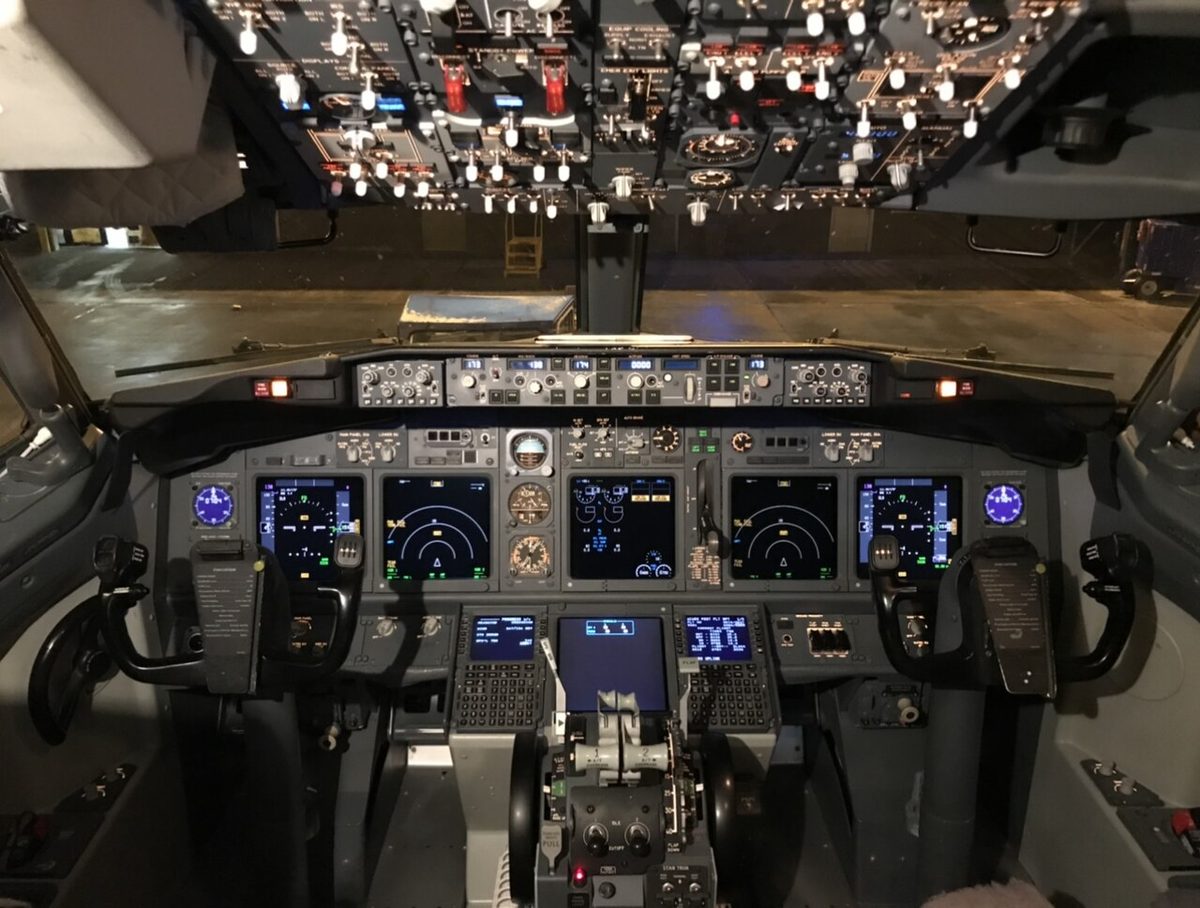
The amber MASTER CAUTION lights come on whenever a system annunciator light does. Two system annunciator panels sit on the glareshield, twelve lights in all, and cover only the systems on the forward overhead, aft overhead and fire control panels; among them are FLT CONT, HYD, FUEL, AIR COND, ENG, DOORS, OVERHEAD and OVHT/DET. An engine overheat, for example, lights both MASTER CAUTION lights, the OVHT/DET annunciator and the ENG OVERHEAT light. Not every amber light feeds the system: a detector loop FAULT light on the fire panel lights neither MASTER CAUTION nor OVHT/DET.
Pushing a MASTER CAUTION light extinguishes both MASTER CAUTION lights and the annunciator lights and resets the system for the next caution.
Recall and simple faults
A single fault in certain redundant systems, a simple fault, lights neither MASTER CAUTION nor an annunciator, but the master caution system stores it. Pushing and releasing either annunciator panel performs a master caution recall: if a master caution condition exists, the related annunciators and MASTER CAUTION lights come on, simple faults included, and the system light goes out again when MASTER CAUTION is pushed.
| Light seen on recall | Meaning |
|---|---|
| SPEED TRIM FAIL, MACH TRIM FAIL | A single flight control computer channel has failed |
| AUTO SLAT FAIL | A single stall management yaw damper (SMYD) computer has failed |
| GPS | A single GPS sensor unit has failed |
| PACK | The primary or the standby pack control has failed |
| One fuel LOW PRESSURE light in a main tank | Brings MASTER CAUTION and FUEL only on recall |
While the panel is held, all twelve annunciator lights should illuminate; any that does not sends the crew to the dispatch deviation guide (DDG). Recall is part of the Before Taxi procedure, where all annunciator lights must illuminate and then extinguish, and the descent procedure includes a recall and review. If an amber caution appears during a recall and goes out after the master caution reset, the crew checks the DDG or the operator's equivalent; the non-normal checklist is not needed.
Master lights test
Setting the master LIGHTS TEST and DIM switch to TEST causes a master caution recall, and any stored fault keeps its light on when the switch is released. The captain's preflight uses it to check the panel lights by scan flow, verifying that every annunciator panel light is lit. The fire warning lights are not checked by this test; they, and any light that does not respond, are tested with their own test switches or push-to-test features.
Other dedicated tests follow the same idea. The autopilot disengage light TEST switch held to 1 shows the A/P, A/T and FMC lights steady amber; held to 2, the A/P and A/T lights steady red and the FMC light steady amber. On battery power alone the stall warning, the aural warnings and master caution recall still work.
Aural warnings: horn and clacker
| Aural | Alert |
|---|---|
| Clacker | Airspeed limit, Vmo/Mmo |
| Warning tone | Autopilot disengage |
| Intermittent horn | Take-off configuration, cabin altitude |
| Steady horn | Landing gear configuration |
| Fire bell | Fire |
| Voice | Ground proximity and windshear |
Aurals generally silence themselves when the condition clears. Two independent Mach/airspeed warning systems sound the clacker whenever Vmo/Mmo is exceeded, triggered by a signal from the ADIRU to the aural warning module; only reducing speed below the limit silences it. Each MACH AIRSPEED WARNING TEST switch tests its own system and is inhibited in the air, so the preflight check pushes each in turn and listens for the clacker.
The 737 warning horn has its own recall item: an intermittent horn in flight is the cabin altitude warning, on the ground the take-off configuration warning, and a steady horn in flight the landing configuration warning.
Warning: the cabin altitude and take-off configuration warnings use the same intermittent tone. When it sounds in flight above 10,000 ft MSL, the first actions are oxygen masks on with regulators at 100 % and crew communication established.
The take-off configuration warning is armed on the ground when either or both forward thrust levers are advanced for take-off. It sounds, with the red TAKEOFF CONFIG light, if the trailing edge flaps are outside the flaps 1 to 25 take-off range or in a skew, asymmetry or uncommanded motion, the leading edge devices are not set for take-off or move uncommanded, the speed brake lever is not DOWN, the spoiler control valve is open, the parking brake is set or the stabiliser trim is outside the take-off range.
The cabin altitude warning comes on above 10,000 ft cabin altitude with the red CABIN ALTITUDE light. ALT HORN CUTOUT silences the horn; the light stays on until the pressure switch resets, 500 to 1,500 ft below the activation altitude.
The steady landing gear warning horn sounds when a gear is not down and locked:
| Flaps | Horn sounds when | HORN CUTOUT |
|---|---|---|
| Up to 10 | Below 800 ft RA with a thrust lever between idle and about 20°, or one engine out and the other lever below 34° | Silences it above 200 ft RA only |
| 15 to 25 | A thrust lever below about 20°, or one engine out and the other below 34° | Cannot silence it |
| More than 25 | Whatever the thrust lever position | Cannot silence it |
Stall warning and icing logic
The stick shaker is two eccentric weight motors, one on each control column, which vibrate both columns before a stall develops. It is armed in flight at all times and deactivated on the ground. Two independent, identical SMYD computers decide when to warn, from the alpha vane angle of attack, ADIRU data, the anti-ice controls, wing configuration, air/ground sensing and thrust. The amber pitch limit indicator on the PFD shows the attitude at which the shaker would operate.
On the ground with AC power, each STALL WARNING TEST switch tests its own SMYD computer: No. 1 shakes the captain's column and No. 2 the first officer's, although the vibration is felt on both. The test needs the AC transfer buses powered for up to 4 minutes, and with hydraulic power off the leading edge flaps can droop enough to signal an asymmetry and fail it.
The stall warning icing logic changes the warning when ice protection is used:
- ENGINE ANTI-ICE ON sets the stick shaker logic for icing conditions, adjusting the stick shaker and minimum manoeuvre speed bars on the speed tape.
- ENGINE ANTI-ICE OFF restores the normal logic only if wing anti-ice has not been used in flight.
- WING ANTI-ICE ON in the air sets the icing logic, which then stays for the rest of the flight whatever the switch position.
The FMC VREF is not adjusted automatically. An asymmetry detected by the flap slat electronic unit (FSEU) also makes the SMYD warn at a lower angle of attack, with lower pitch limit indications on both PFDs and higher minimum manoeuvre speeds. If the stick shaker runs for more than five seconds in flight the autopilot disengages, and it cannot be re-engaged until the shaker stops. See angle of attack, stall warning and stall protection.
GPWS inhibits and altitude callouts
The GPWS gives radio altitude based alerts for excessive descent rate, excessive terrain closure, altitude loss after take-off or go-around, unsafe terrain clearance when not in the landing configuration, and excessive deviation below the ILS or GLS glideslope or the FMC flight path angle. The enhanced function adds look-ahead terrain alerts from a worldwide terrain database, based on position, barometric altitude, vertical flight path and groundspeed.

The ground proximity panel carries:
- BELOW G/S P-INHIBIT light: amber with the below-glideslope alert active; pushing it inhibits the GLIDESLOPE alert below 1,000 ft radio altitude.
- GPWS INOP light: computer failure, power loss, or invalid inputs from the radio altimeter, ADIRU, ILS receiver, IRS, FMC, stall management computers or EFIS control panel.
- SYS TEST switch: tests the GPWS lights, display annunciations and aurals on the ground; inhibited in flight.
- Guarded GPWS inhibit switches, normally at NORM: FLAP INHIBIT removes TOO LOW FLAPS, GEAR INHIBIT removes TOO LOW GEAR, and TERR INHIBIT removes the look-ahead terrain alerts and the terrain display.
Alerts are prioritised. An actual windshear warning inhibits the look-ahead and radio altitude based alerts; those in turn inhibit predictive windshear alerts; GPWS and windshear warnings inhibit all TCAS alerts. Look-ahead terrain functions must not be used within 15 NM of take-off, approach or landing at an airport or runway not in the GPWS database.
Note: terrain ahead may exceed the aeroplane's climb performance. A ground proximity alert does not guarantee terrain clearance.
On most variants the GPWS calls radio altitudes on approach: 2,500 ("TWENTY FIVE HUNDRED"), 1,000, 500, 400, 300, 200, 100, 50, 40, 30, 20 and 10 ft. On certain variants the smart 500 callout is given only in some conditions: FIVE HUNDRED sounds below 500 ft if the approach is not an ILS or GLS, a back course is detected, glideslope cancel is selected, or the path is more than 2 dots from a valid localiser or glideslope. "APPROACHING MINIMUMS" comes at DH or MDA plus 80 ft and "MINIMUMS" at DH or MDA, from the captain's MINS selector, on radio altitude at RADIO and barometric altitude at BARO. BANK ANGLE sounds as the roll exceeds 35°, 40° and 45°, each resetting once the bank is back to 30° or less. These aurals reach speakers and headsets at preset volumes that the crew cannot change (B737 communications).
737 MAX differences
- On the MAX, SPEED TRIM FAIL also comes on when the angle of attack split vane monitor disables MCAS and speed trim; MASTER CAUTION and FLT CONT can be reset, but SPEED TRIM FAIL stays lit for the rest of the flight.
- STAB OUT OF TRIM also lights on the ground below 30 kt if the cross-FCC trim monitor tripped in flight, and take-off is then not permitted.
- A MAINT light replaces the NG's PSEU light, which on the NG shows a proximity switch electronic unit fault or an overwing exit flight lock that has not disengaged.
- The roll command alerting system (RCAS), with ROLL/YAW ASYMMETRY and ROLL AUTHORITY alerts and a roll command arrow, is standard on the MAX and optional on the NG.
- With the updated flight control computer software, in pitch modes without speed protection the autopilot disconnects one second after stick shaker onset and the flight director bars bias out of view, except in flare and in dual-channel operation.
- The 737-9 and 737-8200 can have mid exit doors, with their own flight deck indications and checklist; the FSB Rev 21 draft also adds them to the take-off configuration warning on both models.
Frequently asked questions
What is a simple fault on the Boeing 737?
A simple fault is a single fault in certain redundant systems. It does not light the MASTER CAUTION or system annunciator lights, but it is stored in the master caution system. Pushing either system annunciator panel recalls it: the related annunciator and MASTER CAUTION lights come on, and the system light goes out when MASTER CAUTION is pushed. A single FCC channel failure shown by SPEED TRIM FAIL on recall is an example.
What does an intermittent horn mean on the 737?
An intermittent horn sounding in flight is a cabin altitude warning, given when the cabin altitude exceeds 10,000 ft, and the crew don oxygen masks. On the ground it is a take-off configuration warning, given when a thrust lever is advanced for take-off with the aeroplane not configured correctly. A steady horn in flight is the landing gear configuration warning.
What is the 737 stall warning icing logic?
Selecting an ENGINE ANTI-ICE switch ON, or the WING ANTI-ICE switch ON in the air, sets the stick shaker logic for icing conditions, which adjusts the stick shaker and minimum manoeuvre speed bars. Turning engine anti-ice off restores the normal logic only if wing anti-ice has not been used in flight; once wing anti-ice has been used, the icing logic stays for the rest of the flight. The FMC VREF is not adjusted automatically.
When can the 737 landing gear warning horn be silenced?
Only with flaps up through 10 and above 200 ft radio altitude, using the landing gear warning HORN CUTOUT switch. With flaps 15 to 25 the horn sounds when a thrust lever is below about 20 degrees, or with an engine inoperative and the other lever below 34 degrees, and it cannot be silenced. With flaps greater than 25 it sounds whatever the thrust lever position.
What is the 737 smart 500 callout?
On certain variants, FIVE HUNDRED is called when descending below 500 ft radio altitude only if the approach is not an ILS or GLS, a back course is detected, glideslope cancel is selected, or the flight path is outside plus or minus 2 dots of a valid localiser or glideslope. On a well-flown ILS the callout is omitted.
Test yourself on B737 Warning Systems
The v1prep banks cover this topic in the B737 type-rating bank, with a worked explanation for every answer. EASA ATPL, PPL, IR and CPL, the FAA written tests and A320/B737 type ratings.
Start practising →Sources and further reading
- FAA Flight Standardization Board Report, Boeing 737
- FAA, Summary of the FAA's Review of the Boeing 737 MAX (November 2020)
- 14 CFR 25.1322, Flightcrew alerting
- EASA Easy Access Rules for Large Aeroplanes (CS-25), CS 25.1322 Flight crew alerting and CS 25.703 Take-off warning system
- 14 CFR 25.1303, Flight and navigation instruments (speed warning device)
- Honeywell MK V and MK VII EGPWS Pilot Guide
Library articles are written for study and exam preparation. They do not replace your aircraft's approved documentation, your operator's procedures or the regulations themselves.