B737 Fire Protection
Boeing 737 fire protection comprises overheat and fire detection with extinguishing for the engines and APU, smoke detection with fire suppression for the two lower cargo compartments, fire detection only in the main wheel well, and smoke detection with automatic extinguishers in the lavatories.
The Boeing 737 protects five areas against fire: the two engines, the APU, the lower cargo compartments, the main wheel well and the lavatories. Each has its own mix of detection and extinguishing. The engines and the APU have both, the cargo compartments have smoke detection and a fire suppression system, the main wheel well has detection only, and the lavatories look after themselves with no flight deck indication on most variants.
Type rating questions concentrate on what each light means, what the fire switch closes, how many bottles serve which engine and how the tests are read. This article follows the 737 Next Generation (NG) FCOM and notes the 737 MAX. The principles are in fire and overheat detection, engine fire protection and cargo and lavatory fire protection.
- Fire protection overview
- Engine overheat and fire detection
- Engine fire switches and extinguishers
- APU fire protection
- Cargo fire detection and extinguishing
- Wheel well and lavatory fire detection
- Fire warning lights and bell
- Detection and extinguisher tests
- Engine fire, severe damage or separation
- Frequently asked questions
Fire protection overview
| Area | Detection | Extinguishing | Power |
|---|---|---|---|
| Engines | Two overheat/fire loops each | Two bottles, shared | Detection: battery bus; extinguishing: hot battery bus |
| APU | One fire loop | One bottle | Detection: battery bus; extinguishing: hot battery bus |
| Forward and aft cargo | Dual-loop smoke detectors | Two suppression bottles | Detection: DC buses 1 and 2; suppression: hot battery bus |
| Main wheel well | One fire loop | None | AC transfer bus 2 and battery bus |
| Lavatories | Smoke detector | Automatic, heat activated |
The nose wheel well has no fire detection. On battery power alone the engine and APU fire detection, the engine and APU bottles and the cargo bottles all remain available.
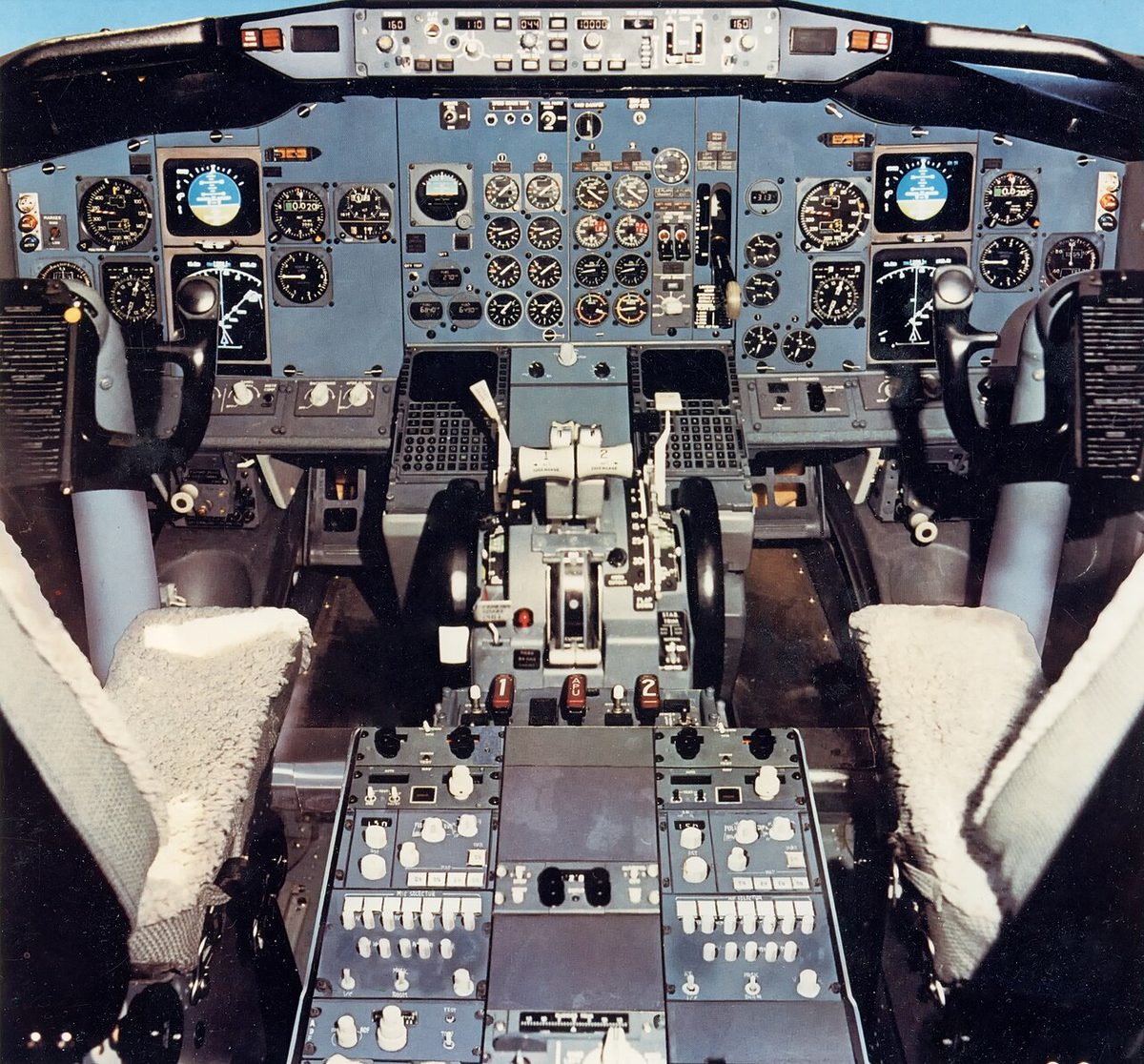
Most controls are on the overheat/fire protection panel: the engine and APU fire switches, the fire switch override, the OVHT DET, TEST, EXT TEST and BELL CUTOUT switches and their lights. It is part of the aft electronic panel, on the control stand behind the thrust levers. The cargo compartments have their own cargo fire control panel.

Engine overheat and fire detection
Each engine has two detector loops, and each loop detects both overheat and fire: as a detector's temperature rises to a predetermined limit it senses an overheat, and at a higher temperature a fire. Normally both loops must sense the condition before an alert is given. A light stays on until the temperature drops below the onset temperature.
The OVHT DET switch for each engine selects the loops. In NORMAL, if one loop fails, it is deselected automatically and the other works as a single-loop detector, with no flight deck indication. If both fail, the amber FAULT light comes on and that engine's detection is inoperative. With the switch at A or B the system is a single-loop system using the selected loop; the other is not monitored, and if the selected loop fails, FAULT lights and detection is lost. The FAULT light brings on neither MASTER CAUTION nor the OVHT/DET annunciator.
An engine overheat lights the amber ENG OVERHEAT light of that engine, both MASTER CAUTION lights and the OVHT/DET annunciator. An engine fire sounds the fire warning bell and lights both master FIRE WARN lights and the engine fire switch; on most variants the engine start lever also lights red and the engine's overheat indications come on.
Engine fire switches and extinguishers
The engine fire switch, the 737's fire handle, is normally locked down to prevent an inadvertent engine shutdown. A fire warning in the switch or an ENG OVERHEAT light unlocks it, and the fire switch override button unlocks it manually. Pulling the switch up:
- arms one discharge squib on each engine fire bottle;
- closes the engine fuel shutoff valve and the spar fuel shutoff valve;
- closes the hydraulic fluid shutoff valve and deactivates the engine-driven pump's LOW PRESSURE light;
- closes the engine bleed air valve, which removes wing anti-ice from that wing and closes the bleed-air-operated pack valve;
- disables the thrust reverser;
- trips the generator control relay and breaker;
- allows the switch to be rotated.
The extinguishing system has two bottles for the two engines, two fire switches, two BOTTLE DISCHARGED lights and an EXT TEST switch, and either or both bottles can be discharged into either engine. Rotating the fire switch fires a squib and discharges one bottle into that engine; rotating it the other way discharges the remaining bottle. The amber BOTTLE DISCHARGED light comes on a few seconds later, and also whenever a bottle's pressure is low.
APU fire protection
The APU has a single fire detection loop. A fault monitoring circuit lights the amber APU DET INOP light, with MASTER CAUTION and OVHT/DET, if the loop fails. An APU fire sounds the bell, lights both master FIRE WARN lights and the red APU fire switch, and the APU shuts down automatically. On the ground only, the APU fire warning horn also sounds in the main wheel well and the APU fire warning light there flashes.
The APU fire switch is mechanically locked in its normal position unless there is a fire signal. Pulling it backs up the automatic shutdown: it deactivates the fuel solenoid and closes the APU fuel shutoff valve, closes the APU bleed air valve and the air inlet door, trips the APU generator control relay and breaker, arms the bottle squib and allows the switch to be rotated. Rotating it in either direction discharges the single APU bottle, and the APU BOTTLE DISCHARGED light comes on after a few seconds. Pulling the APU fire switch is also the way to shut the APU down immediately.
The APU ground control panel in the main wheel well lets the ground crew act:
- The APU fire control handle, pulled down, arms the APU BOTTLE DISCHARGE switch on that panel only, closes the APU fuel shutoff valve, bleed air valve and inlet door, and trips the generator.
- The APU BOTTLE DISCHARGE switch, spring-loaded and safety wired, discharges the bottle.
- The HORN CUTOUT switch silences the horn and the fire bell; the APU fire warning light then stops flashing but stays steady.
The APU runs only with the APU fire switch and the APU fire control handle both in, and the battery switch ON (see B737 APU).
Cargo fire detection and extinguishing
The forward and aft cargo compartments each have smoke detectors in a dual-loop configuration, and normally both loops must sense smoke to give an alert. A power failure in one loop converts the system automatically to single-loop detection; after a detector failure, the crew can convert it manually with the DET SELECT switch (NORM, A or B). The amber DETECTOR FAULT light means that one or more selected loops in either compartment have failed.
A cargo fire sounds the bell, lights both master FIRE WARN lights and the red FWD or AFT cargo fire warning light. After the first warning the light may go out, stay on or come back, and if it comes back the master FIRE WARN lights and bell return. None of the cargo fire panel lights is connected to MASTER CAUTION.
Two bottles are installed in the air conditioning mix bay on the forward wing spar. To use them:
- Push the cargo fire ARM switch for the affected compartment (FWD or AFT), which arms its extinguisher.
- Push the cargo fire DISCH switch for at least one second. With the system armed, it discharges the first bottle and starts a 60-minute timer for the second.
The amber cargo fire DISCH light shows that either bottle has discharged or its pressure is low, and may take up to 30 seconds to come on. The total suppression time is 195 minutes: 180 minutes to reach an airport, plus 15 for a missed approach, landing and passenger unloading. If the system remains armed after the first discharge, the second bottle is inhibited on landing; disarming the system disables the second-bottle timer. The agent suppresses rather than extinguishes the fire, and smoke may persist until fire fighters reach it after landing. The CARGO FIRE checklist calls for the packs in HIGH, and in pressurised flight a forward cargo fire alarm commands the overboard exhaust valve to its smoke mode (see B737 air conditioning).
Wheel well and lavatory fire detection
A single fire detector loop covers the main wheel well, powered by AC transfer bus 2 and the battery bus. A fire there sounds the bell and lights both master FIRE WARN lights and the red WHEEL WELL fire warning light, which stays on until the detector has cooled below its onset temperature. There is no extinguishing system in the wheel well.
Each lavatory has a smoke detector and a heat-activated extinguisher beneath the sink. When smoke is detected, an aural warning sounds and a red light comes on at the lavatory; on most variants there is no flight deck indication, while certain variants also show an amber LAVATORY SMOKE light on the forward overhead panel. The extinguisher discharges automatically, with no flight deck indication.
Fire warning lights and bell
The two red master FIRE WARN lights come on for a fire warning, or a test, in an engine, the APU, the main wheel well or a cargo compartment, and the fire warning bell sounds; on the ground the remote APU fire warning horn sounds as well. Pushing either master FIRE WARN light extinguishes both, silences the bell and the remote horn, and resets the system for further warnings. The BELL CUTOUT switch on the overheat/fire protection panel does the same. The zone's own light, such as the engine fire switch or the WHEEL WELL light, stays on while the condition exists.
Exam tip: red with a bell means fire (engines, APU, wheel well, cargo); amber with MASTER CAUTION and OVHT/DET means an engine overheat or a failed APU loop. A FAULT light and the cargo panel lights give no master caution at all.
Detection and extinguisher tests
The detection and extinguishing systems are tested on the preflight. The TEST switch is held to FAULT/INOP and then to OVHT/FIRE, the EXT TEST switch to 1 and 2, and all indications clear when the switches are released.
| Test | Expected indications |
|---|---|
| FAULT/INOP | Both MASTER CAUTION lights, OVHT/DET annunciator, FAULT light, APU DET INOP light |
| OVHT/FIRE | Bell, both master FIRE WARN, both MASTER CAUTION, OVHT/DET, both engine fire switches, APU fire switch, both ENG OVERHEAT lights, WHEEL WELL light (with AC power); on the ground, the wheel well APU horn and flashing light |
| EXT TEST 1 or 2 | Green EXT TEST lights: squib circuit continuity to the engine and APU fire switches |
| Cargo fire TEST | Bell, master FIRE WARN, green EXT FWD and AFT lights, FWD and AFT cargo fire warning lights, DISCH light |
The APU is not run if the APU DET INOP light fails to come on during the FAULT/INOP test. With the APU running, the OVHT/FIRE test flashes the light and sounds the horn on the APU ground control panel, which ground staff can mistake for an APU fire. The cargo fire test, required once per flight day, is the only way to find individual detector faults: a failed detector lights DETECTOR FAULT during the test, without MASTER CAUTION. At the end of the test the indications may take up to four seconds to go out together.
Engine fire, severe damage or separation
The recall items of the Engine Fire, Severe Damage or Separation checklist are:
- Autothrottle (if engaged): disengage, so the thrust lever stays where the pilot puts it.
- Thrust lever of the affected engine: close. This also helps identify the engine.
- Engine start lever: CUTOFF.
- Engine fire switch: pull, pressing the override if it is still locked.
- If the engine fire switch or ENG OVERHEAT light stays illuminated: rotate the switch to a stop and hold for one second.
- If after 30 seconds the warning is still present: rotate it to the other stop and hold for one second.
An engine overheat has its own shorter recall: autothrottle disengage and thrust lever close, then the full fire checklist if the ENG OVERHEAT light remains. Comparisons with other types are in engine failure and engine fire.
The descriptions and figures above are those of the NG FCOM. The 737 MAX shares the type rating, but its four-screen MAX Display System replaces the NG's six display units, so MAX crews confirm the indications in their own FCOM.
Frequently asked questions
What happens when you pull the engine fire switch on a Boeing 737?
Pulling the switch up arms one discharge squib on each engine fire bottle, closes the engine and spar fuel shutoff valves, the hydraulic shutoff valve and the engine bleed air valve, disables the thrust reverser, trips the generator control relay and breaker, and deactivates the engine-driven hydraulic pump LOW PRESSURE light. It also frees the switch to rotate. No agent is discharged until the switch is rotated.
How many engine fire bottles does the Boeing 737 have?
Two, shared by both engines. Pulling an engine fire switch arms a squib on each bottle, and either or both bottles can be discharged into either engine: rotating the switch to one stop fires one bottle, and rotating it the other way fires the remaining one. The APU has its own single bottle, and the cargo compartments two more.
How long does the 737 cargo fire suppression last?
On the 737 NG, pushing the cargo fire DISCH switch with the system armed fires the first bottle at once and starts a 60-minute timer for the second. The total suppression time is 195 minutes: 180 minutes to reach an airport and 15 more for a missed approach, landing and passenger unloading. The system suppresses a fire rather than extinguishing it.
What does the FAULT light on the 737 overheat and fire panel mean?
With the OVHT DET switch in NORMAL, the amber FAULT light means both detector loops of an engine have failed and that engine's detection is inoperative; a single loop failure is deselected automatically with no indication. With the switch at A or B, it means the selected loop has failed. The FAULT light does not bring on MASTER CAUTION or the OVHT/DET annunciator.
What are the recall items for an engine fire on the Boeing 737?
Autothrottle disengage, if engaged; thrust lever of the affected engine close, which helps identify it; engine start lever CUTOFF; engine fire switch pull, using the override if needed. If the fire switch or ENG OVERHEAT light stays illuminated, the switch is rotated to a stop and held for one second; if after 30 seconds the warning remains, it is rotated to the other stop.
Does the Boeing 737 wheel well have a fire extinguisher?
No. The main wheel well has fire detection only, with a single detector loop powered by AC transfer bus 2 and the battery bus. A fire there sounds the bell, lights both master FIRE WARN lights and the red WHEEL WELL light, which stays on until the detector cools below its onset temperature. The nose wheel well has no fire detection system.
Test yourself on B737 Fire Protection
The v1prep banks cover this topic in the B737 type-rating bank, with a worked explanation for every answer. EASA ATPL, PPL, IR and CPL, the FAA written tests and A320/B737 type ratings.
Start practising →Sources and further reading
- EASA Type Certificate Data Sheet IM.A.120, Boeing 737
- FAA Flight Standardization Board Report, Boeing 737
- 14 CFR 25.1181, Designated fire zones; regions included
- 14 CFR 25.1195, Fire extinguishing systems
- 14 CFR 25.857, Cargo compartment classification
- EASA Easy Access Rules for Large Aeroplanes (CS-25)
- FAA Aviation Maintenance Technician Handbook, Airframe (FAA-H-8083-31B), Fire Protection Systems
Library articles are written for study and exam preparation. They do not replace your aircraft's approved documentation, your operator's procedures or the regulations themselves.