Aircraft Wheels and Tyres
Aircraft wheels and tyres carry the aircraft on the ground, cushion the landing and transmit braking and steering forces to the runway. Wheels are light alloy, usually divided in two halves; tyres are bias or radial and, on transport aircraft, usually tubeless, inflated with nitrogen and protected by fuse plugs against bursting from brake heat.
Aircraft wheels and tyres carry the whole weight of the aircraft on the ground, cushion part of the landing impact and pass every braking and steering force to the runway. The main wheels also house the brakes, so they must survive the heat of a heavy stop.
Tyres run at high pressures, are flexed and heated on every take-off and landing, and sit beside the brakes. European training texts attribute about 90 per cent of tyre failures to incorrect gas pressure, which is why pressure, creep and wear are watched so closely.
Wheel construction
Aircraft wheels are made of aluminium alloy or, where weight matters most, magnesium alloy, about 35 per cent lighter for the same volume but more prone to corrosion and more flammable. They are forged or cast, for fatigue strength under repeated loading, then machined and ground. Aluminium wheels are protected by anodising and magnesium wheels by chromate treatment.
Wheels are classified by how the tyre is fitted:
- A loose flange wheel has one flange forming part of the wheel body and the other removable, so the tyre can be slid on; a loose flange is held by a locking device, such as a snap ring, on the rim, and a detachable flange by bolts.
- A divided wheel, or split-hub wheel, is made of two halves bolted together, with a seal at the joint. It is the usual construction on modern transport aircraft, and the sealed joint makes it airtight for tubeless tyres.
Two features stop the tyre turning on the wheel. A knurled flange has its inner face roughened, so that the side pressure of the tyre locks the bead by friction. A tapered bead seat is slightly conical, so that inflation pressure forces the bead outwards into a tighter wedge fit. Wheels for tubeless tyres also have a finer finish, are impregnated to seal the metal, and use O-ring seals between the halves and at the inflation valve, which is mounted in the wheel.
Tyre construction
The tyre cover, or casing, contains the pressure or protects the inner tube, keeps the tyre's shape under load, transmits braking force and provides the wearing surface. It is built up from plies of nylon or rayon cord, laid parallel rather than woven, with a film of rubber between plies so that the cords do not cut one another as the tyre flexes.
- The tyre bead holds the tyre on the wheel. The plies are wrapped around coils of inextensible steel wire bonded together with rubber, and chafer strips protect the outside of the bead.
- Breaker strips, narrow plies set in thick rubber between the casing and the tread, spread impact loads and protect the casing cords from concussion damage.
- The tread is the wearing surface. Most aircraft tyres have a ribbed tread pattern of straight circumferential grooves, which channel water away from the contact area and help resist aquaplaning. A reinforced tread, marked DRR, has a fabric layer in the tread for durability; that fabric may show as the tread wears and must not be mistaken for the casing cords.
- A chine tyre is a nose wheel tyre with a moulded ridge on its shoulder that deflects water spray away from the engine intakes. It is used above all on aircraft with rear-mounted engines; a single nose wheel has chines on both sides, twin nose wheels on the outboard side.
Bias and radial tyres
In a bias tyre, also called a cross-ply tyre, the cords run diagonally across the tyre, and those of adjacent plies cross at roughly right angles to one another. The sidewalls are stiff.
In a radial tyre the cords run straight from bead to bead, at about 90° to the tyre's centreline, and belt plies under the tread stiffen the crown. The sidewall is more flexible and the tread stiffer, so the tyre wears better and has lower rolling resistance. Radial tyres are increasingly used on transport aircraft.
Tubed and tubeless tyres
A tubeless tyre has an inner rubber lining that makes the cover gas-tight, and seals on the wheel through the wedge fit of its bead on the tapered seat, a seal that tightens as pressure rises. European training texts list its advantages over a tubed tyre: it holds pressure longer, leaks only slowly when punctured because the unstretched lining clings to the object, resists impact better and is about 7.5 per cent lighter. Its valve is in the wheel, so creep cannot tear it off.
A tubed tyre has an inner tube whose valve passes through a hole in the rim; on a divided wheel the wheel's own valve is removed to make room for it. Brake heat reaches the tube through the wheel, so tubes are made with standard, thickened or cord-reinforced bases for increasing brake heat, and a replacement must be of the same type.
Every inflation valve contains a Schrader valve core, a spring-loaded non-return valve. Because the core is not a perfect seal, the valve cap is mandatory: it is the secondary seal and keeps dirt out.
Tyre markings and ratings
The sidewall carries what is needed to fit and operate the tyre:
- Tyre size markings give the outside diameter, the section width and the bead seat, or wheel, diameter, in inches or millimetres; a 49 × 17 tyre is 49 in in diameter and 17 in wide.
- The ply rating (PR) is an index of strength, not a count of plies. Modern cords are strong enough that a tyre with a ply rating of 32 may have only 18 actual plies.
- The tyre speed rating is the highest ground speed at which the tyre has been tested and approved, usually in mph. The A320's tyre speed limit is 195 kt; a 225 mph rating, as on the first-generation E190, is about 195 kt. Because it is a ground speed, it can limit the take-off mass at hot, high aerodromes or with a tailwind (see brake energy and tyre speed limits).
- ECTA or CONDUCTING marks a conductive tyre, one with carbon added to the rubber so that it conducts static charge from the aircraft to the ground.
- The tyre balance mark, a red dot or triangle, marks the lightest part of the tyre. It is fitted next to the inflation valve, generally the heaviest part of the wheel.
- Green or grey dots mark awl vents, small holes that let gas trapped between the plies escape, so that it cannot expand and damage the casing when the outside pressure falls at altitude.
Inflation pressure and nitrogen
Tyres are grouped into tyre pressure categories: low pressure, about 25 to 35 psi, for grass surfaces and light aircraft; medium pressure; high pressure, about 70 to 90 psi, for concrete runways; and extra high pressure, above 90 psi and up to about 350 psi, for the largest transport aircraft.
The rated inflation pressure is the manufacturer's figure for a cold tyre carrying no load. Mounted on the aircraft and loaded, the same tyre reads about 4 per cent higher, because the cover deforms, and after taxi, take-off or landing the heat can add up to about another 10 per cent. Pressures are therefore checked on cold tyres, allowing for the 4 per cent, and a hot tyre is never bled down, since it would be under-inflated once it cooled.
Nitrogen tyre inflation is standard on transport aircraft. Nitrogen is inert, so it cannot support combustion inside a tyre heated by its brake, and it is dry, so it does not corrode the wheel from inside. Specifications typically allow up to 5 per cent oxygen in the tyre.
Pressure governs both wear and failure:
| Over-inflated | Under-inflated | |
|---|---|---|
| Contact | Tyre bulges, runs on its centre ribs | Tyre flattens, runs on its shoulders |
| Wear pattern | Crown wear | Shoulder wear |
| Main risks | Stiff casing, less able to absorb impacts, so bursts on debris or rough surfaces | Sidewall flexing and overheating, creep, aquaplaning at a lower speed |
The last point follows from the dynamic aquaplaning speed, which rises with the square root of the tyre pressure (see aquaplaning).
Tyre creep
Tyre creep is the tendency of a tyre to rotate slowly around its wheel in service, encouraged by heavy braking and above all by under-inflation. A little creep just after fitting is normal. Persistent creep is dangerous on a tubed tyre: the tube is dragged round with the tyre while its valve is fixed in the rim, and the valve can be torn out, deflating the tyre. Correct inflation pressure is the main defence.
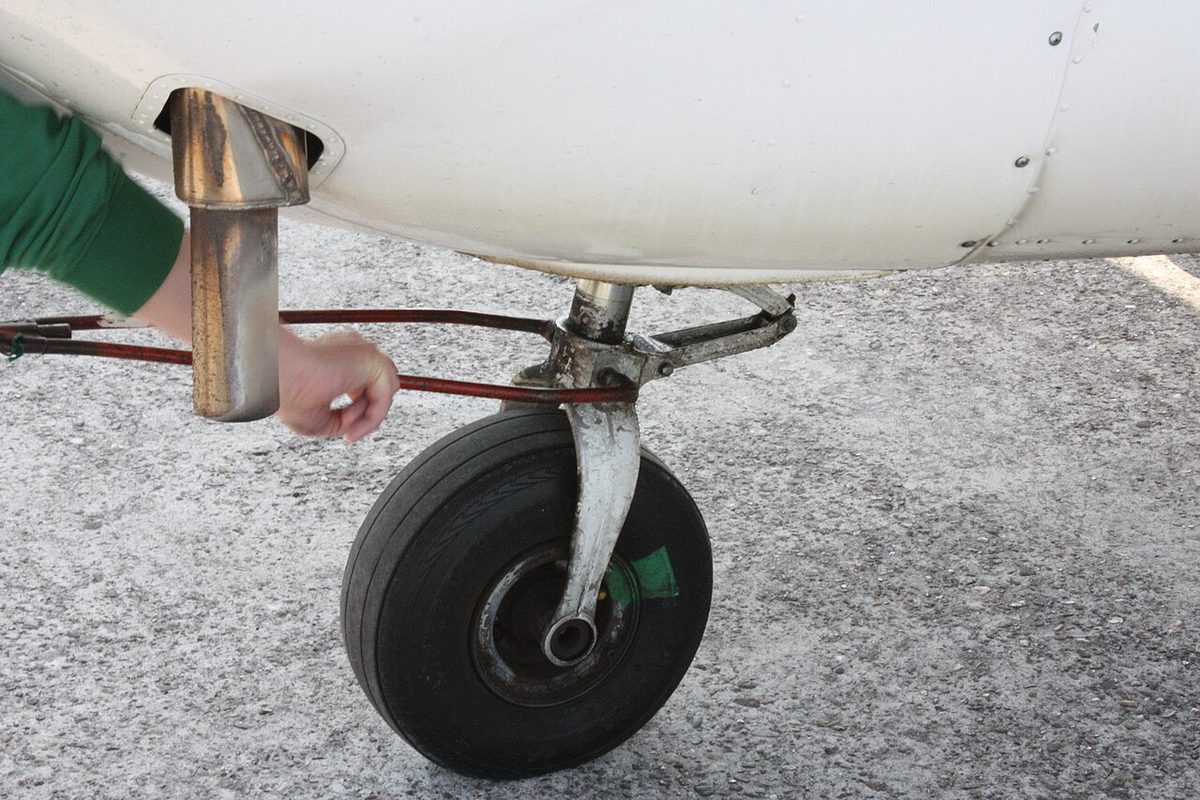
Creep marks show it: matching lines, typically white, painted across the tyre sidewall and the wheel rim and aligned when the tyre is fitted. If they are offset on the walk-round, the tyre has crept, and the offset shows by how much. European training texts set the limit at 1 in for tyres up to 24 in outside diameter and 1.5 in for larger tyres; beyond it the tyre is removed and the tube and valve inspected.
Wear, damage and tread limits
Tread wear limits are set by marker grooves. A patterned tyre is removed when it is worn to the base of the marker grooves, or of the marker tie bars, over 25 per cent or more of its circumference, and a plain tread tyre when it is worn to the casing fabric. A worn tread drains water poorly, so aquaplaning begins at a lower speed.
Tyre wear patterns tell a story: crown wear points to over-inflation, shoulder wear to under-inflation. A tyre flat spot, a patch worn through at one point of the tread, comes from a locked wheel skidding, which is what anti-skid touchdown and locked wheel protection exist to prevent.
Damage rules on the walk-round are strict:
- An object embedded in the tread is not pulled out, since that could turn a slow leak into a rapid deflation. It is reported, and maintenance probes the cut with a blunt tool.
- A cut that reaches the cords, exposed casing fabric or a bulge makes the tyre unserviceable.
- Oil, fuel, hydraulic fluid and glycol attack rubber and are wiped off at once; strong sunlight, heat and prolonged damp also degrade it.
A deflated tyre passes its load to its neighbours. The A320 may taxi with no more than one deflated tyre per gear at up to 7 kt in turns, or with two deflated tyres on one main gear at up to 3 kt, with nose wheel steering limited to 30°. If tyre damage is suspected after landing, the crew asks for an inspection before vacating the runway.
Fusible plugs and tyre bursts
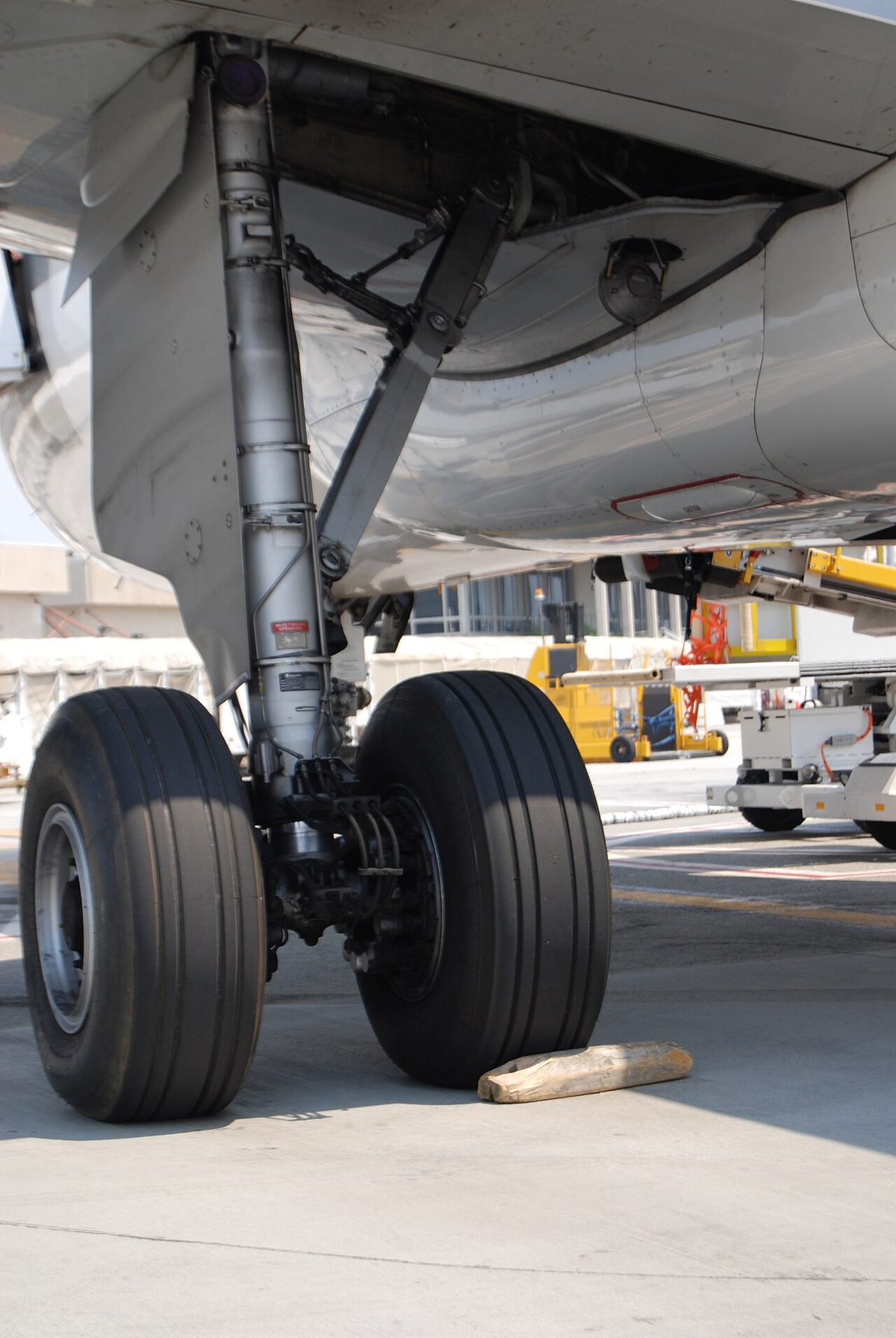
CS 25.735(j) and 14 CFR 25.735(j) require each braked wheel to have a means of preventing a wheel failure or tyre burst caused by high brake temperature. That means is the fusible plug, also called the fuse plug or wheel fuse plug: a plug in the wheel held by an alloy that melts at a set temperature. When brake heat raises the wheel to that temperature the alloy melts, tyre pressure blows the plug out, and the tyre deflates through a small hole in a controlled way instead of bursting. European training texts give a colour code for the melting temperature: red 155 °C, green 177 °C and amber 199 °C. A melted plug means the brake, wheel and tyre have overheated; the aircraft is not flown until they have been inspected, and wheel and brake are typically replaced.
A tyre burst is far more dangerous than a controlled deflation. Fragments of tread and casing can cut brake and hydraulic lines, damage flaps, gear doors and structure, and be ingested by engines, while the remaining tyres take the extra load and braking efficiency falls. Tread separation, the tread peeling away from the casing, has similar effects. On 25 July 2000 an Air France Concorde ran over a metal strip during its take-off at Paris Charles de Gaulle; pieces of the cut tyre ruptured a fuel tank, the leaking fuel caught fire and the aircraft crashed shortly after take-off (see bird strike and foreign object damage). Designers also allow for loose tread: on the Boeing 737, if a spinning main tyre with loose tread strikes a fitting in the wheel well opening during retraction, that gear stops retracting and free-falls back to the down position.
Fuse plugs, tyres and wheels release their energy sideways, along the line of the axle, so people approach hot or damaged wheels only from the front or rear (see wheel brakes).
Exam tip: fusible plugs protect against overheating, not over-inflation, and they melt because of brake heat. Rated inflation pressure is for a cold, unloaded tyre; add about 4 per cent when checking a cold tyre on the aircraft.
Frequently asked questions
Why are aircraft tyres filled with nitrogen?
Nitrogen is inert, so it cannot support combustion inside a tyre that has been heated by its brake, and it is dry, so it does not corrode the wheel from inside. Compressed air contains oxygen and moisture. Specifications typically allow up to 5 per cent oxygen in the tyre gas, which leaves room for small amounts of air introduced during servicing.
What is tyre creep?
Creep is the slow rotation of a tyre around its wheel rim in service, encouraged by heavy braking and above all by under-inflation. On a tubed tyre it is dangerous, because the tube is dragged round while its valve is fixed in the rim, and the valve can be torn out. Matching creep marks painted across tyre and rim show on the walk-round whether, and how far, the tyre has moved.
What does a fusible plug in an aircraft wheel do?
A fusible plug, or fuse plug, is held in the wheel by an alloy that melts at a set temperature. If brake heat raises the wheel to that temperature, the plug blows out and the tyre deflates through a small hole instead of bursting. A melted plug means the wheel, tyre and brake have overheated, and the aircraft must not fly until they have been inspected.
What is the difference between bias and radial aircraft tyres?
In a bias, or cross-ply, tyre the cords of successive plies run diagonally across the tyre in opposite directions, which gives stiff sidewalls. In a radial tyre the cords run straight from bead to bead, at right angles to the centreline, with belt plies under the tread. Radials have more flexible sidewalls, a stiffer tread, better wear and lower rolling resistance.
When must an aircraft tyre be replaced?
European training texts give the main criteria. A patterned tyre is removed when it is worn to the base of the marker grooves over 25 per cent or more of its circumference, and a plain tread tyre when worn to the casing fabric. Cuts that reach the cords, exposed casing fabric, bulges or excessive creep also make it unserviceable, and a melted fuse plug calls for inspection of tyre, wheel and brake.
Test yourself on Aircraft Wheels and Tyres
The v1prep banks cover this topic in Aircraft General Knowledge (021), with a worked explanation for every answer. EASA ATPL, PPL, IR and CPL, the FAA written tests and A320/B737 type ratings.
Start practising →Sources and further reading
- FAA Aviation Maintenance Technician Handbook, Airframe (FAA-H-8083-31B), Chapter 13, Aircraft Landing Gear Systems
- EASA Easy Access Rules for Aircrew (Part-FCL), theoretical knowledge syllabus, 021 Airframe, Systems, Electrics, Power Plant
- EASA Easy Access Rules for Large Aeroplanes (CS-25), CS 25.731 Wheels, CS 25.733 Tyres and CS 25.735 Brakes and braking systems
- 14 CFR 25.733, Tires
- 14 CFR 25.735, Brakes and braking systems
Library articles are written for study and exam preparation. They do not replace your aircraft's approved documentation, your operator's procedures or the regulations themselves.