Pre-flight Preparation and Routine Checks
Pre-flight preparation is everything a crew does before take-off to be sure the flight can be made safely: gathering and studying the information for the flight, inspecting the aircraft outside and inside, and checking controls and instruments, followed in flight by regular routine checks such as FREDA.
Pre-flight preparation is the work done before take-off to make sure a flight can be made safely: studying the information for the flight, inspecting the aircraft outside and in, and checking that the controls and instruments work. It ends only when the aircraft is lined up, and it continues in flight as a set of routine checks repeated at intervals.
The steps are the same whether the aircraft is a two-seat trainer or an airliner; what changes is who does them and how they are recorded. A light aircraft pilot does everything alone from the flight manual's checklist. An airline crew divides the work, follows the operator's standard operating procedures, and records defects and servicing in the technical log (see technical log, MEL and deferred defects). Many accidents that begin before take-off, from frost left on the wings to controls still locked, trace back to a step in this sequence that was missed or rushed.
Pre-flight information (NWKRAFT)
ICAO Annex 2 and SERA require the pilot-in-command to become familiar, before a flight, with all available information appropriate to it. For flights away from the vicinity of an aerodrome and for every IFR flight, that includes a careful study of the current weather reports and forecasts, the fuel requirements and an alternative course of action if the flight cannot be completed as planned.
The FAA's rule, 14 CFR 91.103, is similar and is remembered in the United States by the NWKRAFT mnemonic:
| Letter | Item | Applies to |
|---|---|---|
| N | NOTAMs | All flights, as part of "all available information" |
| W | Weather reports and forecasts | IFR flights and flights not in the vicinity of an airport |
| K | Known traffic delays advised by ATC | IFR flights and flights not in the vicinity of an airport |
| R | Runway lengths at airports of intended use | Every flight |
| A | Alternatives if the flight cannot be completed as planned | IFR flights and flights not in the vicinity of an airport |
| F | Fuel requirements | IFR flights and flights not in the vicinity of an airport |
| T | Take-off and landing distance data from the flight manual | Every flight |
So even a 15-minute circuit flight at the home airport requires the pilot to know the runway lengths and the aircraft's take-off and landing distances for the day. Temporary flight restrictions, which are issued as NOTAMs at short notice, are a typical trap for those who skip the N.
Airline crews receive this material as a briefing package with the operational flight plan, the NOTAM bulletin, weather and the mass and balance documentation. The pilot's own fitness is part of the preparation too; personal checklists such as IMSAFE (illness, medication, stress, alcohol, fatigue, and emotion or eating) catch what no walk-round will.
Exterior walkaround inspection
The exterior inspection, also called the exterior walkaround, walk-round or walkaround inspection, is a walk around the aircraft to obtain a global assessment of its condition. Airbus's own description of the objective is exactly that, adding that any missing part or panel is checked against the configuration deviation list (CDL) to see whether the aircraft may be dispatched without it. In the A320 standard operating procedures, items marked with an asterisk are the only ones repeated after a transit stop without a crew change; a new crew does them all.
The walk-round follows a fixed route, and on most types covers:
- Surfaces: damage, dents, leaks, missing fasteners and panels. Frost, ice and snow must be removed from the wings, tail and control surfaces before take-off; even a thin, rough layer of frost reduces lift and increases drag.
- Probes and ports: covers removed; on the 737, the skin around the pitot probes and static ports checked for wrinkling, which could point to damage.
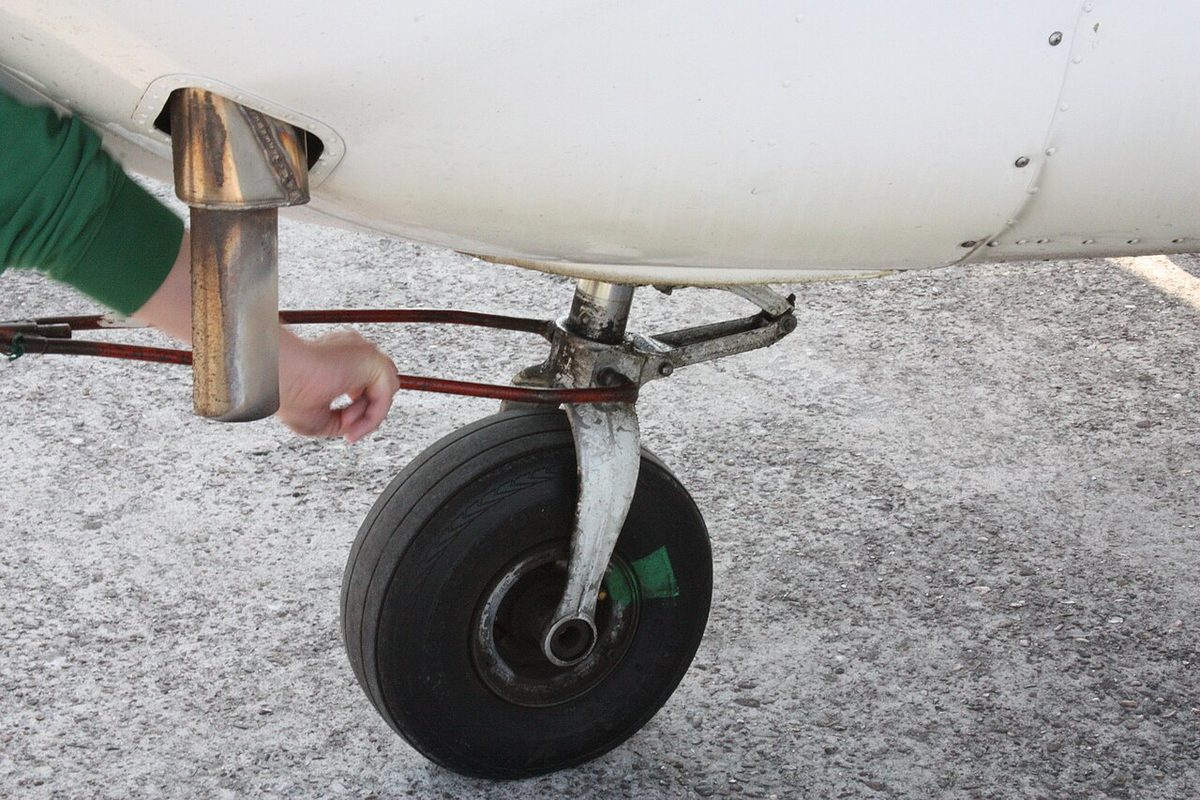
- Landing gear: tyres for cuts and wear, safety pins removed, brake wear indicator pins (on the A320 and 737 checked with the parking brake set), and strut extension. A strut almost fully compressed on an empty aircraft means low gas pressure or lost fluid. Any difference between the two main gears is reported.
- Engines and cowlings: intakes and fan blades, latches closed. Fan cowls left unlatched after maintenance and missed on the walk-round have come open and separated on the take-off roll or in the climb. The 737 accepts fluid from the engine drains only if it is less than a continuous stream.
- Indicators: the discs that show whether a fire extinguisher bottle or the crew oxygen bottle has discharged overboard.
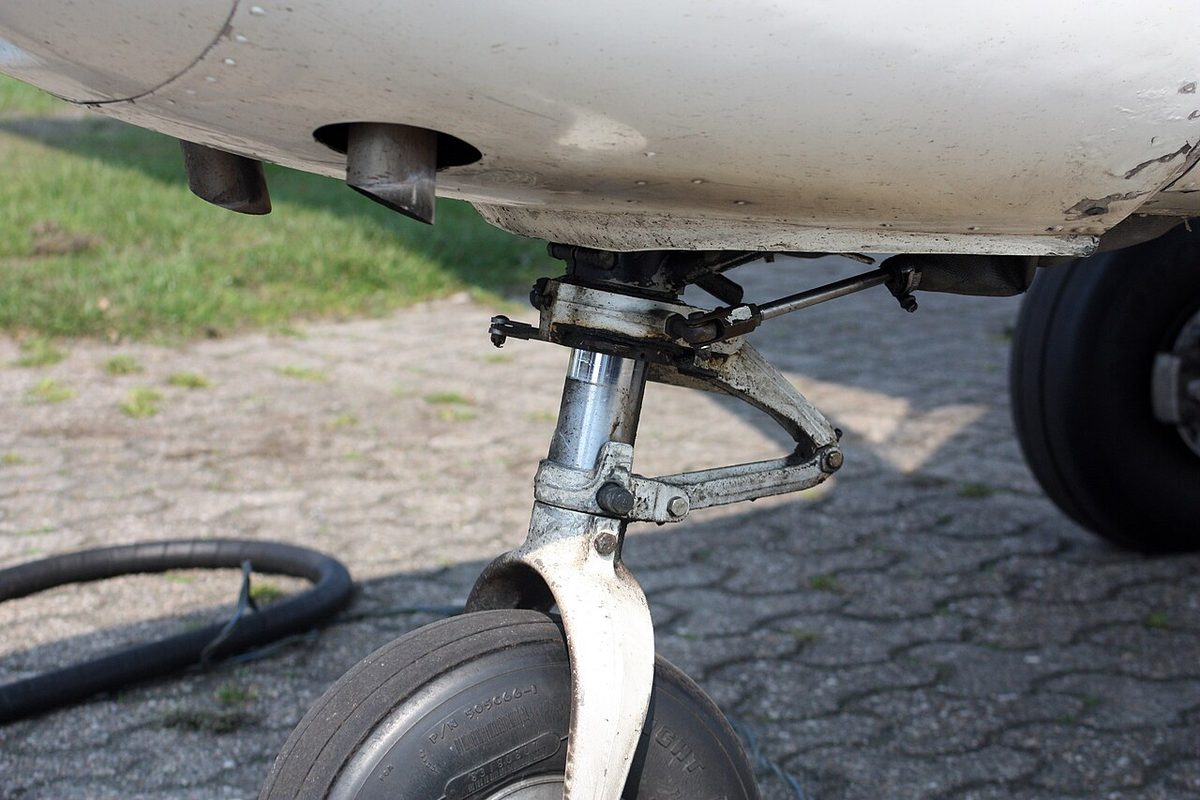
Light aircraft add their own items. Fuel is drained from every sump before the first flight of the day and after refuelling: water is denser than fuel and collects at the drain, and draining continues until the sample is clean. The colour identifies the grade; 100LL Avgas is blue, and a clear, kerosene-smelling sample in a piston aircraft means it may have been misfuelled with jet fuel and must not fly. Tank caps and vents, oil level, control locks, mass balance weights and the creep marks on tyres and wheels are checked too.
Note: A walk-round done under bright apron floodlight at night costs the pilot's dark adaptation, which takes about 30 minutes to recover. Use as little white light as the job allows.
Cockpit preparation
Cockpit preparation sets up the aircraft's systems, navigation and performance for the flight. On the A320 the pilot who arrives first carries out a preliminary cockpit preparation: pressing the ECAM recall button for at least three seconds to show the cautions and warnings of the previous flight, checking the technical log, checking hydraulic, engine oil and oxygen levels on the ECAM, and reviewing the operations engineering bulletins that apply, above all the red ones. On the 737 the preliminary preflight procedure assumes the electrical power up supplementary procedure has been done, and in the flight instrument check only the TCAS OFF flag, and NO VSPD until the speeds are entered, may be shown.
The main preparation then follows a scan of the panels in a fixed order, the flight management system is programmed by one pilot and cross-checked by the other, the performance data are entered, and the crew briefs the departure before the before-start checklist (see standard operating procedures and checklists).
The pre-flight altimeter check is part of it. With the aerodrome QNH set, the altimeter must read the known elevation of the check location within 60 ft (20 m) for an altimeter with a test range of 0 to 30,000 ft, or 80 ft (25 m) for one tested to 50,000 ft, under the PANS-OPS check; some operators use tighter figures. Standby instruments with their own battery have a battery test, and an attitude indicator with a caging device is uncaged at least five minutes before take-off.
Flight control check
The flight control check confirms that each control moves fully and freely, in the correct sense, and returns to neutral. It is made before take-off, often while taxiing or at the holding point.
In a light aircraft the pilot moves each control to its stops while looking at the surfaces. The walk-round matters as much as the check: on a servo-tab control, where the pilot's input moves only the tab, the cockpit control can still move freely while the surface itself is locked, so a free-feeling control does not prove the surface is free.
Airliners use a defined sequence. On the A320 the pilot flying silently applies full sidestick deflections in pitch and roll while the pilot monitoring watches the flight controls page and calls "full up, full down, neutral" and "full left, full right, neutral"; the rudder is then checked with the pedal disconnect button pressed, so that the nose wheels do not move. On the 737 the inputs are slow and deliberate, one direction at a time, and the nose wheel steering wheel is held during the rudder check for the same reason.
Taxi instrument checks
The taxi instrument checks find a failed instrument on the ground rather than in cloud. At the start of the taxi the brakes are tested. Then, in a turn:
- the turn indicator or turn coordinator shows a turn in the correct direction;
- the ball moves to the outside of the turn, because on the ground nothing banks the aircraft to balance the turn;
- the heading indicator and the compass follow the turn, in the right direction;
- the attitude indicator stays level.
Before take-off the altimeter is set and compared with the aerodrome elevation, the vertical speed indicator reads zero and the clock is running. Lined up on the runway, the heading indicator and compass should agree with the runway's magnetic direction, a final gross-error check. Airline crews make the equivalent checks against their displays and verify the runway before starting the take-off roll (see taxiing and runway incursion prevention).
En-route FREDA checks
Once airborne, the preparation turns into routine monitoring. Many light aircraft pilots learn the FREDA check, a sequence repeated at regular intervals:
- Fuel: quantity in each tank, the tank selected, fuel pump and pressure, and consumption against the plan.
- Radio: the correct frequency, and the next one ready.
- Engine: temperatures and pressures, and a check for carburettor icing. Carburettor ice can form at outside air temperatures from about −10 °C to +30 °C, and is most severe from −2 °C to +15 °C, so it is checked well outside icing weather.
- Direction indicator: realigned with the magnetic compass every 10 to 15 minutes, in straight, level, unaccelerated flight, since the compass is accurate only then.
- Altimeter: the correct setting, QNH or standard pressure as the phase requires, and the right altitude or flight level.
Since the direction indicator needs realigning every 10 to 15 minutes anyway, it is convenient to run the whole sequence at the same time. Airline crews do the same job with their own routines: fuel checks against the flight plan at waypoints (see in-flight fuel management), altimeter cross-checks at the transition, and a regular scan of the systems.
Frequently asked questions
What does NWKRAFT stand for?
NWKRAFT is a memory aid for the pre-flight information that 14 CFR 91.103 requires a pilot in command to know: NOTAMs, Weather reports and forecasts, Known traffic delays advised by ATC, Runway lengths at airports of intended use, Alternatives available if the flight cannot be completed as planned, Fuel requirements, and Take-off and landing distance data. NOTAMs, runway lengths and distances concern every flight; the weather, delay, alternative and fuel items apply to IFR flights and flights not in the vicinity of an airport.
What is checked on an aircraft walkaround?
The walkaround is a global look at the aircraft's condition. The pilot checks for damage, fluid leaks and missing panels; that frost, ice and snow have gone; that covers, pins and locks are removed; the tyres, brakes and gear struts; the engine intakes and cowlings; probes and static ports; and indicators such as fire bottle and oxygen discharge discs. On light aircraft the fuel is drained for water and its colour checked.
What is FREDA?
FREDA is a routine check made at regular intervals in flight, mostly by pilots of light aircraft: Fuel (quantity, tank selected, consumption against the plan), Radio (correct frequency, next frequency ready), Engine (temperatures, pressures and carburettor heat), Direction indicator (realigned with the magnetic compass in straight, level, unaccelerated flight) and Altimeter (correct setting and the right altitude or level).
How accurate must the altimeter be on the pre-flight check?
Under the PANS-OPS pre-flight check, with the aerodrome QNH set the altimeter must read the known elevation within 60 ft (20 m) for an instrument with a test range of 0 to 30,000 ft, or within 80 ft (25 m) for one tested to 50,000 ft. The check is made at a location whose elevation is published; a larger error means the instrument is unserviceable.
What should the instruments do in a taxi turn?
In a turn on the ground the turn indicator or coordinator shows a turn in the correct direction, the ball is thrown to the outside of the turn because the aircraft cannot bank, the heading indicator and compass follow the turn smoothly and the attitude indicator stays level. A gyro instrument that sticks, lags or topples during taxi is unserviceable, and finding out on the ground is the point of the check.
Test yourself on Pre-flight Preparation and Routine Checks
The v1prep banks cover this topic in Operational Procedures (070), with a worked explanation for every answer. EASA ATPL, PPL, IR and CPL, the FAA written tests and A320/B737 type ratings.
Start practising →Sources and further reading
- 14 CFR 91.103, Preflight action
- ICAO Annex 2, Rules of the Air
- FAA Airplane Flying Handbook (FAA-H-8083-3C), Chapter 2, Ground Operations
- FAA Pilot's Handbook of Aeronautical Knowledge (FAA-H-8083-25), Chapter 8, Flight Instruments
- FAA Instrument Flying Handbook (FAA-H-8083-15B)
- ICAO Doc 8168, Procedures for Air Navigation Services, Aircraft Operations (PANS-OPS), and Annex 6, Operation of Aircraft
Library articles are written for study and exam preparation. They do not replace your aircraft's approved documentation, your operator's procedures or the regulations themselves.