De-Icing Boots and Fluid Ice Protection
Pneumatic de-icing boots are rubber covers on wing and tail leading edges that inflate in cycles to crack off ice that has already formed. Fluid ice protection, best known as the TKS weeping wing, seeps a glycol-based freezing point depressant through porous leading-edge panels so that ice cannot form or stick.
Jets keep their leading edges warm with bleed air, but piston twins and turboprops have little hot air to spare. They protect their wings and tails in one of two other ways. Pneumatic de-icing boots are rubber covers on the leading edges that inflate to crack off ice that has already formed. A fluid ice protection system, best known as TKS and nicknamed the weeping wing, seeps a glycol-based fluid through porous leading edges so that ice cannot form or stick.
The first is a de-icing system and the second an anti-icing system, and that difference decides when each is used (see ice protection and ice detection). Both appear on aircraft approved for flight into known icing, and both have limits: boots cannot reach ice that forms aft of them, and a fluid system lasts only as long as its tank. How ice forms and why it matters is covered in airframe icing.

Pneumatic de-icing boots
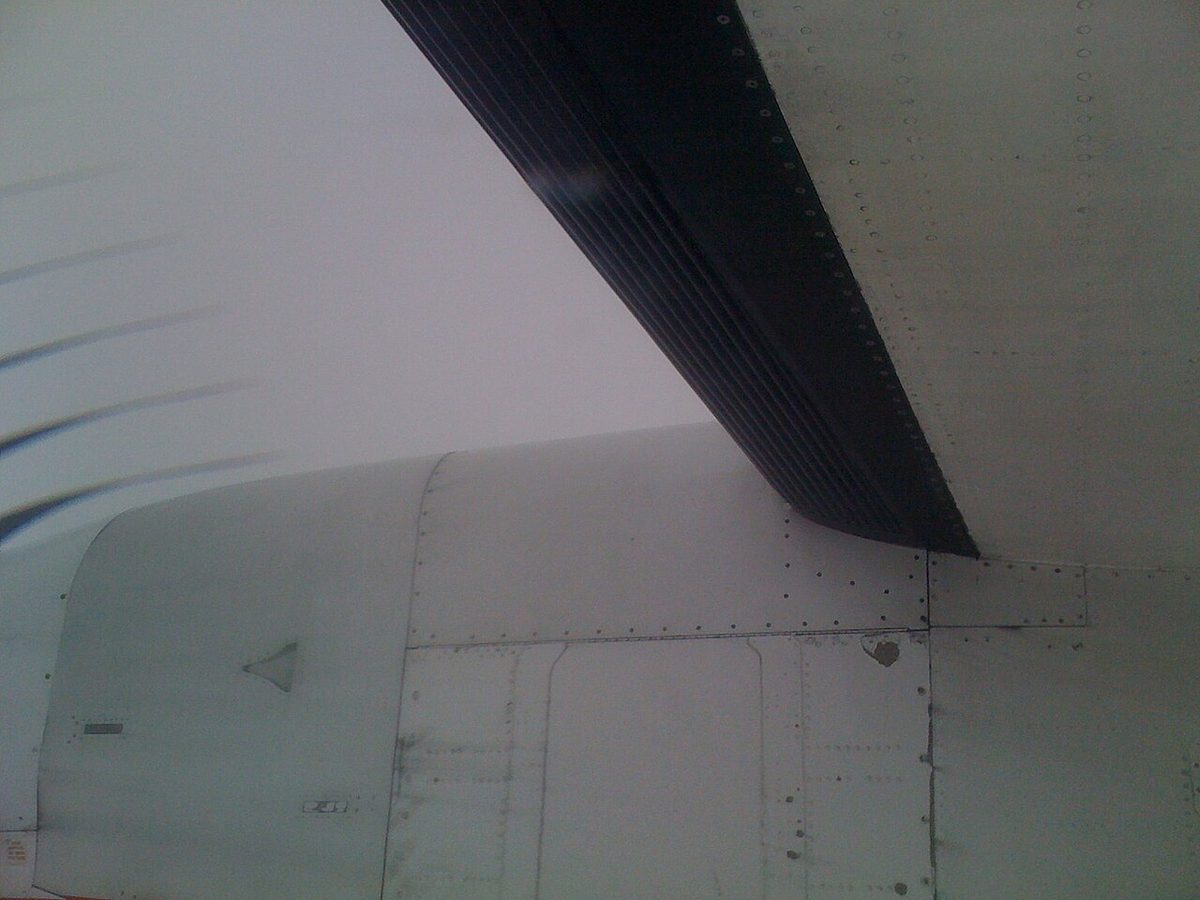
A pneumatic de-icing boot is made of layers of natural rubber and rubberised fabric. Between the layers lie flat inflatable tubes of rubberised fabric, closed at the ends and vulcanised into the boot, running either along the span or along the chord depending on the design. Each boot is connected to the air supply by flexible hoses and clips, its outer surface carries a conductive coating that bleeds off static electricity, and it is cemented to the leading edge or held by screw fasteners into rivnuts.
ATPL texts list boots on piston-engined aircraft and on twin turboprops, such as the Beechcraft King Air, Piper Navajo, ATR 42 and 72, Saab 340 and Dash 8. They are not used on modern jet transports, which have bleed air for thermal anti-icing (see thermal anti-icing).
The principle is mechanical. When the system operates, air pressure is admitted to the tubes and the boot swells. The change of shape breaks the bond between the ice and the rubber, the ice cracks and the airflow carries it away. At the end of the inflation, automatic valves dump the air to atmosphere and suction deflates the tubes completely. When the system is off, suction is applied continuously to hold the boots flat against the leading edge, so that they keep the aerofoil's shape and do not lift in the airflow and add drag. Because ice must form before it can be broken off, a boot is a de-icer, never an anti-icer.
Boot air supply and vacuum pumps
Boots need both pressure to inflate and suction to deflate. ATPL texts give three sources of inflation air:
- the pressure side of an engine-driven vacuum pump, whose suction side provides the deflation;
- a high-pressure air reservoir;
- on some turboprops, air tapped from an engine compressor stage, with suction for deflation then produced by the venturi section of an ejector nozzle driven by bleed air.
The air reaches the individual boots through distribution valves, which may be shuttle valves, solenoid-operated valves or a motor-driven valve, and pressure and suction indications let the crew check that the system works. On light aircraft approved for known icing, an ice light shining on the leading edge, usually of the left wing, lets the pilot watch the boots shed ice at night.
Boots wear with use. They can be tested on the ground following the maintenance procedure, checking that they inflate evenly, that the indications respond and that there are no leaks, but they are not cycled without need, because repeated cycling shortens their life.
Cyclic operation
Boots are not all inflated at once. They are divided into groups that inflate in turn, which keeps the demand on the air supply within its capacity and keeps the effect of a failure symmetrical. ATPL texts give a typical layout of three groups:
| Group | Boots |
|---|---|
| 1 | Left and right wing outboard boots |
| 2 | Left and right wing inboard boots |
| 3 | Fin and tailplane boots |
In this example one complete cycle through the three groups takes 34 seconds, whatever the setting of the cycle selector. The selector changes only the dwell between cycles: about 206 seconds for light icing and 26 seconds for heavy icing. The flight manual describes each type's own logic.
Cyclic de-icing means that ice is always allowed to build between cycles before it is removed. ATPL texts therefore treat boots under the airframe rule: airframe protection is applied at the onset of indicated icing, shown by ice on the leading edges, aerials or wiper arms or by an ice detector, rather than in advance like engine anti-ice. Some systems can start de-icing automatically when an ice detector senses ice, if the crew has selected AUTO.
Ice bridging
Pilots were long taught not to inflate boots too early. A thin film of ice is flexible; an inflating boot could stretch it without breaking it, and when the boot deflated the ice would stay in the shape of the inflated boot, a bridge the boot could no longer reach, on which more ice then built up. The traditional guidance, still found in EASA ATPL material for older boots, was therefore to wait until 1/4 to 1/2 inch (6 to 13 mm) of ice had accumulated, when it would be brittle enough to crack.
For modern boots the advice is different. Current FAA guidance in AC 91-74B is to operate them at the first sign of ice and keep cycling them, unless the aircraft flight manual or POH says otherwise, because tests have shown modern boot designs to be much less prone to bridging. The two answers are not a contradiction but a difference between older and current practice. In an exam, read whether the question asks for the traditional rule; in the aircraft, follow the flight manual.
Exam tip: boots are de-icers: they remove ice that has formed, by inflating, and are held flat by vacuum when off. The traditional threshold of 1/4 to 1/2 inch (6 to 13 mm) existed to avoid ice bridging; AC 91-74B now calls for modern boots to be used at the first sign of ice.
Boots also share a limit with every leading-edge system. Supercooled large droplets strike farther aft than cloud droplets and can freeze behind the boots, where nothing removes them. A ridge of ice formed this way led to the loss of an ATR 72 near Roselawn, Indiana, in 1994. Ice on the side windows or aft of the boots calls for leaving the conditions at once (see airframe icing).
TKS weeping-wing systems
A fluid system works the other way round: it stops ice from forming. A freezing point depressant (FPD) fluid, glycol-based, typically ethylene or propylene glycol, is pumped to the leading edges and seeps out through a porous surface. The airflow carries the fluid back over the aerofoil, where it mixes with any water that strikes the surface and lowers the freezing point of the mixture, so that ice cannot form or bond to the skin. ATPL texts cite the Piper Malibu and Meridian with TKS weeping wings as examples. The same fluid can protect the propellers through a slinger ring on the hub (see propeller ice protection).
The fluid reaches the surface through distributors of two types:
- Panel distributors cover large areas of leading edge and are more economical and efficient. Each consists of a porous outer panel, a microporous sheet and a back plate, fitted over or let into the leading edges of the wings and tailplane. They cannot be used on surfaces with double curvature.
- Strip distributors are inserted into the leading edge and suit surfaces with double curvature, such as fins. They are connected in series to the main supply pipe.
The supply is usually an electrically driven pump, whose speed may be varied by a rheostat to control the flow, delivering the fluid at about 10 psi; some systems use air pressure instead, with a relief valve and a control valve in the supply line. Check valves stop the fluid draining away when the pump is not running, and the pump has its own filter. Being an anti-icing system, TKS is switched on before or on entering icing conditions.
Freezing point depressant fluid
The fluid itself sets the system's main limit: endurance. The tank holds a finite quantity and cannot be refilled in flight, so once it is empty the aircraft has no protection on the surfaces it serves. The pilot checks the quantity before flight, estimates the likely exposure to icing against the fluid available, monitors the gauge in flight and plans to leave the icing, or divert, while fluid remains. Compared with a bleed air system, which works as long as the engines run, a fluid system buys time rather than immunity.
The principle is the same as that of the glycol-based fluids used for ground de-icing and anti-icing, which also protect by lowering the freezing point of water; the difference is that the in-flight system keeps renewing the fluid on the leading edge for as long as the pump runs.
Whichever system is fitted, it is only one part of the approval. In EU operations, CAT.OP.MPA.255 allows flight into expected or actual icing only in an aircraft certified and equipped for it. The FAA's approval for flight into known icing (FIKI) needs a complete system: wing and tail de-icing or anti-icing, propeller de-icing, heated pitot and stall warning, windscreen protection and an ice inspection light for night flight. An aircraft with only some of this equipment, fitted for inadvertent icing, must leave icing conditions at once (see large aeroplane certification).
Frequently asked questions
When should de-icing boots be activated?
It depends on the boots and the flight manual. The traditional rule, still taught in EASA ATPL texts for older boots, was to wait until about 1/4 to 1/2 inch (6 to 13 mm) of ice had built up, so that the ice was brittle enough to crack. Current FAA guidance in AC 91-74B is to operate modern boots at the first sign of ice and keep cycling them, unless the AFM or POH says otherwise. The aircraft's own manual always takes precedence.
What is ice bridging on de-icing boots?
Ice bridging is the reason pilots were long told not to operate boots too early. A thin film of ice is flexible, so an inflating boot could stretch it without breaking it. When the boot deflated, the ice was left standing in the shape of the inflated boot, a bridge the boot could no longer reach, and further ice built up on it. Modern boots are considered much less prone to it, which is why current FAA guidance calls for using them at the first sign of ice.
How does a TKS weeping wing work?
An electric pump draws a glycol-based freezing point depressant fluid from a tank and pushes it, at a low pressure that ATPL texts give as about 10 psi, to porous panels along the leading edges. The fluid seeps through the surface and the airflow carries it back over the wing. Water striking the surface mixes with it, and the freezing point of the mixture falls below the outside temperature, so ice cannot form or bond to the skin.
Are de-icing boots anti-icing or de-icing equipment?
Boots are de-icing equipment: they let ice form and then break it off by inflating, so they are used once ice is present and cycled while it keeps forming. TKS fluid systems, by contrast, are anti-icing equipment, switched on before or on entering icing conditions so that ice never gets a hold. Confusing the two leads to using a system at the wrong time, which matters both in exams and in the aircraft.
Why are de-icing boots held down by vacuum?
When the boots are not inflating, suction from the vacuum side of the pump, or from an ejector venturi driven by bleed air, is applied to the tubes continuously. It holds the rubber flat and tight against the leading edge, so that the boots keep the aerofoil shape and do not lift or flutter in the airflow, which would add drag. At the end of each inflation the air is dumped and the vacuum pulls the tubes fully flat again.
Test yourself on De-Icing Boots and Fluid Ice Protection
The v1prep banks cover this topic in Aircraft General Knowledge (021), with a worked explanation for every answer. EASA ATPL, PPL, IR and CPL, the FAA written tests and A320/B737 type ratings.
Start practising →Sources and further reading
- FAA Advisory Circular AC 91-74B, Pilot Guide - Flight in Icing Conditions
- FAA Aviation Maintenance Technician Handbook, Airframe (FAA-H-8083-31B), Chapter 15, Ice and Rain Protection
- FAA Pilot's Handbook of Aeronautical Knowledge (FAA-H-8083-25), Chapter 7, Aircraft Systems
- EASA Easy Access Rules for Air Operations (CAT.OP.MPA.255, Ice and other contaminants, flight procedures)
- EASA Easy Access Rules for Large Aeroplanes (CS-25), CS 25.1419 Ice protection and Appendices C and O
Library articles are written for study and exam preparation. They do not replace your aircraft's approved documentation, your operator's procedures or the regulations themselves.