Aerodrome Operating Minima
Aerodrome operating minima are the limits of usability of an aerodrome: for take-off, a runway visual range or visibility and, where needed, a cloud ceiling; for landing, a decision altitude or height or a minimum descent altitude or height, together with the RVR or visibility required for the approach type and category.
Every instrument take-off and landing is made against a set of numbers: how far the pilot must be able to see along the runway to take off, how low the aircraft may descend on the approach without seeing the runway, and how much visibility must be reported before the approach may be continued. Together these are the aerodrome operating minima. They turn the design limits of a procedure into a go or no-go test for a particular crew, aircraft and runway on a particular day.
EASA rewrote its rules on minima, as part of its all-weather operations package, with effect from 30 October 2022, and textbooks still carry the older EU-OPS figures. This article gives the current EASA framework, flags the older values tested in question banks, and sets out where the FAA differs. How the obstacle clearance beneath the minima is designed is covered in obstacle clearance and approach minima.
What are aerodrome operating minima
ICAO defines aerodrome operating minima as the limits of usability of an aerodrome. For take-off they are an RVR or visibility and, if necessary, cloud conditions. For landing on a 2D approach they are an MDA/H with a visibility or RVR and, if necessary, cloud conditions; on a 3D approach, a DA/H with a visibility or RVR, as appropriate to the type and category of operation.
Under CAT.OP.MPA.110, a commercial operator establishes minima for every departure, destination and alternate aerodrome it plans to use, by a method set out in its operations manual; the resulting values appear in Part C. The method takes account of, among other things, the aircraft and its equipment, the flight crew, the runway, its lighting and aids, the obstacle clearance altitude or height (OCA/H) and any minima promulgated by the State of the aerodrome. France, for example, publishes minima on its approach charts for CAT I approaches, approaches with vertical guidance, non-precision approaches and visual manoeuvres. These are the lowest usable without a specific operational approval, and operators may raise or reduce them as the operational rules allow.
Approach operations are classed by their minima. A Type A operation has an MDH or DH at or above 250 ft. A Type B operation has a DH below 250 ft and is divided into CAT I (DH not below 200 ft, RVR not below 550 m), CAT II and CAT III (see low visibility operations).
Take-off minima
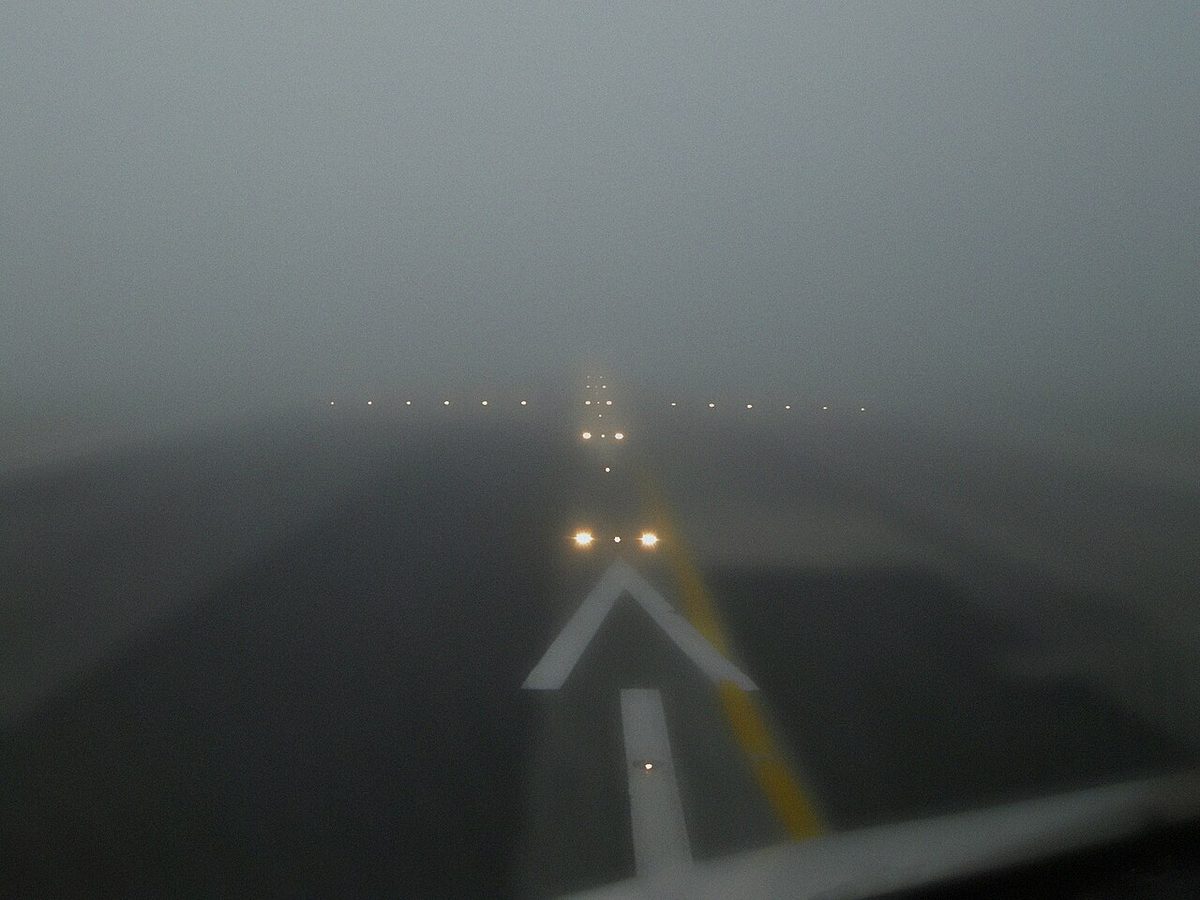
Take-off minima are expressed as an RVR or visibility. They depend mainly on the runway's markings and lighting, because what the pilot needs is enough visual guidance to keep straight and, if necessary, to stop. Some take-off minima also include a cloud ceiling, typically where obstacles must be seen and avoided in the climb. For multi-engine aeroplanes the minima also depend on the height from which the one-engine-inoperative net take-off flight path can be shown to clear the obstacles.
Charts show the result. On the Lyon Saint-Exupéry aerodrome chart, runways 17L and 17R have a minimum take-off RVR of 550 m for all categories, while runways 35L and 35R allow 125 m, with a note clearing them for low visibility take-offs below 125 m. Under EASA rules any take-off below 550 m RVR is a low visibility take-off, and below 400 m the operator needs a specific approval under SPA.LVO.
If weather or performance would prevent a return to the departure aerodrome shortly after take-off, the operator nominates a take-off alternate. For a twin-engined aeroplane it must lie within 1 hour at the one-engine-inoperative cruise speed, for aeroplanes with three or more engines within 2 hours, and its forecast must be at or above the applicable minima from 1 hour before to 1 hour after the estimated time of arrival there.
In the United States, takeoff minimums are published for each airport under Part 97. Where none are published, 14 CFR 91.175(f) sets standard takeoff minimums for operators under Parts 121, 125, 129 and 135: 1 statute mile for aeroplanes with two engines or fewer, and half a mile for aeroplanes with more than two engines and for helicopters. Part 91 operators are not bound by them. Non-standard minimums, marked on charts by a triangle with a T, may trade a climb gradient for weather: at Arlington, Washington, runway 34 offers standard minimums with a climb of 260 ft per NM to 800 ft, or a ceiling of 1,200 ft and 2½ miles for a visual climb. Airlines go lower with operations specifications, down to RVR 500 ft with centreline lights and RVR 300 ft with a head-up guidance system.
System minima and DA/DH
The operating minimum on an approach is the highest of the OCA/H for the aircraft category, the system minimum for the navigation aid, any limit in the flight manual, the State's published minimum and any increment imposed by the operator. The system minimum reflects how accurately the aid can place the aircraft, whatever the terrain. The values applied in EASA theory are:
| Facility | Lowest DH or MDH |
|---|---|
| ILS (CAT I) | 200 ft |
| Localiser, with or without DME | 250 ft |
| VOR/DME | 250 ft |
| VOR | 300 ft |
| NDB/DME | 300 ft |
| NDB | 350 ft |
| SRA terminating at 0.5 / 1 / 2 NM | 250 / 300 / 350 ft |
A DH is measured above the threshold, and a straight-in MDH above the aerodrome elevation, or above the threshold where it lies more than 2 m (7 ft) below the aerodrome. Circling minima are always above aerodrome elevation, and the lowest are 400 ft and 1,500 m for Category A and 500 ft and 1,600 m for Category B.
The Lyon ILS or LOC RWY 35L chart shows how the pieces combine. The CAT I obstacle clearance heights run from 141 ft for Category A to 179 ft for Category DL, yet the ILS line is a DA of 1,020 ft, a DH of 200 ft, for every category, because the CAT I system minimum is higher. The localiser line, with an OCH of 429 ft, gives an MDA of 1,250 ft (430 ft), and the RVR rises from 550 m to 1,300 m. The FAA applies the same principle in 14 CFR 91.175(b): the authorised DA/DH or MDA is the highest of those prescribed by the procedure, for the pilot in command and for the equipment used.
Exam tip: under the older EU-OPS rules a non-precision approach could not use an MDH below 250 ft or an RVR below 750 m, and question banks still ask for these values.
RVR, controlling RVR and CMV
A reported RVR always takes precedence over the meteorological visibility, for take-off as well as landing, because it describes the runway itself. Under the current EASA rules the touchdown zone RVR is the controlling RVR, or the midpoint value if no touchdown value is reported. Midpoint and stop-end values are advisory. The older EU-OPS rules also made the midpoint and stop-end values controlling where reported and relevant, with minimums of 125 m at the midpoint, or the touchdown value if lower, and 75 m at the stop end. The FAA treats touchdown RVR as controlling and midpoint and rollout values as advisory or controlling according to the operator's authorisation (see visibility and runway visual range).
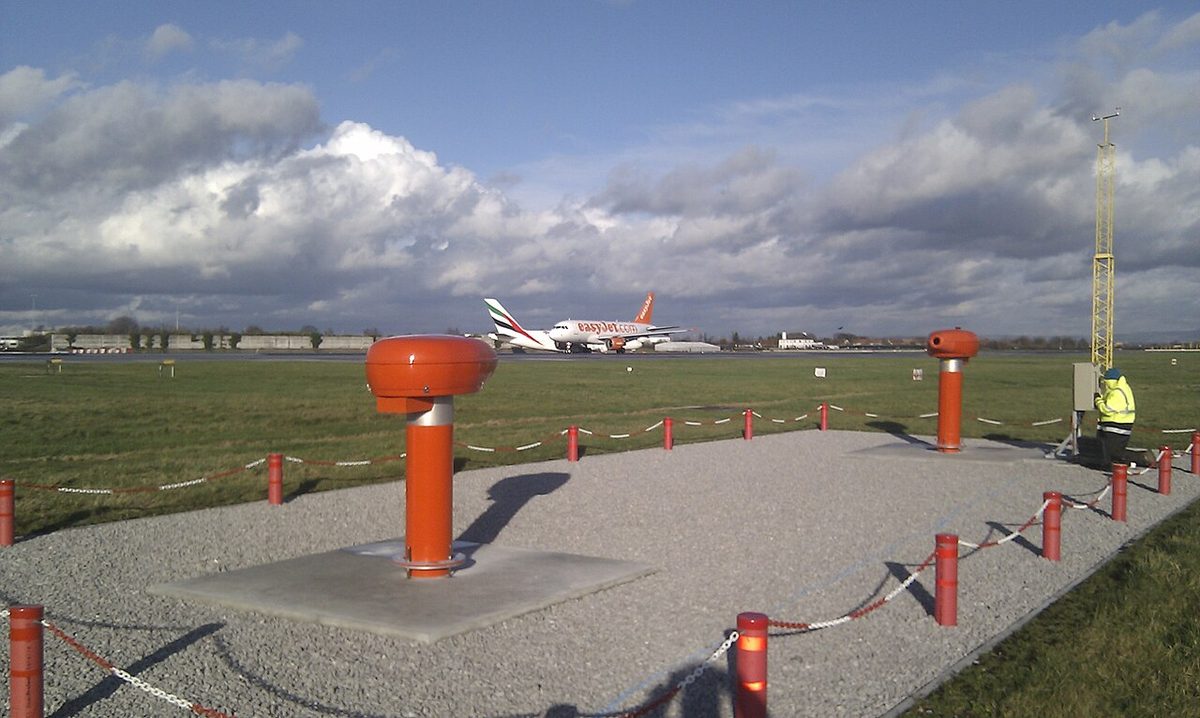
Where no RVR is reported, EASA allows the reported visibility to be turned into a converted meteorological visibility (CMV) by a factor that credits the runway lighting. With high-intensity approach and runway lighting the factor is 1.5 by day and 2.0 by night, lower factors apply with other lighting, and an unlit runway gets a factor of 1.0 by day only. A CMV may not be used when an RVR is reported, for take-off minima, or for any RVR minimum below 800 m, which rules it out for all CAT II and CAT III operations.
The FAA converts in the other direction. Where an RVR minimum is published but no RVR is reported, 14 CFR 91.175(h) replaces it with a visibility: RVR 1,600 ft is ¼ mile, 2,400 ft ½ mile, 3,200 ft ⅝ mile, 4,000 ft ¾ mile, 4,500 ft ⅞ mile, 5,000 ft 1 mile and 6,000 ft 1¼ miles.
Required visual references
At the DA/H, or before descending below the MDA/H, the pilot must have the required visual reference: a part of the runway environment, distinctly visible and identifiable, which allows the aircraft's position and path to be judged. For Type A and CAT I operations it may be elements of the approach lighting, the threshold with its markings or lights, a visual glide slope indicator such as a PAPI, the touchdown zone with its markings or lights, or the runway edge lights. If the reference is lost below the minimum, the pilot goes around.
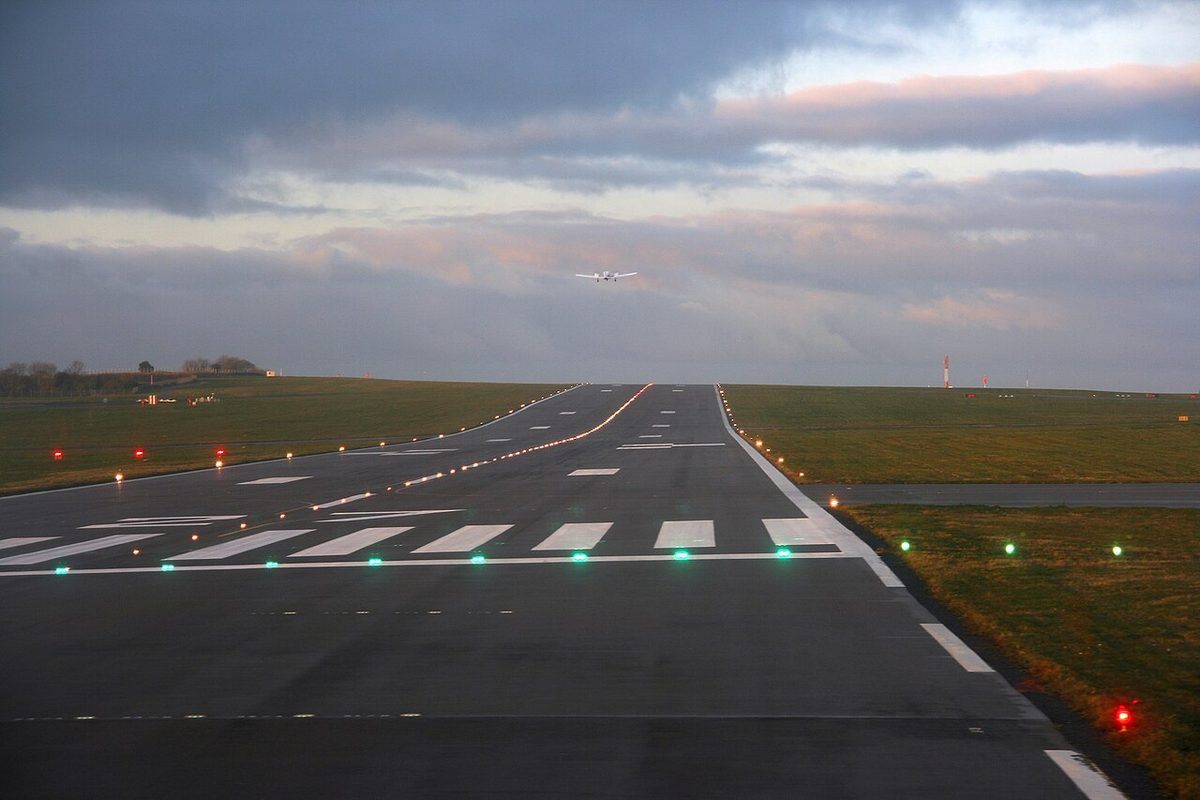
The FAA's list in 14 CFR 91.175(c) is similar: the approach light system, the threshold, threshold markings and lights, runway end identifier lights, the visual glideslope indicator, the touchdown zone, its markings and lights, and the runway, its markings and lights. With only the approach lights in sight the pilot may not descend below 100 ft above the touchdown zone elevation unless the red terminating bars or red side row bars are also visible. The aircraft must also be continuously in a position to land with a normal descent, touching down within the touchdown zone in Part 121 and 135 operations, and the flight visibility must not be less than the procedure requires. CAT II and CAT III require longer segments of lights, set out in low visibility operations.

The approach ban
The approach ban stops crews continuing approaches that have little chance of success. Under EASA rules, for commercial and non-commercial flights alike (in Part-NCO, NCO.OP.210), an approach may be started whatever the reported RVR or visibility. If the reported value is below the applicable minimum, however, the approach may not be continued below 1,000 ft above the aerodrome, or into the final approach segment where the DH or MDH is itself more than 1,000 ft above the aerodrome. Once past that point, a later deterioration does not force a go-around; the approach continues to the DA/H or MDA/H, where the decision rests on the visual reference. The ban applies to RVR and visibility only. A low reported cloud base does not stop the approach, although it makes a go-around likely. Where no RVR is reported, a converted visibility may be used.
| EASA | FAA | |
|---|---|---|
| Who | Part-CAT and Part-NCO operations | Parts 121 and 135; none in Part 91 |
| Gate | 1,000 ft above the aerodrome, or the final approach segment if the DH/MDH is above 1,000 ft | The final approach fix |
| After the gate | Continue to DA/H or MDA/H | Continue to DA or MDA |
The older ICAO and EU-OPS wording placed the gate at the outer marker or equivalent position for a precision approach, and at 1,000 ft above the aerodrome for a non-precision approach. Under 14 CFR 121.651, a US airline flight may not continue past the final approach fix unless the latest reported visibility or RVR is at or above the minimum; if it drops below after the fix, the approach may continue to the DA or MDA.
High minimums rule
The high minimums rule is a US Part 121 requirement that adds a margin for captains new to a type. Under 14 CFR 121.652, until the pilot in command has 100 hours as PIC in the type in Part 121 operations, the MDA or DA/DH is raised by 100 ft and the landing visibility by half a mile or the RVR equivalent, so that RVR 2,400 ft becomes RVR 5,000 ft in the operations specification table. The raised minimums need not exceed the airport's alternate minimums, but may never be lower than 300 ft and 1 mile, and they do not apply to take-off. The 100 hours may be reduced by up to half by counting one Part 121 landing in the type for each hour, if the pilot has at least 100 hours as PIC in another type in Part 121 operations. Under EASA rules, the flight crew is one of the factors the operator's method for establishing minima must take into account (see pilot in command and flight crew composition).
Frequently asked questions
What are aerodrome operating minima?
They are the limits of usability of an aerodrome for take-off and landing. Take-off minima are given as an RVR or visibility, with a cloud ceiling where obstacles must be seen and avoided. Landing minima are a decision altitude or height, or a minimum descent altitude or height, together with an RVR or visibility. Under EASA rules the operator establishes them for every aerodrome it plans to use, by a method in its operations manual.
What is the approach ban?
Under EASA rules an instrument approach may be started whatever RVR is reported, but if the reported RVR or visibility is below the applicable minimum it may not be continued below 1,000 ft above the aerodrome, or into the final approach segment where the DH or MDH is more than 1,000 ft. If the RVR drops below the minimum after that point, the approach may continue to the DA/H or MDA/H.
What are the FAA standard takeoff minimums?
Under 14 CFR 91.175(f), where no takeoff minimums are published for the airport, operators under Parts 121, 125, 129 and 135 need a visibility of 1 statute mile for aeroplanes with two engines or fewer, and half a mile for aeroplanes with more than two engines and for helicopters. Part 91 operators are not bound by them. With operations specifications, airlines may go lower, down to RVR 500 ft with centreline lights.
What is converted meteorological visibility?
CMV is a reported meteorological visibility multiplied by a factor for the runway lighting, used when no RVR is reported. With high-intensity approach and runway lighting the factor is 1.5 by day and 2.0 by night, so 1,000 m by day becomes 1,500 m. It may not be used when an RVR is reported, for take-off minima, or for any RVR minimum below 800 m.
What is the high minimums rule?
Under 14 CFR 121.652, a Part 121 captain with fewer than 100 hours as pilot in command in the type in Part 121 operations adds 100 ft to the DA or MDA and half a mile, or the RVR equivalent, to the landing visibility. The raised minimums need not exceed the airport's alternate minimums but may never be below 300 ft and 1 mile, and they do not apply to take-off.
Test yourself on Aerodrome Operating Minima
The v1prep banks cover this topic in Operational Procedures (070), with a worked explanation for every answer. EASA ATPL, PPL, IR and CPL, the FAA written tests and A320/B737 type ratings.
Start practising →Sources and further reading
- EASA Easy Access Rules for Air Operations (Regulation (EU) No 965/2012), CAT.OP.MPA.110 aerodrome operating minima
- EASA, Explanatory Note to ED Decision 2022/012/R, All-weather operations
- ICAO Annex 6, Operation of Aircraft, and Doc 8168 (PANS-OPS)
- AIP France, AD 1.1, Aerodrome availability and conditions of use (1.1.4, aerodrome operating minima)
- AIP France, AD 2 LFLL, Lyon Saint-Exupéry (aerodrome chart and ILS or LOC RWY 35L)
- 14 CFR 91.175, Takeoff and landing under IFR
- 14 CFR 121.651, Takeoff and landing weather minimums, IFR, all certificate holders
- 14 CFR 121.652, Landing weather minimums, IFR, all certificate holders
Library articles are written for study and exam preparation. They do not replace your aircraft's approved documentation, your operator's procedures or the regulations themselves.