Low Visibility Operations
Low visibility operations are take-offs and instrument approaches flown in a runway visual range below 550 m or with a decision height below 200 ft. They need a certified aircraft, a trained crew, an approved operator and an aerodrome applying low visibility procedures.
Low visibility operations (LVO) are the take-offs and approaches flown when fog, low cloud or heavy precipitation push the runway visual range (RVR) or the decision height (DH) below what a standard Category I operation allows. They rest on a chain of four links: an aircraft certified for the operation, a crew trained and current in it, an operator approved to conduct it, and an aerodrome whose guidance, lighting and procedures protect it. If any link is missing, the lower minima are not available.
Europe rewrote its all-weather operations rules through Regulation (EU) 2021/2237, which amended the Air Operations Regulation (EU) No 965/2012 and applied from 30 October 2022. The terms now follow ICAO. Textbooks and question banks still carry the older EU-OPS vocabulary, so this article gives the current EASA framework, flags the old terms, and sets out where the FAA differs. For the ground equipment itself, see the instrument landing system.
- What are low visibility operations
- Low visibility procedures (LVP)
- Low visibility take-off (LVTO)
- CAT II and CAT III approaches
- SA CAT I and SA CAT II (formerly LTS CAT I and OTS CAT II)
- Alert height, fail-passive and fail-operational systems
- Eye reference point and cockpit cut-off angle
- SMGCS and low visibility taxiing
- The FAA framework
- Frequently asked questions
What are low visibility operations
EASA defines low visibility operations as approach or take-off operations on a runway with an RVR below 550 m or with a DH below 200 ft (EASA writes "low-visibility"). Instrument approach operations are classified by their lowest minima:
- A Type A operation has a minimum descent height or DH at or above 250 ft.
- A Type B operation has a DH below 250 ft and is subdivided into CAT I, CAT II and CAT III.
| Operation | Decision height | RVR (EASA and ICAO) |
|---|---|---|
| CAT I | 200 ft or above | 550 m or more (ICAO: or visibility 800 m) |
| SA CAT I | Not below 150 ft | Not below 400 m |
| CAT II | Below 200 ft, not below 100 ft | 300 m or more |
| CAT III | Below 100 ft, or none | Below 300 m, or no limitation |
Where the DH and the RVR fall into different categories, ICAO's note says the operation is conducted to the requirements of the more demanding one. Each operator establishes its aerodrome operating minima under CAT.OP.MPA.110 (see aerodrome operating minima). Take-offs below 400 m RVR, CAT II and CAT III approaches, and operations with operational credits also need a specific approval under Part-SPA, Subpart LVO (SPA.LVO).
Exam tip: the pre-2022 rules divided CAT III into IIIA (DH below 100 ft, RVR at least 200 m) and IIIB (DH below 50 ft or none, RVR below 200 m but not below 75 m), and said that the RVR decided the category when DH and RVR disagreed. Current EASA and ICAO texts use a single CAT III and the more demanding category.
Low visibility procedures (LVP)
Low visibility procedures (LVP) are the measures an aerodrome applies to keep low visibility operations safe. An aerodrome that offers CAT II or CAT III approaches or low visibility take-offs publishes its own procedures and triggers, usually with a preparation phase as the RVR or cloud base falls and full LVP at published thresholds. ICAO's European guidance on all weather operations at aerodromes (EUR Doc 013) describes the elements. Crews normally learn from the ATIS that "LVP are in force". Typical measures are:
- Protection of the ILS critical and sensitive areas, so aircraft hold at CAT II/III holding positions further from the runway.
- Greater spacing between arrivals, so that the preceding aircraft has cleared the sensitive area before the next one is close in.
- Restrictions on vehicles and people on the manoeuvring area, with stop bars in use.
- Monitoring of the ILS, lighting and RVR systems, with standby power ready.
CAT II and CAT III minima depend on these protections, so they are not available unless LVP are in force. The cost is capacity, with holding and delays that the fuel plan must allow for.
Low visibility take-off (LVTO)
Under the 2022 rules, a low visibility take-off (LVTO) is a take-off in an RVR below 550 m. Take-offs between 550 m and 400 m need no specific approval, but the minima still depend on the runway lighting. Below 400 m, the operator needs an LVTO approval under SPA.LVO.
EASA's AMC sets the conditions for the lowest values. Below 150 m, and down to 125 m, the runway must have high-intensity centreline lights no more than 15 m apart and high-intensity edge lights no more than 60 m apart. LVP must be in force, and a 90 m visual segment must be available from the flight deck at the start of the take-off run. The required RVR must be met at every reporting point relevant to the take-off run. Below 125 m the flight manual minimum applies, never lower than 75 m, together with further aircraft and runway requirements.
A 90 m segment at 15 m spacing shows six intervals, or seven centreline lights, enough to track the centreline by eye. A take-off alternate may be required when the weather at the departure aerodrome is below landing minima.
Exam tip: under the older EU-OPS rules, an LVTO was defined as a take-off in an RVR below 400 m. Question banks still use that figure.
CAT II and CAT III approaches
A CAT II or CAT III approach needs all four links of the chain:
- Aircraft: certified for the category under CS-AWO or equivalent, with its capability stated in the flight manual. The DH is read from the radio altimeter.
- Crew: two pilots, both trained and qualified for the operation and current in it.
- Aerodrome: a suitable ILS or equivalent approach system, lighting that includes touchdown zone and runway centreline lights, and LVP in force.
- Operator: a SPA.LVO approval, with procedures, training and records.
At the DH the pilot needs the required visual reference, a segment of lights long enough to confirm position and trend. With a fail-operational system and no DH, the landing does not depend on seeing the runway before touchdown. The touchdown zone RVR is controlling. Lowest minima generally rely on autoland or a head-up guidance system to touchdown.
The minimum equipment list (MEL) states which items may be inoperative for dispatch. Many entries carry MEL operational and maintenance procedures, marked (O) and (M), which must be completed before the aircraft flies. Separately, the flight manual lists the equipment each landing category needs, so an aircraft dispatched with items inoperative may be downgraded, for example from fail-operational to fail-passive, or to CAT II or CAT I only. The crew checks the landing capability against the forecast before departure and again before the approach.
Exam tip: under EU-OPS, a CAT II approach needed at DH a segment of at least three consecutive lights of the approach centreline, touchdown zone, runway centreline or edge lighting, plus a lateral element such as a crossbar or the threshold. CAT III with a fail-passive system needed three consecutive lights. CAT IIIB with a fail-operational system and a DH needed at least one centreline light.
SA CAT I and SA CAT II (formerly LTS CAT I and OTS CAT II)
Operations with operational credits allow lower minima than the ground facilities alone would support, because the aircraft, the crew or both bring extra capability.
- SA CAT I (special authorisation category I) allows a DH not lower than 150 ft and an RVR that depends on the approach lighting, not lower than 400 m. CS-AWO now contains the airworthiness standard for aircraft flying to these minima.
- SA CAT II (special authorisation category II) is a CAT II approach to a runway that does not meet all the CAT II infrastructure requirements.
Before 2022, EASA called the equivalent operations lower than standard category I (LTS CAT I) and other than standard category II (OTS CAT II). Both terms remain in older manuals and in question banks, where LTS CAT I is tested with an RVR as low as 400 m.
Enhanced flight vision systems (EFVS) earn credits too. Under CAT.OP.MPA.312, an EFVS 200 operation lets an equipped aircraft use reduced RVR minima, but the RVR may not go below 550 m, nor the DH below 200 ft, so EFVS 200 is not a low visibility operation and needs no specific approval. The FAA's 14 CFR 91.176 goes further: EFVS may be used in place of natural vision below the DA or DH, either to 100 ft above touchdown zone elevation or, with the required equipment and authorisation, to touchdown.
Alert height, fail-passive and fail-operational systems
Automatic landing systems are classed by their behaviour after a failure:
- A fail-passive system causes no significant out-of-trim condition or deviation of flight path or attitude after a failure, but the landing is not completed automatically. The pilot takes over, so a DH and visual reference are needed. Airbus annunciates this capability as CAT 3 SINGLE.
- A fail-operational system can still complete the approach, flare and landing automatically after a failure below alert height, the remaining part of the system taking over. Airbus annunciates CAT 3 DUAL. Boeing shows LAND 3 for fail-operational and LAND 2 for fail-passive.
The alert height (AH) is a radio height, set for the aircraft type and its fail-operational landing system. If a failure occurs above it in a redundant part of the landing system, or in the relevant ground equipment, the crew discontinues the approach and goes around. Below it, a single failure no longer stops the landing. Alert height is therefore a failure-management height, not a visual decision point. A fail-operational CAT III approach may be flown with no DH at all; the alert height still applies.

Eye reference point and cockpit cut-off angle
The design eye reference point is the position for which the manufacturer designed the flight deck view, and markers at each pilot station let the pilot set the seat to it. A pilot sitting too low loses part of the view over the nose, which in fog can mean losing the lights needed at DH.
The cockpit cut-off angle is the angle below the horizontal of the lowest line of sight over the nose. Together with eye height and pitch attitude, it sets the obscured segment, the stretch of ground ahead that the pilot cannot see. The visual segment is what remains between the edge of the obscured segment and the limit of visibility. A higher nose attitude or a lower seat lengthens the obscured segment and shortens the visual segment.
This geometry is why the lowest take-off minima are tied to a visual segment of a set length, not to the RVR alone. On approach, fog is often thicker in the vertical than along the ground (see visibility and RVR), so the slant view at DH can be shorter than the reported RVR suggests.
SMGCS and low visibility taxiing
On the ground, low visibility turns taxiing into the phase with the least margin. A surface movement guidance and control system (SMGCS) is the combination of lighting, markings, signs, procedures and surveillance that keeps aircraft and vehicles on cleared routes. Its key elements are:
- Taxiway centreline lights, alternating green and yellow where they cross the ILS sensitive area or approach a runway.
- Stop bars at runway holding positions, crossed only when switched off.
- Runway guard lights and clearance bars.
- Published low visibility taxi routes.
- Surface movement radar or advanced SMGCS surveillance at larger aerodromes.
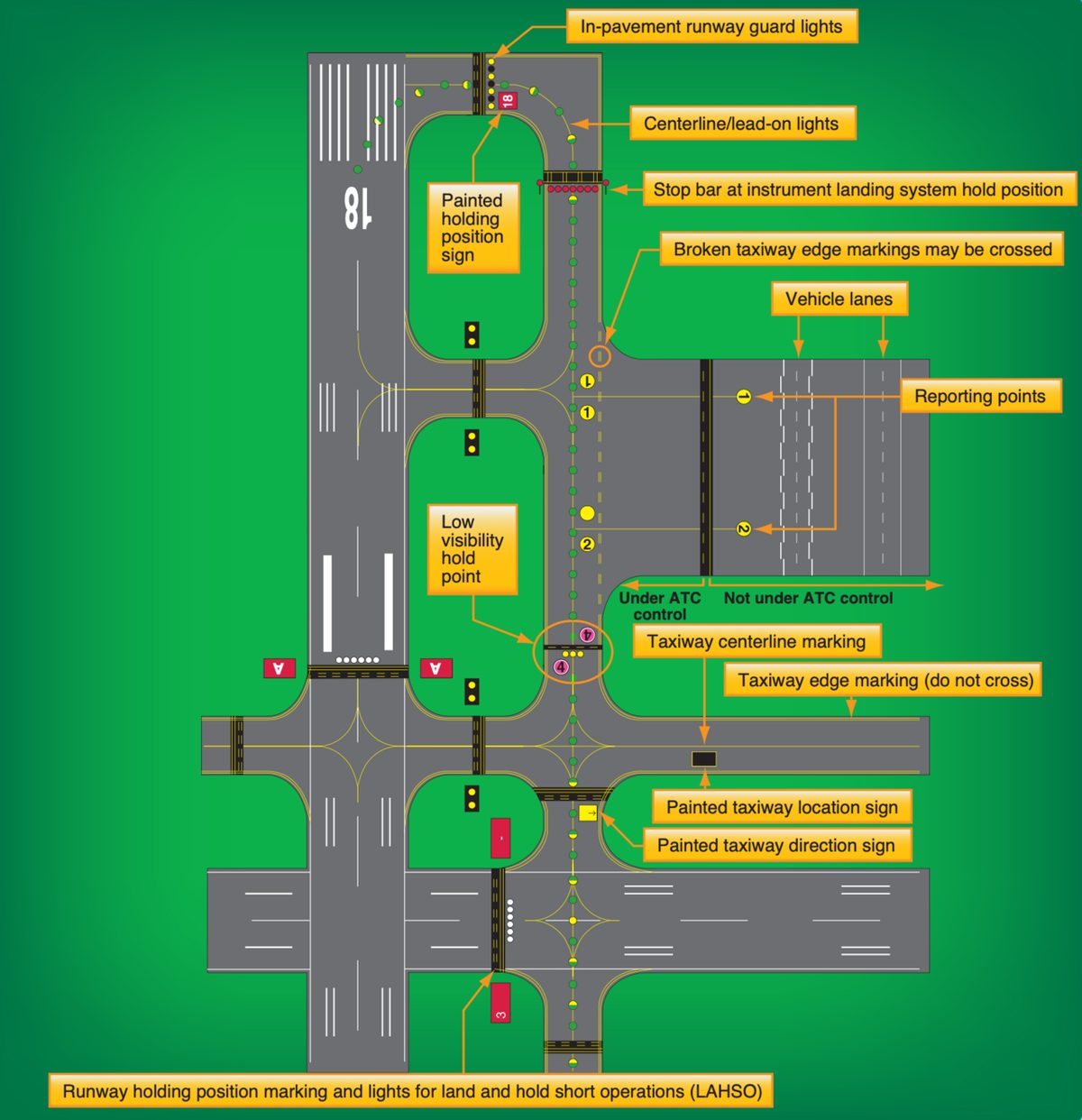
The FAA's AC 120-57B set out an SMGCS plan for US airports where scheduled air carriers operate in an RVR below 1,200 ft, and called for taxiway centreline lights, with edge lights on curves, along the taxi routes used below 600 ft RVR. Its 2023 replacement, AC 120-57C, renamed the plan LVO/SMGCS. Crews brief the taxi route on the chart, taxi slowly, read back every holding point and stop to ask when in doubt.
The FAA framework
The FAA reaches similar minima by a different route. Its criteria for take-off, landing and roll-out in all weather are consolidated in AC 120-118 (2018). Air carriers receive their authorisations through operations specifications. The main differences:
| EASA | FAA | |
|---|---|---|
| CAT III | Single category: DH below 100 ft or none, RVR below 300 m | IIIa: RVR at least 700 ft. IIIb: RVR 150 ft to below 700 ft. IIIc: no RVR limit |
| SA CAT I | DH 150 ft, RVR 400 m or more | DH 150 ft, RVR 1,400 ft, HUD to DH |
| SA CAT II | CAT II to a runway lacking some CAT II infrastructure | DH 100 ft, RVR 1,200 ft, autoland or HUD to touchdown |
The FAA approves SA CAT I and SA CAT II facilities under Order 8400.13, and charts these procedures with a note requiring specific authorisation.
Frequently asked questions
What is the difference between CAT II and CAT III approaches?
A CAT II approach has a decision height below 200 ft but not below 100 ft and an RVR of at least 300 m. A CAT III approach has a decision height below 100 ft or none, and an RVR below 300 m or no RVR limit. EASA and ICAO now treat CAT III as a single category, while the FAA still divides it into IIIa, IIIb and IIIc, with RVR limits quoted in feet.
What is alert height in a CAT III approach?
Alert height is a radio height, set for the aircraft type and its fail-operational landing system. If a failure occurs in a redundant part of the landing system or in the relevant ground equipment above it, the approach is discontinued and a go-around flown. Below it, the landing continues automatically after a single failure. It is a failure-management height, not a visual decision height.
What RVR counts as a low visibility take-off?
Since EASA's all-weather rules changed on 30 October 2022, a low visibility take-off is any take-off in an RVR below 550 m, but only take-offs below 400 m need a specific approval under SPA.LVO. The older EU-OPS definition, still tested in many question banks, was a take-off below 400 m. With approval and the right lighting, RVR may go down to 125 m, and lower with suitable aircraft equipment.
What is the difference between fail-passive and fail-operational autoland?
After a failure, a fail-passive system causes no significant deviation of flight path or attitude, but it cannot finish the landing, so the pilot takes over and must have visual reference. A fail-operational system can still complete the approach, flare and landing automatically after a failure below alert height. Fail-operational systems allow the lowest minima, including operations with no decision height.
What does LVP in force mean?
It means the aerodrome has activated its low visibility procedures, usually announced on the ATIS. ILS critical and sensitive areas are protected, aircraft hold at CAT II/III holding points further from the runway, spacing between arrivals increases and vehicle movements are restricted. Operators need those protections before crews can use CAT II or CAT III minima or take off in very low RVR.
Test yourself on Low Visibility Operations
The v1prep banks cover this topic in Operational Procedures (070), with a worked explanation for every answer. EASA ATPL, PPL, IR and CPL, the FAA written tests and A320/B737 type ratings.
Start practising →Sources and further reading
- EASA, Explanatory Note to ED Decision 2022/012/R, All-weather operations
- EASA, Easy Access Rules for All Weather Operations (CS-AWO)
- ICAO EUR Doc 013, European Guidance Material on All Weather Operations at Aerodromes, 6th edition (2023)
- FAA AC 120-118, Criteria for Approval/Authorization of All Weather Operations for Takeoff, Landing, and Rollout
- FAA Order 8400.13E, facility evaluation and approval for SA CAT I, SA CAT II and CAT II/III operations
- FAA AC 120-57C, Low Visibility Operations/Surface Movement Guidance and Control Systems (LVO/SMGCS)
- 14 CFR 91.176, Straight-in landing operations below DA/DH or MDA using an enhanced flight vision system (EFVS)
Library articles are written for study and exam preparation. They do not replace your aircraft's approved documentation, your operator's procedures or the regulations themselves.