Instrument Approach Procedures
An instrument approach procedure is a published series of manoeuvres, flown by reference to instruments with specified protection from obstacles, that takes an aircraft from the en-route structure or an initial approach fix to a point from which it can land and, if it cannot, into a missed approach.
An instrument approach procedure (IAP) is a published sequence of manoeuvres that brings an aircraft in instrument conditions from the en-route structure to a point from which it can land, with obstacle protection at every stage, and into a missed approach if it cannot. A pilot who keeps to the published track and altitudes is protected; the protection ends when the aircraft leaves the procedure or descends below the minimum without the required visual reference.
ICAO's design criteria are in PANS-OPS (Doc 8168); the United States uses TERPS. Under 14 CFR 91.175(a), a civil pilot who needs an instrument approach at a US civil airport must use a standard procedure prescribed in 14 CFR Part 97 unless the FAA authorises otherwise. Examples come from current FAA charts for Olympia, Yakima, Hoquiam and Everett, Washington.
- Anatomy of an instrument approach
- Feeder routes and approach transitions
- Initial approach segment and IAF
- Reversal procedures
- Intermediate segment and IF
- Final approach segment and FAF
- Aircraft categories and circling
- The visual segment
- Missed approach segment
- Straight-in and timed approaches
- Frequently asked questions
Anatomy of an instrument approach
Every procedure is a chain of instrument approach segments, each with its own obstacle clearance and purpose:
| Segment | From | To | Purpose |
|---|---|---|---|
| Arrival | En-route fix | Initial approach fix (IAF) | Join the procedure |
| Initial | IAF | Intermediate fix (IF), or where established on the intermediate or final course | Lose height, align, reverse course |
| Intermediate | IF | Final approach fix (FAF) or point | Settle speed and configuration |
| Final | FAF or point | Runway or missed approach point (MAPt) | Descend to the minimum |
| Missed approach | MAPt or decision altitude | Fix where holding or en-route clearance applies | Climb to a safe altitude |
Approaches are classed by their final approach guidance. A precision approach (PA), such as an ILS, GLS or PAR, gives lateral and vertical guidance meeting ICAO Annex 10 precision standards. An approach with vertical guidance (APV), such as LPV or LNAV/VNAV, gives both without meeting them. A non-precision approach (NPA), such as a VOR, NDB, localiser, LNAV or LP approach, gives lateral guidance only. EASA, following ICAO, now classes approach operations as 3D, with lateral and vertical guidance, or 2D, with lateral guidance only.
FAA titles name the final approach aid and the runway, as in VOR RWY 6. A procedure that allows only circling takes a letter instead, as in the VOR-A at Everett, Washington.
Feeder routes and approach transitions
A feeder route carries an aircraft from an en-route fix to an IAF, with a course, distance and minimum altitude. At Olympia one runs from the Seattle VORTAC on 207° for 22.2 NM at 6,000 ft to the IAF HOGVU. Published feeder routes form part of an approach clearance. On RNAV procedures the same links appear as approach transitions, coded in the navigation database. A STAR may also end at an IAF or IF, so that arrival and approach join without a break.
Many RNAV approaches instead publish a terminal arrival area, whose sector altitudes give at least 1,000 ft of obstacle clearance, replace the minimum sector altitude and may be flown once the aircraft is cleared for the approach (see RNP approaches and minimum safe altitudes). An aircraft on radar vectors keeps its last assigned altitude until established on a published segment.
Initial approach segment and IAF
The initial approach segment runs from the initial approach fix (IAF) to the IF, or to the point where the aircraft is established on the intermediate or final course. Most height is lost here, and the aircraft is aligned by straight legs, DME arcs or a course reversal; at Yakima, 13 DME arcs from the IAFs CIDOG and WIKIK lead onto the localiser course. PANS-OPS provides 300 m (984 ft) of obstacle clearance in the primary area of the initial segment and allows intercept angles at the IF of up to 90° for precision approaches and 120° for non-precision approaches. The AIM limits ATC clearances for RNAV aircraft direct to an IAF or IF to intercepts of 90° or less.
FAA charts underline a minimum altitude, overscore a maximum, do both for a mandatory altitude and neither for a recommended one.
Reversal procedures
14 CFR 97.3 defines the procedure turn as the manoeuvre prescribed when a reversal is needed to establish the aircraft inbound; the chart fixes the outbound course, direction of turn, distance limit and minimum altitude, and the pilot chooses the type and rate of turn and where to begin it. FAA charts show a barbed arrow on the manoeuvring side. At Yakima the aircraft flies outbound from XOWLO on 094°, turns onto the 45° leg of 139°, reverses onto 319° and intercepts 274° inbound, remaining within 10 NM and at or above 4,300 ft until established.
The normal limit is 10 NM, reduced to 5 NM for Category A or helicopters only and extended to 15 NM for high-performance aircraft, and the AIM recommends no more than 200 KIAS in the manoeuvre. PANS-OPS provides two reversal procedures, the procedure turn and the base turn, and the racetrack procedure:
- Procedure turn: 45°/180°, with an outbound leg of 1 minute for Categories A and B and 1 minute 15 seconds for C, D and E, or 80°/260°, which takes 2 minutes in still air.
- Base turn: a teardrop, the AIM's teardrop procedure, from an outbound track onto an inbound track that is not its reciprocal.
- Racetrack procedure: a holding-type pattern, used when an aircraft must first hold and the hold's orientation suits neither of the others.
A hold-in-lieu of procedure turn (HILPT) replaces the barb with a holding pattern at the IF or FAF. It is flown as charted, within the published leg length or time and holding speeds, and is complete once the aircraft is established inbound after the entry (see holding patterns). At Olympia the HILPT at BOSTO has 5 NM legs, 356° outbound and 176° inbound, with a minimum altitude of 3,000 ft.
NoPT marks a route or sector from which no reversal is flown. Some NoPT altitudes are lower than the procedure turn altitude, so a pilot who flies the turn with ATC clearance stays at or above the procedure turn altitude until established inbound. Under 91.175(j) a pilot may not fly a procedure turn, unless ATC clears one, when radar vectored to the final approach course or fix, on a timed approach from a holding fix, or on a NoPT route. Otherwise a charted procedure turn or HILPT is required unless ATC clears the aircraft for a straight-in approach.
Intermediate segment and IF
The intermediate approach segment runs from the intermediate fix (IF) to the FAF. The aircraft is aligned with the final course, slows and configures, and flies level or nearly so at the platform altitude from which the final descent begins. For an ILS, PANS-OPS defines the final approach point as the point where the intermediate approach altitude meets the nominal glide path; FAA charts mark this glide slope intercept altitude with a lightning bolt, and the glide path is intercepted from below (see instrument landing system). At Yakima the IF, OPISE, is at 17.6 DME; minimum altitudes are 4,000 ft to ZITLU and then 3,800 ft to XOWLO at 9.9 DME, the localiser FAF. Where no fix marks the start of the intermediate segment, the AIM assumes it begins 10 NM before the FAF.
Final approach segment and FAF
The final approach segment (FAS) runs from the final approach fix (FAF) or point along the final approach course, 274° at Yakima, to the runway or MAPt. On non-precision profiles FAA charts mark the FAF with a Maltese cross. On an on-airport VOR or NDB approach with no FAF, the final segment begins when the aircraft is established inbound after the reversal. PANS-OPS puts the non-precision FAF ideally 5 NM and at most 10 NM from the threshold, with an optimum final descent gradient of 5.2% (318 ft per NM, 3°) and a maximum of 6.5%.
Stepdown fixes in the final segment allow a lower altitude once an obstacle is passed; they apply only to lines flown to an MDA.
A decision altitude (DA) belongs to approaches with vertical guidance: the pilot decides on reaching it while descending, and the momentary dip below it in a go-around is allowed for. A minimum descent altitude (MDA) is a floor: the aircraft may not go below it without the required visual reference, and the missed approach begins at the MAPt, defined by timing, a fix, a navaid or a waypoint. FAA charts give the DA or MDA in feet MSL, with the height above touchdown (HAT) for straight-in lines and the height above airport (HAA) for circling. The Olympia RNAV chart shows the three types:
| Line | Class | Minimum | HAT | Visibility |
|---|---|---|---|---|
| LPV | APV | DA 407 ft | 200 ft | ½ SM |
| LNAV/VNAV | APV | DA 629 ft | 422 ft | ¾ SM |
| LNAV | NPA | MDA 680 ft | 473 ft | ½ SM, 1 SM for C and D |
The operating minimum may never be lower than the obstacle clearance altitude (OCA/H) of the design; under 91.175(b) the authorised minimum is the highest of those set by the procedure, the pilot and the equipment in use. Commercial operators normally fly non-precision finals as a continuous descent to a derived decision altitude (see stabilised approach).

Aircraft categories and circling
Minima and protected areas depend on the aircraft approach category, set by a reference speed at maximum certificated landing mass: VREF, or 1.3 VSO, for the FAA, and VAT, 1.3 VSO or 1.23 VS1g, for ICAO and EASA.
| Category | Speed | ICAO maximum circling speed | EASA lowest circling MDH and visibility |
|---|---|---|---|
| A | Below 91 kt | 100 kt | 400 ft, 1,500 m |
| B | 91 to 120 kt | 135 kt | 500 ft, 1,600 m |
| C | 121 to 140 kt | 180 kt | 600 ft, 2,400 m |
| D | 141 to 165 kt | 205 kt | 700 ft, 3,600 m |
| E | 166 kt and above (ICAO: 166 to 210 kt) | 240 kt | Not tabulated |
Circling, which ICAO calls visual manoeuvring (circling), always ends at an MDA, whatever approach preceded it. The protected area is drawn from arcs around each runway end whose radius grows with category, from 1.3 NM for Category A to 2.3 NM for D on older FAA procedures. A pilot circling faster than the category allows uses the higher category's minima; the AIM's example is a Category B aeroplane circling at 145 kt, which uses Category D. If visual reference is lost while circling, the pilot makes a climbing turn towards the landing runway and joins the missed approach.
The visual segment
Below the DA or MDA the procedure gives no implicit obstacle protection. Designers check the visual segment, and an obstacle there can raise the visibility, remove the VDP or, if unlit, close the approach at night. Such restrictions appear as chart notes: the Hoquiam VOR RWY 6 chart, for example, states that straight-in and circling approaches to runway 6 are not authorised at night. Under 91.175(c) the pilot may descend below the DA or MDA only when continuously in a position to land normally, with the prescribed flight visibility and at least one listed reference in sight. The approach lights alone permit descent to 100 ft above touchdown zone elevation unless the red terminating bars or red side row bars are also visible.
The visual descent point (VDP), a bold V on FAA charts, is the point on a straight-in non-precision final from which a normal descent from the MDA can begin; pilots should not leave the MDA before it. Olympia's, for the LNAV line only, is 1.3 NM from the threshold. Where none is published, HAT ÷ 300 gives the distance in NM for a 3° descent.
Missed approach segment
A clearance for an approach includes its published missed approach, which is protected only if begun at or above the DA or MDA and flown from the MAPt, without turning early. TERPS assumes a climb of at least 200 ft per NM and PANS-OPS 2.5% unless more is published. At Yakima the 200 ft ILS minimum requires 275 ft per NM to 3,600 ft; aircraft unable to achieve it use a DA of 1,713 ft (HAT 645 ft) (see go-around and missed approach).
Straight-in and timed approaches
A straight-in approach needs no circling. FAA straight-in minima are published when the final course lies within 30° of the runway and a normal descent is possible; otherwise only circling minima appear, although a pilot with the runway in sight may still land straight in when cleared. "Cleared straight-in" means no reversal is flown.
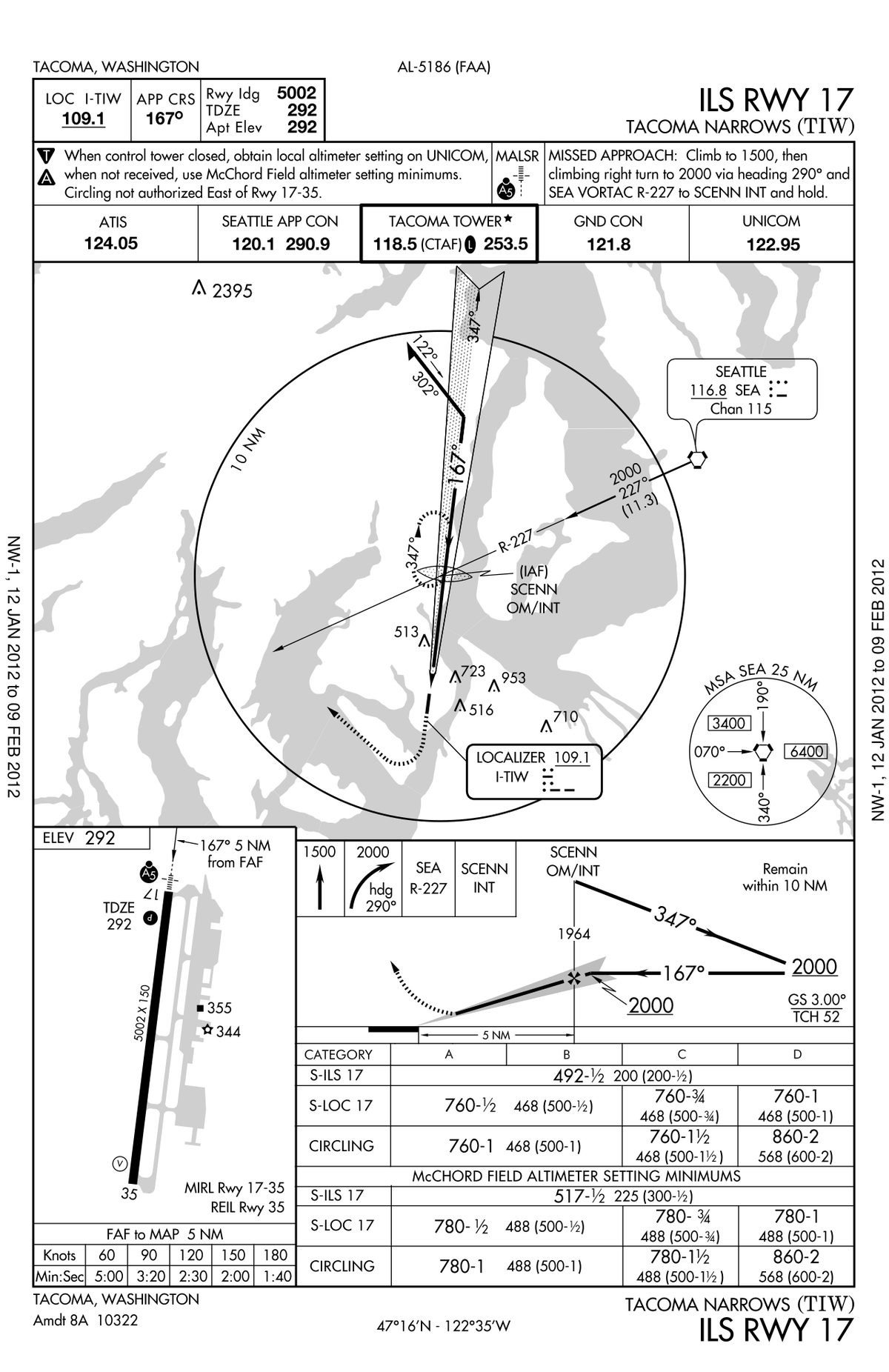
A timed approach from a holding fix sequences aircraft from the hold by time. The AIM requires an operating tower, direct communication with approach control until handed to the tower, and a missed approach without course reversal. Each pilot receives a time to leave the fix inbound and adjusts the hold to cross it on time, with no procedure turn. Clock timing also defines many MAPts: on the Tacoma Narrows chart, 5 NM from FAF to MAPt takes 3 minutes 20 seconds at 90 kt.
Frequently asked questions
What are the segments of an instrument approach?
There are five. The arrival segment, a feeder route, STAR or approach transition, leads from the en-route structure to the initial approach fix. The initial segment runs from the IAF to the intermediate fix and is where height is lost and course reversals are flown. The intermediate segment, from the IF to the final approach fix, sets up speed and configuration. The final segment ends at the missed approach point or runway, and the missed approach segment follows if no landing is made.
What is the difference between DA and MDA?
A decision altitude belongs to an approach with vertical guidance, such as an ILS, LPV or LNAV/VNAV. The pilot decides at the DA while still descending, and the brief dip below it during a go-around is allowed for in the design. A minimum descent altitude belongs to a lateral-only approach and is a floor. The aircraft may not go below it without the required visual reference, and the missed approach is started at the missed approach point.
When is a procedure turn not required?
Under 14 CFR 91.175(j) a pilot may not fly a procedure turn, unless ATC clears one, when radar vectored to the final approach course or fix, when flying a timed approach from a holding fix, or when the route or sector flown is marked NoPT. ATC can also issue a straight-in approach clearance. Otherwise a charted procedure turn or hold in lieu of it is a required part of the procedure.
How are aircraft approach categories determined?
By a reference speed at maximum certificated landing mass, not at the actual landing weight. The FAA uses VREF or 1.3 VSO; ICAO and EASA use VAT, 1.3 VSO or 1.23 VS1g. Category A is below 91 kt, B 91 to 120 kt, C 121 to 140 kt, D 141 to 165 kt and E above that. An aircraft manoeuvring faster than its category's range uses the minima of the higher category.
What is a visual descent point?
A visual descent point is a defined point on the final approach course of a straight-in non-precision approach from which a normal descent from the MDA to touchdown can begin. FAA charts mark it with a bold V. Pilots should not descend below the MDA before reaching it. Where none is published, dividing the height above touchdown by 300 gives an approximate distance in nautical miles from the threshold for a 3 degree descent.
What is the difference between a precision, APV and non-precision approach?
A precision approach, such as an ILS, GLS or PAR, gives lateral and vertical guidance meeting the ICAO Annex 10 precision standards. An approach with vertical guidance, such as LPV or LNAV/VNAV, gives both but to lower integrity standards. Both end at a decision altitude. A non-precision approach, such as a VOR, NDB, localiser or LNAV approach, gives lateral guidance only and ends at a minimum descent altitude. ICAO now also calls these 3D and 2D operations.
Test yourself on Instrument Approach Procedures
The v1prep banks cover this topic in General and Radio Navigation (061/062), with a worked explanation for every answer. EASA ATPL, PPL, IR and CPL, the FAA written tests and A320/B737 type ratings.
Start practising →Sources and further reading
- FAA Aeronautical Information Manual, Chapter 5 Section 4, Arrival Procedures (approach charts, clearances, procedure turns, minima, missed approach)
- 14 CFR 91.175, Takeoff and landing under IFR
- 14 CFR 97.3, Symbols and terms used in procedures
- FAA Aeronautical Chart Users' Guide, Terminal Procedures Publication
- FAA Instrument Procedures Handbook (FAA-H-8083-16B)
- ICAO Doc 8168, Procedures for Air Navigation Services, Aircraft Operations (PANS-OPS), and Annex 6, Operation of Aircraft
- EASA, Easy Access Rules for Air Operations (Regulation (EU) No 965/2012)
Library articles are written for study and exam preparation. They do not replace your aircraft's approved documentation, your operator's procedures or the regulations themselves.