Visibility and Runway Visual Range
Visibility is the greatest distance at which objects, or lights at night, can be seen and identified. Runway visual range (RVR) is the distance over which a pilot on the runway centreline can see the runway markings or lights, assessed by instruments beside the runway.
Visibility is the distance at which objects, or lights at night, can be seen and identified. Pilots meet several versions of it, and they are not interchangeable: the meteorological visibility in a METAR, the flight visibility judged from the cockpit, the ground visibility that governs VFR take-offs and landings in control zones, and the runway visual range (RVR) that governs instrument approaches and take-offs in poor visibility. Each is defined for a different purpose and obtained in a different way.
The distinction matters because minima are written in terms of one of them, not visibility in general. A crew that confuses the meteorological visibility with the RVR, or the reported visibility with what will be seen at decision height, can start an approach it may not legally continue, or continue one that cannot succeed.
Definitions of visibility
| Term | What it means | Where it is used |
|---|---|---|
| Meteorological visibility | How far an observer can see and identify a dark object by day, or lights of a set intensity by night | METAR and TAF visibility, fog and mist classification |
| Meteorological optical range (MOR) | An instrumental measure of how quickly the air absorbs and scatters light, expressed as a distance | Basis of automatic visibility and of RVR |
| Prevailing visibility | The visibility reached or exceeded over at least half the horizon or aerodrome | The main visibility group of a METAR |
| Minimum or sector visibility | The visibility in the worst direction, where it differs markedly | Added to the report with a direction |
| Ground visibility | The visibility at an aerodrome as reported by an accredited observer or by automatic systems | VFR in control zones, US surface areas |
| Flight visibility | The visibility forward from the cockpit of an aircraft in flight | VFR minima; at the minimum on an FAA approach |
| Runway visual range | How far a pilot on the runway centreline can see the runway markings or lights | Approach and take-off minima |
| Vertical visibility | How far up one can see into an obscuration that hides the sky | Replaces the cloud group, as VV002 |
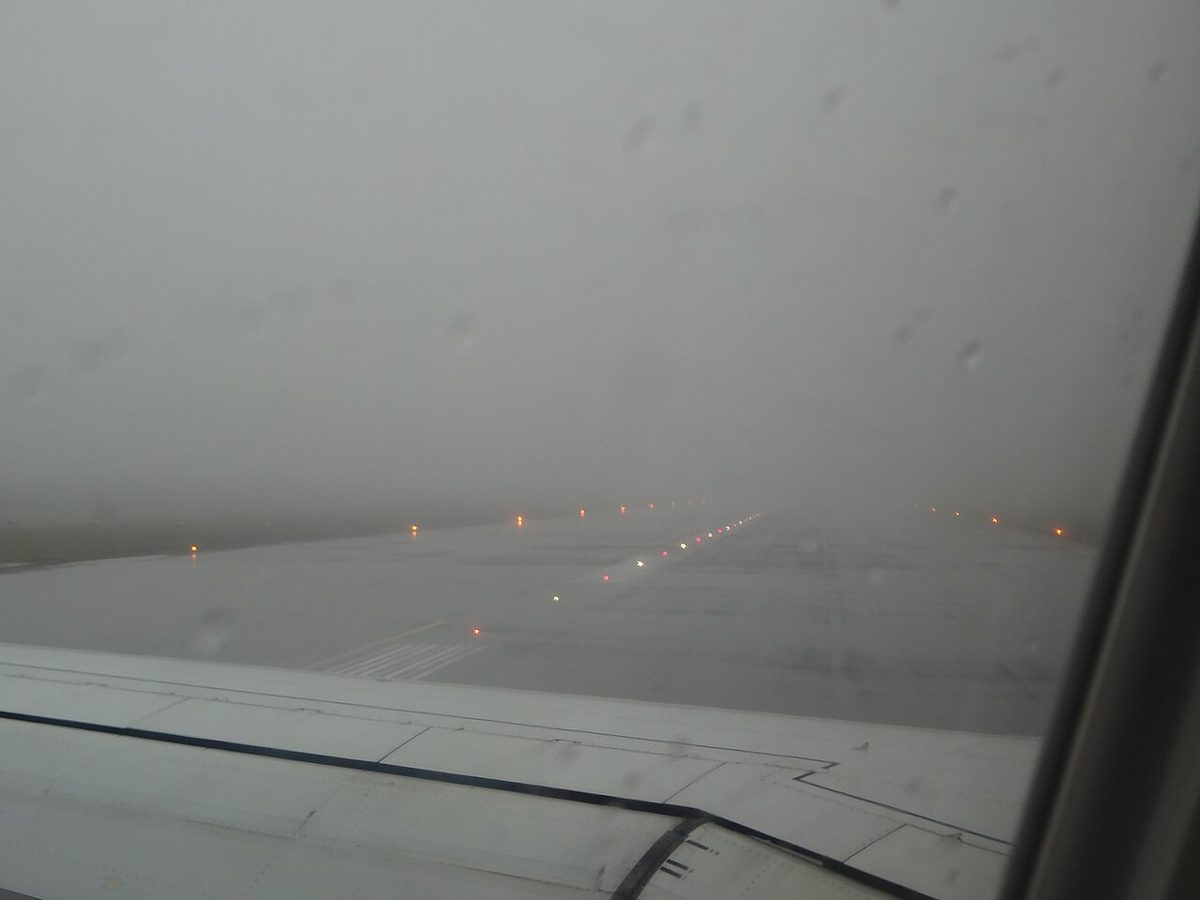
Slant visibility, what the pilot actually sees looking forward and down on the approach, is not measured or reported at all. In fog it is often worse than the RVR, because the pilot looks through the whole depth of the fog, which is why a report of VV002 or an RVR at the minimum does not guarantee that the runway will be seen at 200 ft (see cloud cover and ceiling).
Meteorological visibility and MOR
Meteorological visibility, often shortened to met vis, is the greatest horizontal distance at which an observer with normal eyesight can recognise a dark object against the background by day or, by night, see lights of a specified intensity. It is a property of the air, not of the runway, and it is the figure that decides whether an obscuration is reported as fog (below 1,000 m) or mist (see fog). Ground visibility is the visibility at an aerodrome as reported by an accredited observer or by automatic systems.
The meteorological optical range (MOR) is its instrumental counterpart. A sensor measures how much light the air between two points absorbs and scatters, and the result is expressed as the distance over which a beam would fade to a threshold. Automatic stations report a visibility derived from such a sensor, which samples the air around one point instead of scanning the horizon, and the same kind of measurement feeds the RVR calculation.
In a METAR the visibility is given in metres: 9999 means 10 km or more and 0000 less than 50 m. Local routine reports give it in metres below 5 km and in kilometres above. US reports give statute miles, up to 10SM, with M1/4SM for less than a quarter of a mile; US TAFs forecast no more than P6SM, more than 6 SM.
Prevailing and sector visibility
Visibility is rarely the same in every direction, so the report must choose one figure. Under ICAO rules the prevailing visibility is the greatest visibility reached or exceeded within at least half the horizon circle or within at least half of the aerodrome surface. The sectors making up that half may be contiguous or not. The FAA defines prevailing visibility on the same half-horizon principle.
Where one direction is much worse, ICAO reports add the minimum visibility and its direction, as in 4000 1400SW: prevailing 4,000 m, but 1,400 m to the south-west. The minimum is added when it is below 1,500 m, or below half the prevailing visibility and less than 5,000 m. A bank of fog lying on one side of the aerodrome, perhaps over the approach, shows up this way. US reports instead add a sector visibility in the remarks when visibility in some sector differs markedly from the prevailing value.
Flight visibility and ground visibility
Flight visibility is the visibility forward from the cockpit of an aircraft in flight, judged by the pilot. The FAA defines it as the average forward horizontal distance at which prominent unlighted objects can be seen and identified by day and prominent lighted objects by night. The VFR minima are written in flight visibility: under SERA, for example, 8 km at and above FL100 and 5 km below it in most airspace, and under 14 CFR 91.155 values such as 3 SM in Class E below 10,000 ft MSL (see VFR, IFR and meteorological conditions).
Ground visibility is the reported visibility at the aerodrome. It governs VFR operations close to the ground in controlled airspace. Under SERA, unless it has a special VFR clearance, a VFR flight may not take off or land at an aerodrome in a control zone, or enter its aerodrome traffic zone or traffic circuit, when the ground visibility is less than 5 km or the ceiling is less than 1,500 ft. Under 14 CFR 91.155(d) the equivalent is a ground visibility of at least 3 SM in the surface area of Class B, C, D or E airspace or, if no ground visibility is reported, a flight visibility of at least 3 SM.
On an instrument approach the FAA makes flight visibility the legal test at the minimum: under 14 CFR 91.175 the pilot may not descend below the DA or MDA unless the flight visibility is at least that prescribed for the procedure. Reported values are then planning information, although in airline operations 14 CFR 121.651 forbids continuing past the final approach fix unless the latest weather report gives a visibility at or above the minimum, and under 121.655 a reported RVR for the runway is the value that controls. EASA rules apply the reported RVR or visibility instead, through the approach ban described below.
Runway visual range
ICAO defines the runway visual range (RVR) as the range over which the pilot of an aircraft on the centreline of a runway can see the runway surface markings or the lights delineating the runway or identifying its centreline. EASA exam material puts the observer 15 ft above the runway in the touchdown zone, looking in the direction of take-off or landing, and seeing marker boards by day or runway lights by night.
RVR is not a visibility measured along the runway. Instruments measure how quickly the air near the runway is losing light, and a computer then works out how far a pilot would see lights of the intensity in use against the prevailing background brightness. Because runway lights can be seen much further than an unlit object, RVR is generally greater than the meteorological visibility in fog, although it can occasionally be lower. The lighting setting is part of the result: in its local reports France calculates RVR with the maximum light intensity available on the runway, a declared difference from ICAO practice.
Under ICAO rules RVR is reported when the visibility or the RVR is below 1,500 m. UK practice, which EASA exam material follows, adds that it is reported whenever shallow fog is reported or forecast, because a thin layer of fog can lie below the sensors. It is observed only; there is no RVR forecast. Instrumented runway visual range (IRVR) is RVR assessed at up to three points along a runway, normally the touchdown zone, the midpoint and the stop end, so that the crew knows the conditions over the whole landing or take-off run.
Transmissometers and forward scatter meters
Two kinds of instrument measure the air for visibility and RVR.
- A transmissometer has a light projector and a photoelectric receiver a known distance apart. The intensity arriving at the receiver depends on the clarity of the air along the path. It measures continuously, but it samples only a small part of the atmosphere.
- A forward scatter meter, or forward scatter visibility meter, projects a narrow beam and measures the light scattered forward off particles into a receiver set at an angle of about 20 to 50° to the beam. Using three sensors at different angles, a system can determine automatically whether the particles are water, ice or solid. Forward scatter meters are replacing transmissometers.
Either way, the measurement describes a small sample of air at one point beside the runway. Fog is often patchy, so the readings from the touchdown zone, midpoint and stop end can differ widely.

Reporting RVR
In a METAR each RVR group follows the visibility (see METAR and SPECI). R30/1100 means an RVR of 1,100 m for runway 30, the value representative of the touchdown zone; parallel runways carry L, C or R, as in R27L/0900. The values are ten-minute means, reported in steps of 25 m up to 400 m, 50 m between 400 and 800 m, and 100 m above 800 m. P means the RVR exceeds the highest value the system can assess, as in R30/P1500, and M that it is below the lowest, as in R30/M0050. A final U, D or N shows the tendency during the ten minutes: up, down or no distinct change, U and D marking a change of 100 m or more.
ATC and ATIS pass the current values. Where several are available they are always given in the order touchdown zone, midpoint, stop end, such as 600, 400 and 550 m for runway 28L, with the word MISSING in the position of any value not available.
Under the EASA all-weather operations rules applicable since 30 October 2022, the touchdown zone RVR is controlling (the midpoint value if no touchdown value is reported), and midpoint and stop-end values are advisory: they help the crew judge whether there will be enough visual reference for the roll-out and taxi. The older EU-OPS rules, still found in exam questions, also made the midpoint and stop-end values controlling where reported and relevant, with minimums of 125 m, or the touchdown value if lower, at the midpoint and 75 m at the stop end. A reported RVR takes precedence over the meteorological visibility for take-off as well as landing. Where no RVR is available, the reported visibility may be converted to a converted meteorological visibility (CMV), with factors of 1.5 by day and 2.0 by night where high-intensity approach and runway lighting is in use, lower factors with other lighting, and no credit on an unlit runway, where the factor is 1.0 and conversion is allowed by day only. A CMV may not be used when an RVR is reported, for take-off minima, or for any required RVR below 800 m (see aerodrome operating minima).
Exam tip: under EASA's approach ban an approach may be started whatever the reported RVR, but if the RVR is below the minimum it may not be continued below 1,000 ft above the aerodrome, or into the final approach segment where the DH or MDH is more than 1,000 ft. If it drops below the minimum after that point, the approach may be continued to the DA/H or MDA/H.
The FAA reports RVR in hundreds of feet and adds FT, as in R28L/2400FT; a V shows variation during the ten minutes, as in R28L/1600V3000FT. The touchdown RVR is controlling, and the midpoint and rollout values are advisory or controlling according to the operator's authorisation. When an RVR minimum other than a Category II or III minimum is published but no RVR is reported, 14 CFR 91.175(h) and the AIM give equivalent visibilities; a value between those listed takes the next higher RVR, without interpolation:
| RVR (ft) | 1,600 | 2,400 | 3,200 | 4,000 | 4,500 | 5,000 | 6,000 |
|---|---|---|---|---|---|---|---|
| Visibility (SM) | 1/4 | 1/2 | 5/8 | 3/4 | 7/8 | 1 | 1 1/4 |
For the lowest minima, the RVR at each relevant point, the runway lighting and the protection of the instrument landing system all have to be in place (see low visibility operations).
Frequently asked questions
What is the difference between visibility and RVR?
Meteorological visibility describes how far an observer can see and identify objects, a dark object by day or lights of a set intensity by night, and is reported for the aerodrome as a whole. Runway visual range is the distance a pilot on the runway centreline can see the runway markings or lights. It is derived from instruments beside the runway and the runway lighting in use, so it is usually greater than the visibility in fog.
When is RVR reported?
Under ICAO rules RVR is added to METARs and passed by ATC when the visibility or the RVR itself is below 1,500 m. UK practice, which EASA exam material follows, also reports it whenever shallow fog is reported or forecast. In the United States it is reported, in feet, when the visibility is 1 statute mile or less or the RVR is 6,000 ft or less. RVR is an observation only and is never forecast.
What is prevailing visibility?
Prevailing visibility is the visibility reported in a METAR. Under ICAO rules it is the greatest visibility reached or exceeded over at least half the horizon circle or half the aerodrome surface; the sectors making up that half need not be adjacent. The FAA uses the same half-horizon principle. Where visibility is much worse in one direction, ICAO reports add a minimum visibility with its direction, and US reports add a sector visibility in the remarks.
What is the difference between a transmissometer and a forward scatter meter?
A transmissometer sends a beam of light from a projector to a photoelectric receiver a known distance away and measures how much arrives, which depends on the clarity of the air between them. A forward scatter meter projects a narrow beam and measures the light scattered off particles into a receiver set at an angle of about 20 to 50 degrees. Forward scatter meters are replacing transmissometers.
Can RVR be forecast?
No. RVR depends on the runway lighting and on conditions measured at particular points beside the runway, so it exists only as an observation. TAFs and trend forecasts give the visibility instead. For planning, crews compare forecast visibility with the minima; once airborne, the approach decision uses the latest reported RVR, or where none is available, the reported visibility, converted if the rules allow.
Test yourself on Visibility and Runway Visual Range
The v1prep banks cover this topic in Meteorology (050), with a worked explanation for every answer. EASA ATPL, PPL, IR and CPL, the FAA written tests and A320/B737 type ratings.
Start practising →Sources and further reading
- WMO-No. 782, Aerodrome Reports and Forecasts, A Users' Handbook to the Codes
- SKYbrary, Weather Observations at Aerodromes
- EASA Easy Access Rules for Air Operations (Regulation (EU) No 965/2012)
- Commission Implementing Regulation (EU) No 923/2012, Standardised European Rules of the Air (SERA)
- FAA-H-8083-28B, Aviation Weather Handbook
- FAA Aeronautical Information Manual, Chapter 5, Section 4 (5-4-20, RVR value conversions)
- 14 CFR 91.175, Takeoff and landing under IFR
- ICAO EUR Doc 013, European Guidance Material on All Weather Operations at Aerodromes, 6th edition (2023)
Library articles are written for study and exam preparation. They do not replace your aircraft's approved documentation, your operator's procedures or the regulations themselves.