Radiotelephony Transmitting Technique
Radiotelephony transmitting technique is the set of rules for speaking on aviation radio: using the microphone, spelling with the ICAO alphabet, saying numbers, frequencies and times, making initial calls and radio checks, keeping a listening watch and giving each message its proper priority.
A good radio transmission is heard once, understood the first time and occupies the frequency for as short a time as possible. Radiotelephony transmitting technique is the set of habits and rules that achieve this: how the microphone is used, how letters, numbers and times are spoken, how contact is established and checked, and which message goes first when several compete for the same frequency. The rules come from ICAO Annex 10, Volume II, and are repeated with national detail in SERA, the UK's CAP 413 and the FAA's AIM.
The words themselves, from ROGER to UNABLE, are covered in radiotelephony phraseology, and call signs in radiotelephony call signs. This article is about delivery, which exam questions test in detail and which decides, on a busy frequency, whether a message gets through at all.
Microphone technique
Microphone technique starts before the switch is pressed:
- Listen first. Set the volume and check that the frequency is free, so as not to transmit over someone else.
- Know the message. Decide what to say before keying the microphone, so there are no pauses to fill.
- Press, pause, speak. Press the transmit switch fully, wait a moment, then start: a transmitter takes a moment to come up to power, and words spoken as the switch moves are clipped. Release it only after the last word.
- Keep an even delivery. Speak in a normal conversational tone at a constant volume, at about 100 words per minute, and slower when the recipient has to write the message down. Shouting distorts the signal; it does not strengthen it.
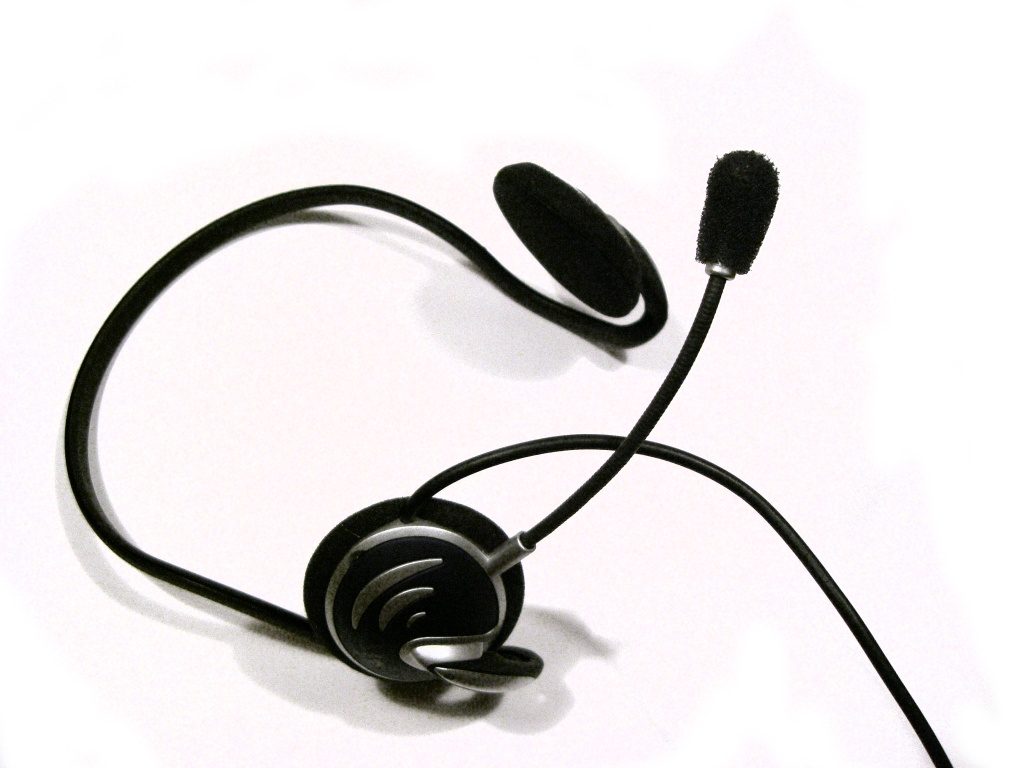
- Mind the microphone. Keep it close to the lips but not touching them. Speaking too close, lip contact and holding the boom all cause distortion.
- Break up long messages with short pauses, so the listener can take them in and the frequency can be checked.
A transmitter that stays keyed, through a stuck switch or a selection left on, blocks the frequency for everyone, and because a radio does not receive while it transmits, the crew concerned hears only an unusual silence. On a normally busy frequency that silence is the cue to check both transmit switches first (see radio communication failure).
The ICAO spelling alphabet
The ICAO spelling alphabet, usually called the ICAO phonetic alphabet, gives each letter one word that should sound the same whatever the speaker's native language, and that stays distinct from the others through a noisy, distorted signal. It avoids confusions such as C, D and V, which sound alike when spoken as letters.
| Letter | Word | Letter | Word | Letter | Word |
|---|---|---|---|---|---|
| A | Alfa | J | Juliett | S | Sierra |
| B | Bravo | K | Kilo | T | Tango |
| C | Charlie | L | Lima | U | Uniform |
| D | Delta | M | Mike | V | Victor |
| E | Echo | N | November | W | Whiskey |
| F | Foxtrot | O | Oscar | X | X-ray |
| G | Golf | P | Papa | Y | Yankee |
| H | Hotel | Q | Quebec | Z | Zulu |
| I | India | R | Romeo |
The words are fixed: older national alternatives, or improvised ones, are not used. A registration such as G-BJQX is sent as "Golf Bravo Juliett Quebec X-ray". Proper names, service abbreviations and words whose spelling may be in doubt are spoken, then spelled out, so a small private strip might be named and then spelled letter by letter. Common abbreviations such as ILS, VOR, NDB, QNH or QDM are not spelled, and several are spoken as words: ATIS, AFIS, AIRAC, CAVOK, NOTAM, PAPI, SELCAL, SID, STAR, TACAN, VOLMET and VORTAC. Each ATIS broadcast is also identified by a letter of the alphabet, and a new letter is used whenever the information changes.
Transmitting numbers
RTF number pronunciation modifies some digits so that they stay distinct through a noisy, distorted signal.
| Figure | Spoken | Figure | Spoken |
|---|---|---|---|
| 0 | ZERO | 7 | SEVEN |
| 1 | WUN | 8 | AIT |
| 2 | TOO | 9 | NIN-ER |
| 3 | TREE | Decimal | DAY-SEE-MAL |
| 4 | FOW-ER | Hundred | HUNDRED |
| 5 | FIFE | Thousand | TOUSAND |
| 6 | SIX |
The rules for the transmission of numbers are short but exact. Call signs, headings, wind direction and speed, altimeter settings, squawks, runway designators and frequencies are spoken digit by digit. So are flight levels, except whole hundreds. Altitudes, heights, cloud heights, visibility and RVR that contain whole hundreds or thousands use the words HUNDRED and THOUSAND; everything else is digit by digit.
| Item | Written | Spoken |
|---|---|---|
| Flight level | FL180 | flight level one eight zero |
| Flight level, whole hundreds | FL100 | flight level one hundred |
| Altitude | 2,500 ft | two thousand five hundred feet |
| Altitude | 11,000 ft | one one thousand feet |
| Heading | 070 | heading zero seven zero |
| Surface wind | 240/10 | two four zero degrees one zero knots |
| QNH | 1000 hPa | QNH one thousand |
| QNH | 997 hPa | QNH nine nine seven hectopascals |
| Squawk | 6500 | squawk six five zero zero |
| Frequency, 8.33 kHz | 119.105 | one one nine decimal one zero five |
| Frequency, last two digits zero | 125.100 | one two five decimal one |
Colloquial forms such as "twenty-five hundred" or "heading seventy" are not used, because mixing the conventions is exactly how a heading turns into a level. When QNH is below 1000 hPa the unit is spoken with the value, and 1000 hPa itself is "one thousand".
A frequency is passed as its six-digit channel designator, with the word DECIMAL, never "point". Only when the fifth and sixth digits are both zero are the first four spoken alone, so 118.000 is "one one eight decimal zero". A pilot with a radio limited to 25 kHz spacing sets the first five digits. The fixed phrase for 8.33 kHz capability keeps the word "point": "AFFIRM EIGHT POINT THREE THREE".
Time checks
Aviation uses Coordinated Universal Time (UTC) on the 24-hour clock, sometimes called Zulu time; local time has no place on the radio. Normally only the minutes are transmitted, each digit separately, so a report of passing a point at 1447 gives the time as "four seven". The hour is added whenever there could be doubt, for example close to the hour or for an estimate well ahead. A time check given by an ATS unit is to the nearest half minute.
Initial call and establishing contact
The initial call-up names the station called first and the caller second, as in "(station), (call sign)", so the station knows at once that the call is for it; the full call sign is used until the ground station shortens it. The content that follows depends on the unit and the State. Typical items are the aircraft type, position, level and intentions, which SERA requires before entry into a radio mandatory zone, and the ATIS letter held, so the controller need pass only what has changed. On a transfer while climbing or descending, the call gives the level passing and the level cleared, which lets the new controller verify the Mode C readout. FAA guidance summarises the contents as whom you are calling, who you are, where you are and what you want, and asks for the exact altitude, to the nearest 100 ft, on first contact.
Establishing two-way radio communication requires a reply. In the United States, the AIM treats communication as established for entry into Class C or Class D airspace only when the controller answers using the aircraft's call sign. If there is no answer, at least 10 seconds should pass before a second call, since the reply may simply be delayed; then check the frequency, volume and audio panel before trying another frequency or a relay.
Radio checks and the readability scale
A radio check tests the quality of a transmission. It consists of the station called, the aircraft's call sign, the words RADIO CHECK and the frequency in use: "(station), (call sign), radio check (frequency)". The reply, or the answer to HOW DO YOU READ, grades readability on the readability scale:
| Readability | Meaning |
|---|---|
| 1 | Unreadable |
| 2 | Readable now and then |
| 3 | Readable but with difficulty |
| 4 | Readable |
| 5 | Perfectly readable |
"Loud and clear" and counting aloud are not standard. A report of readability 3 before departure is a prompt to check the microphone and headset and to consider the other radio.
General calls and listening watch
A general call is addressed to all stations likely to hear it. It begins "ALL STATIONS", followed by the identification of the calling station, and no reply is expected unless individual stations are then called to acknowledge. The station that controlled distress traffic, for example, uses one to announce that the distress traffic has ended, and a controller warns all aircraft near an emergency descent with a similar broadcast. A broadcast such as ATIS is different again: it is addressed to no one in particular.
A listening watch means keeping the receiver on the appropriate frequency and actually listening. A controlled flight maintains a continuous air-ground voice watch with the ATS unit, as does a VFR flight inside a radio mandatory zone. A crew with one radio who needs to call the company must ask the controller's permission before leaving the frequency, since the controller relies on being able to reach them. On HF, a successful SELCAL check lets the crew turn the loudspeaker down, but the receiver must stay on and tuned, and any other watch the route requires still applies. MONITOR (frequency) is an instruction to listen out without calling.
Categories and priority of messages
The aeronautical mobile service handles messages in a fixed order of priority:
| Priority | Category | Examples |
|---|---|---|
| 1 | Distress messages and distress traffic | MAYDAY |
| 2 | Urgency messages, including medical transport | PAN PAN; PAN PAN MEDICAL |
| 3 | Communications relating to direction finding | QDM requests |
| 4 | Flight safety messages | ATC movement and control messages |
| 5 | Meteorological messages | Weather reports and forecasts |
| 6 | Flight regularity messages | Servicing, loading, schedule changes, crew arrangements |
Distress traffic has absolute priority, and urgency traffic priority over everything except distress. A crew asking its company for a fuel bowser is at the bottom of the list and stops the moment anything above it appears on the frequency. Where data link is in use, voice is kept for time-critical and emergency communications, so distress and urgency are normally declared by voice (see distress and urgency communications).
Exam tip: readability 3 is readable but with difficulty; wait at least 10 seconds before a second call; time checks are to the nearest half minute; direction finding ranks third, above flight safety.
Frequently asked questions
How do pilots say numbers on the radio?
Each digit is normally spoken separately, using the ICAO pronunciations such as TREE for 3, FIFE for 5 and NINER for 9. Call signs, headings, wind, altimeter settings, frequencies and squawks are passed digit by digit, and so are flight levels except whole hundreds, so FL100 is flight level one hundred. Altitudes, heights, cloud heights, visibility and RVR containing whole hundreds or thousands use the words HUNDRED and THOUSAND, so 2,500 ft is two thousand five hundred feet.
How do you say a radio frequency in aviation?
A frequency is spoken as its six-digit channel designator, digit by digit, with the word DECIMAL, never POINT. When the fifth and sixth digits are both zero only the first four are spoken, so 125.100 becomes one two five decimal one and 118.000 becomes one one eight decimal zero. An 8.33 kHz channel such as 119.105 is always spoken in full, one one nine decimal one zero five.
What is the readability scale in a radio check?
Readability is graded from 1 to 5. Readability 1 is unreadable, 2 readable now and then, 3 readable but with difficulty, 4 readable and 5 perfectly readable. A radio check consists of the station called, the aircraft's call sign, the words radio check and the frequency in use, and the reply gives the readability number. Informal replies such as loud and clear are not standard.
What is the order of priority of radio messages?
ICAO ranks aeronautical mobile messages in six categories. Distress messages come first, then urgency messages, including medical transport messages, then communications relating to direction finding, flight safety messages, meteorological messages and finally flight regularity messages. ATC movement and control messages are flight safety messages; company requests about servicing, loading or crew arrangements are flight regularity messages and give way to everything else.
How long should you wait before calling a station again?
At least 10 seconds should pass before a second call to the same station, because the station may be busy or its reply may simply be delayed. Before calling again, check the frequency selected, the volume, squelch and audio panel, and whether the station is open and within range. If there is still no answer, try another published frequency or ask another aircraft to relay.
Test yourself on Radiotelephony Transmitting Technique
The v1prep banks cover this topic in Communications (090), with a worked explanation for every answer. EASA ATPL, PPL, IR and CPL, the FAA written tests and A320/B737 type ratings.
Start practising →Sources and further reading
- ICAO Annex 10, Aeronautical Telecommunications, Volume II, Communication Procedures including those with PANS status (ICAO Store)
- EASA Easy Access Rules for Standardised European Rules of the Air (SERA)
- UK CAA Regulatory Library, SERA.6005 Requirements for communications and SSR transponder
- UK CAA, CAP 413 Radiotelephony Manual
- FAA Aeronautical Information Manual, Chapter 4 Section 2, Radio Communications Phraseology and Techniques
- FAA Aeronautical Information Manual, Chapter 4 Section 1 (4-1-20, altitude report on initial contact)
- FAA Aeronautical Information Manual, Chapter 3 Section 2 (Class C and Class D two-way communication)
Library articles are written for study and exam preparation. They do not replace your aircraft's approved documentation, your operator's procedures or the regulations themselves.