Auxiliary Power Unit (APU)
The auxiliary power unit (APU) is a small gas turbine, usually installed in a fireproof compartment in the tail, that drives a generator and supplies bleed air independently of the main engines: on the ground for power, air conditioning and engine starting, and in flight as a back-up source.
The auxiliary power unit (APU) is a small gas turbine engine carried in addition to the propulsion engines, normally in a fireproof compartment in the tail cone. It drives an electrical generator and supplies compressed air, so that an airliner can be powered, air-conditioned and have its engines started with no ground equipment at all. In flight it becomes a back-up source of electrical power and, below its altitude limits, of bleed air.
The APU is also the one gas turbine on board that often runs with nobody watching it: at the stand, during turnarounds, with the crew in the terminal. Its design follows from that. The start and shutdown are automatic, the unit protects itself by shutting down without crew action, and on some types its fire extinguisher discharges by itself on the ground.
APU purpose and location
An APU is a small turboshaft: almost all of its power goes into a shaft rather than into thrust (see gas turbine engine types). On the A320 it is a single-shaft gas turbine that drives an accessory gearbox, carrying the generator and the starter, and also produces bleed air. The A320 family has flown with several models, among them the Honeywell 131-9A and the Pratt & Whitney APS 3200; the Boeing 737 NG uses the Honeywell 131-9B, and the E190-E2 the APS2600E.
What the APU does depends on the phase of flight:
- On the ground it supplies bleed air for the air conditioning packs and engine starting, and electrical power for the whole aircraft, independently of ground power and air carts.
- At take-off it can feed the packs on some types, so that the engines are relieved of the bleed load and deliver more thrust, which improves performance at high weights or temperatures.
- In flight it backs up the electrical system and the air conditioning, and can assist an engine start.
It supplies no hydraulic power and no thrust. Some dispatch rules, notably for ETOPS, require a working APU as an extra electrical source.
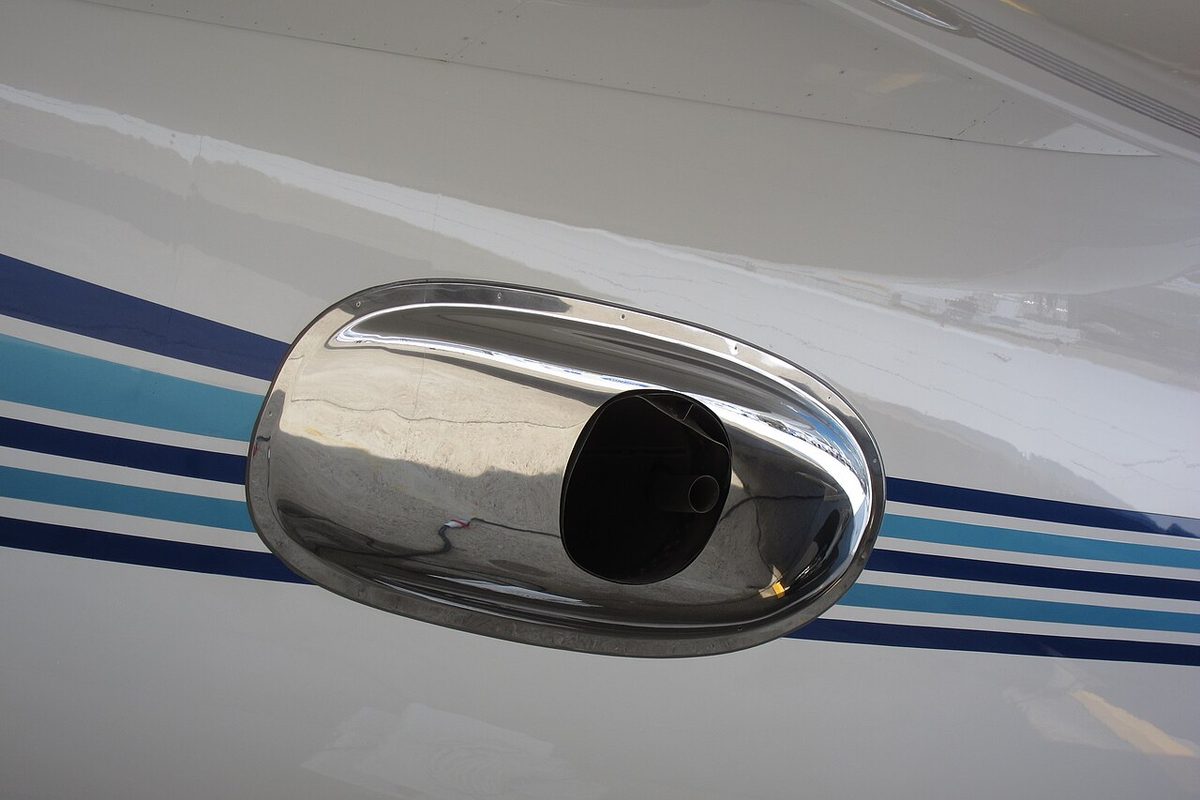
APU air intake
The APU's own intake is closed when the unit is not running. The A320 uses an electrically operated APU air intake flap. Selecting the MASTER SW pushbutton ON powers the APU system: the electronic control box runs a power-up test, the intake flap and the APU fuel isolation valve open, and the start can begin only once the flap is fully open. On shutdown the flap closes when the APU speed has fallen to 7 %, and the batteries are left on until it has closed, about 2 minutes after the AVAIL light goes out.
The Boeing 737 has an automatically operated APU air inlet door on the right side of the fuselage. Moving the APU switch to START opens the door, and the start sequence begins only when the door is fully open; after shutdown the door closes with the fuel valve as the speed runs down. Cooling air for the compartment and the oil cooler has a separate inlet above the exhaust.
APU starting and fuel supply
Airliner APUs are usually started electrically. The A320's electric starter is controlled by the electronic control box (ECB), a full-authority digital controller that also sequences the shutdown, meters fuel and monitors speed, temperature and bleed air. Starting power comes from the batteries, the aircraft network or ground power. On the 737 NG the APU generator doubles as a starter-generator, taking AC from the No. 1 transfer bus when it is available and battery power otherwise (see DC generators, motors and starter-generators).
The A320 start sequence is typical:
- The starter is energised once the intake flap is fully open.
- Ignition comes on 1.5 seconds later.
- At 60 % speed the starter and ignition switch off; the APU is now self-sustaining.
- Above 95 % the green AVAIL light comes on, and bleed air and electrical power can be used.
Start attempts are limited. The A320 allows three consecutive attempts, then a 60-minute wait. The 737 requires at least 30 seconds between failed attempts and a 15-minute cooling period after three. The A320 can start its APU throughout the normal flight envelope, and the 737 up to the aeroplane's maximum certified altitude. On batteries alone, the A320's APU should be started within 30 minutes of selecting the batteries to AUTO.
Fuel comes from the aircraft's main fuel system. The A320's APU is fed from the left fuel feed line, normally under pressure from the tank pumps. If that pressure is missing, for example on batteries only or with the pumps off, a dedicated APU fuel pump starts automatically. ATPL texts describe it as an APU DC fuel pump; the A320's is in fact powered from an AC bus, with a static inverter as back-up. The 737 draws APU fuel from the left side of the fuel manifold when the AC fuel pumps run, and by suction from main tank No. 1 when they do not (see fuel feed, boost pumps and crossfeed).
APU generator
Because an APU governs its own speed, its generator runs at constant speed and needs no constant speed drive or IDG (see AC generators, CSD and IDG). On the A320 the APU generator has the same output as each engine generator, up to 90 kVA, and can replace either or both of them at any time, in flight or on the ground. On the 737 NG it can power both AC transfer buses on the ground or in flight.
ATPL texts describe the APU generator in flight as a back-up that may supply only part of the network, and load shedding protects it: on the 737, if the APU is the only source in flight, all galley buses are shed automatically. On the 737 the battery switch must stay on while the APU runs: switching it off shuts the APU down, because the control unit loses power. The A320 shuts its APU down if DC power is lost while the aircraft is on batteries only.
APU bleed air and load compressor
APU bleed air enters the same pneumatic manifold as engine bleed air, through the APU bleed valve. On the A320 it comes from the APU's load compressor, one of the three high-pressure air sources of the pneumatic system. Inlet guide vanes set the bleed flow; on the A320 they are moved by a fuel-pressure actuator commanded by the ECB, and a check valve stops engine or ground air flowing back into the load compressor.
Valve logic keeps APU air and engine air from flowing into each other:
- On the A320 the APU bleed valve opens only at or above 95 % APU speed; opening it opens the crossbleed valve and closes the engine bleed valves, so APU air reaches both packs.
- On the E190-E2 the APU bleed valve closes whenever engine bleed air is being delivered.
- The 737's limitations require the APU bleed valve to be closed in several configurations, for example with ground air connected and the isolation valve open, and forbid engine power above idle during an engine start with the APU bleed valve open.
If combined electrical and bleed demand drives the 737 APU's exhaust gas temperature too high, the inlet guide vanes move towards closed to reduce bleed extraction while the electrical load is kept; during an engine start, electrical load is shed first.
Bleed pressure falls with altitude, so bleed use has lower limits than electrical use:
| Use | A320 | Boeing 737 NG | E190 E1 and E2 |
|---|---|---|---|
| APU start | Normal flight envelope | Up to maximum certified altitude | – |
| Bleed to assist an engine start | 20,000 ft | – | 21,000 ft (E1) |
| Bleed for air conditioning | 22,500 ft one pack, 15,000 ft two packs | 17,000 ft (bleed only) | 15,000 ft (both) |
| Bleed and electrical load together, in flight | – | 10,000 ft | – |
| Electrical load only | – | 41,000 ft | – |
| Wing anti-ice | Not permitted | – | Not used (E2) |
The 737 APU can supply both packs on the ground but only one in flight. The APU bleed duct has its own leak detection loop; on the A320 a leak closes the APU bleed and crossbleed valves but does not shut the APU down (see bleed air and pneumatic systems).
Automatic and protective shutdown
The APU is self-monitoring. ATPL texts give the classic causes of an APU automatic shutdown as fire, oil pressure failure, overspeed and overheat. The A320's ECB lists over twenty, among them fire (on the ground only), a closed intake flap, failure to accelerate, EGT overtemperature, high oil temperature, loss of DC power when on batteries and loss of the EGT thermocouples, each announced by the ECAM alert APU AUTO (EMER) SHUT DOWN. Its speed limit is 107 %.
On the 737 the electronic control unit performs an APU protective shutdown whenever it detects a fault that could damage the APU or the aircraft, and one of three amber lights on the APU panel shows why: FAULT, OVERSPEED or LOW OIL PRESSURE.
Some types shorten the list in flight, where losing the APU may matter more than protecting it. The E190-E2 APU shuts itself down in flight only for overspeed, underspeed or a critical control failure; high EGT, oil problems, fire and sensor failures stop it automatically only on the ground. After an automatic shutdown its crew select the APU off and do not restart it, unless the shutdown happened during the start.
During refuelling the A320 may start or stop its APU, but not restart it after a failed start or an automatic shutdown, and a fuel spill calls for a normal APU shutdown (see refuelling safety).
Stabilisation and cool-down periods
Two waiting periods are there to extend the APU's service life. The APU stabilisation period comes after the start: the 737 APU runs for two full minutes before it is used as a bleed air source.
The APU cool-down cycle comes at shutdown. On the A320, if the APU has been supplying bleed air, it keeps running for a cooling period of 60 to 120 seconds after the MASTER SW is switched off. On the 737, selecting OFF trips the APU generator and closes the bleed valve, and the APU runs on without load for a 60-second cooling period. The E190-E2 runs for 2 minutes before its fuel shutoff valve closes.
An emergency shutdown skips the cooling period: the APU fire control stops the APU at once, and the A320's ground-crew APU SHUT OFF pushbutton, under the nose, runs the automatic shutdown sequence without the cool-down cycle.
APU fire protection
The APU compartment is a designated fire zone under CS 25.1181 and 14 CFR 25.1181, so it needs fire detection and a fixed extinguishing system like an engine (see fire and overheat detection).
- Detection. The A320 has two loops, A and B, each with one sensing element in the APU compartment, and a fire detection unit. The 737 has a single loop; if it fails, an APU DET INOP light comes on, and the APU is not run if that light fails to illuminate during the pre-flight test.
- Extinguishing. Both types have one bottle, discharged into the APU compartment. The A320's bottle has two squibs.
- Isolation. On the A320, releasing the APU FIRE pushbutton shuts the APU down, arms the squib, closes the low-pressure fuel valve, stops the APU fuel pump, closes the APU bleed and crossbleed valves and deactivates the APU generator. Pulling the 737's APU fire switch backs up the automatic shutdown and closes the fuel valve, bleed valve and air inlet door, trips the APU generator and arms the bottle.
APU fire extinguisher auto-discharge is the exception to the principle that a fire detection system never fires the extinguishers by itself, and it exists because the APU runs unattended. On the ground the A320 shuts the APU down and discharges the bottle automatically 3 seconds after the fire warning; in flight the crew release the APU FIRE pushbutton and then press the AGENT pushbutton. Its APU fire test is therefore not held for more than 3 seconds on the ground. The 737 NG shuts its APU down automatically on a fire warning, and the crew fire the bottle by rotating the APU fire switch. On the E190-E2 the APU shuts down automatically 10 seconds after a fire is detected on the ground, unless the crew have already pressed APU EMER STOP.
Because the ground crew may be the first to know, APUs have a remote APU fire warning horn. On the A320 a horn sounds in the nose gear bay and a red APU FIRE light comes on at the external power panel, where the APU SHUT OFF pushbutton silences the horn. On the 737, on the ground only, a horn sounds and a red light flashes on the APU ground control panel in the main wheel well, which also has a fire control handle and a bottle discharge switch for the ground crew.
Exam tip: APU auto-shutdown causes are fire, oil pressure failure, overspeed and overheat. Only the APU's bottle may discharge automatically on a fire warning, because the APU runs unattended; on the A320 this happens on the ground only, 3 seconds after the warning. Engine bottles are always fired by the crew.
Frequently asked questions
What does an APU do on an aircraft?
The auxiliary power unit is a small gas turbine, usually in the tail, that drives a generator and supplies compressed air. On the ground it powers the electrical system, runs the air conditioning packs and starts the main engines without ground equipment. In flight it backs up the engine-driven generators and, below its altitude limits, the air conditioning, and it can help to start an engine. It gives no thrust and no hydraulic power.
Can the APU be used in flight?
Yes, within limits published for each type. Electrical power is usually available up high: the Boeing 737 NG allows APU electrical load alone up to 41,000 ft. Bleed air is limited lower, because thin air gives less pressure. On the A320 the limits are 20,000 ft to assist an engine start, 22,500 ft for air conditioning with one pack and 15,000 ft with both packs, and APU bleed is never used for wing anti-ice.
Why does the APU keep running after it is switched off?
It runs a cool-down cycle. After it has been supplying bleed air it keeps running without load for a set time, 60 seconds on the Boeing 737 and 60 to 120 seconds on the A320, so that its hot section cools gradually before the fuel is shut off. This extends its service life. An emergency shutdown, with the fire switch or the ground crew's shut-off button, stops it at once without the cooling period.
What happens if the APU catches fire on the ground?
Because the APU often runs with nobody on the flight deck, its fire protection acts on its own on the ground. On the A320 the APU shuts down and its single extinguisher bottle discharges automatically 3 seconds after the fire warning, while a horn sounds under the nose and a red light comes on at the external power panel to alert the ground crew. In flight the crew discharge the bottle themselves.
What causes an automatic APU shutdown?
The APU controller shuts the unit down when a fault could damage it or the aircraft: typically fire, overspeed, excessive exhaust gas temperature, low oil pressure or high oil temperature, a failure to accelerate during the start, or loss of its electrical supply or sensors. Some types shorten the list in flight, where an unwanted shutdown matters more. The E190-E2, for example, shuts its APU down in flight only for overspeed, underspeed or a critical control failure.
Test yourself on Auxiliary Power Unit (APU)
The v1prep banks cover this topic in Aircraft General Knowledge (021), with a worked explanation for every answer. EASA ATPL, PPL, IR and CPL, the FAA written tests and A320/B737 type ratings.
Start practising →Sources and further reading
- EASA, Explanatory Note to ED Decision 2018/001/R, Part-FCL theoretical knowledge learning objectives (021 Airframe and Systems)
- EASA Easy Access Rules for Large Aeroplanes (CS-25)
- EASA Type Certificate Data Sheet EASA.A.064, Airbus A318, A319, A320, A321 (APU installations)
- 14 CFR 25.1181, Designated fire zones; regions included
- 14 CFR 25.1195, Fire extinguishing systems
- FAA Aviation Maintenance Technician Handbook, Airframe (FAA-H-8083-31B), Fire Protection Systems
Library articles are written for study and exam preparation. They do not replace your aircraft's approved documentation, your operator's procedures or the regulations themselves.