A320 Fire and Smoke Protection
A320 fire and smoke protection comprises dual-loop fire and overheat detection with fixed extinguishers for the engines and the APU, smoke detection for the cargo compartments, lavatories and avionics bay, a cargo extinguishing bottle, automatic lavatory waste bin extinguishers and portable extinguishers in the cockpit and cabin.
The A320's fire protection watches the engines and the APU with heat-sensing detection loops, and the cargo holds, lavatories and avionics bay with smoke detectors. Fixed extinguishers serve the engines, the APU, the cargo compartments and the lavatory waste bins, and portable extinguishers are carried in the cockpit and the cabin. There is no fixed smoke detection in the cockpit.
The logic of the warnings, the effects of the FIRE pushbuttons and the differences between a fire on the ground and in flight are classic type rating questions. Detection principles are explained in fire and overheat detection, engine fires in general in engine fire protection, and holds and lavatories in cargo and lavatory fire protection. Bleed duct leaks, which are detected by separate overheat loops, are covered in A320 bleed air and ice protection.
Fire protection overview
| Zone | Detection | Extinguishing |
|---|---|---|
| Each engine | Fire and overheat loops A and B | Two bottles, crew discharge |
| APU | Fire and overheat loops A and B | One bottle, automatic on the ground, crew discharge in flight |
| Forward and aft cargo | Smoke detectors on two loops | One bottle shared by both compartments |
| Lavatories | One smoke detector each | Automatic extinguisher in each waste bin |
| Avionics bay | One smoke detector | None: ventilation smoke configuration |
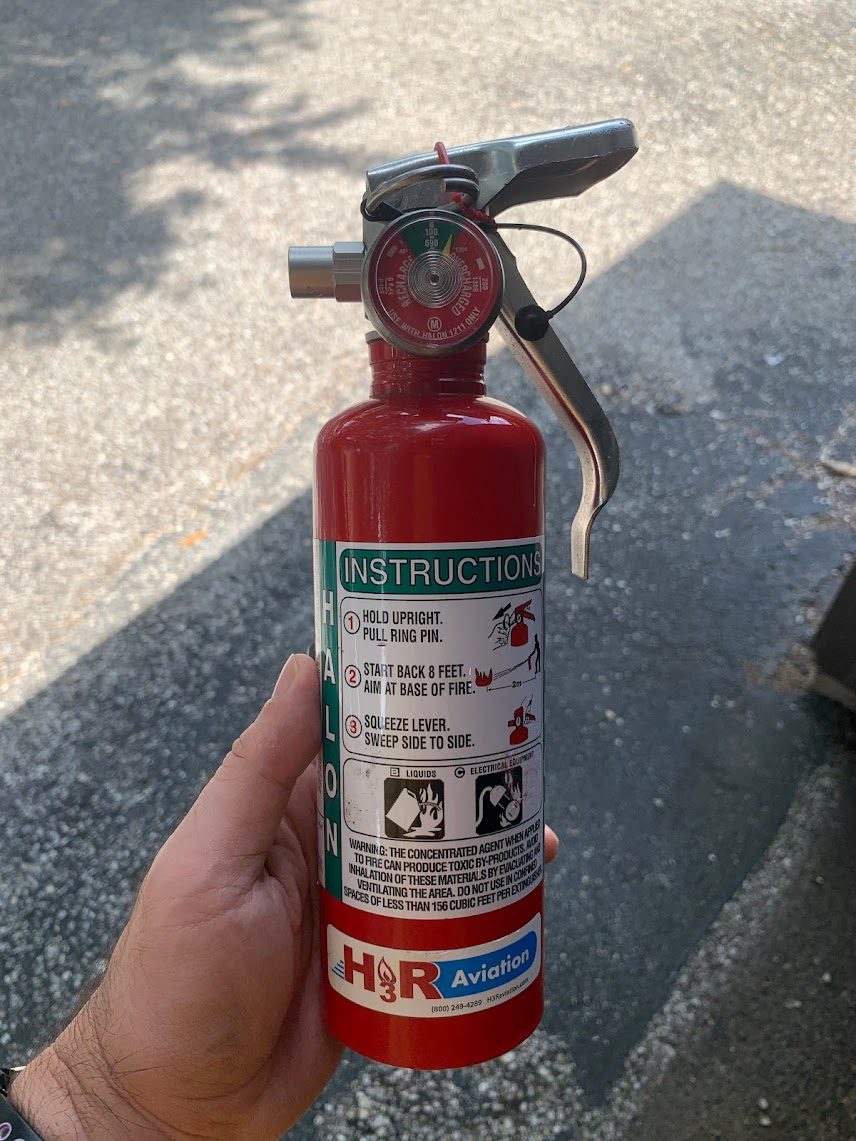
| Cockpit and cabin | No fixed smoke detection in the cockpit | Portable extinguishers |

Detection loops and warning logic
The engines and the APU each have a fire and overheat detection system made of two identical detection loops, A and B, mounted in parallel, and a fire detection unit (FDU). The engine loops have three or four sensing elements, depending on the installation, in the pylon nacelle, the engine core and the fan section. On the APU, each loop has one sensing element in the APU compartment. When a sensing element is heated it signals the FDU, and the fire warning is triggered as soon as both loops detect a temperature above the preset level.
A fire warning appears if:
- both loops signal a fire;
- one loop signals a fire and the other has failed;
- both loops break within 5 seconds of each other, the flame effect, since a fire can burn through both almost at once;
- a test is performed on the FIRE panel.
A fire signal from a single loop while the other is healthy does not give a warning. A fault in one loop, a break or a loss of power, gives only a loop fault caution, and the unaffected loop still protects the zone. The engine fire warning consists of the continuous repetitive chime, the flashing MASTER WARNING light, the ECAM ENG FIRE warning, the red lights in the ENG FIRE pushbutton and the red FIRE light on the ENG MASTER panel, which identifies the engine to be shut down.
On the A320neo the fire zones depend on the engine. EASA's findings record that the PW1100G-JM has one designated fire zone, the core, and no fire detection or extinguishing in its fan compartment, whereas the LEAP-1A has two zones, the fan area and the core.
Engine fire extinguishing
Each engine has two extinguisher bottles, each discharged by an electrically fired squib with a dual electrical supply, and controlled from the FIRE panel in the cockpit. The ENG FIRE pushbutton of each engine is normally in and guarded; pushing it releases it. Its red lights come on whenever that engine's fire warning is active, whatever the pushbutton position. In flight, the pilot flying and the pilot monitoring crosscheck before any action on a guarded control.
Releasing the ENG FIRE pushbutton:
- silences the aural warning;
- arms the squibs of both bottles;
- closes the low-pressure fuel valve, the hydraulic fire shutoff valve (green for engine 1, yellow for engine 2), the engine bleed valve and the pack flow control valve;
- cuts the FADEC power supply;
- deactivates the IDG.
It does not close the crossbleed valve directly, and it does not discharge a bottle. Once the pushbutton is released, the two AGENT pushbuttons of that engine become active and their SQUIB lights come on white to show which pushbutton to press. A brief push on an AGENT pushbutton discharges its bottle; the amber DISCH light then shows that the bottle has lost its pressure.
Exam tip: the ENG FIRE pushbutton isolates the engine and arms the bottles; only the AGENT pushbutton discharges them. Each AGENT pushbutton fires one of the engine's two bottles.
APU fire extinguishing
The APU has one bottle with two squibs. The response depends on where the aircraft is:
- On the ground, an APU fire shuts the APU down automatically and the bottle discharges automatically 3 seconds after the fire warning appears. An external warning horn, in the nose gear bay, sounds and a red APU FIRE light comes on on the external power panel, to alert the ground crew; the light goes out when the fire has been extinguished.
- In flight, there is no automatic shutdown for fire and no automatic discharge. The crew release the APU FIRE pushbutton and then press the APU AGENT pushbutton.
Releasing the APU FIRE pushbutton shuts the APU down, silences the aural warning, arms the squib, closes the LP fuel valve, stops the APU fuel pump, closes the APU bleed valve and the crossbleed valve, and deactivates the APU generator. Like the engine pushbutton, it does not discharge the bottle. A red disc outside at the rear of the fuselage shows that the agent has been discharged overboard because of bottle overpressure.
The ground crew can stop the APU with the APU SHUT OFF pushbutton on the same external power panel, in the nose landing gear bay. It closes the APU LP fuel shutoff valve and makes the electronic control box run the same sequence as an automatic shutdown, but without a cooling period, and it silences the external horn. If the batteries are switched off while the APU is running, APU fire extinguishing is not available. The APU's other protections are described in A320 APU.
Fire panel and fire tests
The ENG FIRE TEST pushbutton tests the detection and extinguishing system of its engine. It produces the continuous repetitive chime and flashing MASTER WARNING, the ECAM ENG FIRE warning, the red lights of the ENG FIRE pushbutton, the white SQUIB lights if the discharge supplies are available, the amber DISCH lights and the red FIRE light on the ENG MASTER panel. That last light stays off if loop A of engine 1 or loop B of engine 2 is faulty.
The APU FIRE TEST gives the same indications for the APU. On the ground it must not be held for more than 3 seconds: the APU may then shut down automatically and its bottle may discharge. Tested on the ground with only the batteries supplying the network, the SQUIB and DISCH lights come on without ECAM warnings, and the red APU FIRE light only partly, as one set of bulbs is not powered.
A separate maintenance panel TEST pushbutton tests the APU fire warning, automatic extinguishing and shutdown circuits. The APU MASTER SW must be ON, the OK light confirms correct operation, a running APU shuts down, and the RESET pushbutton resets the test circuit.
Cargo, lavatory and avionics smoke detection
Cargo compartments. The forward compartment has two smoke detectors and the aft compartment four, in the ceiling panel cavities, each linked to one of two detection loops. A smoke detection control unit (SDCU) with two identical channels, or the cabin intercommunication data system (CIDS) with a smoke detection function, processes their signals and sends them to the ECAM. The red SMOKE light and the ECAM warning come on when both detectors of a cavity detect smoke, or one does and the other is inoperative. The compartment's ventilation isolation valves then close and its extraction fan stops automatically.
One cargo bottle with two discharge heads, one per compartment, feeds three nozzles: one in the forward and two in the aft compartment. Pressing the FWD or AFT DISCH pushbutton fires the squib for that compartment, and the amber DISCH light comes on within 60 seconds, when the bottle is fully discharged. The cargo smoke TEST pushbutton, pressed for at least 3 seconds, tests the detectors in sequence: the SMOKE lights come on twice with the ECAM warning, the ventilation isolation valves close and the DISCH lights come on amber, but no agent is discharged.
Lavatories. Each lavatory has one smoke detector in its air extraction duct, connected to a double-channel SDCU or to the CIDS. The signal goes to the flight warning computer, which alerts both the cockpit and the cabin. Each lavatory waste bin has its own automatic fire extinguisher.
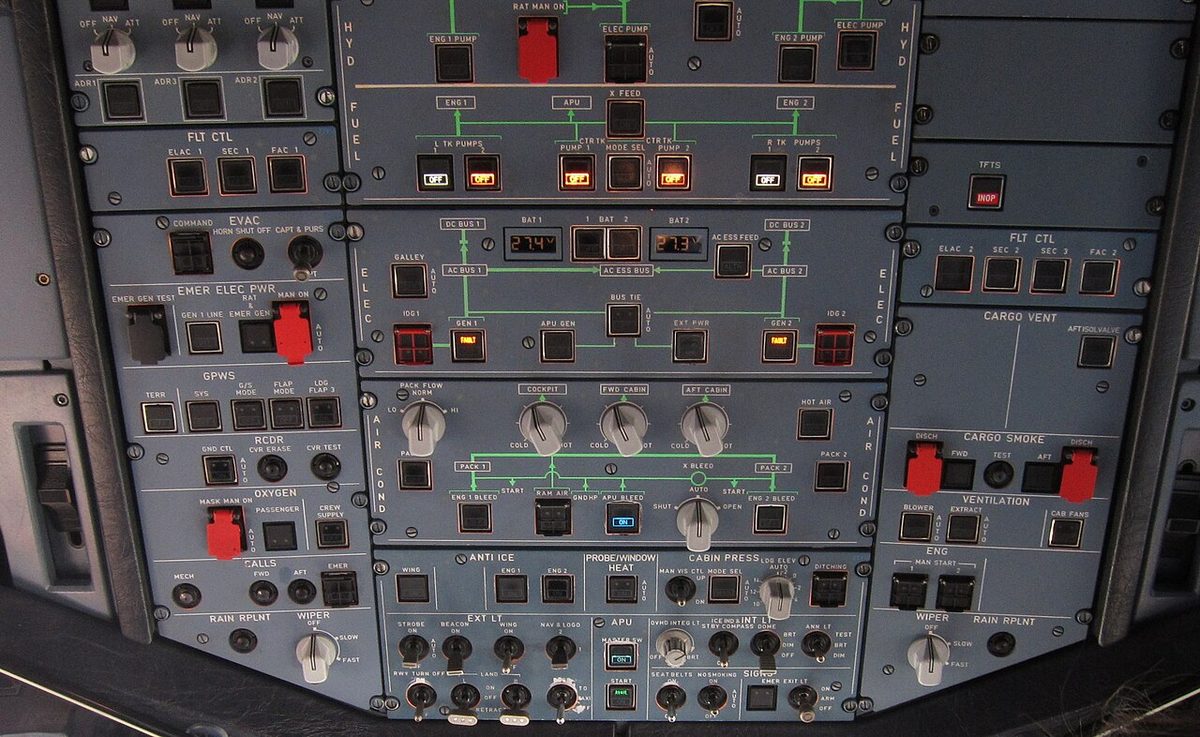
Avionics bay. One smoke detector sits in the air extraction duct of the avionics ventilation. When it detects smoke for more than 5 seconds, the crew get a single chime and the MASTER CAUTION light, the ECAM AVIONICS SMOKE caution, the amber SMOKE light in the GEN 1 LINE pushbutton on the EMER ELEC PWR panel and the FAULT lights of the BLOWER and EXTRACT pushbuttons. It is a caution, not a fire warning. The ventilation smoke configuration is described in A320 ventilation and cargo heating; selecting GEN 1 LINE OFF, part of the smoke procedure, opens the GEN 1 line contactor, as described in A320 electrical system.
Frequently asked questions
How does the A320 engine fire detection work?
Each engine and the APU has two identical detection loops, A and B, mounted in parallel and connected to a fire detection unit. A fire warning needs both loops to detect a fire, or one loop to detect it while the other has failed. It is also given if both loops break within 5 seconds of each other, the flame effect, and during a test. A single loop fault only gives a caution, and the other loop still protects the engine.
What happens when the A320 ENG FIRE pushbutton is pushed?
Pushing the guarded ENG FIRE pushbutton releases it. This silences the aural warning, arms the extinguisher squibs, closes the low-pressure fuel valve, the hydraulic fire shutoff valve, the engine bleed valve and the pack flow control valve, cuts the FADEC power supply and deactivates the IDG. It does not discharge a bottle: the crew must then press an AGENT pushbutton, whose white SQUIB light shows that it is ready.
Does the A320 APU fire extinguisher discharge automatically?
Only on the ground. When an APU fire is detected on the ground, the APU shuts down automatically and its single bottle discharges 3 seconds after the fire warning appears, while an external horn and a red light on the external power panel alert the ground crew. In flight there is no automatic discharge: the crew release the APU FIRE pushbutton, which shuts the APU down, and then press the APU AGENT pushbutton.
How many fire extinguisher bottles does the A320 have?
Each engine has two bottles, discharged by the AGENT 1 and AGENT 2 pushbuttons, and the APU has one bottle with two squibs, so the fire panel controls five bottles. The cargo compartments share one more bottle with two discharge heads, one for each compartment, feeding one nozzle in the forward and two in the aft compartment. Each lavatory waste bin also has its own automatic extinguisher.
What happens when smoke is detected in the A320 avionics bay?
When the smoke detector in the avionics ventilation extraction duct detects smoke for more than 5 seconds, the crew get a single chime, the MASTER CAUTION light and the ECAM AVIONICS SMOKE caution, the SMOKE light in the GEN 1 LINE pushbutton and the FAULT lights of the BLOWER and EXTRACT pushbuttons. It is a caution, not a fire warning; the BLOWER and EXTRACT pushbuttons at OVRD then give the ventilation smoke configuration.
Test yourself on A320 Fire and Smoke Protection
The v1prep banks cover this topic in the A320 type-rating bank, with a worked explanation for every answer. EASA ATPL, PPL, IR and CPL, the FAA written tests and A320/B737 type ratings.
Start practising →Sources and further reading
- 14 CFR 25.1203, Fire detector system
- 14 CFR 25.1195, Fire extinguishing systems
- 14 CFR 25.857, Cargo compartment classification
- EASA Easy Access Rules for Large Aeroplanes (CS-25)
- EASA, Explanatory Note to ED Decision 2018/001/R, Part-FCL theoretical knowledge learning objectives (021 Airframe and Systems)
- FAA Aviation Maintenance Technician Handbook, Airframe (FAA-H-8083-31B), Fire Protection Systems
- EASA TCDS EASA.A.064, Annex I, Special Conditions and Equivalent Safety Findings
Library articles are written for study and exam preparation. They do not replace your aircraft's approved documentation, your operator's procedures or the regulations themselves.