Germanwings Flight 9525
- Date
- Phase of flight
- Cruise
- Location
- Prads-Haute-Bléone, Alpes-de-Haute-Provence, France
- Aircraft
- Airbus A320-211
- Registration
- D-AIPX
- Operator
- Germanwings
- Flight
- Germanwings 9525 (4U9525)
- Occupants
- 150
- Fatalities
- 150144 passengers and 6 crew (2 flight crew and 4 cabin crew); no one on the ground was injured
- Investigating body
- Bureau d'Enquêtes et d'Analyses pour la sécurité de l'aviation civile (France)
- Final report
- BEA2015-0125
- Report date
- Report title
- Final Report: Accident on 24 March 2015 at Prads-Haute-Bléone (Alpes-de-Haute-Provence, France) to the Airbus A320-211 registered D-AIPX operated by Germanwings
On 24 March 2015 Germanwings flight 9525, an Airbus A320, flew into terrain in the French Alps, killing all 150 people on board. The BEA found that the co-pilot, alone in the cockpit and suffering from a mental disorder, deliberately set the autopilot to descend and kept the captain locked out.
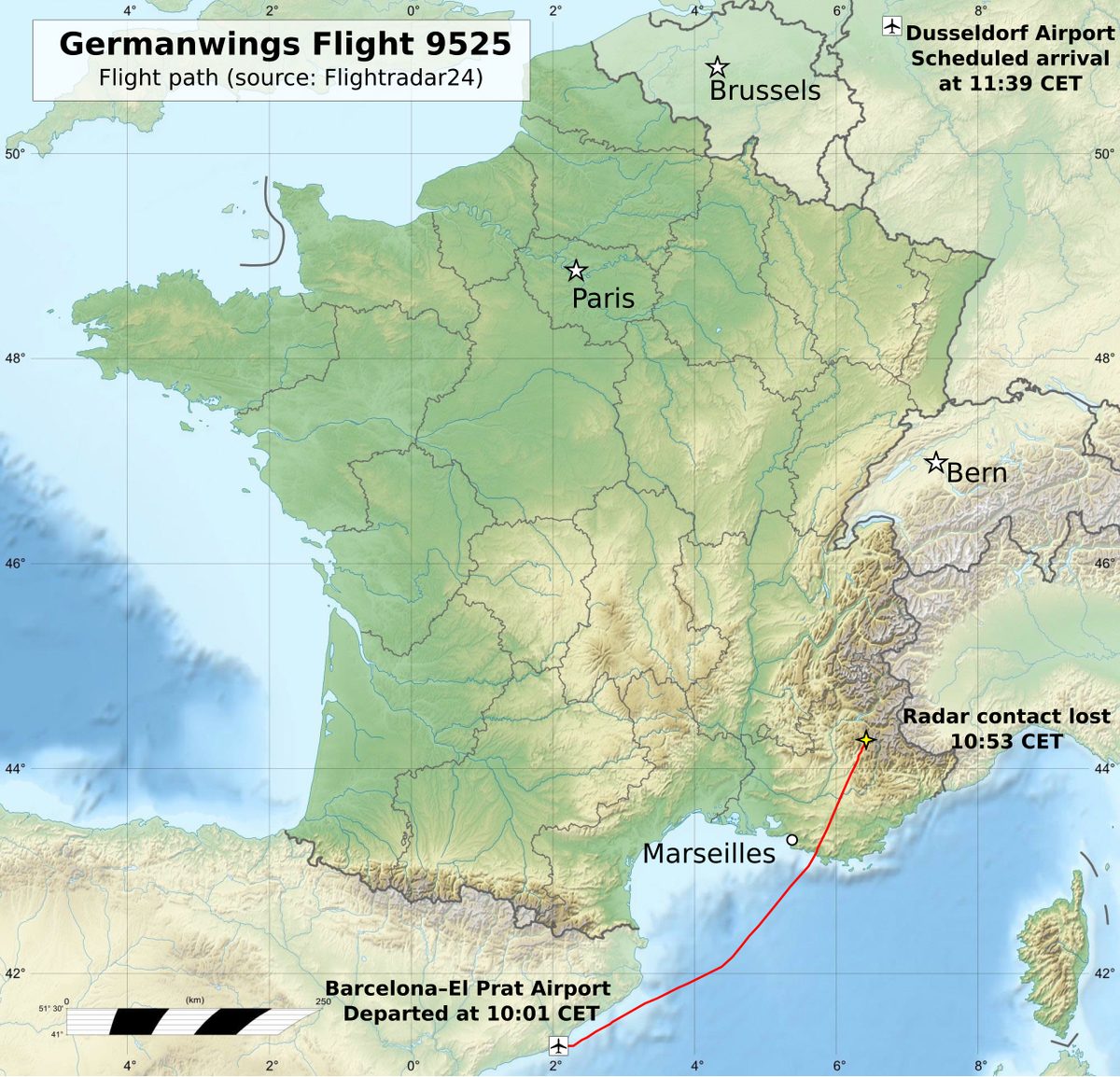
On 24 March 2015 an Airbus A320 operated by Germanwings as flight 4U9525, from Barcelona to Düsseldorf, left its cruising level of FL380 and descended for about ten minutes until it struck mountainous terrain at Prads-Haute-Bléone in the French Alps. All 150 people on board were killed. The captain had left the cockpit a few minutes after the aircraft levelled off, and he was never able to return.
The investigation by France's Bureau d'Enquêtes et d'Analyses (BEA) established from the flight recorders that the co-pilot, alone at the controls, deliberately commanded the descent with the autopilot and kept the reinforced cockpit door locked. The BEA's final report, published on 13 March 2016, does not name him, and neither does this page. Its main subject is not the aircraft, which had no relevant fault, but the system meant to keep an unfit pilot off the flight deck: aeromedical certification, self-declaration of illness, medical confidentiality and support for pilots.
The accident matters to every pilot because it tested two assumptions that underpin multi-crew flying: that a second pilot can always take over from one who is incapacitated, and that a locked door protects the flight deck.
The flight
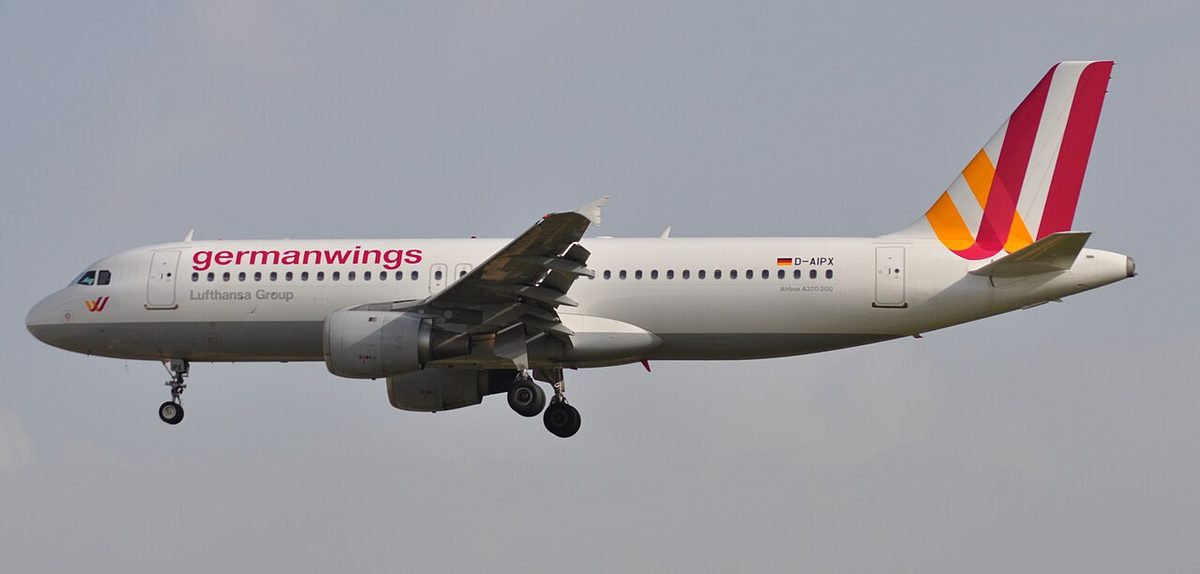
D-AIPX was an A320-211, serial number 147, which entered service in 1991 and had flown 58,313 hours and 46,748 cycles. It flew for Lufthansa until January 2014, when it joined the Germanwings fleet. The BEA found that the aircraft had a valid certificate of airworthiness, that its maintenance was up to date, and that the recorders showed no system failure or fault that could have contributed to the accident.
The same two pilots had flown the aircraft from Düsseldorf to Barcelona that morning. The captain, aged 34, had 6,763 flying hours, 3,811 of them on type. The co-pilot, aged 27, had 919 hours, 540 on type. He had joined Germanwings in December 2013. Instructors and examiners had judged both pilots above standard, and none of the pilots who had flown with the co-pilot in the preceding months reported any concern about his behaviour.
Flight 4U9525, callsign GWI18G, took off from runway 07R at Barcelona at 09:00 UTC (10:00 local time) with 144 passengers, 2 pilots and 4 cabin crew. The co-pilot was pilot flying. The cruise was in clear skies above scattered cirrus, and visibility at the accident site was greater than 10 km.
The accident
The aircraft levelled at FL380 at 09:27:20. At 09:30:00 the captain read back a clearance direct to the IRMAR waypoint, the last transmission from the flight. Eight seconds later he told the co-pilot he was leaving the cockpit and asked him to take the radio. The door was heard opening at 09:30:24 and closing three seconds later.
At 09:30:53 the altitude selected on the flight control unit (FCU) changed in one second from 38,000 ft to 100 ft, the lowest value the A320 accepts. The autopilot changed to OPEN DES and the autothrust to THR IDLE, and the aircraft began to descend. From 09:33:12 the speed target was selected manually; it was changed several times and at 09:35:03 set to 350 kt, the maximum selectable value, equal to VMO. The rate of descent varied between 1,700 and 5,000 ft/min and averaged about 3,500 ft/min. The autopilot and autothrust remained engaged to the end.
| Time (UTC) | Event |
|---|---|
| 09:30:24 | Captain leaves the cockpit; aircraft in cruise at FL380 |
| 09:30:53 | Selected altitude changed from 38,000 ft to 100 ft; OPEN DES and THR IDLE engage |
| 09:33:47 | Marseille controller asks the cleared level; no reply (aircraft at 30,000 ft) |
| 09:34:31 | Cockpit access buzzer sounds for one second |
| 09:35:03 | Selected speed increased to 350 kt |
| 09:35:32 to 09:39:02 | Knocking on the cockpit door recorded six times |
| 09:37:13 | A muffled voice asks for the door to be opened |
| 09:39:30 to 09:40:28 | Noises similar to violent blows on the door recorded five times |
| 09:40:41 | GPWS "Terrain, Terrain, Pull Up, Pull Up" |
| 09:41:06 | Recording ends at the collision with terrain |
During the descent the Marseille control centre called the flight eleven times on three frequencies, including 121.5 MHz, and asked another aircraft to relay. A French air defence controller made three more calls. None was answered. The cabin interphone call sounded in the cockpit four times without reply. The recorders captured breathing attributed to the co-pilot until seven seconds before impact. Low-amplitude inputs on his sidestick between 09:39:33 and 09:40:07 stayed below the autopilot disconnection threshold and had no effect on the flight path.
The accident site lay in mountainous terrain about 1,550 m above sea level. The wreckage was fragmented and spread over about 4 hectares of a sloping, rocky ravine.
The investigation
Commanding a descent with the autopilot
In OPEN DES the A320 autopilot controls pitch to hold the target speed while the autothrust commands idle. It is engaged by selecting an altitude below the current one and pulling the altitude knob. With 100 ft selected, the autopilot continued the descent in this mode until the end of the recording. The ground proximity warning sounded 25 seconds before impact.
French radars received the aircraft's Mode S Enhanced Surveillance data, including the selected altitude, but in March 2015 those parameters were not yet shown on French controllers' screens. The controllers therefore could not see that 100 ft had been selected.
The flight data recorder also held the morning flight from Düsseldorf. While the captain was out of the cockpit between 07:19:59 and 07:24:29, during a descent cleared by air traffic control, the selected altitude was set to 100 ft several times, and once to the maximum of 49,000 ft. Because of the engaged autopilot modes these selections did not change the flight path. The BEA wrote that these actions "may be interpreted as a rehearsal".
The cockpit door locking system
The A320's cockpit door has a bullet-resistant composite structure and three electric strikes that lock it whenever it is closed. From the cabin, a crew member enters the normal code on a keypad, which sounds a one-second buzzer in the cockpit; the pilots check the camera image and use a three-position switch on the pedestal:
- UNLOCK opens the door.
- LOCK keeps it locked and disables the keypad for 5 minutes. Each new LOCK selection restarts the 5 minutes.
- With no action, the door stays locked.
For suspected crew incapacitation there is an emergency code. It sounds a continuous buzzer for 15 seconds, after which the door unlocks for 5 seconds unless someone in the cockpit selects LOCK or UNLOCK first. The design follows ICAO Annex 6, which requires a door that resists penetration by small arms fire and grenade shrapnel and forcible intrusion, and that can be locked and unlocked from either pilot station.
Sound tests in a similar A320 could not identify door switch movements on the recording; the BEA judged that the buzzer at 09:34:31 was most probably a routine access request.
The co-pilot's medical history
The co-pilot's first class 1 medical certificate was issued without restriction in April 2008. From August 2008 to July 2009 he had a severe depressive episode without psychotic symptoms, was treated and interrupted his training. In July 2009 his certificate was issued again with a waiver stating that it would become invalid if there were a relapse into depression. It was revalidated or renewed every year until July 2014. The examiners knew of the waiver, assessed him through observation and discussion, and saw nothing that called for a psychiatric referral. The waiver did not require specific psychiatric assessments or shorter intervals, and no psychiatrist or psychologist took part in his certificate revalidations or renewals after it was issued.
About five months after his last examination, in December 2014, he began to show symptoms that the experts consulted by the BEA considered may be consistent with a psychotic depressive episode. He consulted several doctors. In February 2015 a physician referred him to a psychotherapist and a psychiatrist, and on 10 March 2015 the same physician diagnosed a possible psychosis and recommended psychiatric hospital treatment. A psychiatrist prescribed anti-depressant and sleeping-aid medication in February and March 2015, and post-mortem toxicology found anti-depressants and a sleeping aid. Several sick leave certificates were issued, and not all reached Germanwings. He continued to fly, including on the day of the accident, and did not contact an aeromedical examiner. None of the doctors informed any authority.
The BEA concluded that on the day of the accident he was unfit to fly, and that no action could have been taken by the authorities or his employer because nobody, including the co-pilot himself, had informed them.
Why self-declaration failed
European rules (MED.A.020) require a licence holder to stop flying and seek aeromedical advice without undue delay when medical fitness decreases or regular medication begins. The BEA identified three factors that might have contributed to his failure to self-declare: the illness itself, which probably impaired his judgement; the financial consequences, since his loss-of-licence insurance offered a one-time payment of €58,799 and nothing covered lost income; and the probable fear of losing his career. It also noted that German law gave doctors no clear guidance on when a threat to public safety outweighs medical confidentiality.
The BEA also examined the "1% rule" from ICAO's Manual of Civil Aviation Medicine, under which a medical condition carrying a risk of incapacitation of about 1% per year is acceptable because a second pilot can take over. That mitigation fails when the second pilot is outside the cockpit or when the incapacitation takes the form of deliberate unsafe action. The BEA argued that the target for such mental conditions should be at least two orders of magnitude lower, 0.01% per year. Its search of ICAO and BEA databases since 1980 found 12 public transport accidents or incidents involving intentional manoeuvres, possible intentional manoeuvres or a mental disorder of a crew member.
Probable cause and contributing factors
The BEA stated its causes as follows: "The collision with the ground was due to the deliberate and planned action of the co-pilot who decided to commit suicide while alone in the cockpit." It added that the process for medical certification of pilots, "in particular self-reporting in case of decrease in medical fitness between two periodic medical evaluations, did not succeed in preventing the co-pilot, who was experiencing mental disorder with psychotic symptoms, from exercising the privilege of his licence."
Factors that may have contributed to the failure of self-reporting:
- the co-pilot's probable fear of losing his ability to fly as a professional pilot if he had reported his decrease in medical fitness;
- the potential financial consequences of having no insurance against loss of income in case of unfitness to fly;
- the lack of clear guidelines in German regulations on when a threat to public safety outweighs medical confidentiality.
Finally, security requirements had led to cockpit doors designed to resist forcible intrusion, and this made it impossible to enter the flight compartment before the aircraft struck the terrain.
Safety recommendations and what changed
The BEA issued eleven recommendations, FRAN-2016-011 to FRAN-2016-021, and asked that they be treated as a single package, warning that partial implementation could be counter-productive:
| Subject | Addressee | Recommendation |
|---|---|---|
| Pilots with a history of mental illness | EASA | Define follow-up conditions when a class 1 certificate is issued, such as a shorter validity or specific psychiatric evaluation at renewal |
| In-flight incapacitation data | EASA | Routine analysis of in-flight incapacitation, in particular psychological and psychiatric causes |
| Loss of licence | EASA, IATA | Operators to mitigate the socio-economic risks of losing a licence for medical reasons |
| Anti-depressants | EASA | Define when pilots may be declared fit while taking anti-depressants under medical supervision |
| Medical confidentiality | WHO, European Commission, BMVI and BÄK | Rules and guidelines on when doctors should inform authorities that a patient's health is very likely to affect public safety, without legal risk to the doctor |
| Peer support | EASA | Operators to promote peer support groups for pilots, their families and peers |
The BEA made no recommendation on cockpit door design. It considered alternatives, such as keys or fingerprint access, but judged that the risk of an attack in flight remained the greater threat.
Action began before the final report. On 27 March 2015 EASA issued Safety Information Bulletin 2015-04, recommending that operators require at least two authorised persons in the cockpit at all times, or equivalent measures. An EASA-led task force delivered six recommendations to the European Commission on 16 July 2015: keep the two-person rule and evaluate it after one year; psychological evaluation of pilots before entering service; drug and alcohol testing; stronger oversight of aeromedical examiners; a European aeromedical data repository; and pilot support systems within a just culture.
Lessons for pilots
Fitness to fly is a daily personal decision. Between examinations, the whole system depends on the pilot declaring illness or medication. The BEA showed how illness, money and career fears can all push against that declaration. A pilot who starts regular medication or feels unwell should seek aeromedical advice before flying, not after.
Exam tip: Under Part-MED, a licence holder must not exercise licence privileges when aware of any decrease in medical fitness that might make them unable to exercise those privileges safely, or when taking medication likely to interfere with safe operation. Class 1 holders must seek the advice of an AeMC or AME without undue delay. See medical certification.
Know the support available. Germanwings pilots had access to peer support programmes, but no record showed that the co-pilot used them. The BEA asks operators to promote confidential peer support that aims to return pilots to flying. Learn how your company's programme works before you or a colleague needs it.
Incapacitation is not only physical. Crews train for the colleague who slumps over the controls, and the "1% rule" assumes that a second pilot is present and able to take over (see fitness to fly and pilot incapacitation). The BEA's review of earlier events shows that the psychological incapacitation of a pilot is difficult for other crew members to control, even with both pilots on the flight deck. Unusual behaviour, confused statements or unexplained changes to automation settings are cues to raise with the other crew member, using the assertiveness taught in crew resource management.
Understand your door. On the A320, the LOCK position overrides the emergency code and blocks the keypad for 5 minutes, and the emergency code only works if nobody inside responds within 15 seconds. The BEA observed that "a door cannot address a risk that could be present from both sides". Cockpit access procedures, including who enters when a pilot leaves, are covered in flight deck security.
Exam tip: ICAO Annex 6 requires the flight crew compartment door of large passenger aircraft to resist small arms fire and grenade shrapnel and forcible intrusion, and to be capable of being locked and unlocked from either pilot's station.
Automation does what it is told. One FCU selection produced a stable, automatic descent towards terrain. Selected altitude, the FMA and vertical speed are the first things to check when an aircraft leaves its cleared level.
The BEA concluded that "the collision with the ground was due to the deliberate and planned action of the co-pilot who decided to commit suicide while alone in the cockpit". It found that the medical certification process, in particular self-reporting of a decrease in medical fitness between two periodic examinations, did not prevent a pilot with a mental disorder with psychotic symptoms from flying, and that the reinforced cockpit door made it impossible to enter the flight deck before impact.
Train this on v1prep
The theory behind this accident and the questions that test it, each with a worked explanation.
Question banks
- ATPL Human Factors494 questions with worked explanations
- ATPL Air Law527 questions with worked explanations
- A320 Doors46 questions with worked explanations
In the Library
- Fitness to Fly and Pilot IncapacitationCovers self-assessment of fitness to fly, everyday health threats such as dehydration, low blood sugar and travel illness, and how crews recognise and handle incapacitation.
- Medical CertificationEASA and FAA medical certificate classes, who issues them, the examination, special issuance and BasicMed, and a pilot's duties when medical fitness decreases.
- Flight Deck Security and Bomb ThreatsThe reinforced flight deck door and the rules for keeping it locked, normal and emergency access, secondary barriers, how bomb threats are assessed, bomb on board procedures and the least-risk bomb location.
- Crew Resource Management (CRM)Covers the aims and skills of CRM, crew coordination and cross-monitoring, group decision-making pitfalls, debriefing, and single-pilot resource management.
Frequently asked questions
What caused the Germanwings 9525 crash?
The French BEA concluded that the collision with the ground was due to the deliberate and planned action of the co-pilot, who was alone in the cockpit. He changed the selected altitude to 100 ft, the autopilot descended the A320 at idle thrust, and he kept the cockpit door locked. The BEA also found that medical certification, relying on pilots to self-report a decrease in fitness, had not stopped a pilot with a mental disorder with psychotic symptoms from flying.
Why could the captain not get back into the cockpit on Germanwings 9525?
Since the 11 September 2001 attacks, airliner cockpit doors have been reinforced to resist small arms fire and forcible intrusion, and they can be locked from inside. The A320's door locking system lets the crew inside deny entry and override the emergency access code. The BEA found that security requirements led to doors designed to resist forcible intrusion, which made it impossible to enter the flight deck before the aircraft struck the terrain.
Did anyone know the Germanwings co-pilot was unfit to fly?
According to the BEA, he held a valid class 1 medical certificate carrying a waiver because of a depressive episode in 2008 and 2009. From December 2014 he consulted several doctors, received anti-depressant and sleeping-aid medication and several sick leave certificates, and was referred for psychiatric hospital treatment. He did not contact an aeromedical examiner, and no doctor informed any authority. Neither the authorities nor his employer had been told.
How many people died on Germanwings flight 9525?
All 150 people on board were killed: 144 passengers, 2 flight crew and 4 cabin crew. The Airbus A320-211, registered D-AIPX, was flying from Barcelona to Düsseldorf and struck mountainous terrain at Prads-Haute-Bléone in the French Alps at 09:41 UTC on 24 March 2015. The aeroplane was destroyed.
What safety recommendations did the BEA make after Germanwings 9525?
The BEA issued eleven recommendations, to be implemented as one package, to EASA, IATA, the European Commission, the WHO and German authorities. They cover follow-up of pilots with a history of mental illness, routine analysis of in-flight incapacitation, reducing the financial consequences of losing a licence, flying on supervised anti-depressant medication, clear rules for doctors to report a threat to public safety, and peer support programmes for pilots.
What is the two-person cockpit rule?
Three days after the accident, on 27 March 2015, EASA issued Safety Information Bulletin 2015-04. It recommended that operators reassess the risks of a pilot leaving the flight deck and require at least two authorised persons in the cockpit at all times, or equivalent measures. The BEA acknowledged its potential benefits but noted that it cannot fully remove the risk and that its security risks and training needs must be assessed.
Sources and further reading
- BEA, Final Report BEA2015-0125, accident to Airbus A320-211 D-AIPX on 24 March 2015 (English translation)
- BEA, Preliminary Report on the accident to D-AIPX (May 2015)
- EASA Safety Information Bulletin 2015-04 (authorised persons in the cockpit)
- EASA-led Germanwings Task Force, final report to the European Commission (July 2015)
Crash Investigations pages summarise official investigation reports for study and exam preparation. The investigating body's report is the authoritative account and prevails wherever it differs from this page. Under ICAO Annex 13, an investigation exists to prevent accidents, not to apportion blame or liability.