Go-Around and Missed Approach
A go-around is the manoeuvre by which a pilot abandons an approach or landing and climbs away. After an instrument approach it becomes the missed approach, flown along the published missed approach procedure from the missed approach point, or as ATC directs, to a safe altitude.
A go-around is the manoeuvre by which a pilot abandons an approach or a landing and climbs away, at any height and for any reason. After an instrument approach it becomes the missed approach, flown along the published missed approach procedure unless ATC gives other instructions. ICAO defines that procedure simply as the one to be followed if the approach cannot be continued. A go-around close to the runway is a balked or rejected landing in the FAA's AIM; European performance texts spell it baulked.
The go-around is the standard escape from an approach that is not working, yet line pilots seldom fly one for real. A study for the Flight Safety Foundation found that only about 3% of unstable approaches end in a go-around, and the Foundation names the failure to go around as the leading risk factor in approach-and-landing accidents (see stabilised approach). The manoeuvre has hazards of its own: high thrust, large pitch changes, a busy flight deck and, at night or in cloud, a powerful illusion of pitching up.
When to go around
For instrument approaches under FAA rules the trigger is written into 14 CFR 91.175(c). Below the DA/DH or MDA a pilot may continue only while three conditions hold:
- the aircraft is continuously in a position from which a descent to a landing on the intended runway can be made at a normal rate using normal manoeuvres, and, under Parts 121 and 135, with touchdown in the touchdown zone;
- the flight visibility is not less than the procedure requires;
- at least one listed reference is distinctly visible and identifiable: the approach lights, the threshold, its markings or lights, the runway end identifier lights, the visual glideslope indicator, the touchdown zone, its markings or lights, or the runway, its markings or lights.
The approach lights alone allow descent only to 100 ft above touchdown zone elevation, unless the red terminating bars or red side row bars are also in view. Paragraph (e) then requires an immediate missed approach whenever these conditions are not met below the MDA, or at the missed approach point, including a DA/DH, and at any time after it until touchdown. When circling, the pilot must go around if an identifiable part of the airport is not distinctly visible, unless only a normal bank hides it. EASA's rule is the same in substance: the visual reference required for the operation and the runway must be established at the DA/H or MDA/H and maintained.
Operators add triggers that are not written into the minima:
- an approach not stabilised at the gate, or unstable below it;
- a windshear warning, "GO AROUND, WINDSHEAR AHEAD", or a microburst alert (see windshear and microbursts);
- the ATC instruction "GO AROUND", answered "GOING AROUND", or, on a precision radar approach, no landing clearance by 2 NM from the threshold;
- a GPWS or TAWS warning, or an unsafe landing configuration (see GPWS and TAWS);
- loss of RNP integrity or of approach mode after the final approach fix;
- a failure above alert height on a CAT III approach (see low-visibility operations);
- a long landing beyond the touchdown zone, under many operators' procedures.
Exam tip: the EASA approach ban is a gate at 1,000 ft above the aerodrome, or the start of the final segment where the DH or MDH is higher. If the reported RVR falls below the minimum after the aircraft has passed it, the approach may continue to DA/H or MDA/H, where the pilot's own visual reference decides.
The missed approach point and the visual segment
The missed approach point (MAP; ICAO: MAPt) is the latest point at which the missed approach may begin, and it depends on the approach. On a vertically guided approach it is the point where the aircraft reaches the DA/DH on the path. On non-precision and circling procedures it is a fix, a NAVAID, a waypoint, or a time from the final approach fix: at 100 kt groundspeed a 5.0 NM segment takes 3 minutes.
A DA is a decision made while descending, and the procedure design allows for the momentary sink below it as the aircraft transitions to the climb. An MDA is a floor. Commercial operators therefore fly non-precision approaches as a continuous descent to a derived decision altitude, typically the MDA plus about 50 ft, so that the go-around never breaks it.
Missed approach obstacle protection assumes the go-around starts at the DA/DH, or at the MAP not lower than the MDA. A pilot who decides early may climb at once but should follow the final approach course to the MAP before turning, unless ATC clears otherwise, because no allowance is made for an abnormally early turn. Below the minimum, the AIM warns, there is no implicit obstacle protection between the MDA or DA and touchdown; that part of the approach is flown by eye.
A balked landing below the minimum or beyond the MAP is the awkward case. The published procedure may no longer guarantee obstacle clearance or separation from other traffic. 91.175(e) authorises an appropriate missed approach that ensures obstruction clearance, and the AIM asks the pilot to plan it before starting the approach, considering aircraft performance, charted obstacles and the departure procedure for the runway.
When visual reference is lost while circling, the pilot makes an initial climbing turn towards the landing runway and continues it until established on the missed approach course. This keeps it within the protected circling area.

Missed approach procedure and climb gradient
An approach clearance includes the published missed approach unless ATC says otherwise, and radar vectors may replace it. A visual approach has no missed approach segment: the tower issues instructions.
The FAA's missed approach assumes a climb of at least 200 ft per nautical mile, about 3.3%, unless a higher gradient is published. The rate of climb needed rises with groundspeed: 200 ft/NM means 400 ft/min at 120 kt and 500 ft/min at 150 kt.
ICAO PANS-OPS designs the missed approach around a nominal climb gradient of 2.5%, about 152 ft/NM, unless a higher value is published, and divides it into three phases:
| Phase | Extent | Obstacle clearance | Turns |
|---|---|---|---|
| Initial | From the MAPt until the climb is established | — | None |
| Intermediate | Until 50 m (164 ft) of clearance is obtained and can be maintained | 30 m (98 ft) | Up to 15° |
| Final | To a new approach, a hold or en-route flight | 50 m (164 ft) | As prescribed |
The procedure ends at the missed approach altitude, usually at a holding fix. The AIM warns against leaving the published missed approach before reaching a safe altitude. A missed approach is also a mandatory report to ATC, followed by a request: another approach, a hold or a diversion.
Go-around procedure and callouts
In a light aeroplane the order is power, attitude, then flap in stages as speed and climb build. Retracting full flap at once at low speed causes a sudden loss of lift and a sink towards the ground. Retractable gear comes up once the climb is positive and no runway remains ahead.
In transport aircraft the operator's procedure governs; typical calls are:
| Step | Airbus A320 | Boeing 737 |
|---|---|---|
| Initiate | PF sets TOGA, rotates towards 15°, announces "GO AROUND" | PF pushes TO/GA, rotates to the go-around attitude, calls "FLAPS 15" |
| Flap | PM retracts one step | PM sets flaps 15 |
| Climb | PM "POSITIVE CLIMB", PF "GEAR UP" | PM "POSITIVE RATE", PF "GEAR UP", PM "THRUST SET" |
| Modes | FMA: MAN TOGA, SRS, GA TRK or NAV | TO/GA mode; roll mode above 400 ft RA |
| Clean-up | Thrust levers to CL at thrust reduction altitude | At acceleration height, flap retraction on schedule |
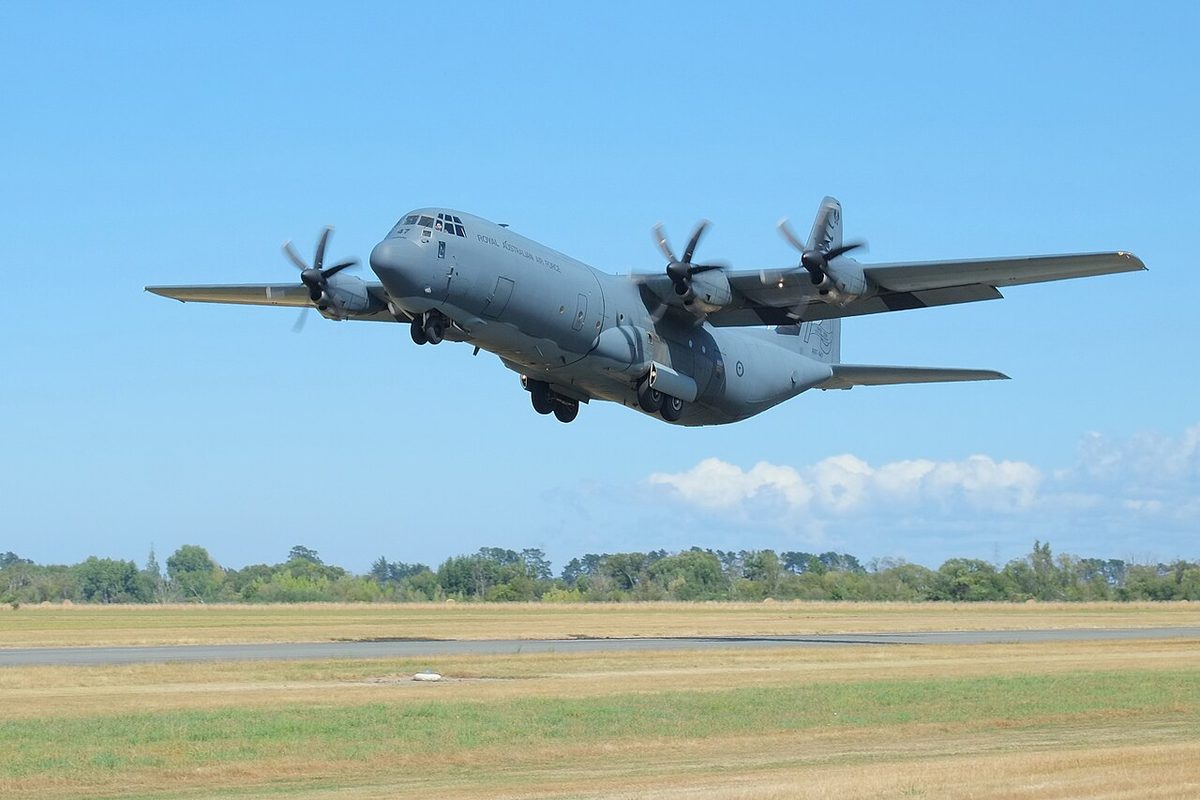
Positive climb or positive rate of climb is called when both the altimeter and the vertical speed indicator confirm a climb; a nose-up attitude alone is not proof. Gear is not raised before that, because an aircraft that settles back with the gear in transit can collapse it, and the squat switch cannot be relied on as a guard.
Full go-around thrust at light weight gives far more climb than needed. The 737's first TO/GA push below 2,000 ft RA commands a reduced go-around thrust for 1,000 to 2,000 ft/min, and a second push gives full thrust. On the A320 the levers must be set to the TOGA detent to engage the go-around modes and the FMS go-around phase, and they come back to CL at the go-around thrust reduction altitude. With the flap lever at 0, the guidance stays in its approach modes. During the manoeuvre the A320's pilot monitoring calls "BANK" beyond 7°, "PITCH" above 20° or below 10° nose-up, and "SINK RATE" if the aircraft is not climbing.
Engine-out missed approach
Transport aeroplanes are certified to climb away in two cases:
| Case | CS-25 / FAR 25 | Configuration | Minimum gradient |
|---|---|---|---|
| Approach climb, one engine inoperative | 25.121(d) | Approach flap, gear up, go-around thrust on the remaining engines | 2.1% twin, 2.4% three engines, 2.7% four |
| Landing climb, all engines | 25.119 | Landing flap, gear down, thrust available 8 s after moving the levers from flight idle, speed not above VREF | 3.2% |
Either can limit landing mass on hot or high days. Under EU-OPS 1.510, still examined in EASA performance papers, an approach with a decision height below 200 ft needs a one-engine-inoperative missed approach gradient of at least 2.5%, or the published gradient if higher. VREF may not be less than VMCL, the minimum control speed in the landing configuration with the critical engine inoperative and the others at go-around thrust.
The engine-out missed approach is flown at a lower pitch attitude, about 12.5° on the A320 against 15° with all engines, and 13° on the 737-400 flight director. For EASA Class B twins the exam figures are 2.5% with all engines, gear down and landing flap, and 0.75% at 1,500 ft above the landing surface on one engine with gear and flap up.
Low approach and low pass
The FAA defines a low approach as an approach over an airport or runway, including the go-around, in which the pilot intentionally does not touch the runway. It is the normal ending of a practice instrument approach, cleared by the tower with missed approach instructions. A low pass is a flypast for observation, typically so that the tower can check that the gear is down; ICAO phraseology has "CLEARED LOW PASS" for it. Both are go-arounds planned in advance. After a larger aircraft's low approach, missed approach or touch-and-go, the AIM advises waiting at least 2 minutes before taking off or landing.
No-fault go-around policy
A no-fault go-around policy states that no pilot will be criticised for going around. Either pilot may call it, and the pilot flying complies without debate; any discussion comes afterwards. The FAA's AC 120-71B asks operators to publish a go-around policy, and most airlines make it no-fault. The target is plan continuation bias: the pull towards landing that grows as the runway comes into view. Briefing the go-around conditions in advance turns the decision into a check, not a debate (see crew resource management).
Accidents show the cost of hesitation. At Mangalore in 2010 an Air India Express Boeing 737-800 overran after its captain continued an unstabilised approach despite three go-around calls from the first officer (see fatigue). At San Francisco in 2013, the NTSB found that Asiana Flight 214's crew delayed the go-around after knowing the aircraft was below the glidepath and speed tolerances.
Go-around hazards
- Somatogravic illusion. The otoliths read forward acceleration as a nose-up pitch. At night or in cloud the pilot feels the aircraft pitching up steeply and is tempted to push, and in such accidents the aircraft typically descends in an attitude that looks normal. The defence is to set and hold the go-around attitude on the attitude indicator and confirm the climb on the altimeter and VSI (see visual illusions).
- Pitch-up and trim. With the thrust line below the centre of gravity, as with underwing engines, go-around thrust adds a nose-up moment to the nose-up trim already set for the slow approach. Pitch can overshoot and speed decay unless the pilot holds the attitude (see upset prevention and recovery).
- Low level-off. At light weight the aircraft can reach a low missed approach altitude within seconds, with flaps still being retracted, inviting altitude overshoots and flap overspeeds.
- Instrument errors. An air-driven attitude indicator briefly shows a slight climb when a light aircraft accelerates, agreeing with the illusion. A magnetic compass accelerating on a westerly heading in the northern hemisphere shows a false turn towards north.
- Sink after initiation. GPWS Mode 3 calls "DON'T SINK" if height is lost after a go-around; re-establish the climb.
Frequently asked questions
What is the difference between a go-around and a missed approach?
A go-around is any abandoned approach or landing followed by a climb, flown visually or on instruments at any height. A missed approach is the go-around that follows an instrument approach. It follows the published missed approach procedure, or ATC's instructions, from the missed approach point to a published altitude. Its obstacle protection assumes it starts no later than the missed approach point, at or above the minimum.
What is the standard missed approach climb gradient?
ICAO PANS-OPS procedures assume a nominal missed approach climb gradient of 2.5%, about 152 ft per nautical mile, unless a higher gradient is published. The FAA requires at least 200 ft per nautical mile, about 3.3%, unless the chart specifies more. In feet per minute the requirement grows with groundspeed. At 120 kt, 200 ft/NM means 400 ft/min.
When must a pilot go around on an instrument approach?
At the decision altitude or missed approach point if the required visual reference is not distinctly visible, and at any time below the minimum until touchdown if it is lost or the aircraft can no longer land normally. When circling, the pilot goes around if an identifiable part of the airport is lost from view. Airline procedures add unstable approaches, windshear warnings and ATC instructions.
Why is the landing gear raised only after a positive rate of climb?
While retracting, the gear is neither locked down nor stowed, so an aircraft that settles back onto the runway in that state can collapse its gear. The pilot monitoring therefore confirms a climb on both the altimeter and the vertical speed indicator and calls positive rate or positive climb. Only then does the pilot flying call for gear up. A nose-up attitude alone does not prove the aircraft is climbing.
What is the difference between a low approach and a low pass?
A low approach is an approach deliberately continued down to low height over the runway without touching down, followed by a go-around, typically to practise an instrument approach. A low pass is a flypast along the runway, usually so that the tower or ground staff can look at the aircraft, for instance to check the landing gear. Both need a clearance and a planned climb-out.
Why can a go-around be dangerous?
It is rarely flown for real, so it often comes as a surprise at a moment of high workload. High thrust with underwing engines pitches the nose up, and a light aircraft can reach a low missed approach altitude within seconds. At night or in cloud the acceleration creates a strong false sensation of pitching up, and a pilot who pushes the nose down to correct it can fly back into the ground.
Test yourself on Go-Around and Missed Approach
The v1prep banks cover this topic in Operational Procedures (070), with a worked explanation for every answer. EASA ATPL, PPL, IR and CPL, the FAA written tests and A320/B737 type ratings.
Start practising →Sources and further reading
- FAA Aeronautical Information Manual, Chapter 5 Section 4 (5-4-5 visual segment, 5-4-21 Missed Approach)
- 14 CFR 91.175, Takeoff and landing under IFR
- FAA Pilot/Controller Glossary, L (low approach)
- FAA Instrument Procedures Handbook (FAA-H-8083-16B)
- FAA Airplane Flying Handbook (FAA-H-8083-3C), Chapter 9, Approaches and Landings
- EASA Easy Access Rules for Large Aeroplanes (CS-25.119 and CS-25.121)
- Flight Safety Foundation, Go-Around Decision-Making and Execution Project, Final Report
- NTSB AAR-14/01, Asiana Airlines Flight 214, Boeing 777-200ER, San Francisco, California
Library articles are written for study and exam preparation. They do not replace your aircraft's approved documentation, your operator's procedures or the regulations themselves.