Boundary Layer
The boundary layer is the thin layer of air next to an aircraft's surface in which viscosity dominates, so that the flow speed rises from zero at the skin to the free-stream value at its outer edge. Whether it is laminar or turbulent governs skin friction, flow separation and the stall.
The boundary layer is the thin layer of air next to the surface of a wing, fuselage or any other part of an aircraft in which the air's viscosity matters. At the skin itself the air is at rest relative to the surface; a short distance away it moves at the full speed of the surrounding flow. Everything in between is the boundary layer, and although it is thin, it decides a great deal about how the aircraft flies.
Friction within it produces skin friction drag. Its ability, or failure, to follow the surface against rising pressure decides where the flow separates, and with it the form drag, the maximum lift coefficient and the stall. Frost, ice, dirt and heavy rain act on the aircraft largely through the boundary layer, and slats, slots, stall strips and vortex generators are all ways of managing it.
What the boundary layer is
Air in contact with a surface does not slip over it: the molecules touching the skin are carried along with it, so relative to the aircraft the flow speed at the surface is zero. This is the no-slip condition. Each layer of air a little further out is slowed by the layer beneath it, and the speed rises with distance from the skin until it reaches the local free-stream value. The region over which this happens is the boundary layer, and the way the speed changes across it is its velocity profile.
The layer is thin, but it is not uniform. It starts at the leading edge, or at the nose of a fuselage, and grows thicker as the air travels rearwards. Outside it, viscosity has so little effect that the flow can be treated as that of an ideal fluid, which is why Bernoulli's theorem, strictly valid only for an incompressible, inviscid fluid, describes the pressure field around a wing so well at low speed. Inside it, viscosity rules. ATPL theory texts stress that the boundary layer determines the maximum lift coefficient, the stall characteristics, the form drag and much of the high-speed behaviour of a wing.
Viscosity and skin friction
Viscosity is a fluid's internal friction, its resistance to one layer sliding over another. Air has a low viscosity compared with oil or syrup, but not zero, and in the boundary layer the speed changes so sharply over so short a distance that the resulting shear forces become significant.
The shear stress at the surface, summed over the whole wetted area, is the skin friction drag, one of the two components of profile drag and part of parasite drag (see drag). Its size depends on how steeply the speed rises close to the surface. A gentle rise, as in a laminar layer, gives little friction; a steep rise, as in a turbulent layer, gives much more. Skin friction also grows with the wetted area and the roughness of the surface. Scratches, repairs, dirt and grease accumulated over an airframe's life increase it, which is one reason an ageing aircraft burns more fuel.
Laminar and turbulent boundary layers
A laminar boundary layer is one in which the air moves in smooth, parallel layers with little mixing between them. Its speed rises gradually from the surface, it is thin and its skin friction is low. The penalty is that the air closest to the surface is slow and has little kinetic energy, so the layer cannot push far against rising pressure and separates readily.
A turbulent boundary layer is full of irregular eddies that mix faster air from its outer part down towards the surface. It is thicker, its speed rises steeply close to the skin, and its skin friction is considerably higher. In return the air near the surface carries much more kinetic energy, so a turbulent layer can travel much further against an adverse pressure gradient before it separates.
| Property | Laminar | Turbulent |
|---|---|---|
| Motion | Smooth layers, little mixing | Eddies mixing across the layer |
| Thickness | Thinner | Thicker |
| Speed change close to the surface | Gradual | Steep |
| Skin friction | Low | High |
| Kinetic energy near the surface | Low | High |
| Resistance to separation | Poor | Good |
This is the central trade-off of boundary layer aerodynamics: laminar flow is cheap in drag but fragile; turbulent flow costs drag but stays attached.
Exam tip: compared with a turbulent layer, a laminar layer has lower skin friction, less kinetic energy, is thinner and has a greater tendency to separate. A turbulent layer is more resistant to separation because of its higher kinetic energy.

The transition point
Over a wing the boundary layer is normally laminar from the leading edge and becomes turbulent some distance back. The change takes place over a short region, conventionally called the transition point. Ahead of the point of lowest pressure the flow is accelerating and the pressure is falling, which keeps a laminar layer stable. A laminar layer cannot survive long once the pressure starts to rise in the direction of flow, so on a conventionally curved aerofoil transition usually occurs at or near the point of maximum thickness, where the adverse pressure gradient begins.
The position of the transition point depends mainly on two things:
- Surface condition. Roughness, dirt, insect debris, ice and poorly finished repairs trip the layer into turbulence early. A heavy rain film roughens the surface and distorts the section, and can move transition forward, especially on laminar flow sections.
- Pressure gradient. Anything that brings the adverse pressure gradient further forward brings transition forward too. Increasing the angle of attack moves the suction peak forward, and the transition point follows it.
Transition also becomes more likely the faster the flow and the further it has travelled along the surface, relative to the air's viscosity, which aerodynamicists express as the Reynolds number. Moving the transition point forward increases skin friction drag, because a greater area of the surface is covered by turbulent flow.
Adverse pressure gradient and separation
From the stagnation point at the leading edge the air over the upper surface accelerates to the point of minimum pressure, the suction peak. Over that stretch the pressure falls in the direction of flow, a favourable pressure gradient, which helps the boundary layer along. From the point of minimum pressure to the trailing edge the pressure rises again. Pressure rising in the direction of flow is an adverse pressure gradient, and the boundary layer must slow down to climb it.
The air closest to the surface, already the slowest, loses its momentum first. If it runs out of kinetic energy, or the gradient is too steep, it stops, then begins to flow backwards. The boundary layer lifts off the surface at the separation point, and behind it lies a region of reversed, eddying flow that feeds a wide, turbulent wake. Boundary layer separation is this mechanism; flow separation is its result, the main flow no longer following the contour of the surface. Separation destroys the pressure recovery towards the trailing edge, so form drag rises sharply, and it destroys the suction over the rear of the wing, so lift falls.
As the angle of attack increases, the suction peak strengthens and moves forward and the adverse gradient behind it steepens. Separation begins near the trailing edge and creeps forward. Its turbulent wake passing over the tailplane and rear fuselage produces the pre-stall buffet. At the critical angle of attack, about 16° for a typical section, separation has spread so far that lift can no longer increase, and the wing stalls.
At high Mach numbers a shock wave on the upper surface produces a sudden pressure rise, an extremely steep adverse gradient, and the boundary layer can separate immediately behind it. This shock-induced separation causes shock stall and high-speed buffet (see high-speed flight).
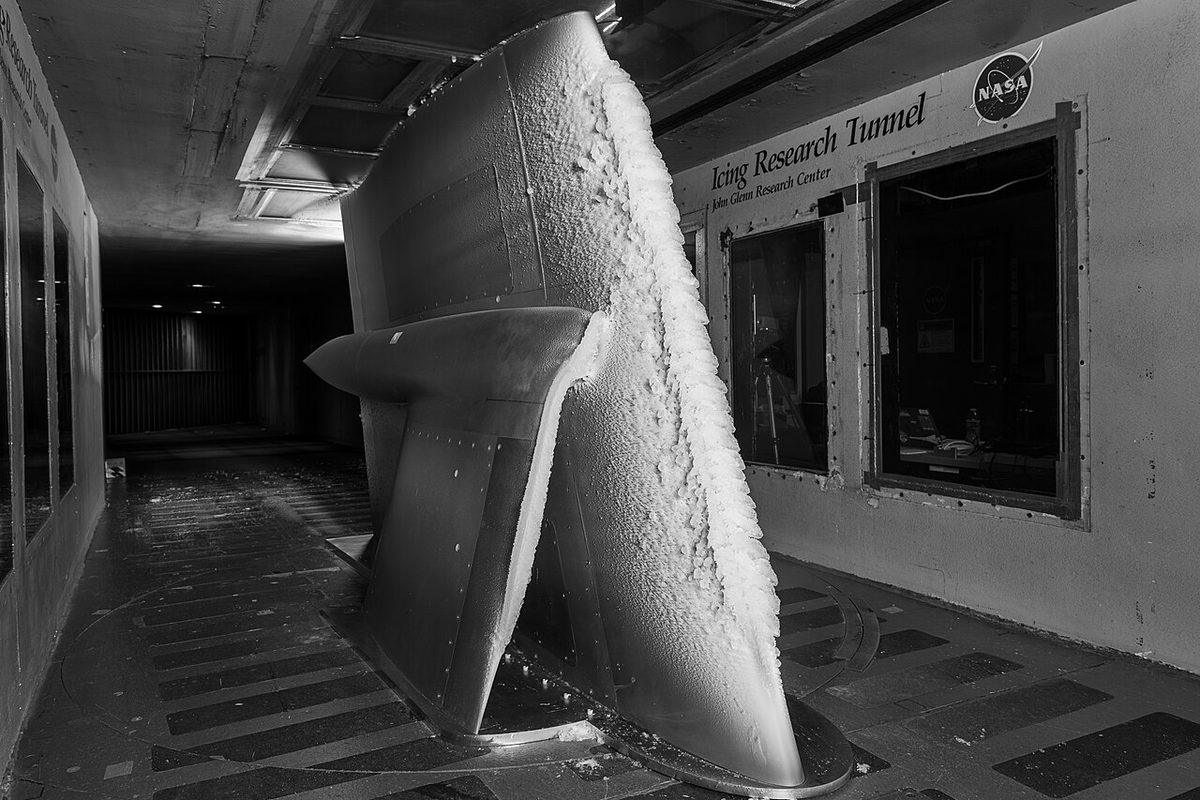
Contamination works through the same mechanism. Frost, ice and snow roughen the surface and rob the boundary layer of energy, so it separates at a lower angle of attack. The maximum lift coefficient falls, the stall speed rises and the stall can come before the stall warning, which is set for the clean wing. FAA AC 20-117 notes that frost, ice or snow with the roughness of medium or coarse sandpaper on the leading edge and upper surface can reduce lift by as much as 30 % and increase drag by 40 %. A heavy coat of hard frost typically raises the stall speed by about 5 to 10 %, and a leading-edge ice accretion that cuts CLmax by 30 % raises it by about 20 %, since stall speed varies as 1 ÷ √CLmax (see airframe icing).
Laminar flow aerofoils
A laminar flow aerofoil (FAA: laminar flow airfoil) is shaped to keep the boundary layer laminar over as much of the surface as possible and so cut skin friction. Its maximum thickness, and with it the point of minimum pressure, lies further aft than on a conventional section, so the favourable pressure gradient extends further back and transition is delayed.
The benefit comes with conditions. The low drag is obtained only over a limited range of lift coefficients, often called the drag bucket; outside that range the drag advantage disappears. And it depends on an accurate, smooth surface. Insect debris, rain, ice, dirt or a rough repair near the leading edge trips the layer early and the advantage is lost, and a heavy rain film on a laminar section can increase drag and raise the stall speed significantly, which is why manufacturers may recommend speed adjustments for heavy rain.
Vortex generators and boundary layer control
Many devices on an aircraft exist to control the boundary layer rather than to add lift directly.
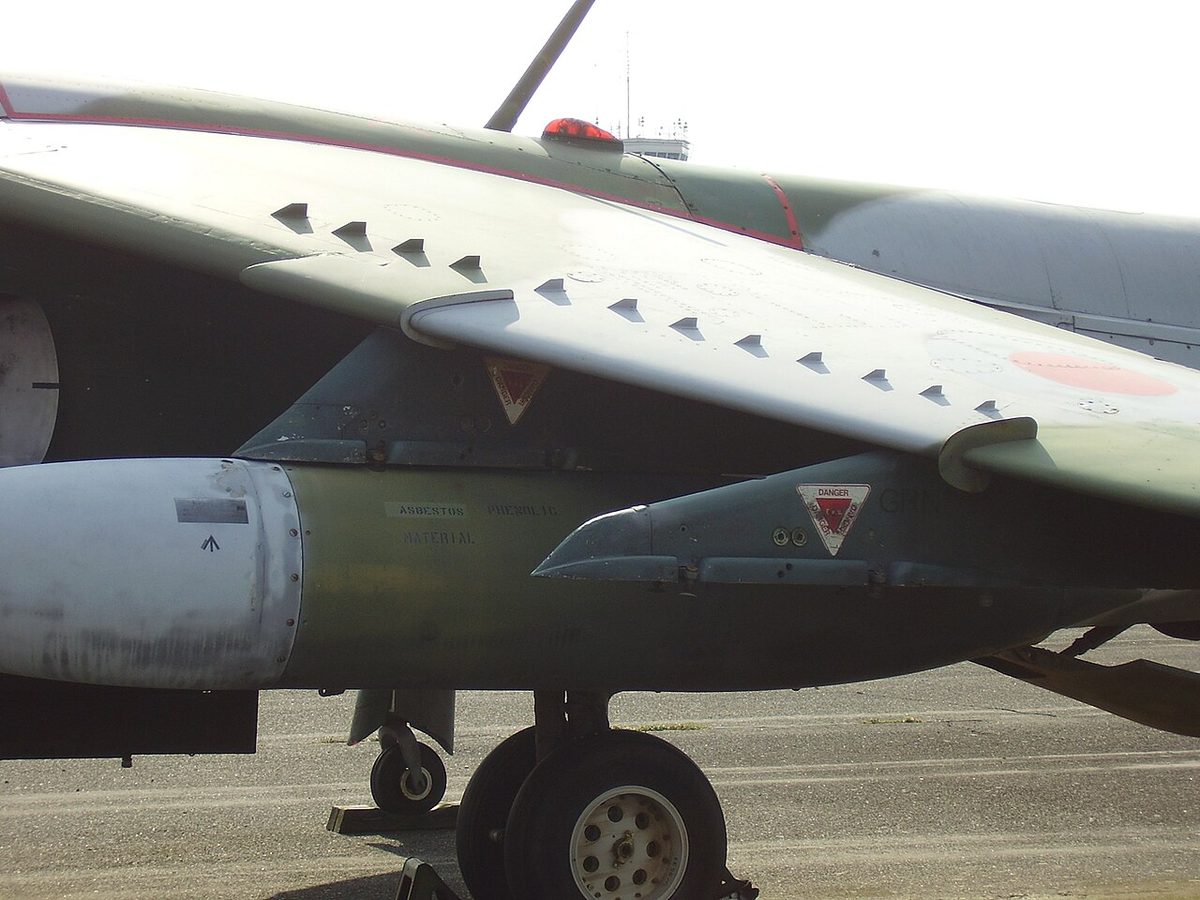
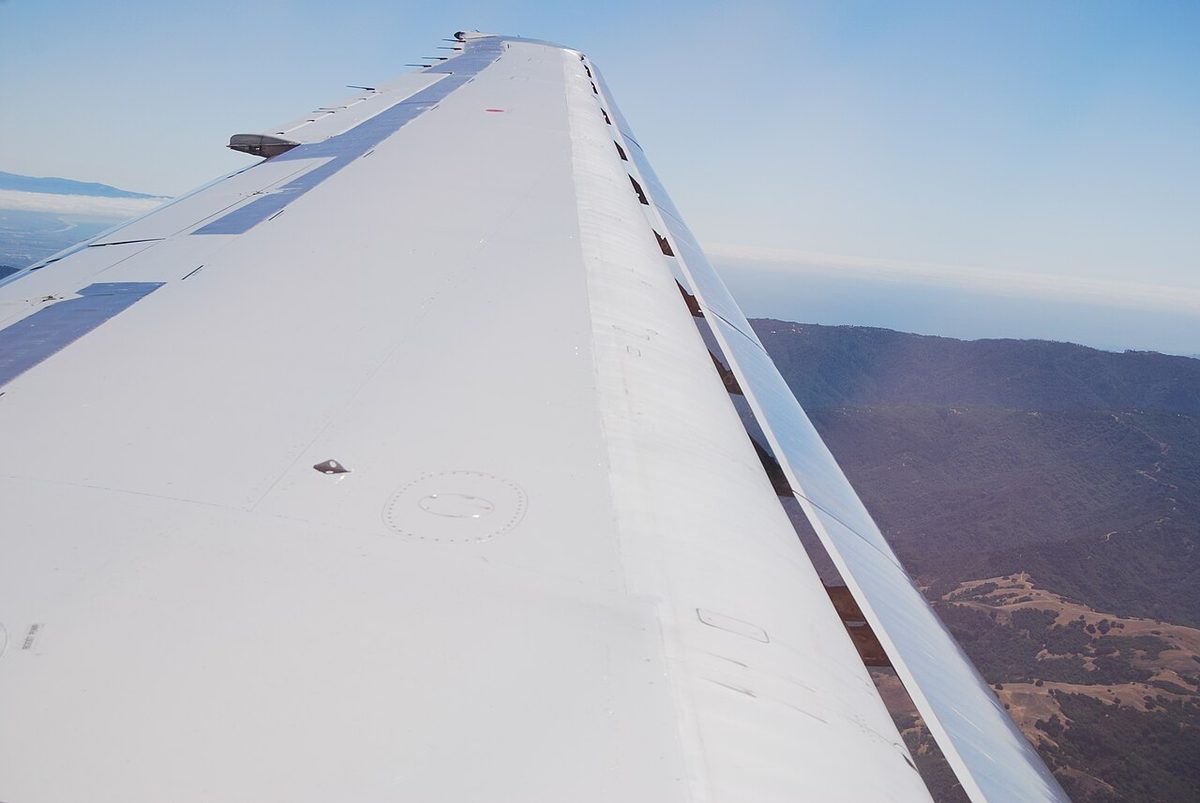
Vortex generators are rows of small vanes standing up from the surface, each set at an angle to the airflow. Each vane sheds a small vortex from its tip, which mixes fast, high-energy free-stream air down into the slow air next to the skin. The re-energised boundary layer can follow the adverse pressure gradient further aft, so separation is delayed. Placed ahead of the ailerons, they keep the ailerons in attached flow to a higher angle of attack; on the wings of high-speed aircraft, they help the boundary layer survive the pressure rise at a shock wave, reducing shock-induced separation and buffet. The price is a small increase in parasite drag. On transport aircraft, flight with some vortex generators missing is covered by the configuration deviation list, with any performance penalty it specifies.
Other devices work on the same principle:
- Slots and slats duct high-pressure air from beneath the wing through a gap over the upper surface, adding kinetic energy to the boundary layer. The stalling angle of attack rises, typically to about 25° against about 16° for the basic section.
- Slotted flaps open a gap between wing and flap that feeds high-energy air over the flap's upper surface, delaying separation there.
- Stall strips do the opposite on purpose: at high angle of attack their sharp edge trips separation on the inboard wing, so that the root stalls first.
- Wing fences and vortilons stop the boundary layer drifting outboard on swept wings, where spanwise flow thickens it towards the tips and promotes tip stall.
See high-lift devices for how slats and flaps combine these effects with added camber and area.
Frequently asked questions
What is the boundary layer in aerodynamics?
The boundary layer is the thin layer of air next to a surface in which viscous forces dominate. At the skin the air is at rest relative to the surface, and across the layer its speed rises to that of the free stream. Friction inside it causes skin friction drag, and its ability to keep following the surface against rising pressure decides where the flow separates, which sets the maximum lift coefficient and the stall.
What is the difference between a laminar and a turbulent boundary layer?
A laminar boundary layer flows in smooth layers with little mixing. It is thin and gives low skin friction, but the air near the surface has little energy, so it separates readily when pressure rises. A turbulent boundary layer is full of eddies that mix fast air down towards the skin. It is thicker and gives more skin friction, but its extra energy lets it stay attached much further against an adverse pressure gradient.
What is the transition point on a wing?
The transition point is where the boundary layer changes from laminar to turbulent flow. On a conventional aerofoil it lies at or near the point of maximum thickness, where the pressure stops falling and starts to rise. Surface roughness, dirt, ageing, ice and a heavy rain film move it forward, as does an increase in angle of attack. The further forward it lies, the greater the area of turbulent flow and the higher the skin friction drag.
What causes boundary layer separation?
Behind the point of minimum pressure the air over a wing flows into rising pressure, an adverse pressure gradient. The boundary layer slows as it climbs this gradient, and if it runs out of kinetic energy, or the gradient is too steep, the air next to the surface stops and reverses and the flow leaves the surface. Higher angles of attack, roughness and contamination, and shock waves at high Mach numbers all promote it.
What do vortex generators do on a wing?
Vortex generators are rows of small vanes set at an angle to the airflow. Each sheds a small vortex that mixes fast free-stream air down into the slow boundary layer, giving it the energy to follow the adverse pressure gradient further aft. Separation is delayed, both towards the stall at low speed and behind shock waves at high speed, which keeps ailerons effective and reduces buffet. The price is a small increase in parasite drag.
Test yourself on Boundary Layer
The v1prep banks cover this topic in Principles of Flight (081), with a worked explanation for every answer. EASA ATPL, PPL, IR and CPL, the FAA written tests and A320/B737 type ratings.
Start practising →Sources and further reading
- FAA Pilot's Handbook of Aeronautical Knowledge (FAA-H-8083-25), Chapter 5, Aerodynamics of Flight
- EASA, Explanatory Note to ED Decision 2018/001/R, Part-FCL theoretical knowledge learning objectives
- NASA Glenn Research Center, Boundary Layer
- NASA Glenn Research Center, Reynolds Number
- FAA AC 20-117, Hazards Following Ground Deicing and Ground Operations in Conditions Conducive to Aircraft Icing
- FAA Instrument Flying Handbook (FAA-H-8083-15B), Chapter 4, Aerodynamic Factors
Library articles are written for study and exam preparation. They do not replace your aircraft's approved documentation, your operator's procedures or the regulations themselves.