Aircraft Mass Definitions
Aircraft mass definitions are the standard terms that build an aeroplane's loaded mass step by step: from the basic empty mass found by weighing, through the dry operating, operating and zero fuel masses, to the ramp, take-off and landing masses of a particular flight.
Every loading calculation starts from a small set of defined masses. Each is the one before it plus something added: crew and catering, then passengers and cargo, then fuel. Each also has its own ceiling, so the chain is both a way of adding up the load and a list of the checks that must be passed before flight. The terms are exact, and exam questions test them by stating one mass and asking for another.
The European terms come from the mass and balance rules for commercial air transport, formerly EU-OPS 1 Subpart J and now CAT.POL.MAB of the Air Operations Regulation, and are examined in subject 031, Mass and Balance. The FAA covers the same ground in the Pilot's Handbook of Aeronautical Knowledge and the Aircraft Weight and Balance Handbook, in pounds and with its own vocabulary. The limits that cap each mass are described in maximum structural and regulated masses.
Mass versus weight
Mass is the quantity of matter in a body, measured in kilograms or pounds; it does not change with location. Weight is the force gravity exerts on that mass, weight = mass × g, measured in newtons. In mass and balance work the two words are used as synonyms: EASA writes mass, the FAA writes weight, and both mean the figure in kilograms or pounds. Only when scales read in newtons does the distinction matter, and then the reading is divided by 9.81 m/s² to give kilograms.
The other trap is volume. Fuel is uplifted in litres or gallons but loaded on paper as mass, using its density. A refuelling of 10,000 litres entered on the load sheet as 10,000 kg, with fuel at a specific gravity of 0.75, over-records the fuel by 2,500 kg: the aeroplane is lighter than the paperwork says, and it carries 2,500 kg less fuel than the crew believe.
Basic empty mass
The basic empty mass (BEM) is the mass of the aeroplane with its airframe, engines and fixed equipment, plus unusable fuel and full operating fluids such as engine oil. It contains no crew, no usable fuel and no load. It is found by weighing: the manufacturer weighs each aeroplane before it enters service, and it is re-weighed after major modification and at intervals; EU-OPS required an individual aeroplane to be re-weighed every four years.
The basic equipment is the equipment that is part of the aeroplane as weighed. The person in charge of the weighing compiles a weighing schedule that lists it, records the scale readings and states the resulting BEM and its centre of gravity. Items that are not basic equipment, such as galley trolleys and passenger service equipment, are removed before weighing and refitted afterwards, which is why airliners are usually weighed during a deep maintenance visit.
For a light aeroplane the BEM and its centre of gravity are recorded in the aircraft's own mass and balance record, usually in the flight manual, and updated whenever equipment is added or removed. That individual record, not the type figure, is the one to use.
Dry operating mass and variable load
The dry operating mass (DOM) is the total mass of the aeroplane ready for a specific type of operation, excluding usable fuel and traffic load. It includes:
- the crew and their baggage;
- catering and removable passenger service equipment;
- potable water and lavatory chemicals.
The items that turn the basic empty aeroplane into the dry operating aeroplane are grouped in ATPL texts as the variable load, so that DOM = BEM + variable load. Light aircraft texts sometimes use the phrase more loosely, for everything added to the empty aeroplane, occupants, baggage and fuel included. Because the variable load depends on the operation, one aeroplane can have several DOMs, for example with a different crew complement or catering standard. An operator of several aeroplanes of the same model and configuration may use an average DOM and CG for the fleet. On airliners the DOM has a matching dry operating index, the starting point of the load and trim sheet.
Operating mass
The operating mass (OM) is the dry operating mass plus the take-off fuel. It is everything that will be on board at the start of the take-off run except the traffic load, so the traffic load is the take-off mass minus the operating mass.

Traffic load and useful load
The traffic load is the total mass of passengers, their baggage and cargo. Older texts call it the payload, since it is the load that earns revenue. It is established either by actual weighing or, for passengers and baggage, by standard masses (see standard masses for passengers and baggage); freight is normally weighed. Traffic load = zero fuel mass − DOM = take-off mass − operating mass.
The useful load has two meanings, and exam questions exploit the difference:
- In EASA airline mass and balance it is the traffic load plus the take-off fuel, the whole load added to the dry operating aeroplane for a flight. Useful load = take-off mass − DOM.
- In light aircraft and FAA texts it is a capacity: the maximum take-off (or ramp) weight minus the basic empty weight, the most that occupants, baggage and usable fuel together may weigh. What remains after the fuel is taken out is the payload.
A light aeroplane with a basic empty weight of 1,650 lb and a maximum take-off weight of 2,550 lb therefore has a useful load of 900 lb. With 40 US gallons of avgas at 6 lb per gallon, 240 lb, the payload for people and baggage is 660 lb.
Zero fuel mass
The zero fuel mass (ZFM) is the mass of the aeroplane with no usable fuel: the dry operating mass plus the traffic load, or on a light aeroplane the basic empty mass plus occupants and baggage. It is the first subtotal on a load sheet and is checked against the maximum zero fuel mass, a structural limit that protects the wing roots.
Airline crews enter the zero fuel weight and its centre of gravity in the flight management system, which adds the fuel on board to obtain the gross weight used for every speed and performance figure. An error in that entry therefore propagates into the take-off speeds, the approach speed and the fuel predictions, which is why it is cross-checked against the load sheet.
Ramp, take-off and landing mass
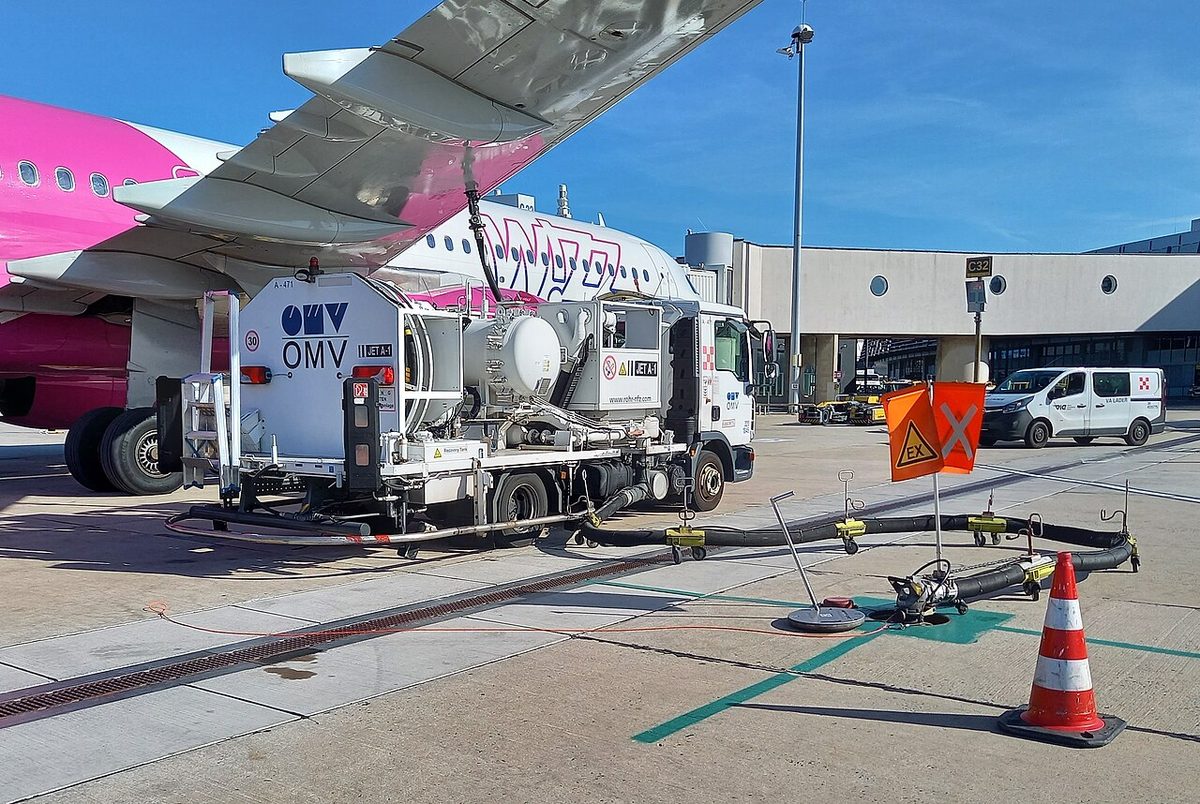
Ramp mass, also called block mass or taxi mass, is the total mass at engine start: the zero fuel mass plus the block fuel, or the take-off mass plus the start-up and taxi fuel. It is limited by the maximum ramp or taxi mass.
Take-off mass (TOM), the FAA's takeoff weight (TOW), is the mass of the aeroplane including everyone and everything on board at the start of the take-off run: DOM + traffic load + take-off fuel. Landing mass (LM) is the take-off mass minus the trip fuel burned to the destination.
| Step | Mass (kg) |
|---|---|
| Dry operating mass | 42,000 |
| + traffic load | 14,000 |
| = zero fuel mass | 56,000 |
| + block fuel (taxi 200, take-off fuel 10,000) | 10,200 |
| = ramp mass | 66,200 |
| − taxi fuel | 200 |
| = take-off mass | 66,000 |
| − trip fuel | 6,500 |
| = landing mass | 59,500 |
In this example the operating mass is 52,000 kg, the useful load 24,000 kg and the traffic load 14,000 kg, and each can be recovered from the others: 66,000 − 52,000 = 14,000. The landing mass still contains the contingency, alternate, final reserve and any extra fuel that has not been burned.
All-up mass (AUM) is a general term for the total mass of the aeroplane at any moment, used when no particular stage is meant. Its FAA counterpart is gross weight (GW), as in maximum gross weight.
FAA weight terminology
The FAA works in pounds, and modern light aircraft handbooks follow the GAMA format:
- Standard empty weight is the airframe, engines, standard equipment, unusable fuel, full oil and full operating fluids.
- Basic empty weight is the standard empty weight plus the optional equipment installed in that particular aeroplane. Usable fuel and the pilot are part of the useful load.
- Licensed empty weight, found in older records, included only undrainable oil rather than full oil, so it is worth checking which definition the records use before adding oil.
The mapping to EASA terms is close but not exact:
| EASA term | FAA term |
|---|---|
| Basic empty mass | Basic empty weight (licensed empty weight in older records) |
| Traffic load | Payload |
| Zero fuel mass | Zero fuel weight |
| Ramp mass | Ramp weight |
| Take-off mass | Takeoff weight, gross weight at take-off |
| Landing mass | Landing weight |
Airlines under Part 121 record the loading on a load manifest (14 CFR 121.665 and 121.693), showing the weight of the aircraft, fuel and oil, cargo and baggage, passengers and crew, the maximum allowable weight for the flight and the total weight computed under approved procedures. AC 120-27F lets them use approved average passenger and bag weights or actual weights.
Exam tip: most mass definition questions reduce to three identities: ZFM = DOM + traffic load, TOM = ZFM + take-off fuel, and LM = TOM − trip fuel. Write the chain down before looking at the options.
Frequently asked questions
What is the difference between basic empty mass and dry operating mass?
Basic empty mass is the aeroplane as weighed, with its fixed equipment, unusable fuel and full operating fluids such as engine oil. Dry operating mass adds everything needed for a particular kind of operation except usable fuel and traffic load, namely the crew and their baggage, catering and removable passenger service equipment, potable water and lavatory chemicals.
What is zero fuel mass?
Zero fuel mass is the mass of the aeroplane with everything on board except usable fuel. On a load sheet it is the dry operating mass plus the traffic load. It is checked against the maximum zero fuel mass, which protects the wing roots, and the zero fuel mass and its centre of gravity are entered in the flight management system of many airliners.
What is the difference between traffic load and useful load?
Traffic load is the passengers, baggage and cargo, once called the payload. In EASA mass and balance, useful load is the traffic load plus the take-off fuel, so it equals take-off mass minus dry operating mass. Light aircraft and FAA texts use useful load for a capacity instead, the maximum take-off or ramp weight minus the basic empty weight, and call what remains after fuel the payload.
What is ramp mass?
Ramp mass, also called block or taxi mass, is the total mass of the aeroplane at engine start, before any fuel has been burned. It equals the take-off mass plus the fuel for start-up and taxi. It is limited by the maximum ramp or taxi mass, which exceeds the maximum take-off mass by about that taxi allowance, so the aeroplane is back at or below its take-off limit at brake release.
Are mass and weight the same thing in mass and balance?
Strictly, no. Mass is the quantity of matter, in kilograms or pounds, and weight is the gravitational force on it, in newtons, equal to mass times g. In mass and balance work the two words are used as synonyms: EASA writes mass and the FAA writes weight for the same figures. Scale readings in newtons are divided by 9.81 to give kilograms.
Test yourself on Aircraft Mass Definitions
The v1prep banks cover this topic in Mass and Balance (031), with a worked explanation for every answer. EASA ATPL, PPL, IR and CPL, the FAA written tests and A320/B737 type ratings.
Start practising →Sources and further reading
- EASA Easy Access Rules for Air Operations (Regulation (EU) No 965/2012), definitions and CAT.POL.MAB
- FAA Pilot's Handbook of Aeronautical Knowledge (FAA-H-8083-25), Chapter 10, Weight and Balance
- FAA Aviation Handbooks and Manuals, Aircraft Weight and Balance Handbook (FAA-H-8083-1B)
- FAA AC 120-27F, Aircraft Weight and Balance Control
- 14 CFR 121.693, Load manifest, all certificate holders
Library articles are written for study and exam preparation. They do not replace your aircraft's approved documentation, your operator's procedures or the regulations themselves.