Aircraft Weighing
Aircraft weighing is the measurement, under controlled conditions, of the reactions at an aircraft's wheels or jacking points in order to find its basic empty mass and the position of its empty centre of gravity, the starting point of every later mass and balance calculation.
Every mass and balance calculation starts from the aircraft's own empty mass and the position of its empty centre of gravity (CG). Those two figures cannot be computed reliably from drawings: two aircraft of the same model differ in equipment, paint, repairs and wiring, and each changes over the years. They are therefore found by aircraft weighing, measuring the load at each wheel or jacking point with the aircraft in a defined condition.
An error at this stage is carried into every flight that follows. A wrong empty mass makes every take-off mass wrong by the same amount, and a wrong empty CG shifts every loaded CG. The rules therefore say when an aircraft must be weighed, and the weighing itself follows a procedure that makes the result repeatable and comparable with the last one.
When aircraft must be weighed
The European rules, set out in EU-OPS 1 Subpart J and still quoted in that form by the exams, require the mass and CG of an aeroplane to be established by actual weighing:
- before initial entry into service, a weighing the exam texts attribute to the manufacturer;
- every four years thereafter, where the aeroplane uses its own individual mass and CG rather than fleet values;
- whenever a major modification has been embodied, since that changes the empty mass and CG.
Minor repairs do not require a re-weigh. Between weighings, changes to the equipment are accounted for by calculation, and the records must be kept current. The mass and balance section of Part-CAT of the Air Operations Regulation, CAT.POL.MAB, has since replaced EU-OPS. It too requires actual weighing before entry into service, requires the accumulated effects of modifications and repairs to be accounted for and documented, and calls for a re-weigh when the effect of a modification is not accurately known.
Weighing an airliner is slow and labour-intensive, so it is normally combined with a deep maintenance input, when the aircraft is already in the hangar for scheduled work.
The FAA approach for light aircraft is continuous record-keeping. Each aircraft's empty weight and CG are held in its own weight and balance record, and whoever alters the aircraft computes and enters the revised figures. Part 121 carriers weigh their aircraft periodically under their approved weight and balance programme, described in Advisory Circular 120-27F.
Preparing the aircraft
A weighing is meaningful only if the aircraft is in the same condition each time. It is weighed in a draught-free hangar, since wind on the airframe would change the readings, and prepared to the basic empty mass standard:
- Usable fuel is drained, leaving only the unusable fuel, which is part of the basic empty mass.
- Fluids are brought to the state the weighing procedure specifies. Modern light aircraft definitions include full engine oil in the basic empty mass; older "licensed empty weight" figures included only the oil that cannot be drained.
- Equipment that is not listed as basic equipment in the weighing schedule, such as service trolleys and removable passenger service equipment, is removed or its mass accounted for.
- Loose items, tools and anything else not part of the aircraft are removed, and the scales are calibrated and zeroed.
The list of basic equipment in the previous weighing schedule defines the condition to prepare to. Without it, a change in the result could come from the aircraft or from the way it was prepared, and the two weighings could not be compared.
Weighing equipment
Three kinds of equipment are in use:
| Equipment | Principle | Typical use |
|---|---|---|
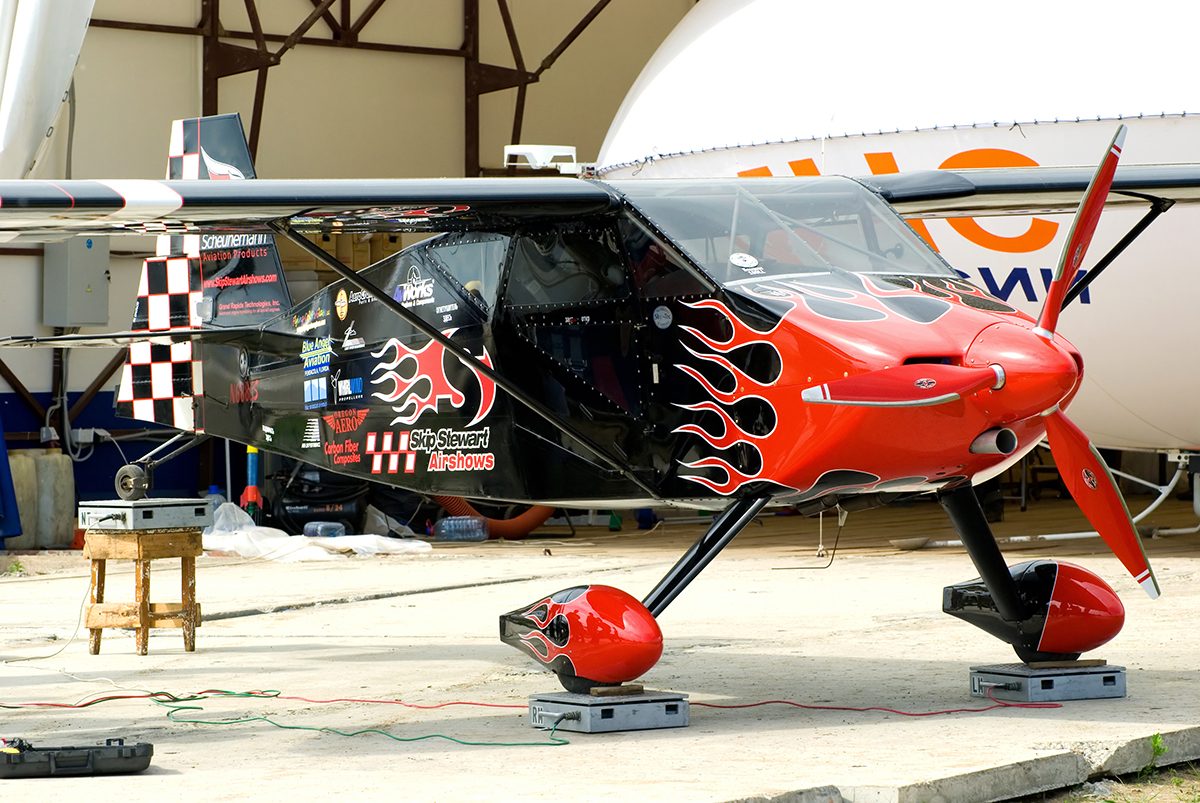
| Weigh-bridge scales (platform scales) | A separate weighing platform under each wheel, read by a balance arm or an electronic display | Light aircraft |
| Hydrostatic weighing unit | A liquid-filled unit between the jack and the jacking point; by Pascal's law the pressure in the closed unit is proportional to the load | Larger aircraft |
| Strain gauge load cells | Electronic cells at the jacking points; the electrical resistance of the gauge changes with the strain produced by the load | Larger aircraft |
Whatever the equipment, each unit reads the load carried at one point, and the readings are added. Some equipment reads in newtons, which are units of force: the mass in kilograms is the reading divided by 9.81, so 4,500 N corresponds to 458.7 kg. The CG position comes out the same either way, because it is a ratio of moment to total.
Jacking points and levelling
Large aircraft are usually weighed on jacks. The manufacturer designates jacking points, reinforced fittings under the wings and fuselage able to carry the aircraft's mass, and a hydrostatic unit or load cell is fitted between the head of each jack and its jacking point. The aircraft is raised until the wheels are clear of the floor, so that its whole mass is carried by the measuring units.
The aircraft must also be level, in the attitude defined by the manufacturer's weighing procedure. Arms from the datum are horizontal distances in that attitude, and the CG sits well above the reaction points. If the aircraft were weighed nose-up, the CG would lie further aft relative to the reaction points than in the level attitude, and the calculated arm would be wrong. The levelling means are specified for the type, in FAA practice in the type certificate data sheet: typically a spirit level laid across levelling lugs, or a plumb bob that must hang over a marked point. On jacks the attitude is adjusted with the jacks themselves; on platform scales, by adjusting the air in the nose wheel strut or the tyre pressures, or by placing blocks under the wheels.
Calculating empty mass and CG
The calculation is the one every CG calculation uses (see centre of gravity):
- Add all the readings to get the total, which is the basic empty mass once any corrections are made.
- Multiply each reading by the arm of its reaction point from the datum, positive aft and negative forward, to get its moment.
- Add the moments and divide the total moment by the total mass to get the empty CG.
An aeroplane with two nose wheels each reading 725 kg and four main wheels each reading 6,000 kg, with the nose and main wheels 10 m apart, gives:
| Reaction point | Mass (kg) | Arm from main wheels (m) | Moment (kg m) |
|---|---|---|---|
| Nose wheels, 2 × 725 | 1,450 | −10.0 | −14,500 |
| Main wheels, 4 × 6,000 | 24,000 | 0 | 0 |
| Total | 25,450 | −0.57 | −14,500 |
The basic empty mass is 25,450 kg, and the CG is 14,500 ÷ 25,450 = 0.57 m forward of the main wheels. Taking moments about the main wheels, rather than the datum, is a convenient short cut; for the records the result is converted into an arm from the datum. A light aircraft works the same way: a nose wheel reading 500 lb at −20 in and two main wheels reading 2,000 lb each at +30 in give 4,500 lb and a CG of +110,000 ÷ 4,500 = +24.4 in.
Corrections follow. Anything on the scales that is not part of the aircraft, such as chocks, blocks or levelling equipment, is tare and is subtracted from the reading of the scale it stands on. Any basic item missing at the weighing, or fuel different from the unusable quantity, is then added or subtracted with its moment.
Weight and balance records
The weighing schedule is compiled by the person in charge of the weighing on each occasion. It lists the basic equipment installed, records the readings and the calculated moments, and ends with a statement of the basic empty mass and CG position, signed by that person. It is kept in the aircraft's technical log until the next weighing (see technical log, MEL and deferred defects). The operator then adds the crew, catering, water and other standard items to reach the dry operating mass and dry operating index used on the load and trim sheet.
In FAA terms the equivalent is the aircraft's weight and balance record and equipment list, usually Section 6 of the flight manual or pilot's operating handbook. Under Part 43, the person who alters the aircraft computes and records the new empty weight and CG. Adding 20 lb of equipment at station 60 to an empty weight of 2,000 lb at station 85 gives (170,000 + 1,200) ÷ 2,020 = 84.75 in, and that becomes the figure the pilot must use. The type certificate data sheet gives only the limits for the model, never an individual aircraft's current empty weight.
Exam tip: the pilot uses the latest entry in the aircraft's own weight and balance record, not the figures of another aircraft of the same model. An out-of-date sheet from before an equipment change is a common finding on flight tests.
Fleet mass values
Weighing every aircraft of a large fleet individually and keeping separate figures for each adds work and complicates load control. The rules therefore allow fleet mass values: an operator with a fleet of aeroplanes of the same model and configuration may use an average dry operating mass and CG for the whole fleet, provided the conditions in the mass and balance rules are met. Those conditions keep each aircraft's own figures close to the fleet values and call for a sample of the fleet to be re-weighed periodically.
Aeroplanes of different models or configurations cannot be averaged together, and an aircraft whose own figures drift too far from the fleet values must be taken out of the fleet average and use its individual values. The benefit is that one set of figures and one dry operating index serve every aircraft in the fleet.
Note: the weighing gives the basic empty mass. The dry operating mass adds the operator's standard items, such as crew, catering and water, and the traffic load and fuel follow on the load sheet (see aircraft mass definitions).
Frequently asked questions
How often must an aircraft be weighed?
Under the European rules quoted in the ATPL exams, an aeroplane's mass and CG are first established by actual weighing before it enters service. An aeroplane using its own individual values is then re-weighed every four years, and whenever a major modification has been embodied. Minor repairs do not require a re-weigh. A fleet of the same model and configuration may instead use average fleet values under its own conditions.
How do you find the CG from weighing?
Add the readings of all the scales or jacking points to get the empty mass. Multiply each reading by the arm of its reaction point from the datum, positive aft and negative forward, and add the results to get the total moment. Divide the total moment by the empty mass to get the CG. If the readings are in newtons, divide them by 9.81 to convert to kilograms first.
What is a hydrostatic weighing unit?
A hydrostatic weighing unit is a fluid-filled cell fitted between a lifting jack and one of the aircraft's jacking points. By Pascal's law the pressure of the liquid in the closed unit is proportional to the load on it, so a gauge on the unit reads the mass carried at that point. Units at every jacking point are read together and their readings added. They are used for larger aircraft.
What is a weighing schedule?
The weighing schedule is the record produced at each weighing by the person in charge of it. It lists the basic equipment installed, records the readings and the calculated moments, and ends with a signed statement of the basic empty mass and CG. It is kept in the aircraft's technical log until the next weighing, and its equipment list defines how the aircraft must be prepared next time so that the results can be compared.
What are fleet mass values?
Fleet mass values are an average dry operating mass and CG used for every aircraft in a fleet of the same model and configuration, instead of each aircraft's individual figures. They simplify load control, since one set of values and one dry operating index serve the whole fleet. They are allowed only under the conditions in the mass and balance rules, and models or configurations cannot be averaged together.
Test yourself on Aircraft Weighing
The v1prep banks cover this topic in Mass and Balance (031), with a worked explanation for every answer. EASA ATPL, PPL, IR and CPL, the FAA written tests and A320/B737 type ratings.
Start practising →Sources and further reading
- EASA Easy Access Rules for Air Operations (Regulation (EU) No 965/2012), CAT.POL.MAB
- Commission Regulation (EC) No 859/2008 (EU-OPS), Subpart J, Mass and Balance
- FAA Aviation Handbooks and Manuals, Aircraft Weight and Balance Handbook (FAA-H-8083-1B)
- FAA Pilot's Handbook of Aeronautical Knowledge (FAA-H-8083-25), Chapter 10, Weight and Balance
- FAA AC 120-27F, Aircraft Weight and Balance Control
- 14 CFR Part 43, Maintenance, Preventive Maintenance, Rebuilding, and Alteration
Library articles are written for study and exam preparation. They do not replace your aircraft's approved documentation, your operator's procedures or the regulations themselves.