Aerodrome Traffic and Circuits
The aerodrome traffic circuit, called the traffic pattern by the FAA, is the specified path flown by aircraft operating in the vicinity of an aerodrome. Together with the rules for aerodrome traffic and aerodrome traffic zones, it keeps departing, arriving and training aircraft in a predictable flow.
Traffic is at its densest close to aerodromes, where aircraft converge on the same runway, climb and descend through each other's levels, and fly slowly with their pilots busy. The aerodrome traffic circuit, which the FAA calls the traffic pattern or airport traffic pattern, is the answer: a standard path around the runway that every pilot can expect every other pilot to fly. With it come the rules on who counts as aerodrome traffic, the zones that protect it, and the procedures at aerodromes with and without a control tower.
ICAO Annex 2 and, in Europe, SERA set the basic rules; each State publishes the local circuit in its AIP and on its aerodrome charts. In the United States, 14 CFR Part 91 sets the rules and the FAA's Advisory Circular 90-66C, Non-Towered Airport Flight Operations, describes the recommended pattern. The two systems agree on the essentials, left-hand turns and a predictable rectangle, and differ on the details of height and joining.
Aerodrome traffic defined
Aerodrome traffic is all traffic on the manoeuvring area of an aerodrome and all aircraft flying in the vicinity of an aerodrome. An aircraft is in the vicinity when it is in, entering or leaving an aerodrome traffic circuit. The aerodrome traffic circuit is the specified path to be flown by aircraft operating in the vicinity of an aerodrome.
A controlled aerodrome is one at which air traffic control service is provided to aerodrome traffic, whether or not a control zone exists around it. Its aerodrome control tower issues clearances to take off and land, joining instructions and traffic information (see air traffic services). The FAA's word for an aerodrome without an operating control tower is a non-towered airport, also written nontowered and still called an uncontrolled airport in parts of the AIM.
Under SERA, an aircraft operated on or in the vicinity of an aerodrome must observe other aerodrome traffic to avoid collision, conform with or avoid the pattern formed by other aircraft, and make all turns to the left when approaching to land and after take-off, unless ATC instructs otherwise or a ground signal shows otherwise. Landing and take-off are normally made into wind. Two further rules of the air apply constantly in the circuit: of two heavier-than-air aircraft approaching to land, the higher gives way to the lower, but the lower must not use this to cut in ahead of an aircraft on final or to overtake it; and an aircraft taxiing on the manoeuvring area gives way to aircraft landing or taking off.
Aerodrome traffic zones
An aerodrome traffic zone (ATZ) is airspace of defined dimensions established around an aerodrome for the protection of aerodrome traffic. ICAO does not fix its size: the State defines it and publishes its dimensions, class and entry rules in the AIP. At an aerodrome with an AFIS, the officer's information service is given to flights within the ATZ.
Weather sets a limit on VFR operations. Under SERA, unless authorised by ATC, a VFR flight must not take off or land at an aerodrome within a control zone, or enter the aerodrome traffic zone or traffic circuit, when the ceiling is less than 1,500 ft (450 m) or the ground visibility less than 5 km.
States also define the vicinity of an aerodrome for particular rules. France, for night VFR, counts a flight as in the vicinity of an aerodrome when it is within the lateral limits of the control zone or, where there is none, within a restricted area protecting the aerodrome traffic or less than 12 km (6.5 NM) from the aerodrome. The United States does not use ATZs; at a towered airport the Class D surface area, generally from the surface to 2,500 ft above the airport, serves the same purpose.
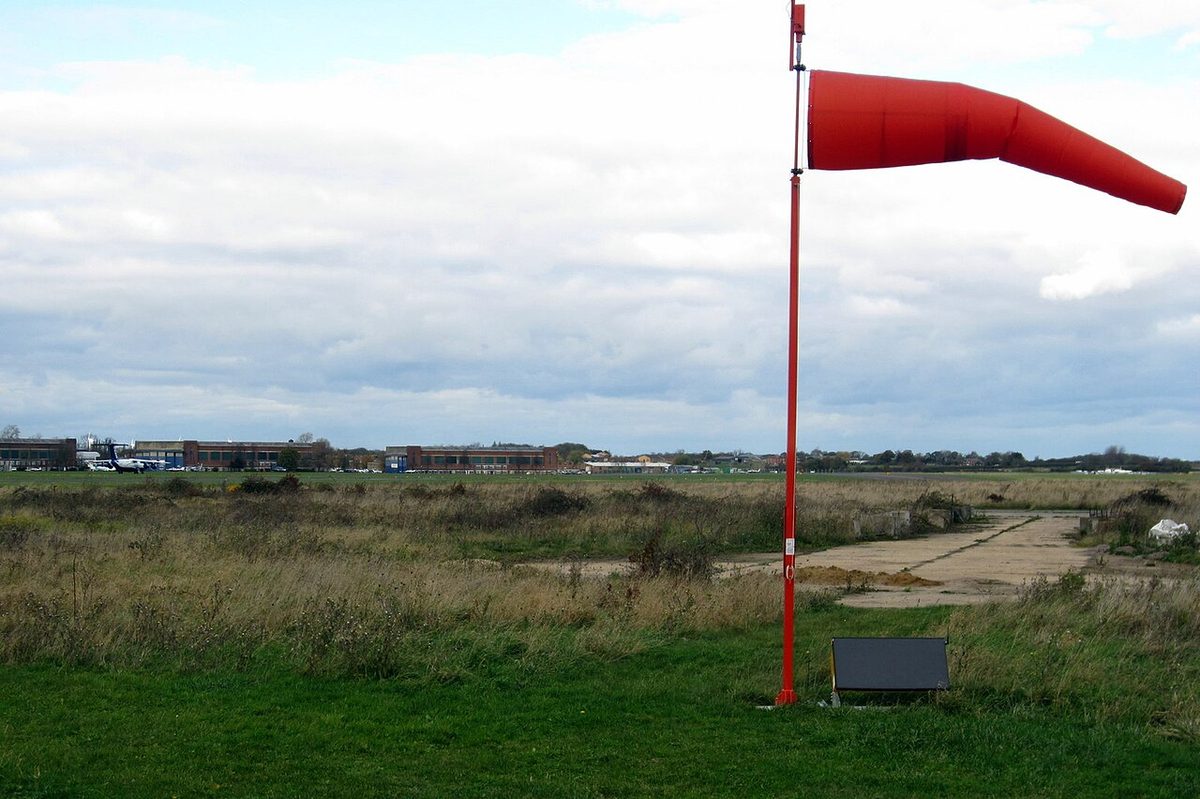
The standard traffic circuit
Circuit layout and legs
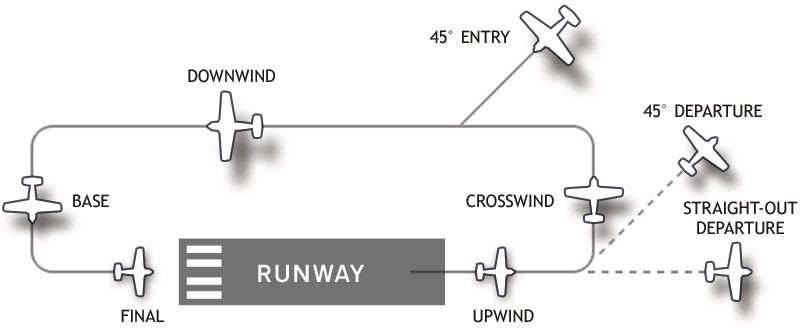
The circuit is a rectangle around the runway, flown to the left unless published otherwise. After take-off the aircraft climbs straight ahead on the upwind or departure leg, then turns through 90° onto the crosswind leg. A second turn puts it on the downwind leg, parallel to the runway and opposite to the landing direction, where the pilot completes the pre-landing checks and reports. A third turn onto the base leg and a fourth onto final line it up with the runway.
The reports on the radio follow the legs. At an ATC or AFIS aerodrome, typical reports are "downwind", with the pilot's intention such as "touch and go" or "full stop", and "final". Final is reported when the aircraft turns onto final within 4 NM (7 km) of touchdown; long final is reported when it turns on beyond that, and, on a straight-in approach, at 8 NM (15 km), followed by final at 4 NM. A tower may replace a joining instruction with "make straight-in approach".
At the end of the approach, the pilot's intention determines the clearance:
- a full-stop landing ends with the aircraft stopped and leaving the runway;
- a touch-and-go, or touch-and-go landing, is a landing followed immediately by a take-off without stopping, used for circuit training;
- a stop-and-go is a landing to a full stop on the runway followed by a take-off from that point, without leaving the runway;
- a low approach descends towards the runway without landing, and a low pass is a flypast, for example so that the tower can inspect the landing gear.
Behind a larger aircraft that has made a low approach, missed approach or touch-and-go, the FAA advises waiting at least 2 minutes before taking off or landing, because its vortices settle and drift near the runway (see wake turbulence and jet blast).
Circuit and pattern altitude
ICAO sets no standard circuit height. Each aerodrome publishes its own, and it may differ by aircraft type. French visual landing charts print the circuit altitude on QNH with the height above aerodrome level in brackets: "1800 (1000)" at Lyon Saint-Exupéry, whose elevation is 821 ft, means 1,800 ft on QNH and 1,000 ft above the aerodrome. Some aerodromes publish several circuits, as at Cannes-Mandelieu, where single-engined aeroplanes fly the circuit at 1,000 ft and twins at 1,500 ft; Toulouse-Lasbordes publishes a separate microlight circuit.
The FAA's traffic pattern altitude (TPA) is published in the Chart Supplement. Where none is published, AC 90-66C recommends 1,000 ft above the airport elevation for piston aeroplanes and 1,500 ft for large and turbine-powered aeroplanes: at an airport with an elevation of 1,250 ft, a light piston aeroplane flies the downwind at 2,250 ft on the altimeter. In Class D airspace, 14 CFR 91.129 requires a large or turbine-powered aeroplane to enter the pattern at least 1,500 ft above the airport and to climb to 1,500 ft above the surface as rapidly as practicable after take-off, unless a departure procedure or cloud clearance requires otherwise.
FAA traffic pattern
At non-towered airports in Class G and Class E airspace, 14 CFR 91.126 and 91.127 require all turns in the pattern to be made to the left unless the airport shows otherwise. Right traffic is shown on the sectional chart by RP followed by the runway number in the airport data block, or at the airport by traffic pattern indicators on the segmented circle (see interception and visual signals).
AC 90-66C describes the preferred entry and departure:
- Entry. Join on a 45-degree downwind entry, a track at 45° to the downwind leg that meets it abeam the middle of the runway, at pattern altitude. An aircraft arriving from the side opposite the downwind crosses over midfield at least 500 ft above pattern altitude, continues clear of the pattern, descends and turns back to enter on the 45. Crossing at pattern altitude straight onto the downwind is an alternative only when the pattern is not busy.
- Departure. Leave straight out, or with a 45° turn in the direction of the pattern after passing the departure end of the runway and reaching pattern altitude. A turn the other way crosses the path of aircraft entering on the 45.
- Straight-in approaches. The FAA discourages VFR straight-in approaches because of the collision risk. A pilot who flies one self-announces about 8 to 10 miles out and has no priority over aircraft in the pattern.
Controlled vs non-towered aerodromes
At a controlled aerodrome, taking off and landing need a clearance from the tower; in the United States, 14 CFR 91.129 forbids anyone at an airport with an operating control tower to take off, land, or operate on a runway or taxiway without an appropriate clearance. The tower sequences the circuit, extends downwind legs, and uses light signals if an aircraft's radio fails (see radio communication failure).
At a non-towered aerodrome the pilots sequence themselves. In the United States they self-announce on the common traffic advisory frequency (CTAF) from 10 miles out, and in Europe they talk to an AFIS, an air/ground station or each other: France uses 123.500 MHz as the common self-announce frequency at aerodromes without ATS and without an assigned frequency. Radio calls support the lookout but do not replace it, since some aircraft have no radio (see communications at non-towered aerodromes).
Part-time towers and satellite airports
A part-time tower operates only during published hours. In the United States, a part-time Class D surface area then reverts to a Class E surface area or to Class G airspace, as the Chart Supplement states ("other times Class E" or "other times Class G"), and pilots self-announce on the CTAF, which may be the tower frequency. In France, control service may be provided outside the scheduled hours without notice, and a control zone may be kept active, without a NOTAM, for up to an hour after the end of the published hours; the tower frequency, and the ATIS where there is one, tell the pilot what is actually in force.
A satellite airport is, in 14 CFR 91.129, any airport within a Class D airspace area other than the primary airport for which it was designated; the same idea applies in Class B and C. A departure from a satellite airport with an operating tower works with that tower; one from a satellite without an operating tower must establish two-way radio contact with the ATC facility having jurisdiction over the Class D airspace as soon as practicable after departing.
IFR at non-towered aerodromes
An IFR arrival at an airport without an operating tower is released from the ATC frequency with "change to advisory frequency approved". The pilot then changes promptly to the CTAF and follows the same traffic advisory practices as the other traffic, because the instrument approach may not be aligned with the runway they are using.
Because no controller can see the runway, ATC protects the airport under the one-in, one-out rule: only one IFR aircraft at a time is allowed into or out of it. Until the arriving pilot cancels IFR, by radio while still in contact, through Flight Service, or by telephone after landing, no other IFR arrival or departure can be cleared. A departing IFR aircraft may receive a clearance with a void time, after which it may no longer be used if the aircraft is not airborne.
Helicopter air taxiing
Air taxiing is, in the ICAO and SERA definition, the movement of a helicopter above the surface of an aerodrome, normally in ground effect and at a ground speed normally less than 20 kt (37 km/h). A hovering or air-taxiing helicopter drives a strong downwash outwards along the ground: the FAA's AIM describes outwash vortices reaching about three times the rotor diameter, enough to upset a light aeroplane, so aeroplane pilots taxi well clear of it.
In the circuit, helicopters keep out of the aeroplane flow. In Class D airspace, 14 CFR 91.129 requires aeroplanes to circle the airport to the left and helicopters to avoid the flow of fixed-wing aircraft. European aerodromes often publish a separate, lower helicopter circuit; at Saint-Cyr-l'École the aeroplane circuit is flown at 1,200 ft, 800 ft above the aerodrome, and the helicopter circuit at 900 ft, 500 ft above the aerodrome.
Exam tip: Final is reported within 4 NM, long final beyond 4 NM, and on a straight-in approach long final at 8 NM. All circuit turns are to the left unless a signal, a chart or ATC says otherwise.
Frequently asked questions
Which way do you turn in the aerodrome traffic circuit?
To the left, unless told otherwise. SERA requires all turns to be made to the left when approaching to land and after take-off, unless ATC instructs otherwise or a ground signal, such as a right-hand arrow in the signal area, shows a right-hand circuit. US rules are the same, and right traffic is shown on charts by RP and the runway number, or at the airport by segmented circle indicators.
What height is the circuit flown at?
ICAO sets no single value, so the circuit altitude is published for each aerodrome; French charts, for example, print the altitude with the height above the aerodrome in brackets, such as 1800 (1000). Where no pattern altitude is published in the United States, the FAA recommends 1,000 ft above the airport for piston aeroplanes and 1,500 ft for large and turbine-powered aeroplanes.
What is an aerodrome traffic zone?
An aerodrome traffic zone (ATZ) is airspace of defined dimensions established around an aerodrome to protect aerodrome traffic. Its size and the rules for entering it are set by the State and published in the AIP. Under SERA, a VFR flight may not enter an ATZ or traffic circuit when the ceiling is below 1,500 ft or the ground visibility below 5 km, unless ATC authorises it.
What is the one-in, one-out rule?
At an airport without an operating control tower, ATC cannot see when an IFR arrival has landed or a departure has left the runway. It therefore allows only one IFR aircraft at a time into or out of the airport. Until the arriving pilot cancels IFR by radio, through Flight Service or by telephone, no other IFR arrival or departure can be cleared, so prompt cancellation after landing matters.
How do you enter the traffic pattern at a non-towered airport?
The FAA's AC 90-66C recommends entering on a 45 degree angle to the downwind leg, abeam the middle of the runway, at pattern altitude. An aircraft arriving from the other side crosses over midfield at least 500 ft above pattern altitude, flies clear of the pattern, descends and turns back to join on the 45. Entering on base or final when other traffic is present is discouraged.
Test yourself on Aerodrome Traffic and Circuits
The v1prep banks cover this topic in Air Law (010), with a worked explanation for every answer. EASA ATPL, PPL, IR and CPL, the FAA written tests and A320/B737 type ratings.
Start practising →Sources and further reading
- EASA Easy Access Rules for Standardised European Rules of the Air (SERA)
- FAA AC 90-66C, Non-Towered Airport Flight Operations
- FAA Aeronautical Information Manual, Chapter 4 Section 1 (4-1-9, traffic advisory practices at airports without operating control towers)
- FAA Aeronautical Information Manual, Chapter 3 Section 2, Controlled Airspace (Class D and part-time surface areas)
- 14 CFR 91.126, Operating on or in the vicinity of an airport in Class G airspace
- 14 CFR 91.129, Operations in Class D airspace
- AIP France, AD 1.1, Aerodrome availability and conditions of use (ATS outside published hours, common self-announce frequency 123.500 MHz)
- FAA Aeronautical Information Manual, Chapter 7 Section 4, Wake Turbulence (7-4-7, helicopters)
Library articles are written for study and exam preparation. They do not replace your aircraft's approved documentation, your operator's procedures or the regulations themselves.