Air Traffic Services
Air traffic services (ATS) is the ICAO generic term for the services given to aircraft by the ground: air traffic control service, divided into area, approach and aerodrome control, flight information service, air traffic advisory service and alerting service.
Air traffic services (ATS) are everything the ground provides to aircraft in flight and on the manoeuvring area to keep them safe and moving: clearances and separation, information, and the alarm when an aircraft goes missing. ICAO Annex 11 sets the Standards and Recommended Practices, PANS-ATM (Doc 4444) the detailed procedures, and in Europe the Standardised European Rules of the Air (SERA) apply them in law. Each State establishes an authority responsible for air traffic services, determines which services are provided in which parts of its airspace, and publishes them in its AIP.
Knowing which service is being given matters to the pilot because it defines who is responsible for what. Under air traffic control, a clearance must be obtained and followed; under flight information service, the pilot receives information and remains responsible for avoiding other traffic. The same radio call can mean very different things depending on whether the station answering is CONTROL, TOWER, INFORMATION or RADIO.
Objectives of ATS
Annex 11 gives air traffic services five objectives:
- to prevent collisions between aircraft;
- to prevent collisions between aircraft on the manoeuvring area and obstructions on that area;
- to expedite and maintain an orderly flow of air traffic;
- to provide advice and information useful for the safe and efficient conduct of flights;
- to notify appropriate organisations regarding aircraft in need of search and rescue aid, and to assist such organisations as required.
The first three are met by air traffic control service, the fourth by flight information service and, where it exists, air traffic advisory service, and the fifth by alerting service. Exam questions use two formulations. The services are said to comprise three divisions, air traffic control, flight information and alerting; and the definition of air traffic service is "a generic term meaning variously" flight information, alerting, air traffic advisory and air traffic control service (area, approach or aerodrome control). Both are correct: the advisory service, which exists only in advisory airspace, appears in the definition but not among the three divisions.
The basic unit of airspace is the flight information region (FIR). All of a State's airspace lies within one or more FIRs, and in every FIR at least flight information service and alerting service are available. Upper airspace may be organised as an upper flight information region (UIR).
Air traffic control service
Air traffic control service is the service provided to prevent collisions between aircraft, and on the manoeuvring area between aircraft and obstructions, and to expedite and maintain an orderly flow of traffic. It works through clearances and instructions (see ATC clearances). A flight that receives it is a controlled flight, meaning a flight subject to an ATC clearance.
Which flights receive it depends on the airspace class:
- every IFR flight in Classes A to E is a controlled flight;
- every VFR flight in Classes B, C and D is a controlled flight and needs a clearance;
- special VFR flights in a control zone receive a clearance and are separated from IFR flights;
- at a controlled aerodrome, all aerodrome traffic receives aerodrome control service.
Receiving air traffic control does not always mean being separated from everyone. In Class C, VFR flights are separated from IFR but only told about other VFR; in Class D, ATC separates IFR from IFR, while VFR flights receive traffic information about all other flights; in Class E, VFR flights need no clearance and receive traffic information as far as practicable (see airspace classification).

Area, approach and aerodrome control
ATC service is divided into three parts, each normally given by its own kind of unit:
| Service | Provided to | Unit | Call sign suffix |
|---|---|---|---|
| Area control service | Controlled flights in control areas and on airways, en route in the FIR or UIR | Area control centre (ACC) | CONTROL |
| Approach control service | Arriving and departing controlled flights | Approach control unit, or the tower or ACC where combined | APPROACH |
| Aerodrome control service | Aerodrome traffic | Aerodrome control tower | TOWER |
Aerodrome traffic means all traffic on the manoeuvring area of an aerodrome and all aircraft flying in its vicinity, which covers aircraft in, entering or leaving the aerodrome traffic circuit (see aerodrome traffic and circuits). Approach control usually works in the control zones and terminal areas around one or more aerodromes. An area control centre (ACC) is the unit established to provide air traffic control service to controlled flights in the control areas under its jurisdiction; it may also provide approach control where no separate unit exists. Air traffic control unit is the generic term for an ACC, an approach control unit or an aerodrome control tower.
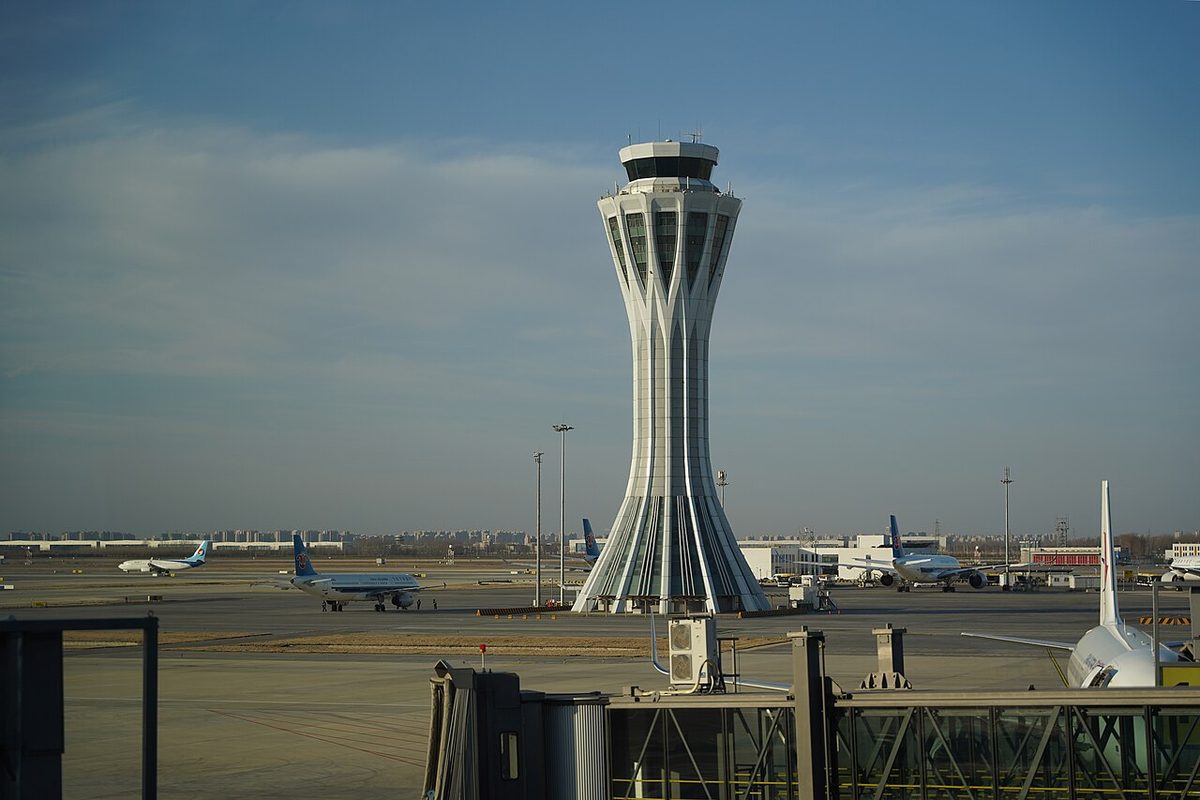
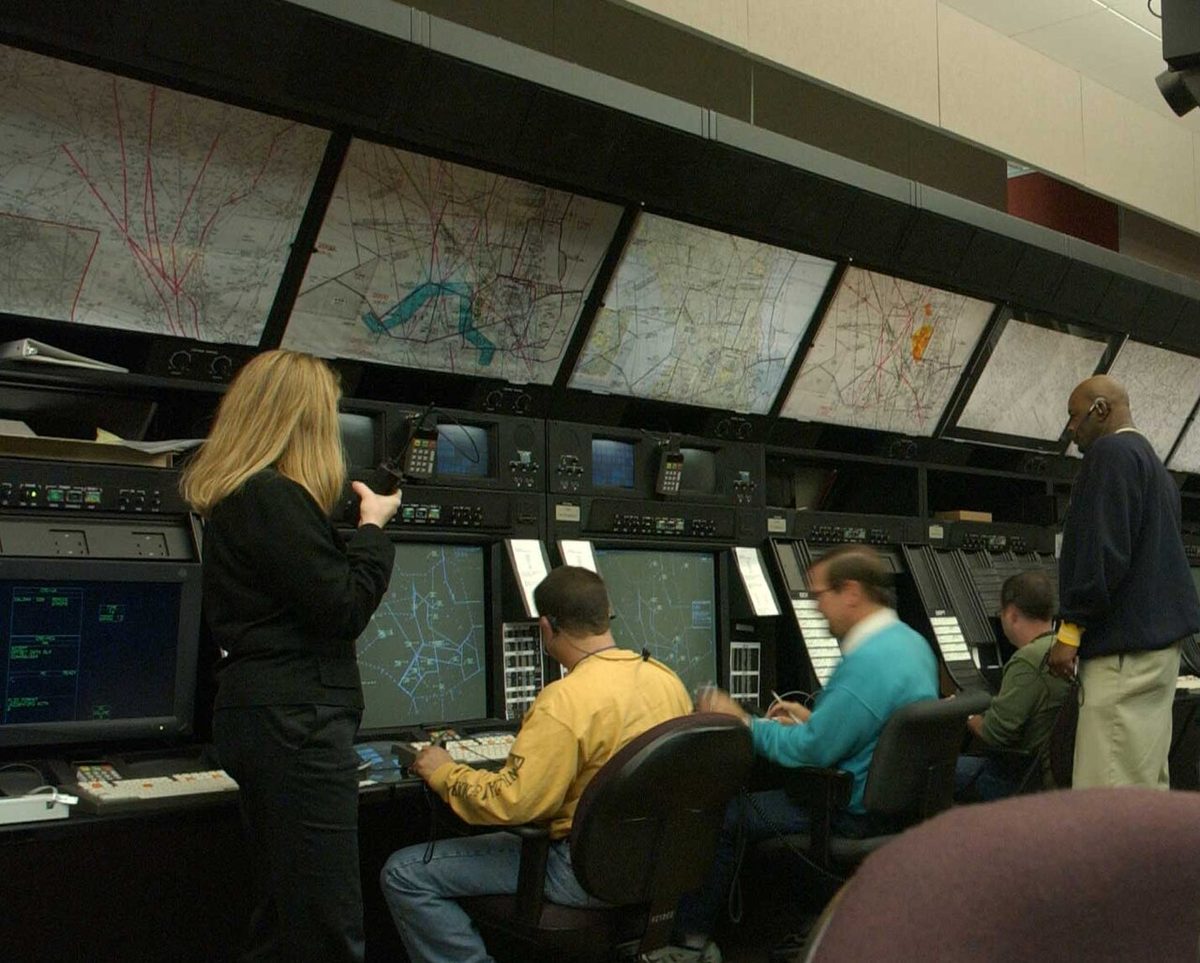
The FAA uses its own names for the same functions: an air route traffic control center (ARTCC, CENTER) for area control, a terminal radar approach control (TRACON) for approach and departure control, and an airport traffic control tower for aerodrome control. How each unit works, from clearance delivery to the area control centre, is described in air traffic control units.
Flight information service
Flight information service (FIS) is a service provided for the purpose of giving advice and information useful for the safe and efficient conduct of flights. It is provided to all aircraft likely to be affected by the information that are receiving an air traffic control service or are otherwise known to the relevant ATS units, for example because they have filed a flight plan or called on the frequency. Its content includes weather, among it SIGMET and AIRMET warnings, the serviceability of navigation aids and aerodrome facilities, and known traffic that may be a collision hazard.
In Class G airspace, flight information on request and alerting service are the only services given. No one separates the traffic, the information is only as good as what the unit knows, and collision avoidance rests on the pilots' lookout. Flight information does not relieve the pilot-in-command of any responsibility, and the pilot-in-command makes the final decision on any suggested change to the flight plan.
The unit providing FIS in an FIR is a flight information centre (FIC), which also provides alerting service there; an ACC may provide both. Its call sign ends in INFORMATION, as in "London Information". In France, flight information around many aerodromes is given in flight information sectors (SIV), each with its own frequency printed on the visual approach charts, such as SIV 3 LYON on 135.530 MHz. The broadcast forms of flight information, ATIS and VOLMET, are covered in flight information and broadcast services.
In the United States, the equivalent functions fall mainly to flight service stations (FSS): air traffic facilities that provide pilot briefings, flight plan processing, en route flight advisories, search and rescue services, and assistance to lost aircraft and aircraft in emergency.
Aerodrome flight information service
An aerodrome flight information service (AFIS) is flight information service given at an aerodrome where aerodrome control service is not provided. The AFIS officer gives information useful for the safe and efficient conduct of flights in the aerodrome traffic zone: the runway in use, the surface wind, the QNH, the state of the aerodrome and known traffic. The officer also alerts the rescue and fire-fighting service and starts overdue action when an aircraft does not arrive.
What AFIS cannot do is clear anyone. The decision to taxi onto the runway, take off, join or land stays with the pilot, and the officer's phrases are informative: "pass your message" invites the pilot to transmit and grants nothing. The call sign suffix is INFORMATION, the same as for an en-route FIS, so the aerodrome context identifies an AFIS. An air/ground station, call sign RADIO, gives less still: its operator passes information, much of it reported by other pilots, and issues no instructions (see communications at non-towered aerodromes).
In France, an aerodrome may switch between services during the day. Outside published hours, aerodrome control or AFIS may be provided at any time without notice, the service actually given being known on the tower or AFIS frequency. At Lyon-Bron, for example, an AFIS can be provided on 118.100 MHz outside tower hours if requested 12 hours in advance; otherwise pilots use the frequency air-to-air, in French only.
Exam tip: INFORMATION means flight information, en route or at an aerodrome, and never a clearance. Only an ATC unit, CONTROL, APPROACH, TOWER, GROUND or DELIVERY, clears or instructs.
Air traffic advisory service
The air traffic advisory service is a service provided within advisory airspace, ICAO Class F, and on advisory routes, to ensure separation, as far as practical, between aircraft operating on IFR flight plans. It sits between control and information:
- IFR flights that use it, known as participating flights, file a flight plan, and SERA requires a flight plan for any IFR flight in advisory airspace;
- the unit acknowledges the flight plan and gives advice, but issues no clearances, so changes to the plan are not subject to clearance;
- an IFR flight crossing an advisory route does so at right angles to the route and at a level appropriate to the semicircular rule;
- VFR flights in Class F receive flight information on request.
The service does not give the same degree of safety as air traffic control, and ICAO regards it as a temporary measure until air traffic control can replace it. Few States still use it: the United Kingdom has reclassified its former advisory routes, and the FAA does not use Class F at all.
Alerting service
The alerting service notifies the search and rescue organisations of aircraft in need of help and assists them. It is provided to all aircraft receiving air traffic control service, as far as practicable to all other aircraft that have filed a flight plan or are otherwise known to ATS, and to any aircraft known or believed to be subject to unlawful interference. Its three emergency phases, INCERFA, ALERFA and DETRESFA, and the rescue organisation behind them are described in alerting service and search and rescue.
ATS units and reporting offices
Air traffic services unit (ATSU) is the generic term for any of three kinds of unit:
- an air traffic control unit: area control centre, approach control unit or aerodrome control tower;
- a flight information centre, providing flight information and alerting service in an FIR;
- an ATS reporting office (ARO), a unit set up to receive reports concerning air traffic services and flight plans submitted before departure.
The ARO is the office on the ground where a flight plan is filed. Under SERA.4001, a flight plan is submitted before departure to an ATS reporting office, called bureau de piste in the French AIP, or transmitted in flight to the appropriate ATS unit. Unless the competent authority prescribes otherwise, a flight plan for a flight that will receive air traffic control or advisory service is submitted at least 60 minutes before departure, or, if filed in flight, so that it reaches the ATS unit at least 10 minutes before the aircraft reaches the point of entry into the control or advisory area. In France a flight plan can be closed by telephone to the regional information and flight assistance office (BRIA).
In the air, the pilot identifies the unit by its call sign: the location name followed by the suffix CONTROL, APPROACH, TOWER, GROUND, DELIVERY, INFORMATION or RADIO. The suffix, more than the place, tells the pilot what service to expect and who holds which responsibility.
Frequently asked questions
What are the objectives of air traffic services?
ICAO Annex 11 gives five. Air traffic services exist to prevent collisions between aircraft, to prevent collisions between aircraft on the manoeuvring area and obstructions there, to expedite and maintain an orderly flow of air traffic, to provide advice and information useful for the safe and efficient conduct of flights, and to notify the appropriate organisations of aircraft in need of search and rescue aid, and assist them as required.
What is the difference between air traffic control and flight information service?
Air traffic control prevents collisions and expedites traffic by issuing clearances and instructions and, depending on the airspace class, by separating aircraft. Flight information service gives advice and information useful for safe and efficient flight, such as weather, the state of facilities and known traffic, but issues no clearances and separates no one. The pilot receiving flight information remains responsible for avoiding other aircraft and for every decision.
What is an AFIS?
An aerodrome flight information service is flight information service provided at an aerodrome that has no aerodrome control service. The officer, whose call sign ends in INFORMATION, passes the runway in use, the wind, the aerodrome conditions and known traffic, and can alert the rescue services, but cannot issue take-off or landing clearances. The decision to take off, land or join the circuit remains with the pilot.
What is the air traffic advisory service?
It is a service provided in advisory airspace, ICAO Class F, and on advisory routes, to keep participating IFR flights separated as far as practical. The flights file a flight plan but receive advice, not clearances, and the service does not give the protection of air traffic control. ICAO treats it as a temporary measure until air traffic control can replace it. The FAA does not use Class F.
Which unit provides area control service?
Area control service is provided by an area control centre (ACC), whose call sign ends in CONTROL, to controlled flights in the control areas and airways under its jurisdiction. An ACC may also provide approach control where no separate approach unit exists. In the United States the equivalent unit is the air route traffic control center, called CENTER on the radio.
Test yourself on Air Traffic Services
The v1prep banks cover this topic in Air Law (010), with a worked explanation for every answer. EASA ATPL, PPL, IR and CPL, the FAA written tests and A320/B737 type ratings.
Start practising →Sources and further reading
- ICAO Annex 11, Air Traffic Services (consolidated text)
- ICAO Doc 4444, Procedures for Air Navigation Services, Air Traffic Management (PANS-ATM), 16th edition, as published by Airservices Australia
- EASA Easy Access Rules for Standardised European Rules of the Air (SERA)
- AIP France, ENR 1.1, General rules (flight plans, ATS reporting offices and BRIA)
- AIP France, AD 1.1, Aerodrome availability and conditions of use (ATS outside published hours)
- FAA Aeronautical Information Manual, Chapter 4 Section 1, Services Available to Pilots
Library articles are written for study and exam preparation. They do not replace your aircraft's approved documentation, your operator's procedures or the regulations themselves.