Wake Turbulence and Jet Blast
Wake turbulence is the disturbed air left behind an aircraft in flight, dominated by two counter-rotating vortices that trail from the wingtips as a by-product of lift. Jet blast and rotor downwash are the related hazards created by engine exhaust and by helicopter rotors.
Wake turbulence is the disturbed air that an aircraft leaves behind it. Almost all of the hazard comes from two tightly rolled, counter-rotating vortices that trail from the wingtips. They are an unavoidable by-product of lift, and the heavier the aircraft, the stronger they are. A light aeroplane that flies into the vortex of an airliner can be rolled faster than its ailerons can stop, and even a large jet following a larger one can suffer violent roll, loss of height and structural overload.
The vortices are invisible, so the defences are procedural. Air traffic control spaces aircraft by wake category, and pilots fly a geometry that keeps them above and upwind of the wake. The same thinking applies on the ground to jet blast and propeller slipstream, and near helicopters to rotor downwash.
How wake vortices form
A wing producing lift has higher pressure beneath it than above it. At the tips, air spills round from the lower surface to the upper, and this spanwise flow, carried rearwards by the airstream, rolls up within a short distance behind the wing into two concentrated vortices. Seen from behind, the left vortex turns clockwise and the right anticlockwise, so between them the air moves down and outboard of them it moves up. The cores end up roughly three-quarters of a wingspan apart. The same flow field produces the downwash behind the wing and the induced drag it causes.
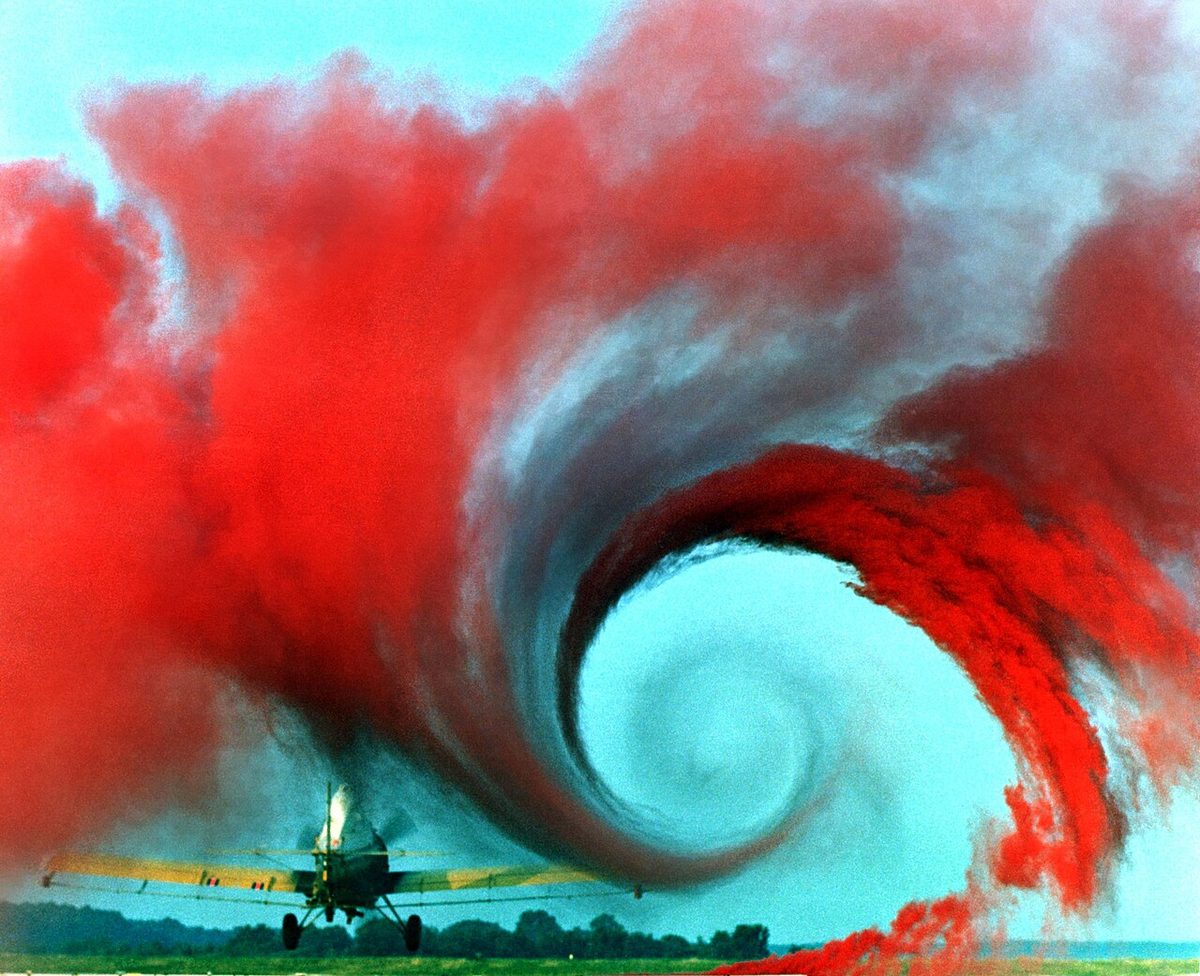
The strength of the vortices depends on the lift the wing must produce, divided by airspeed, air density and wingspan. The strongest wake therefore comes from an aircraft that is heavy, clean and slow: heavy because it needs more lift, slow because it needs a high angle of attack to produce it, and clean because extended flaps and gear change the lift distribution and tend to make the wake less concentrated. The classic worst case is a heavy jet climbing out clean after take-off or flying slowly in a clean configuration. A large aircraft in landing configuration still leaves a dangerous wake.
Vortices exist whenever the wing carries the aircraft's weight. Textbooks put the start at nosewheel lift-off on take-off and the end at nosewheel touchdown on landing, which is why every avoidance technique is keyed to the rotation and touchdown points of the aircraft ahead.
A follower that flies into one core, especially from directly behind, feels an induced roll; if its wingspan is small compared with the vortex, the rolling moment can exceed full aileron authority. Crossing through the wake at an angle gives sharp jolts and load factor changes, and flying between the two cores puts the aircraft in strong downwash, reducing its climb performance.
Vortex behaviour and decay
Behind the generating aircraft the vortices sink. The FAA describes a descent of about 300 to 500 ft/min, slowing with time and levelling off roughly 500 to 900 ft below the generator's flight path; European ATPL theory texts give up to about 1,000 ft below. They weaken as they age, and atmospheric turbulence is the main factor in how quickly they break up. In a strong or gusty wind they decay within a short time; in calm, stable air, such as a still early morning or under an inversion, they can persist for several minutes.
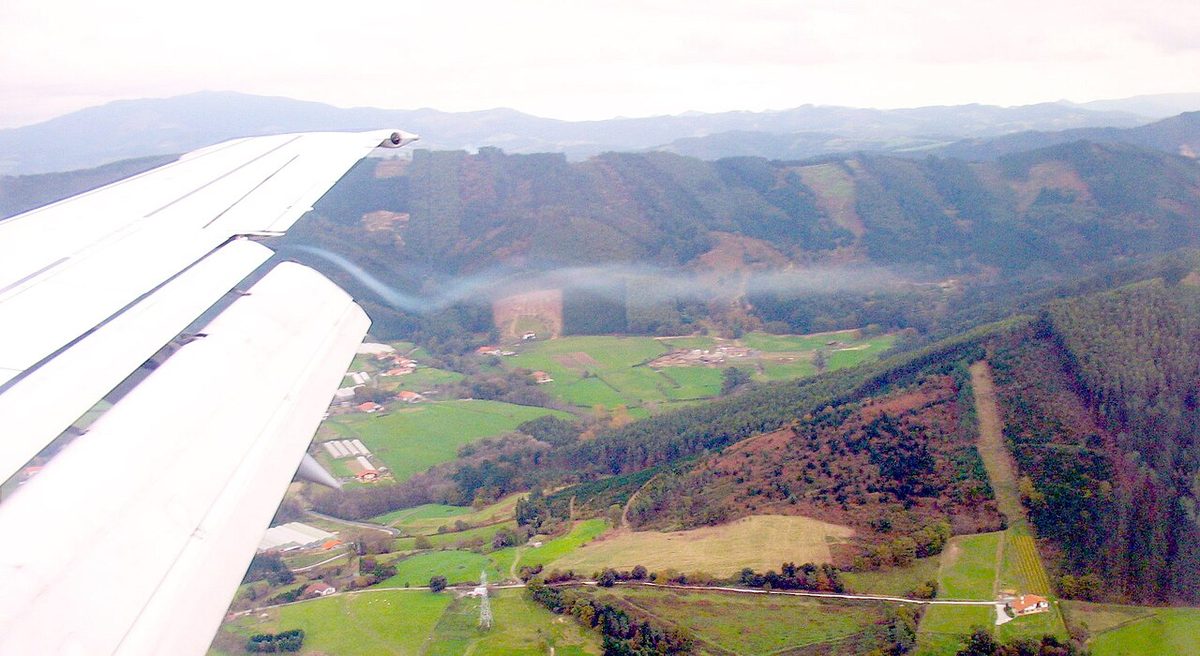
Near the ground, in ground effect, the vortices stop sinking and spread apart. The FAA AIM describes them moving outwards from the track at about 2 to 3 kt once within 100 to 200 ft of the surface; the UK CAA gives up to about 5 kt, at a height of roughly half the generator's wingspan. The wind adds to this drift. A crosswind of about the same speed cancels the outward movement of the upwind vortex and can hold it over the runway, while the downwind vortex is carried quickly towards a parallel runway or taxiway. The FAA quotes a cross-runway component of 1 to 5 kt for this effect. A light quartering tailwind is the most hazardous case, because it can also carry the vortices of a preceding arrival forward into the touchdown zone. Light winds, not strong ones, are the dangerous conditions.
Wake encounters in cruise
Reduced vertical separation (1,000 ft between levels) and very accurate navigation mean that aircraft on the same or opposite tracks can pass through each other's wake. In January 2017 a Bombardier Challenger 604 passing about 1,000 ft below an A380 on an opposite-direction track over the Arabian Sea was rolled several times and lost roughly 10,000 ft before the crew recovered; several occupants were injured and the aircraft was written off. Crews reduce the risk with the Strategic Lateral Offset Procedure (in the North Atlantic, an offset of 1 or 2 NM right of track) and in the NAT may coordinate an offset with the other aircraft on 123.450 MHz. Encounters should be reported to ATC, which can change the level or track of the following aircraft.
Wake turbulence categories
ICAO Doc 4444 (PANS-ATM) defines four wake turbulence categories by maximum certificated take-off mass (MTOM). The letter goes in Item 9 of the flight plan.
| ICAO category | Letter | Criterion |
|---|---|---|
| Super | J | Types designated in ICAO Doc 8643, currently the Airbus A380-800 (MTOM about 560,000 kg) |
| Heavy | H | 136,000 kg or more |
| Medium | M | More than 7,000 kg but less than 136,000 kg |
| Light | L | 7,000 kg or less |
Heavy and Super aircraft include "HEAVY" or "SUPER" immediately after the call sign on initial contact with each ATS unit.
The FAA's own wake turbulence categories (Small, Large, Heavy, Super) are weight classes. Heavy covers aircraft capable of a take-off weight of 300,000 lb or more, Large covers more than 41,000 lb up to 300,000 lb, Small is 41,000 lb or less, and Super is the A380. The FAA also treats the Boeing 757 separately for aircraft following it, because its wake is unusually strong for its weight. The FAA Small class therefore extends far above the ICAO Light limit (41,000 lb is about 18,600 kg).
Weight classes are crude: the ICAO Heavy category runs from a small widebody to a Boeing 747. Re-categorisation (RECAT) schemes group aircraft by mass, wingspan and approach speed and set minima for each leader and follower pair, which often allows closer spacing without extra risk:
- RECAT-EU has six categories: Super Heavy (A), Upper Heavy (B), Lower Heavy (C), Upper Medium (D), Lower Medium (E) and Light (F). EASA endorsed its safety case and publishes which ICAO types fall in each category; it entered service at Paris Charles de Gaulle in March 2016.
- FAA RECAT began at Memphis in November 2012 with six categories (A to F). Its successor, Consolidated Wake Turbulence (CWT) under Order JO 7110.126, uses nine categories, A to I, with the A380 alone in category A.
- ICAO has added an optional set of wake turbulence groups to PANS-ATM, used alongside the four categories.
Wake separation minima
ICAO wake turbulence separation minima apply when the follower is directly behind the leader at the same altitude or less than 1,000 ft below, when both use the same runway or parallel runways less than 760 m apart, or when the follower crosses behind the leader at the same altitude or less than 1,000 ft below. The distance minima used with ATS surveillance are:
| Leader | Follower | Minimum |
|---|---|---|
| Super | Medium | 7 NM |
| Super | Light | 8 NM |
| Heavy | Heavy | 4 NM |
| Heavy | Medium | 5 NM |
| Heavy | Light | 6 NM |
| Medium | Light | 5 NM |
Where time is used instead:
| Situation | Pairs | Minimum |
|---|---|---|
| Arrivals | Medium behind Heavy | 2 min |
| Arrivals | Light behind Heavy or Medium | 3 min |
| Departures (same runway, parallel runways less than 760 m apart, or crossing flight paths) | Medium or Light behind Heavy; Light behind Medium | 2 min |
| Departure from an intermediate part of the runway | Same pairs | 3 min |
| Departures behind a Super | Heavy; Medium or Light | 2 min; 3 min |
Two minutes also applies on runways with a displaced landing threshold and in opposite-direction cases, for example after a heavy aircraft's low or missed approach.
The FAA's traditional radar minima are similar but not identical: heavy behind Super 6 NM, large behind Super 7 NM, small behind Super 8 NM, heavy behind heavy 4 NM, small or large behind heavy 5 NM, small behind a B757 4 NM, and 6 NM for a small aircraft landing behind a heavy, measured as the leader crosses the threshold. Where CWT is in use, its pair-wise values apply instead.
These are IFR minima. Under ICAO rules ATC need not apply wake separation to a VFR arrival landing behind a heavy or medium aircraft, or to an IFR flight on a visual approach that has reported the preceding aircraft in sight and been told to follow it; the controller gives "CAUTION WAKE TURBULENCE" and spacing becomes the pilot's job. In the United States, accepting a visual approach behind another aircraft or visual separation likewise makes wake avoidance the pilot's responsibility. See also separation standards.
Exam tip: behind a Heavy, 4, 5 and 6 NM for Heavy, Medium and Light followers; Medium to Light 5 NM; two minutes for departures, three from an intermediate point.
Wake turbulence avoidance techniques
Wake turbulence avoidance comes down to two facts: the wake sinks below the path that made it, and it drifts with the wind. Stay above that path and upwind of it, and know where the wake begins and ends on the runway.

- Landing behind a larger arrival: stay at or above its approach path, note where it touched down, and land beyond that point.
- Landing behind a larger departure: note its rotation point and land well before it.
- Departing behind a larger departure: rotate before its rotation point, climb above its climb path, and avoid headings that take you below and behind it. An intersection departure starts you downstream of its rotation point, hence the extra minute.
- Departing behind a larger arrival: rotate beyond its touchdown point.
- Parallel and crossing runways: treat a parallel runway closer than 760 m (the FAA says 2,500 ft) as the same runway when the wind can carry the wake across, and cross above a larger aircraft's flight path, never below.
- After a low approach, missed approach or touch-and-go: there is no touchdown or rotation point to work from; the FAA advises waiting at least 2 minutes.
- En route: avoid the area below and behind a larger aircraft. If one is above you on the same track, move laterally, preferably upwind. The FAA regards 1,000 ft of vertical separation as generally safe, but cruise encounters show that a heavy wake can still be felt there.
If an encounter happens, counter the roll with prompt, normal aileron inputs, avoid large or alternating rudder inputs, and on approach go around if the aircraft cannot be kept stable. The loss of American Airlines Flight 587, an Airbus A300 that crashed in New York in November 2001, showed that the recovery can be more dangerous than the encounter: after meeting a Boeing 747's wake, repeated large, alternating rudder inputs overloaded the fin until it separated. Wider guidance is in upset prevention and recovery.
Jet blast
Jet blast is the high-velocity exhaust behind a jet engine. It matters mainly on the ground, where it is strongest at breakaway thrust (the extra power needed to start a heavy aircraft rolling) and take-off thrust, and it extends a long way behind a large jet. It can overturn light aircraft and vehicles, injure people, blow debris into engines and damage buildings and equipment. A jet turning on the apron sweeps its blast sideways across whatever is nearby.
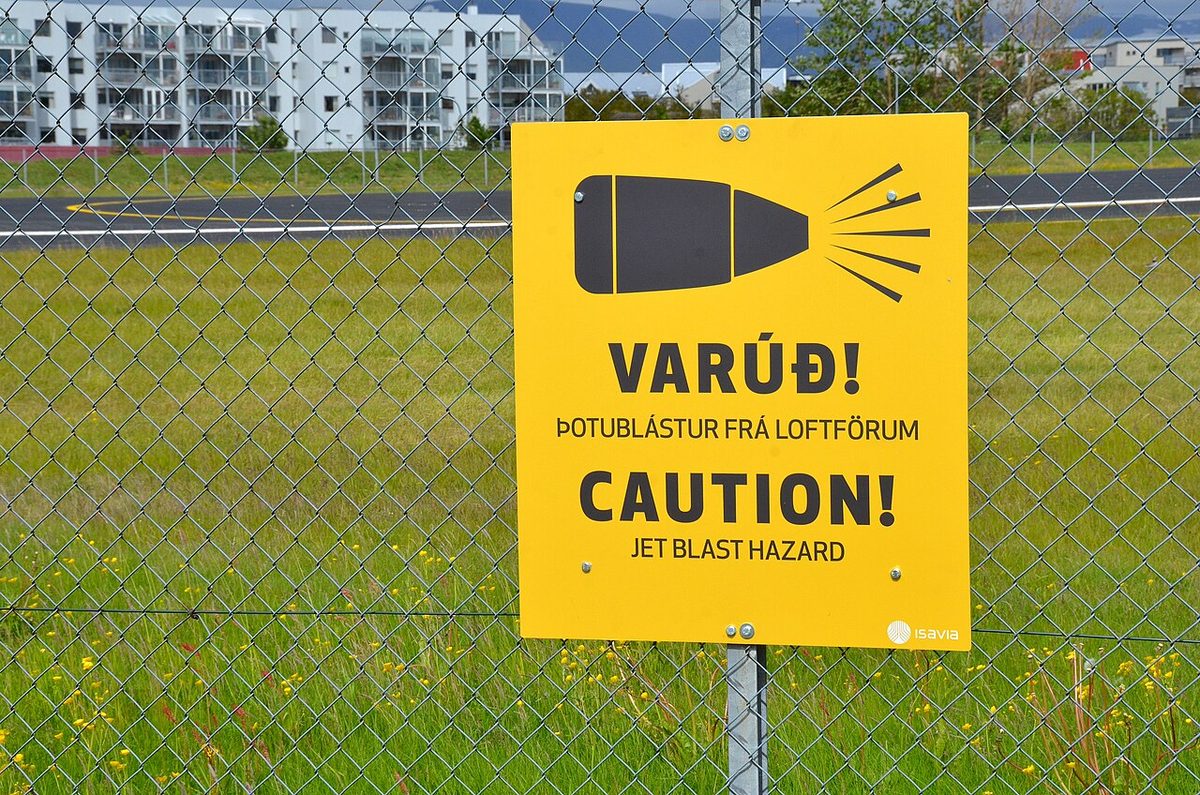
Light aircraft should not taxi close behind a jet or hold directly behind one at a holding point, and should expect blast from aircraft about to turn or apply thrust. Jet crews use the minimum breakaway thrust, check what is behind them before increasing power on the apron, and respect blast fences and marked areas. ATC warns with "CAUTION JET BLAST", or "CAUTION SLIPSTREAM" for propeller aircraft.
Rotor downwash
Rotor downwash is the air driven downwards by a helicopter's main rotor. In a hover or slow hover-taxi close to the surface it spreads outwards as a sheet of fast-moving air with its own vortices; the FAA AIM says these extend to about three rotor diameters in every direction, so light aircraft and people should keep at least that distance from a hovering or hover-taxiing helicopter. The outwash lifts loose objects, dust and snow, and can damage parked light aircraft.
In forward flight a helicopter trails a pair of vortices much like a fixed-wing aircraft, and there is evidence that they are more intense than those of a fixed-wing aircraft of similar weight. Pilots of small aircraft should therefore treat a landing or departing helicopter as a wake generator in its own right.
Frequently asked questions
Why is wake turbulence strongest behind a heavy, clean and slow aircraft?
Vortex strength rises with the lift the wing must produce and falls with airspeed and wingspan. A heavy aircraft needs more lift; flying slowly it needs a high angle of attack to make that lift; and with flaps and gear retracted the lift is concentrated into tight, well-defined vortices. The classic worst case is a heavy jet shortly after take-off, climbing out clean at low speed.
How long should you wait before taking off behind a heavy aircraft?
Under ICAO rules ATC applies two minutes between a heavy departure and a following medium or light aircraft, and between a medium and a following light aircraft, rising to three minutes if the follower departs from an intermediate point on the runway. Behind a Super such as the A380 the minimum is three minutes for medium and light aircraft. Pilots may always ask for more time.
What are the ICAO wake turbulence categories?
ICAO uses four categories based on maximum certificated take-off mass. Light is 7,000 kg or less, Medium is more than 7,000 kg but less than 136,000 kg, and Heavy is 136,000 kg or more. Super, flight plan letter J, covers types specifically designated as such, currently the Airbus A380-800. Heavy and Super aircraft add the word to their call sign on first contact.
What is RECAT in wake turbulence separation?
RECAT, short for re-categorisation, replaces the broad weight-based categories with more groups based on mass, wingspan and approach speed, and sets separation for each leader and follower pair. RECAT-EU uses six categories from Super Heavy to Light and entered service at Paris Charles de Gaulle in 2016. The FAA's Consolidated Wake Turbulence scheme uses nine categories, A to I.
What is the difference between wake turbulence and jet blast?
Wake turbulence is created by lift. The wingtip vortices trail behind any aircraft in flight, from rotation to touchdown, and are a hazard in the air and close to the runway. Jet blast is engine exhaust, strongest behind aircraft on the ground at breakaway or take-off thrust. ATC warns of them with the phrases "caution wake turbulence" and "caution jet blast".
Test yourself on Wake Turbulence and Jet Blast
The v1prep banks cover this topic in Operational Procedures (070), with a worked explanation for every answer. EASA ATPL, PPL, IR and CPL, the FAA written tests and A320/B737 type ratings.
Start practising →Sources and further reading
- FAA Aeronautical Information Manual, Chapter 7 Section 4, Wake Turbulence
- FAA AC 90-23H, Aircraft Wake Vortex Encounter Risk Mitigation
- UK CAA Safety Sense Leaflet 15c, Wake Vortex
- ICAO, Wake Turbulence Groups (PANS-ATM wake categories and groups), 2023
- EUROCONTROL, RECAT-EU European Wake Turbulence Categorisation and Separation Minima
- EASA, Assignment of ICAO aircraft types to RECAT-EU wake turbulence categories
- FAA Order JO 7110.126B, Consolidated Wake Turbulence
Library articles are written for study and exam preparation. They do not replace your aircraft's approved documentation, your operator's procedures or the regulations themselves.