Holding Patterns
A holding pattern is a racetrack-shaped manoeuvre flown about a defined fix, with two turns and two straight legs, that keeps an aircraft inside protected airspace while it waits for further clearance, loses height, or reverses course before an instrument approach.
A holding pattern is a racetrack flown about a fixed point: a turn at the fix, a straight outbound leg, a second turn and a straight inbound leg back to the fix. ICAO describes the holding procedure as a set manoeuvre that keeps an aircraft inside a defined block of airspace until it receives further clearance. Aircraft hold because of traffic, weather or a blocked runway, to lose height before an approach, after a missed approach, and to reverse course where a hold replaces a procedure turn (see instrument approach procedures).
The airspace protected for a hold is built from assumptions about speed, bank angle, leg length and entry technique. A pilot who flies the pattern as designed stays inside it; excess speed, a shallow bank or an improvised entry can take the aircraft outside it. The FAA and ICAO share the same geometry but differ on timing, bank limits and speeds, and these differences are stated in each section and summarised at the end.
The standard holding pattern
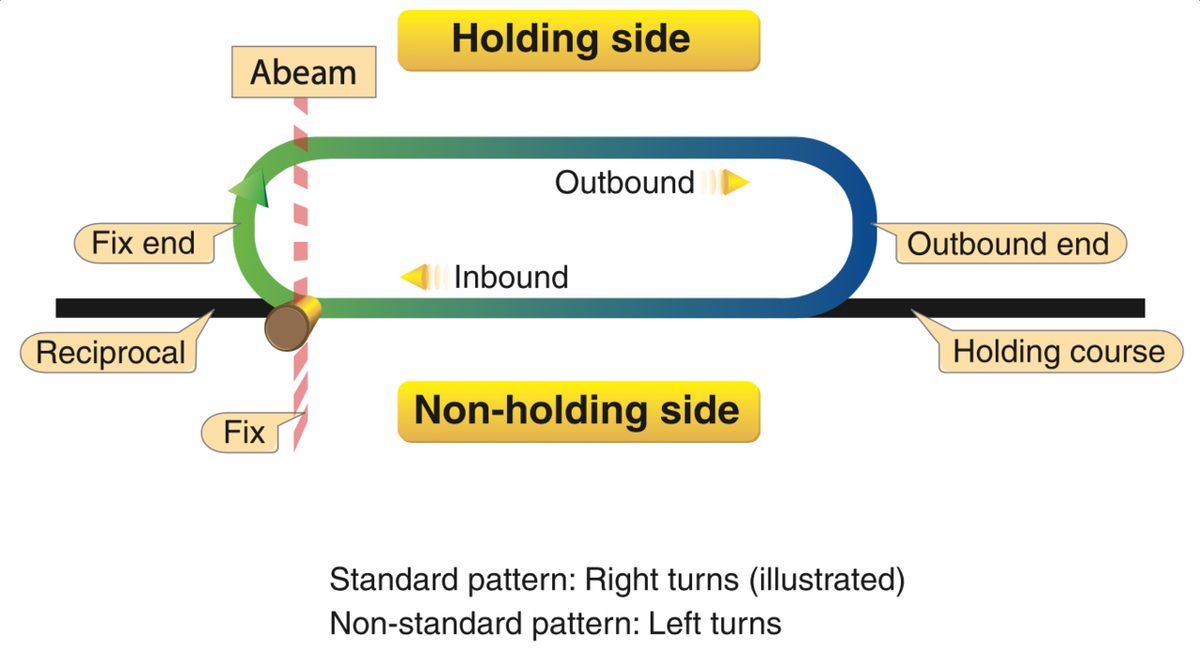
The holding fix is the point about which the pattern is built. The inbound leg ends at the fix; the fix-end turn leads onto the outbound leg, and the outbound-end turn brings the aircraft back inbound. The side of the inbound course on which the pattern lies is the holding side; the other is the non-holding side. A standard pattern uses right turns. A non-standard pattern uses left turns and must be specified by ATC or shown on the chart.
A published hold may be assigned with only its direction and the words "as published", for example "hold east as published". For an uncharted hold, the FAA controller gives the direction of holding from the fix in terms of the eight cardinal points, the fix, the radial, course, bearing, airway or route, the leg length in miles if DME or RNAV is used, the turn direction if left, and an expect further clearance time. For an unpublished hold, ICAO phraseology gives the fix and the direction of the hold from it, the level, the inbound track in three digits, right or left hand, and the outbound time.
If a pilot reaches a clearance limit with no holding instructions and cannot obtain them, the AIM says to hold in a standard pattern on the course on which the aircraft arrived and to request clearance. FAA pilots report the time and altitude on reaching a holding fix and again on leaving it.
Holding fix and rate-one turns
The fix may be a VOR, an NDB, an intersection, a DME fix or an RNAV waypoint. At a VOR the turn outbound begins at the first complete reversal of the TO/FROM indicator.
A rate one turn is 3° per second: 180° in one minute and a full circle in two. In still air a pattern with one-minute legs therefore takes about four minutes. The bank needed grows with true airspeed; a rule of thumb is TAS ÷ 10 + 7, so about 22° at 150 kt. At about 170 kt TAS rate one needs 25°, so faster aircraft turn more slowly and fly wider patterns. The two authorities cap the bank differently:
- FAA: 3° per second, 30° of bank, or 25° when a flight director is used, whichever needs the least bank.
- ICAO: 25° or 3° per second, whichever needs the lesser bank.
When an FMS flies the hold, the AIM asks for a bank limit of at least 25° where it is selectable. A shallower bank widens and lengthens the track.
Entry sectors: direct, parallel and teardrop
Holding entry procedures depend on the aircraft's heading on reaching the fix. A line through the fix at 70° to the inbound course, the 70° line, divides arrivals into three sectors. A direct entry serves the 180° sector, a parallel entry the 110° sector and a teardrop entry the 70° sector. PANS-OPS numbers them sector 3, sector 1 and sector 2 and calls the teardrop the offset entry. The FAA regards a heading within 5° either side of a sector boundary as within good operating limits for choosing the entry.
For a standard pattern with an inbound course of 360°, the holding side is east and the pattern lies south of the fix:
| Entry | Heading on arrival | Procedure |
|---|---|---|
| Direct (sector 3) | 290° through 360° to 110° | Cross the fix and turn right into the pattern |
| Parallel (sector 1) | 180° to 290° | At the fix turn left onto 180°, fly the outbound time on the non-holding side, then turn left through more than 180° to intercept the inbound course or return to the fix |
| Teardrop or offset (sector 2) | 110° to 180° | At the fix turn onto 150°, 30° from the reciprocal on the holding side, fly the outbound time, then turn right to intercept the inbound course |
In the ICAO parallel entry, the aircraft turns right into the normal pattern on its second passage over the fix. PANS-OPS limits the 30° offset leg to 1½ minutes.
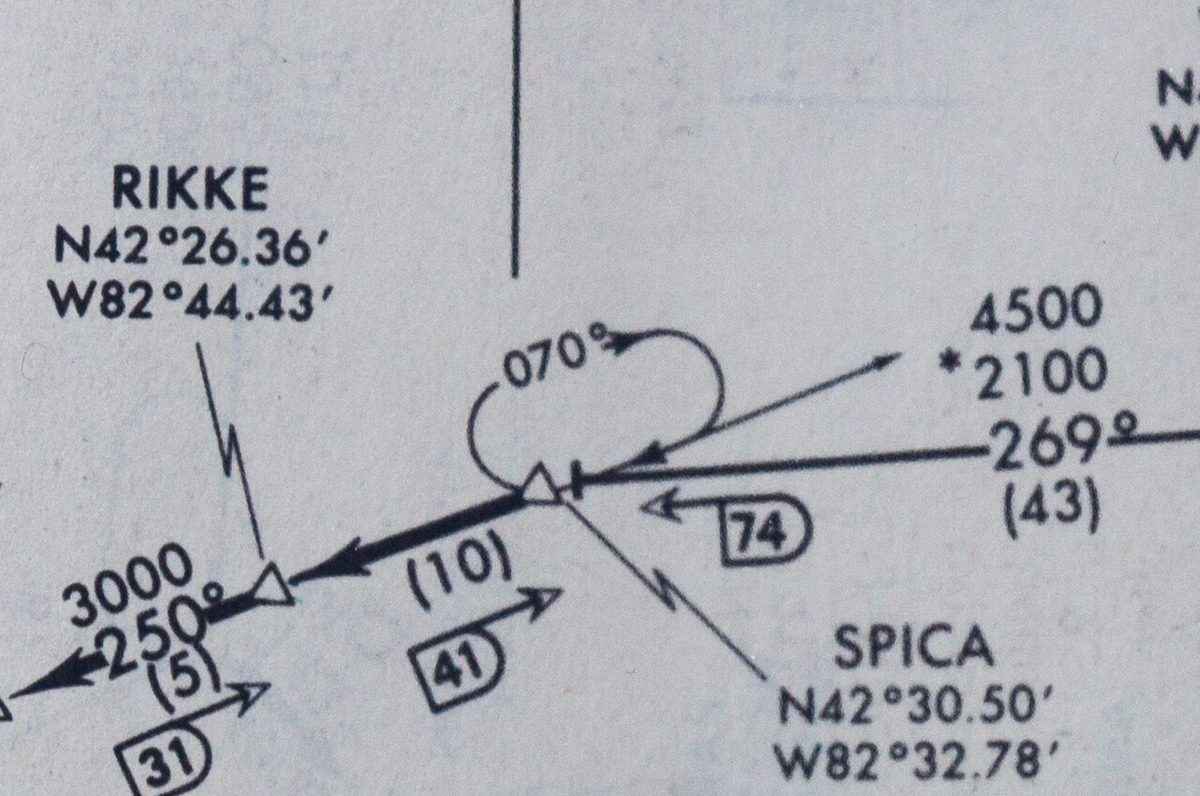
Exam tip: for a right-hand pattern, compare the heading with the inbound course. Within 70° to the left or 110° to the right: direct. Between 110° and 180° to the right: teardrop. Between 70° and 180° to the left: parallel. For left turns, swap left and right.
An RNAV system may choose the entry itself. Many use ground track rather than heading, so a large drift angle can produce an unexpected entry, and some fly a fly-by turn onto the pattern where the design assumed overflight of the fix.
Timing and wind correction
Legs are timed in both systems at one minute at or below 14,000 ft and 1½ minutes above, but the leg timed differs:
- ICAO specifies the outbound time.
- FAA specifies the inbound leg. The first outbound leg is flown for the standard time, and later outbound legs are adjusted until the inbound leg takes one minute, or 1½ minutes above 14,000 ft MSL.
Outbound timing starts over or abeam the fix, whichever comes later; if the abeam point cannot be determined, it starts when the turn outbound is complete. A headwind on the inbound leg calls for a shorter outbound leg, a tailwind for a longer one.
With DME or GPS the chart or ATC gives distances instead. With the inbound course towards the navaid, a fix at 10 NM and a 5 NM leg, the turn inbound is made at 15 DME; with the inbound course away from the navaid, a fix at 28 NM and an 8 NM leg, it is made at 20 DME.
Drift is corrected on both legs. Because the end turns are flown without correction, the outbound leg carries triple drift correction, three times the inbound correction. The AIM's example is 8° left inbound, therefore 24° right outbound.
Maximum holding speeds
The maximum holding speed, called the maximum holding airspeed in the AIM, is the indicated airspeed the protected area was sized for. FAA levels are altitudes above mean sea level:
| Level | FAA maximum (AIM 5-3-8) | ICAO PANS-OPS maximum, normal conditions |
|---|---|---|
| Up to 6,000 ft | 200 KIAS | 230 kt |
| 6,001 to 14,000 ft | 230 KIAS | 230 kt |
| Above 14,000 to 20,000 ft | 265 KIAS | 240 kt |
| Above 20,000 to 34,000 ft | 265 KIAS | 265 kt |
| Above 34,000 ft | 265 KIAS | Mach 0.83 |
Where a PANS-OPS hold is limited to Category A and B aircraft, the maximum is 170 kt. In turbulence, PANS-OPS raises the limit to 280 kt or Mach 0.8 up to 34,000 ft. FAA charts may restrict holds between 6,001 and 14,000 ft to 210 KIAS or show any other limit, such as (175), inside the pattern symbol. Holds at USAF fields allow 310 KIAS and at Navy fields 230 KIAS unless charted otherwise, and a published climb-in-hold allows 310 KIAS unless a lower speed is shown.
The AIM asks pilots to begin slowing 3 minutes before the fix so as to cross it at or below the maximum. Fixed-wing aircraft should hold at 90 KIAS or more to limit wind drift. A pilot who needs more speed because of turbulence or icing tells ATC; in a non-radar environment the pilot should say that the hold cannot be accepted.
Holding stacks
At busy terminals several aircraft hold at the same fix, separated vertically, normally by 1,000 ft, in a holding stack (see separation standards). The first aircraft to arrive normally holds lowest and the later ones successively higher. When the lowest leaves for the approach, the others are cleared down in turn; a climb or descent inside a pattern is called a shuttle. Under ICAO rules, vertical separation is kept between holding aircraft and en-route traffic within 5 minutes' flying time of the holding area unless lateral separation exists.
The lowest usable level protects against terrain. PANS-OPS applies a minimum obstacle clearance of 300 m (984 ft) in the holding area, or 600 m in mountainous terrain, and surrounds it with a 5 NM buffer area in which the clearance reduces to zero at the outer edge. The FAA charts a minimum holding altitude (MHA). An aircraft in a published hold above the MHA may descend to it once cleared for the approach; where no MHA is published it keeps its assigned altitude until established inbound (see minimum safe altitudes).
Expect further clearance and expected approach time
An expect further clearance (EFC) time tells a holding pilot when to expect the next clearance, which may be onward routing or an approach. When an aircraft is cleared to a fix short of the destination and delay is expected, the FAA requires ATC to issue holding instructions, an EFC and an estimate of any further delay. ICAO phraseology uses the same words. When no delay is expected, the controller should issue the onward clearance as soon as possible and, where possible, at least 5 minutes before the aircraft reaches the limit.
An expected approach time (EAT) is the ICAO time at which ATC expects a delayed arrival to leave the holding fix and complete its approach. PANS-ATM requires it to be passed by the quickest means when a hold of 30 minutes or more is expected, and a revised EAT whenever it changes by 5 minutes or more. "No delay expected" and "delay not determined" are the other answers to a request for an EAT.
Both times drive the communication-failure procedures (see radio communication failure):
- FAA, 14 CFR 91.185: leave the clearance limit at the EFC. If the limit is a fix where an approach begins, start the approach as close as possible to the EFC or, if none was received, to the ETA.
- ICAO: begin descent at, or as close as possible to, the last acknowledged EAT, otherwise the flight plan ETA, and land, if possible, within 30 minutes of the ETA or the last acknowledged EAT, whichever is later.
Holding burns fuel that the plan must cover (see fuel planning), so crews compare the EFC or EAT with the fuel on board and set, before holding begins, the time at which they will divert.
FAA and ICAO differences at a glance
| Item | FAA | ICAO PANS-OPS |
|---|---|---|
| Timed leg | Inbound, 1 min at or below 14,000 ft MSL, 1½ min above | Outbound, 1 min at or below 14,000 ft, 1½ min above |
| Bank | 3°/s, 30°, or 25° with flight director, whichever is least | 25° or 3°/s, whichever is less |
| Speeds | 200 / 230 / 265 KIAS | 230 / 240 / 265 kt, Mach 0.83 above 34,000 ft |
| Entry names | Direct, parallel, teardrop | Sectors 3, 1 and 2; offset for teardrop |
| Delay information | EFC time | EAT for approach delay, plus EFC phraseology |
Frequently asked questions
What are the three holding pattern entries?
The direct, parallel and teardrop entries. A line through the fix at 70 degrees to the inbound course divides the arrivals. Aircraft arriving from the 180 degree sector fly a direct entry and simply turn into the pattern at the fix. The 110 degree sector uses the parallel entry, flying outbound on the non-holding side, and the remaining 70 degree sector uses the teardrop, which ICAO calls the offset entry, 30 degrees from the reciprocal of the inbound course.
What are the maximum holding speeds?
The FAA allows 200 KIAS up to 6,000 ft MSL, 230 KIAS from 6,001 to 14,000 ft and 265 KIAS above 14,000 ft. ICAO PANS-OPS, used in Europe, allows 230 kt up to 14,000 ft, 240 kt above 14,000 ft to 20,000 ft, 265 kt above 20,000 ft to 34,000 ft and Mach 0.83 above that, with 170 kt where a pattern is limited to Category A and B aircraft. Charted speeds override both.
How long is the outbound leg in a holding pattern?
At or below 14,000 ft it is one minute, and above 14,000 ft one and a half minutes. ICAO specifies this as the outbound time. The FAA specifies it as the inbound leg time, so the pilot flies the first outbound leg for the standard time and then lengthens or shortens later outbound legs until the inbound leg takes the right time. DME or GPS holds use published distances instead.
What is the difference between EFC and EAT?
An expect further clearance (EFC) time is the time at which a holding aircraft can expect its next clearance, which may be onward routing or an approach. An expected approach time (EAT) is the ICAO time at which ATC expects a delayed arrival to leave the holding fix to begin its approach. After a radio failure, the FAA uses the EFC and ICAO the last acknowledged EAT to time the departure from the hold.
What is triple drift correction in a holding pattern?
It is the technique of applying three times the inbound leg's wind correction angle on the outbound leg. The turns at each end are flown at a constant rate without any wind correction, so the outbound leg must also absorb their drift. The FAA gives the example of correcting 8 degrees left inbound and therefore 24 degrees right outbound. Timing is corrected separately, by adjusting the outbound leg.
Test yourself on Holding Patterns
The v1prep banks cover this topic in General and Radio Navigation (061/062), with a worked explanation for every answer. EASA ATPL, PPL, IR and CPL, the FAA written tests and A320/B737 type ratings.
Start practising →Sources and further reading
- FAA Aeronautical Information Manual, Chapter 5 Section 3 (5-3-8, Holding)
- FAA Instrument Procedures Handbook (FAA-H-8083-16B)
- ICAO Doc 8168, Procedures for Air Navigation Services, Aircraft Operations (PANS-OPS), and related Annexes
- ICAO Doc 4444, Procedures for Air Navigation Services, Air Traffic Management (PANS-ATM), 16th edition, as published by Airservices Australia
- 14 CFR 91.185, IFR operations, two-way radio communications failure
Library articles are written for study and exam preparation. They do not replace your aircraft's approved documentation, your operator's procedures or the regulations themselves.