ATC Separation
ATC separation is the prescribed minimum spacing that air traffic control keeps between controlled aircraft, applied vertically, laterally, longitudinally, by surveillance distance or visually, so that navigation, altimetry and surveillance errors cannot bring two aircraft into conflict.
ATC separation is the spacing that air traffic control keeps between the aircraft it controls. Each method has separation minima, the smallest vertical, lateral, longitudinal or surveillance-based spacing that may be used, set so that the combined errors of navigation, altimetry, surveillance and human reaction still leave a safe margin. ICAO publishes the global standards in Doc 4444 (PANS-ATM), on which the EU's SERA and Part-ATS rules build; the FAA publishes its own in Order JO 7110.65.
Separation is not collision avoidance. When it is lost, safety nets take over: short-term conflict alert on the controller's display and ACAS in the aircraft. Examinations ask for the numbers, but also for the conditions attached to each one and for who is responsible when the pilot, rather than the controller, keeps the aircraft apart.
Purpose of separation
The airspace class decides who is separated from whom. In Classes A and B every flight is separated from every other; in Class C, IFR flights are separated from all flights and VFR flights from IFR; in Classes D and E only IFR flights are separated from each other, and everyone else receives traffic information (see airspace classification).
Controllers work in one of two environments. Procedural separation relies on position reports, estimates and navigation aids and must allow for large uncertainties, so its minima are measured in minutes or tens of miles. Surveillance separation uses positions displayed from radar, ADS-B or multilateration and can be much tighter. At any moment a pair of aircraft is protected by at least one form of separation, and the controller establishes another before the first is lost.

Vertical separation
Vertical separation is provided by assigning different levels. The vertical separation minimum (VSM) is:
- 1,000 ft below FL290;
- 2,000 ft at or above FL290;
- where RVSM is applied by regional agreement, 1,000 ft up to and including FL410 and 2,000 ft above it.
Cruising levels follow the semicircular rule described under altimeter settings. An aircraft may be cleared to a level just vacated by another once the latter has reported leaving it, except when severe turbulence is known to exist, when the higher aircraft is cruise climbing, or when a difference in performance could erode the minimum. With verified Mode C or Mode S levels, the controller can instead treat a level as vacated when the readout shows the aircraft more than 300 ft away from it in the expected direction (see transponders). Pilots in direct contact with each other may, if both agree, be cleared to maintain a specified vertical separation between themselves during climb or descent.
The FAA's figures are the same: 1,000 ft up to and including FL410, 2,000 ft above, and 2,000 ft between a non-RVSM aircraft and any other aircraft at or above FL290.
RVSM and height monitoring
A Reduced Vertical Separation Minimum (RVSM) of 1,000 ft is applied between FL290 and FL410 inclusive, adding six flight levels (FL300, 320, 340, 360, 380 and 400) to the old 2,000 ft structure. It began over the North Atlantic on 27 March 1997, came to 41 European states on 24 January 2002 and to the domestic United States on 20 January 2005.
Both the aircraft and the operator need approval: in Europe under Part-SPA (SPA.RVSM), in the United States under 14 CFR 91.180 and Part 91 Appendix G. The aircraft must have two independent altitude measurement systems, an altitude alerting system, an automatic altitude control system and an altitude-reporting transponder. Approval is shown by the letter W in item 10 of the flight plan. Crews compare the primary altimeters before entering RVSM airspace and report a failure of required equipment, or turbulence severe enough to affect height-keeping, with "UNABLE RVSM DUE EQUIPMENT" or "UNABLE RVSM DUE TURBULENCE". ATC then applies 2,000 ft or moves the aircraft out of the band. A non-approved aircraft, such as a state aircraft or a ferry flight, reports "NEGATIVE RVSM" and may be accommodated with 2,000 ft separation from all others.
RVSM height monitoring checks that the approved aircraft really hold their level. ICAO Annex 6 requires the State of the Operator to ensure that two aeroplanes of each aircraft type grouping of the operator are monitored at least once every two years or within intervals of 1,000 flight hours per aeroplane, whichever period is longer. Measurements come from ground-based height monitoring units or from GPS monitoring units carried on board. They go to regional monitoring agencies, such as the North Atlantic Central Monitoring Agency and the FAA's North American Approvals Registry and Monitoring Organization, which compare the aircraft's measured geometric height with that of its assigned flight level and use its own altitude report to isolate the altimetry system error.
Exam tip: VSM 1,000 ft below FL290; 2,000 ft above FL290 outside RVSM; RVSM 1,000 ft from FL290 to FL410 inclusive; 2,000 ft above FL410.
Lateral separation
Lateral separation keeps aircraft on routes or in areas that do not overlap. It can be based on geographical fixes identified visually or by navigation aids, or on diverging tracks. The classic ICAO criteria, each requiring at least one aircraft to be 15 NM or more from the facility or intersection, are:
| Method | Tracks must diverge by at least |
|---|---|
| VOR radials | 15° |
| NDB tracks to or from the beacon | 30° |
| Dead reckoning, outbound from a known intersection | 45° |
The wider angle for the NDB and dead reckoning reflects their poorer accuracy. Over oceans, lateral minima depend on the navigation specification. ICAO allows 50 NM between tracks for aircraft approved for RNP 10, RNP 4 or RNP 2, and 23 NM for aircraft approved for RNP 4 or RNP 2 with the required controller-pilot data link and ADS-C performance. Because such precise navigation puts aircraft exactly on the centreline, oceanic regions also use the strategic lateral offset procedure, described in the wake turbulence article.
Longitudinal separation
Longitudinal separation keeps aircraft on the same, reciprocal or crossing tracks apart along track, measured in time or in distance. ICAO classifies track pairs whose protection areas overlap by the angle between them:
| Case | Angular difference |
|---|---|
| Same track | Less than 45° or more than 315° |
| Reciprocal tracks | More than 135° but less than 225° |
| Crossing tracks | Any other angle |
For aircraft at the same level on the same track, the time-based minima are:
| Minimum | Condition |
|---|---|
| 15 min | Basic |
| 10 min | Navigation aids permit frequent determination of position and speed |
| 5 min | Preceding aircraft at least 20 kt faster (TAS), both from the same aerodrome, over the same reporting point, or joining at a suitably placed fix |
| 3 min | As for 5 min, with the preceding aircraft at least 40 kt faster |
Turbojets on long routes use the Mach number technique: each flies the Mach number approved by ATC and asks before changing it. With both at the same Mach, 10 minutes is required; when the preceding aircraft is faster, the minimum falls by one minute for each 0.01 Mach of difference, from 9 minutes at 0.02 to 5 minutes at 0.06. With on-track DME or GNSS distances checked at frequent intervals, 20 NM may be used between aircraft at the same level on the same track, or 10 NM when the preceding aircraft is at least 20 kt faster. Aircraft on reciprocal tracks without lateral separation must have vertical separation from 10 minutes before until 10 minutes after their estimated passing, unless it has been confirmed that they have passed.
Composite separation
Composite separation combines vertical separation with one form of horizontal separation, lateral or longitudinal. Each element may then be less than its normal value but not less than half of it. Doc 4444 permits composite separation only on the basis of a regional air navigation agreement; it is intended for route systems where the conventional lateral minimum is 90 NM or more.
Radar separation
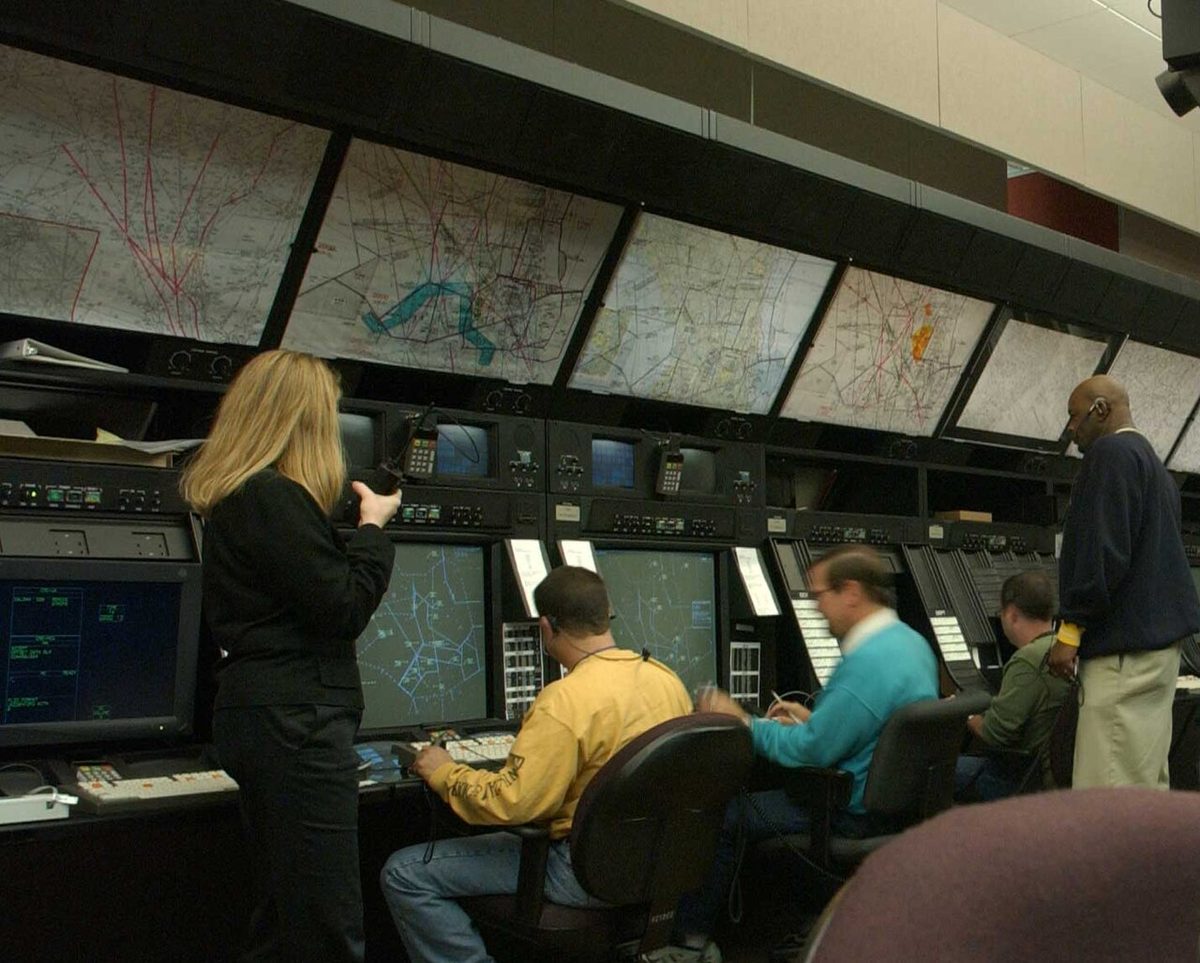
Radar separation, which Doc 4444 now calls separation using ATS surveillance systems, requires both aircraft to be identified. The basic horizontal minimum is 5 NM. The appropriate authority may reduce it to 3 NM where the surveillance system's performance at that location allows, and to 2.5 NM between aircraft established on the same final approach track within 10 NM of the threshold. The 2.5 NM minimum carries conditions, among them an average runway occupancy time proven not to exceed 50 seconds and adequate braking action. No reduced minimum overrides a larger wake turbulence minimum.
| ICAO and EASA | FAA (JO 7110.65) | |
|---|---|---|
| Basic radar minimum | 5 NM | 5 NM en route, or 40 NM or more from the antenna |
| Reduced minimum | 3 NM where the authority allows | 3 NM when less than 40 NM from the antenna |
| Wake categories | Light, Medium, Heavy and Super by maximum take-off mass | Small, Large, Heavy and Super by weight, with the B757 treated separately |
| Visual separation | Near aerodromes, by the controller or by pilots | By the tower or by pilots, with the pilot also avoiding wake |
The frequent exam answer "3 NM within 40 NM of the radar" therefore comes from national rules such as the FAA's; ICAO leaves the conditions to the authority.
Exam tip: radar 5 NM, reducible to 3 NM, and 2.5 NM on the same final approach track within 10 NM of the threshold.
Visual separation
Visual separation replaces the published minima with eyesight. Doc 4444 allows the procedural minima to be reduced near aerodromes when the aerodrome controller can see each aircraft continuously, when each flight crew can see the other and reports that it can maintain its own separation, or when the crew of a following aircraft reports the preceding one in sight and can keep clear. In Class D and E airspace, by day and in VMC, ATC may also clear a controlled flight, on request and with the other pilot's agreement, to climb or descend "maintaining own separation and VMC" from one other aircraft.
In FAA practice, a tower controller may apply visual separation, or a pilot who reports the traffic in sight may be instructed to maintain visual separation from it. AIM 5-5-12 makes that pilot responsible for keeping clear until the flight paths diverge and for avoiding the other aircraft's wake. If sight of the traffic is lost, ATC must be told at once.
Wake turbulence categories and separation
Every aircraft type has a wake turbulence category, filed in item 9 of the flight plan. ICAO uses Light (7,000 kg or less), Medium, Heavy (136,000 kg or more) and Super for the A380; the FAA uses weight classes with different boundaries. Because a single weight class spans very different wakes, re-categorisation schemes group aircraft by mass, wingspan and approach speed and set a minimum for each leader and follower pair: RECAT-EU in Europe, and in the United States the FAA's Wake Turbulence Recategorization (RECAT) programme and its successor, Consolidated Wake Turbulence.
Wake turbulence separation applies when the follower is behind the leader at the same altitude or less than 1,000 ft below, on the same runway or close parallel runways, or crossing behind. Where it exceeds the radar minimum, the wake figure governs. The distance and time values, and the cases in which the pilot rather than ATC takes responsibility for wake, are set out in wake turbulence and jet blast.
Frequently asked questions
What is the standard radar separation between aircraft?
ICAO's basic minimum between aircraft identified on radar or another ATS surveillance system is 5 NM horizontally. The authority may reduce it to 3 NM where the surveillance system allows, and to 2.5 NM between aircraft on the same final approach track within 10 NM of the threshold under strict conditions. The FAA uses 3 NM within 40 NM of a terminal radar antenna and 5 NM beyond. Wake turbulence minima can require more.
What is RVSM?
Reduced Vertical Separation Minimum (RVSM) is the use of 1,000 ft instead of 2,000 ft vertical separation between FL290 and FL410 inclusive, adding six flight levels. Only aircraft and operators approved for RVSM may use it. The aircraft needs two independent altimetry systems, an altitude alerter, an automatic altitude control system and an altitude-reporting transponder, and its height-keeping is monitored. Non-approved aircraft are kept 2,000 ft from others.
What is the vertical separation above FL410?
Above FL410 the vertical separation minimum is 2,000 ft under both ICAO and FAA rules. Below FL290 it is 1,000 ft everywhere. Between FL290 and FL410 it is 1,000 ft in RVSM airspace, which now covers most of the world, and 2,000 ft where RVSM is not applied or when one of the aircraft is not RVSM approved.
Who is responsible for separation when a pilot accepts visual separation?
The pilot. By reporting the other aircraft in sight and accepting an instruction to maintain visual separation, the pilot takes on the task of keeping clear of it, and in FAA practice also of avoiding its wake, until the flight paths diverge. If sight of the traffic is lost, the pilot must tell ATC at once so that the controller can restore another form of separation.
What is composite separation?
Composite separation combines vertical separation with one form of horizontal separation, lateral or longitudinal. Each element may be reduced below its normal value, but never to less than half of it, because the two together still give the required protection. It is used only where a regional air navigation agreement provides for it, on route systems whose normal lateral minimum is very large, 90 NM or more.
Test yourself on ATC Separation
The v1prep banks cover this topic in Air Law (010), with a worked explanation for every answer. EASA ATPL, PPL, IR and CPL, the FAA written tests and A320/B737 type ratings.
Start practising →Sources and further reading
- ICAO Doc 4444, Procedures for Air Navigation Services, Air Traffic Management (PANS-ATM), 16th edition, as published by Airservices Australia
- FAA Order JO 7110.65, Chapter 5 Section 5, Radar Separation
- FAA Order JO 7110.65, Chapter 4 Section 5, Altitude Assignment and Verification
- FAA Aeronautical Information Manual, Chapter 5 Section 5, Pilot/Controller Roles and Responsibilities
- North Atlantic Central Monitoring Agency, Long-term height monitoring requirements
- Federal Register, Reduced Vertical Separation Minimum in Domestic United States Airspace (2003)
- SKYbrary, Composite Separation
Library articles are written for study and exam preparation. They do not replace your aircraft's approved documentation, your operator's procedures or the regulations themselves.