Circling and Visual Approaches
Circling and visual approaches are the parts of an IFR arrival flown by visual reference instead of instrument guidance: circling to a runway not aligned with the final approach, visual and contact approaches, sidesteps to a parallel runway, and the visual end of approaches to closely spaced parallel runways.
An instrument approach brings an aircraft to a point from which the pilot must see to land. When the runway lies straight ahead, the visual part is short. When it does not, or when ATC wants to save time and airspace, the approach is completed by visual reference: by circling to another runway, by accepting a visual approach, by sidestepping to a parallel runway, or by finishing an approach to one of two closely spaced parallel runways.
All of these are flown under an IFR clearance, but obstacle clearance, separation and wake turbulence responsibilities shift in each, and those shifts are what exam questions and accident reports turn on. ICAO criteria are in PANS-OPS (Doc 8168); the FAA uses TERPS and the Aeronautical Information Manual (AIM). The two differ most in circling, where the protected areas and obstacle margins are not the same.
Circling approach and its protected area
ICAO calls circling visual manoeuvring (circling), or VM(C): the visual phase after an instrument approach that brings the aircraft into position to land on a runway not suitably located for a straight-in approach. Any instrument procedure may precede it, but a circling approach is always a non-precision operation flown to a minimum descent altitude or height (MDA/H), even after an ILS. The FAA publishes straight-in minima only where the final approach course lies within 30° of the runway and a normal descent is possible; otherwise only circling minima appear. The AIM prohibits circling from a GLS, from an ILS without a localiser line of minima and from an RNAV (GPS) approach without an LNAV line.
PANS-OPS draws the circling area from arcs centred on each runway threshold, joined by tangents. The radius depends on the category's maximum circling speed, a 25 kt wind throughout the turn and a bank of 20° or rate one, whichever needs less bank. Where a prominent obstacle in one sector would give an unrealistic obstacle clearance altitude, circling is prohibited in that sector. French charts show such restrictions in their minima boxes: at Ajaccio and at Cannes circling is allowed by day only, and it is prohibited east of the runway at Ajaccio and west of runway 17/35 at Cannes.
| Category | Maximum circling IAS | Minimum obstacle clearance | Lowest OCH | ICAO minimum visibility | EASA lowest MDH and visibility |
|---|---|---|---|---|---|
| A | 100 kt | 90 m (295 ft) | 120 m (394 ft) | 1.9 km | 400 ft, 1,500 m |
| B | 135 kt | 90 m (295 ft) | 150 m (492 ft) | 2.8 km | 500 ft, 1,600 m |
| C | 180 kt | 120 m (394 ft) | 180 m (591 ft) | 3.7 km | 600 ft, 2,400 m |
| D | 205 kt | 120 m (394 ft) | 210 m (689 ft) | 4.6 km | 700 ft, 3,600 m |
| E | 240 kt | 150 m (492 ft) | 240 m (787 ft) | 6.5 km | Not tabulated |
These are floors: any higher published circling minimum for the aerodrome applies. An aircraft circling faster than its category allows should use the minima of the higher category; the AIM's example is a Category B aeroplane circling at 145 kt, which uses Category D minima.
The pilot stays at or above the circling MDA until continuously in a position from which a normal descent to the intended runway can be made using normal manoeuvres, and keeps within the protected area. If visual reference is lost, the missed approach of the instrument procedure is flown, starting with a climbing turn towards the landing runway and continuing until established on the missed approach track. The aircraft is then normally beyond the missed approach point, so the AIM warns that joining the missed approach track after leaving the circling area may not give vertical obstacle clearance; extra climb inside the area may be needed (see go-around and missed approach). Circling at low height, at low speed and in marginal weather is demanding, and runway slope or a featureless approach can distort height judgement (see visual illusions).
Expanded circling areas and chart symbols
TERPS guarantees 300 ft of obstacle clearance at the circling MDA inside an area built the same way, from arcs around each runway end joined by tangents. Procedures developed before late 2012 use fixed radii by category, from 1.3 NM for Category A to 2.3 NM for Category D. Procedures developed after late 2012 use expanded circling approach areas, whose radii depend on the category and on the MSL altitude of the circling MDA, to account for the higher true airspeed at altitude. They are identified by a negative "C", a white C in a black square, on the circling line of minima; the radii are tabulated in the front of the Terminal Procedures Publication. Because TERPS gives the same 300 ft in every category over areas of its own size, while PANS-OPS gives 295 to 492 ft over areas built on its own speeds and wind, a crew trained under one system should not assume the other's protection.
FAA charts give the height of a circling MDA above the airport elevation (HAA), not above the touchdown zone. At Yakima, an MDA of 2,100 ft is 1,032 ft above touchdown for the straight-in line but 1,001 ft above the airport for circling, because the airport elevation is the higher figure.
Visual manoeuvring with prescribed track
Where a free circling manoeuvre would be unsafe or noisy, some States publish a visual manoeuvre with prescribed track (VPT), flown visually along a charted path with the circling speed limits. At Chambéry the VPT to runway 36 follows the LOC Y approach to runway 18: the aircraft leaves the 175° final at point A, 2.0 NM DME, turns left onto 135° and flies a charted downwind. Its MDA is 1,880 ft or the MDA of the preceding approach, whichever is higher, and after a missed landing the pilot turns right at the end of the runway to rejoin point B. Brest prohibits its VPT for turbofans when the PAPI is unserviceable, and the French AIP requires a PAPI for any RNP (VPT) approach.
Visual approach
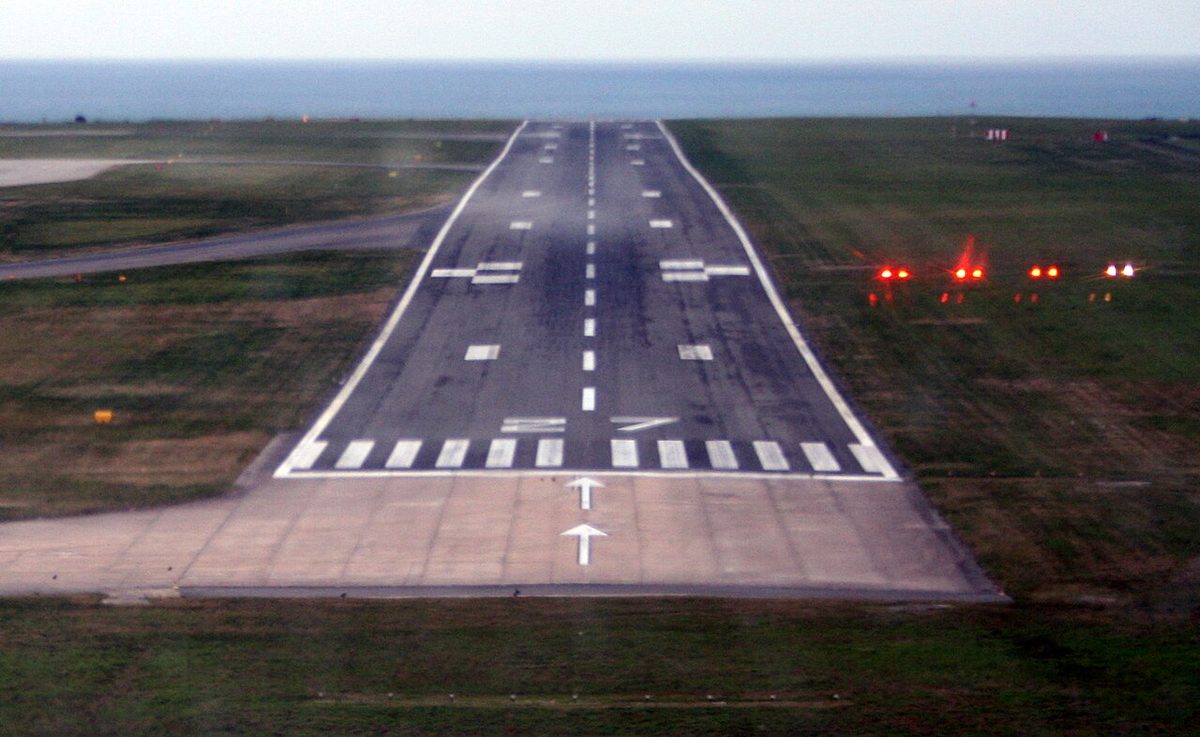
ICAO defines a visual approach as an approach by an IFR flight when part or all of an instrument approach procedure is not completed and the approach is flown with visual reference to terrain. The flight remains IFR. Under the FAA's rules, ATC may authorise one when the reported ceiling is at least 1,000 ft and the visibility at least 3 miles, and the pilot has the airport or the preceding identified aircraft in sight. If the pilot sees the airport but not the traffic, ATC keeps both separation and wake turbulence separation. A pilot who accepts a clearance to follow a preceding aircraft accepts responsibility for a safe approach interval and for wake turbulence separation.
A visual approach is not an instrument approach procedure and has no missed approach segment; a go-around is flown on tower instructions, and the pilot remains responsible for terrain clearance until reaching any assigned altitude. A charted visual flight procedure (CVFP) adds landmarks, courses and recommended altitudes, is used only at airports with an operating control tower and is marked "not authorized at night" where its landmarks cannot be seen.
European operating rules do not allow a commercial operator to fly a visual approach when the RVR is less than 800 m. Some aerodromes restrict visual approaches for noise: Toulouse-Blagnac prohibits them except for safety reasons or when ATC proposes one, and then requires the runway centreline to be intercepted at 3,000 ft AMSL or above.
Contact approach
The contact approach is an FAA procedure. A pilot on an IFR flight plan who is clear of clouds, has at least 1 mile flight visibility and expects to remain so may request it; ATC cannot initiate it. The reported ground visibility at the destination must be at least 1 statute mile, and the airport must have a standard or special instrument approach procedure. ATC separates the aircraft from other IFR and special VFR traffic, but the pilot assumes responsibility for obstruction clearance.
Traffic pattern direction
The standard aerodrome circuit is left-handed. SERA requires all turns to be made to the left when approaching to land and after take-off unless ATC instructs otherwise or a right-hand circuit is indicated. In the United States, 14 CFR 91.126 requires left turns at non-towered airports in Class G airspace unless right turns are indicated. Sectional charts show a right traffic pattern (RP) in the airport data: "RP 16, 34" at Friday Harbor means right-hand traffic for both runways, and "*RP", with the asterisk in front, means special conditions apply, described in the Chart Supplement.
For circling at a non-towered airport, the AIM expects the pilot to use the 91.126 turn direction unless a published circling restriction requires the opposite. At a towered airport the pilot follows the controller's instructions, but an ATC clearance does not cancel a published circling restriction.
Sidestep manoeuvre
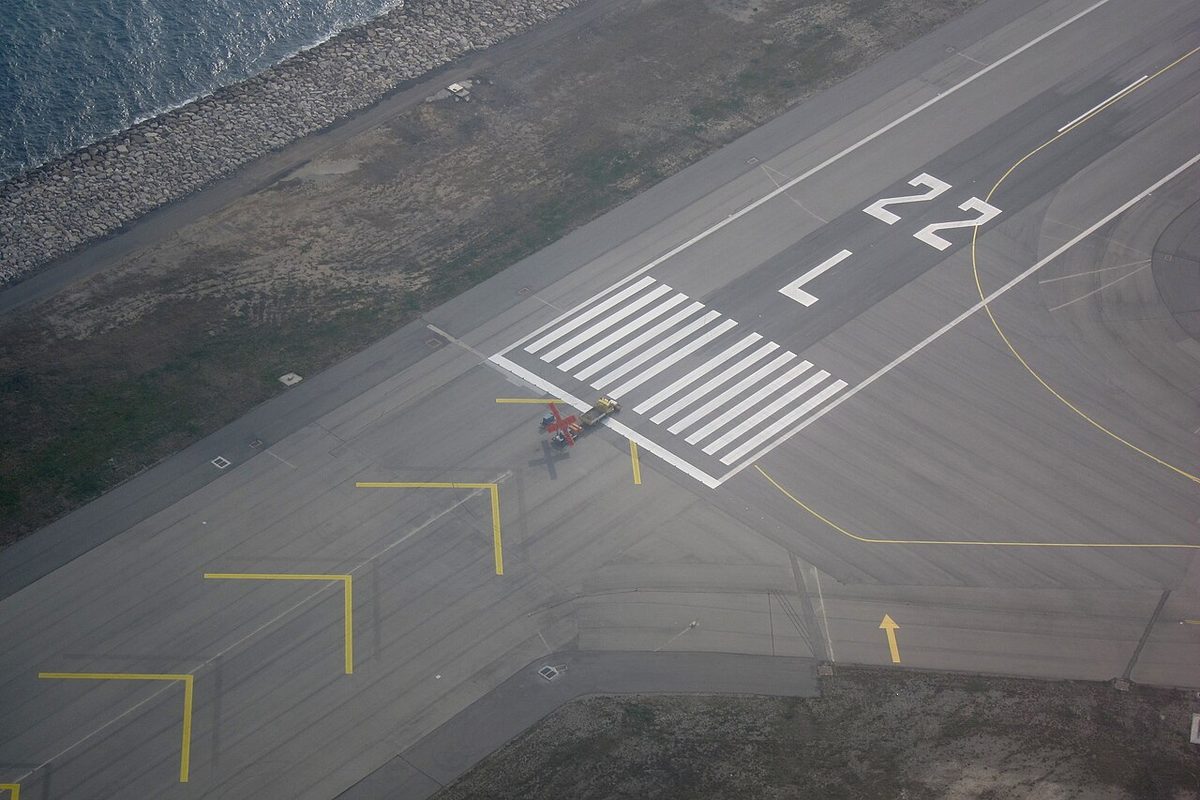
A sidestep manoeuvre (FAA: side-step maneuver) is an instrument approach to one of two parallel runways followed by a straight-in landing on the other. The FAA authorises it where the runways are 1,200 ft apart or less, with a clearance such as "cleared ILS runway 7 left approach, side-step to runway 7 right". The pilot begins the sidestep as soon as possible after sighting the runway or runway environment and still observes stepdown altitudes. Sidestep minima are flown to an MDA whatever the approach flown; they are higher than the precision minima to the primary runway but normally lower than circling minima.
European aerodromes use the same idea. Toulouse-Blagnac allows a change from one parallel runway to the other by day or night, on ATC or pilot request, for an aircraft established on final between 10 NM from the threshold and passing 1,000 ft AMSL.
Closely spaced parallel runways
ICAO defines four modes of parallel runway operation, each with a minimum distance between runway centrelines. All require surveillance radar; without it, single-runway operations resume.
| Mode | Operation | Minimum centreline spacing |
|---|---|---|
| 1 | Independent parallel approaches | 1,035 m |
| 2 | Dependent parallel approaches | 915 m |
| 3 | Independent parallel departures | 760 m |
| 4 | Segregated operations, one runway for arrivals and one for departures | 760 m |
In Mode 1 a no transgression zone (NTZ) at least 610 m wide lies midway between the extended centrelines, and a controller intervenes as soon as an aircraft penetrates it; the normal operating zone either side of each localiser course is bounded by half-scale deviation. When approaches and departures are in simultaneous use, the missed approach track and the departure track must diverge by at least 30°; independent departures need at least 15°. Wake turbulence separation minima apply between aircraft on parallel runways less than 760 m apart, as on a single runway.
The FAA uses feet. Simultaneous dependent approaches serve runways 2,500 to 9,000 ft apart with a diagonal separation of 1.0 NM (2,500 to 3,600 ft), 1.5 NM (over 3,600 to 8,300 ft) or 2 NM (over 8,300 to 9,000 ft). Simultaneous independent approaches need at least 4,300 ft and NTZ monitoring up to 9,000 ft, or 9,200 ft at airports above 5,000 ft. Aircraft are not vectored to intercept final at more than 30°. Simultaneous close parallel approaches use courses closer than 4,300 ft, down to 3,000 ft, and are titled PRM (precision runway monitor). They need pilot training, an Attention All Users Page, NTZ monitoring and a second PRM monitor frequency, which the crew listens to from the moment they are told to contact the tower. A simultaneous offset instrument approach (SOIA) serves runways at least 750 ft but less than 3,000 ft apart: one aircraft flies an offset course and, when ATC reports the straight-in traffic as a factor, must have that aircraft in sight before its offset missed approach point.
Breakout manoeuvres
A breakout is an ATC vector off the final approach course for a threatened aircraft when another aircraft penetrates the NTZ. It begins "TRAFFIC ALERT (call sign) TURN (left/right) IMMEDIATELY HEADING (degrees), (CLIMB/DESCEND) AND MAINTAIN (altitude)". The threatened crew get no warning, because the blundering aircraft is on another frequency; a worst-case 30° blunder between close parallels can produce closing speeds of 135 ft per second.
The breakout is flown immediately and by hand: the autopilot is disengaged, because hand-flown breakouts start faster. A TCAS resolution advisory is followed for its vertical guidance even if it conflicts with the climb or descent in the breakout, while the turn is still flown, and ATC is told as soon as practical. ATC will not assign an altitude below the minimum vectoring altitude. Radar monitoring ends without notice when visual separation is applied, when the pilot reports the approach lights or runway in sight, or at 1 NM from the threshold.
Frequently asked questions
What is the difference between a visual approach and a contact approach?
Under FAA rules a visual approach may be offered by ATC or requested by the pilot, needs a reported ceiling of at least 1,000 ft and visibility of at least 3 miles, and the pilot must have the airport or the preceding aircraft in sight. A contact approach must be requested by the pilot, needs only 1 mile reported ground visibility with the aircraft clear of clouds, requires an airport with an instrument approach, and makes the pilot responsible for obstacle clearance.
What should a pilot do if visual reference is lost while circling?
Follow the missed approach of the instrument procedure just flown. Begin with a climbing turn towards the landing runway, which keeps the aircraft inside the protected circling area, and continue the turn until established on the published missed approach track. Because the aircraft is usually past the missed approach point, extra climb inside the circling area may be needed before joining that track.
What are the circling minima for each aircraft category?
EASA sets the lowest circling minima at an MDH of 400 ft and 1,500 m visibility for Category A, 500 ft and 1,600 m for B, 600 ft and 2,400 m for C, and 700 ft and 3,600 m for D. ICAO PANS-OPS gives lowest obstacle clearance heights of 394, 492, 591 and 689 ft for the same categories. A higher published figure for the aerodrome always takes precedence.
What is a sidestep manoeuvre?
A sidestep is a visual manoeuvre at the end of an instrument approach to one of two parallel runways, ending with a landing on the other. The FAA allows it where the runways are no more than 1,200 ft apart. The pilot starts it as soon as possible after sighting the runway environment, still respects stepdown altitudes, and uses sidestep minima flown to an MDA, higher than those of the primary runway.
What is a breakout on a PRM approach?
A breakout is an ATC vector that takes a threatened aircraft off its final approach course when an aircraft on the adjacent approach blunders towards or into the no transgression zone. It begins with the words traffic alert, must be flown immediately and by hand with the autopilot disengaged, and a TCAS resolution advisory, if one comes, is followed for the vertical part while the turn is still flown.
Test yourself on Circling and Visual Approaches
The v1prep banks cover this topic in General and Radio Navigation (061/062), with a worked explanation for every answer. EASA ATPL, PPL, IR and CPL, the FAA written tests and A320/B737 type ratings.
Start practising →Sources and further reading
- FAA Aeronautical Information Manual, Chapter 5 Section 4 (5-4-13 to 5-4-16 parallel approaches and PRM, 5-4-19 side-step, 5-4-20 circling, 5-4-23 visual, 5-4-25 contact approach)
- ICAO Doc 8168, Procedures for Air Navigation Services, Aircraft Operations (PANS-OPS), and related Annexes
- AIP France, ENR 1.5, Holding, Approach and Departure Procedures (aircraft categories, circling and VPT speeds)
- EASA, Easy Access Rules for Air Operations (Regulation (EU) No 965/2012)
- 14 CFR 91.126, Operating on or in the vicinity of an airport in Class G airspace
- FAA Aeronautical Chart Users' Guide, Terminal Procedures Publication
- AIP France, AD 2 LFBO, Toulouse-Blagnac (visual approaches and change of parallel runway)
Library articles are written for study and exam preparation. They do not replace your aircraft's approved documentation, your operator's procedures or the regulations themselves.