B737 Flight Controls: Pitch and Stabilizer Trim
Boeing 737 pitch control combines two hydraulically powered elevators, moved by cables from the control columns against artificial feel, with a movable horizontal stabiliser trimmed electrically, by the autopilot, by hand through cables and automatically by speed trim and, on the 737 MAX, MCAS; Mach trim adjusts the elevators relative to the stabiliser.
The Boeing 737 controls pitch with two surfaces: two elevators, moved by the pilots through cables and hydraulic power control units (PCUs), and a movable horizontal stabiliser, which trims the aeroplane. The pilot feels artificial forces in the column, produced by a feel computer, and the stabiliser can be moved by the pilots' trim switches, by the autopilot, by hand with the trim wheels, or automatically by the speed trim system. The Mach trim system instead adjusts the elevators relative to the stabiliser.
None of this is fly-by-wire, but several automatic functions act on the stabiliser, and the 737 MAX added one more, MCAS, after its larger engines changed the aeroplane's handling at high angle of attack. An uncommanded trim movement, the runaway stabiliser, is one of the type's recall procedures. This article describes the 737 NG and states where the MAX differs. The general principles are covered in trim systems and powered flying controls and artificial feel.
Elevator control and manual reversion
Cables connect both control columns to the elevator PCUs, which are powered by hydraulic systems A and B, and a torque tube joins the two elevators. Either hydraulic system can operate all the primary flight controls on its own. If both are lost, the elevators, like the ailerons, can still be operated manually: this is manual reversion (see B737 hydraulic system).
If a control column jams, an override mechanism allows the two columns to be separated. Force applied against the jam breaks out either the captain's or the first officer's column, and whichever column then moves freely gives adequate elevator control. On the 737 MAX, the fly-by-wire spoilers add an elevator jam landing assist function.
Elevator feel and centring
Because the pilot does not move the elevators directly, the elevator feel system gives the column artificial feel. Its elevator feel computer simulates aerodynamic forces from airspeed, taken from the elevator pitot system, and from stabiliser position. It uses system A or B pressure, whichever is higher, and the forces reach the columns through the elevator feel and centering unit (the feel and centering unit), which also returns the column to neutral.
The amber feel differential pressure light (FEEL DIFF PRESS) shows excessive differential pressure in the elevator feel computer. It is armed with the trailing edge flaps up and inhibited with them extended. Erroneous activation of the elevator feel shift module can cause it.
The elevator feel shift (EFS) module is part of stall identification. During a stall it raises the system A pressure supplied to the feel and centering unit, roughly doubling the column forces, so that the pilot feels the stall approach in the column. It is inhibited on the ground, below 100 ft radio altitude and with the autopilot engaged, but if it is already active when the aeroplane descends through 100 ft it stays active until the angle of attack falls below about the stick shaker threshold. Nothing on the flight deck shows whether the EFS is armed or active.
Stabiliser trim system
The pilots and the autopilot move the stabiliser in three ways:
- Main electric stabiliser trim. Pushing both stabiliser trim switches on a control wheel trims the stabiliser electrically in the selected direction and disengages the autopilot if it is engaged.
- Autopilot trim. With the autopilot engaged, it trims the stabiliser automatically.
- Manual trim. Cables from the two stabiliser trim wheels on the control stand move the stabiliser directly. The wheels override every other trim input and rotate whenever the stabiliser is moving, and grasping a wheel stops the stabiliser.
Main electric and autopilot trim have two speeds: high with the flaps extended and low with the flaps retracted. Two independent brake systems hold the stabiliser in position. Stabiliser position is read in stabiliser trim units, and each method has its own authority:
| Trim method | Authority (units) |
|---|---|
| Main electric, flaps extended | 0.05 to 14.5 |
| Main electric, flaps retracted | 3.95 to 14.5 |
| Autopilot | 0.05 to 14.5 |
| Manual (trim wheels) | -0.20 to 16.9 |
Manual trim has the widest range, and the trim wheels remain available when every electric channel has been cut out.
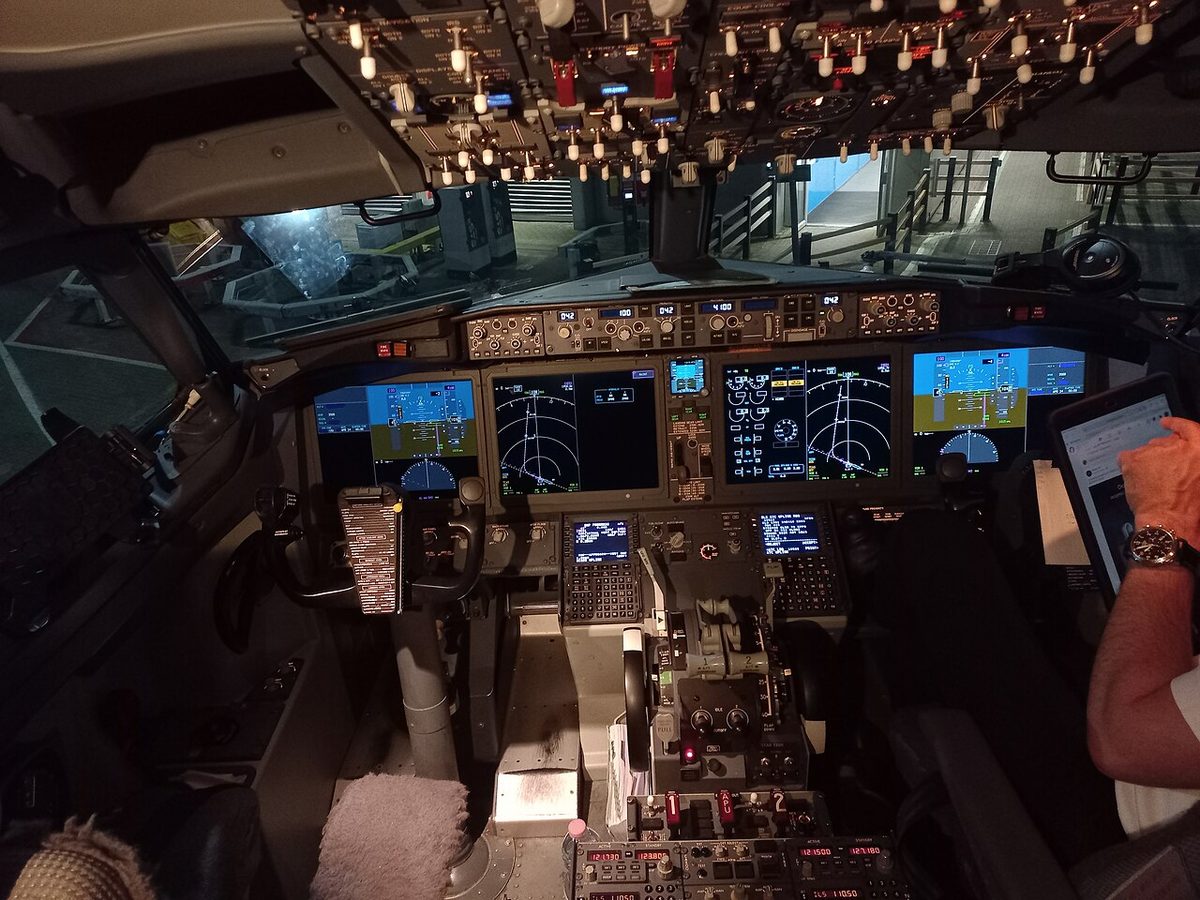
Trim cutout and override switches
Several switches limit what the electric trim can do:
- Control column actuated stabiliser trim cutout switches. When the column is moved against the direction of trim, they stop main electric and autopilot trim, so that pulling against a nose-down trim, or pushing against a nose-up trim, interrupts it.
- Stabiliser trim override switch. At OVERRIDE it bypasses the column cutout switches and restores power to the control wheel trim switches.
- STAB TRIM cutout switches. The MAIN ELECT switch at CUTOUT deactivates the control wheel trim switches. The AUTOPILOT switch at CUTOUT deactivates autopilot trim and disengages the autopilot. Both are at NORMAL for flight, and the autopilot cannot be engaged unless the AUTOPILOT switch is at NORMAL.
Exam tip: the column cutout switches act only while the column opposes the trim; the STAB TRIM cutout switches remove electric trim until they are returned to NORMAL. Neither affects the manual trim wheels.
Take-off green band
The stabiliser trim green band on the trim indicator marks the allowable range of trim settings for take-off. Before start the crew set the take-off trim and check it is in the green band. If take-off is attempted with the trim outside the range, the take-off configuration warning sounds an intermittent horn. On the flight control surface position indicator, the centre mark of the elevator scale shows the elevator's neutral position on the ground with the stabiliser trimmed in the green band; the mark is set for nominal take-off conditions.
Speed trim and Mach trim
The speed trim system (STS) is a speed stability augmentation system. It moves the stabiliser to improve the handling at low weight, aft centre of gravity and high thrust, when the autopilot is not engaged. It operates:
- with its Mach gain fully enabled between 100 KIAS and Mach 0.60, fading out to zero by Mach 0.68;
- from 10 seconds after take-off;
- from 5 seconds after the trim switches are released;
- with the autopilot not engaged and a trim requirement sensed.
The Mach trim system works above Mach 0.615. As speed increases, the Mach trim actuator repositions the elevator feel and centering unit, adjusting the elevators relative to the stabiliser and moving the column's neutral position.
The amber SPEED TRIM FAIL and MACH TRIM FAIL lights show a failure of the system. If one lights only during a MASTER CAUTION recall and goes out when the system is reset, a single flight control computer (FCC) channel has failed.
MCAS on the MAX
The 737 MAX's LEAP-1B engines are larger than the NG's CFM56-7B and sit higher and further forward. Near the stall and in high-g manoeuvres they would make the column lighter than the certification rules allow. The manoeuvring characteristics augmentation system (MCAS), part of the MAX's speed trim system, restores the required pull force by adding nose-down stabiliser trim. The NG has speed trim but no MCAS.
MCAS works only in manual flight, with the autopilot and control wheel steering not engaged, and with the flaps up; since the return-to-service flight control computer software (P12.1.2) it activates only when the angle of attack rises from below to above a threshold that varies with Mach. It trims at 0.27° per second, the speed trim rate with flaps down, and a single command moves the stabiliser by at most 2.5°, at low Mach. The return-to-service changes include:
- Each FCC compares both angle of attack inputs. A split above 5.5° for a set time disables MCAS and speed trim for the rest of the flight, and SPEED TRIM FAIL stays lit. This split monitor is active only once the flaps are up.
- The electric trim switches pause MCAS, and releasing them no longer resets it: the total nose-down trim cannot exceed one MCAS command until the angle of attack has dropped well below the threshold.
- A maximum command limit disables MCAS and speed trim for the rest of the flight if the stabiliser moves too far from its position at activation, preserving pitch control with the column alone.
- AOA DISAGREE, now standard, shows on both PFDs when the vanes differ by more than 10° for more than 10 seconds.
Unlike main electric trim, an MCAS command bypasses the aft column cutout switch, so pulling the column does not stop it. Both STAB TRIM cutout switches at CUTOUT stop and disable it. The original design relied on one angle of attack sensor at a time and could command repeated nose-down trim; the FAA's review links it to the Lion Air JT610 accident, and the MAX was grounded in March 2019, after the second accident, ET302. EASA later found that MCAS is needed for full compliance with the stall and pitch control rules, but that its loss does not prevent safe flight and landing.
Runaway stabiliser and out-of-trim alerts
A runaway stabiliser is uncommanded, continuous trim movement; the revised checklist also covers stabiliser movement that is wrong for the conditions. The recall items are:
- Control column: hold firmly.
- Autopilot (if engaged): disengage, and do not re-engage.
- Autothrottle (if engaged): disengage.
- Control column and thrust levers: control pitch attitude and airspeed.
- Main electric trim: reduce control column forces.
- If the runaway continues: both STAB TRIM cutout switches to CUTOUT.
- If it still continues: grasp and hold the stabiliser trim wheel.
The FAA Flight Standardization Board (FSB) report asks training to stress trying main electric trim before cutout; once both switches are at CUTOUT only the trim wheels remain. Manual trimming becomes harder as airspeed rises, so the runaway stabiliser and stabiliser trim inoperative checklists note that reducing airspeed makes it easier, and training covers the manual trim techniques Boeing defines.
The amber STAB OUT OF TRIM light works on the 737 NG only with the autopilot engaged and shows that the autopilot is not trimming the stabiliser properly. On the 737 MAX it can also light on the ground below 30 kt after the cross-FCC trim monitor tripped during the flight, and take-off is then forbidden. On a dual channel approach, a stabiliser out of trim below 800 ft radio altitude turns the autopilot disengage lights steady red. At 400 ft in a dual autopilot ILS approach the stabiliser is trimmed an extra amount nose up, so if the autopilots then disengage, forward column force may be needed.
Warning: in an upset, excessive use of pitch trim can aggravate the situation or cause loss of control. In a stall recovery, nose-down trim is used only if the elevator alone cannot lower the angle of attack enough.
Frequently asked questions
What is the green band on the Boeing 737 stabiliser trim indicator?
The green band marks the allowable range of stabiliser trim settings for take-off. Before start the crew set the trim for the take-off and check that it lies within the band. If take-off is attempted with the trim outside the take-off range, the take-off configuration warning sounds as an intermittent horn, and the stabiliser trim is one of the items that warning checks.
What do the 737 STAB TRIM cutout switches do?
On the 737 NG there are two, MAIN ELECT and AUTOPILOT, normally at NORMAL. MAIN ELECT at CUTOUT deactivates the control wheel trim switches; AUTOPILOT at CUTOUT deactivates autopilot trim and disengages the autopilot. With both at CUTOUT the stabiliser can only be moved with the manual trim wheels. On the 737 MAX, both STAB TRIM cutout switches at CUTOUT also stop and disable MCAS. They are separate from the column-actuated cutout switches.
What is the difference between speed trim and MCAS on the 737?
The speed trim system, on both the NG and the MAX, moves the stabiliser to improve speed stability in manual flight at low weight, aft centre of gravity and high thrust. MCAS exists only on the MAX and is part of its speed trim system. It adds nose-down trim at high angle of attack, flaps up, in manual flight, so that the column force near the stall meets the certification rules.
What are the runaway stabiliser recall items on the 737?
Hold the control column firmly; disengage the autopilot, not to be re-engaged, and the autothrottle; control pitch attitude and airspeed with the column and thrust levers; use main electric trim to reduce column forces. If the runaway continues, set both STAB TRIM cutout switches to CUTOUT, and if it still continues, grasp and hold the stabiliser trim wheel. Reducing airspeed makes manual trimming easier.
What does the STAB OUT OF TRIM light mean on the 737?
On the 737 NG the amber light works only with the autopilot engaged and shows that the autopilot is not trimming the stabiliser properly. On the 737 MAX, since the return-to-service software, it can also light on the ground below 30 kt after the cross-FCC trim monitor has tripped during the flight, and the crew must then not take off.
Test yourself on B737 Flight Controls: Pitch and Stabilizer Trim
The v1prep banks cover this topic in the B737 type-rating bank, with a worked explanation for every answer. EASA ATPL, PPL, IR and CPL, the FAA written tests and A320/B737 type ratings.
Start practising →Sources and further reading
- FAA, Summary of the FAA's Review of the Boeing 737 MAX (November 2020)
- EASA, Boeing 737 MAX Return to Service Report (January 2021)
- FAA Flight Standardization Board Report, Boeing 737, Revision 17
- EASA Type Certificate Data Sheet IM.A.120, Boeing 737
- EASA Easy Access Rules for Large Aeroplanes (CS-25), CS 25.671 to CS 25.677, control systems and trim
- 14 CFR 25.677, Trim systems
Library articles are written for study and exam preparation. They do not replace your aircraft's approved documentation, your operator's procedures or the regulations themselves.