Transponder Codes and Squawk Phraseology
A transponder code, or squawk, is the four-digit Mode A identity code, from 0000 to 7777, that an aircraft's transponder sends to secondary radar. Most codes are labels assigned by air traffic control; a few, such as 7700, 7600 and 7500, carry a meaning of their own.
A transponder code, universally called a squawk, is the four-digit identity that an aircraft's transponder returns whenever a secondary radar asks for Mode A. Each digit runs from 0 to 7 only, so there are 4,096 codes, from 0000 to 7777. Most of them mean nothing in themselves: they are labels that let the ground system match a radar return to a flight plan. A handful are reserved and carry a message of their own, among them the three emergency codes, the conspicuity codes used by aircraft that have not been given a code, and the default code 2000.
Setting the right code and understanding the instructions about it are tested at every level, from PPL communications to ATPL air law and the FAA written tests. How the transponder and secondary radar work, including Mode S, is covered in secondary surveillance radar and transponders; this article deals with the codes and the phraseology. ICAO Doc 4444 and, in the EU, the Standardised European Rules of the Air (SERA) set the rules; where the FAA's codes or words differ, that is stated.
Discrete codes and code assignment
A discrete code is one whose last two digits are not 00, such as 4271 or 5023. Air traffic control assigns a discrete SSR code, or discrete transponder code, to each flight it wants to see individually, and the ground system then links the code to that flight's plan and displays its call sign and level beside the return. A code ending in 00, such as 7000 or 2000, is non-discrete: many aircraft share it, and it tells the controller only what kind of flight the aircraft is. The FAA notes that controllers occasionally have to assign a non-discrete code.
Codes are passed as four separate digits: 6500 is "SIX FIFE ZERO ZERO", because the rule that lets altitudes be spoken in hundreds and thousands does not apply to squawks. An SSR code is on the list of items that must always be read back, so "squawk 4271" is answered with the code and the call sign. In the United States codes are allocated under FAA Order JO 7110.66, the National Beacon Code Allocation Plan.
A Mode S transponder also sends the aircraft identification entered by the crew, which must match item 7 of the flight plan exactly: the ICAO form, such as BAW123, or the registration when that is the call sign. The controller can then recognise the aircraft by its identification as well as by its code, but the code is still set and read back in the normal way.
Changing codes needs care. The emergency codes trigger alerts at automated ground stations the moment they appear, so a pilot winding the knobs should never pass through them. The FAA's example is a change from 2700 to 7200: change the second digit first, going through 2200, not through 7700. The FAA adds that every code in the 7600 to 7677 and 7700 to 7777 series sets off special indicators, while only 7500 itself is decoded as a hijack. Selecting standby during the change, once the usual advice, removes the aircraft from the secondary radar picture and from other aircraft's TCAS, so current guidance is to enter the new code directly and then check the mode.
Emergency codes: 7700, 7600 and 7500
| Code | Meaning | Instruction or use |
|---|---|---|
| Squawk 7700 | Emergency | SQUAWK MAYDAY; also set when intercepted, unless ATS says otherwise |
| Squawk 7600 | Loss of two-way radio communication | 7601 in the EU for an IFR flight continuing in VMC |
| Squawk 7500 | Unlawful interference | Treated as genuine the moment it appears |
7700 declares an emergency of any kind. It produces a distinctive indication on every secondary radar display that receives the aircraft, not only at the unit the crew is working, but it carries no information about what is wrong: the MAYDAY or PAN PAN call does that (see distress and urgency communications). A crew already identified on a discrete code normally keeps it, because the controller already knows which aircraft is in trouble and a change could delay assistance; they may still select 7700 whenever that seems the better course, and do so when told "SQUAWK MAYDAY". An intercepted aircraft sets 7700 unless the ATS unit instructs otherwise, under SERA.11015. When the emergency has been cancelled, the crew returns to the assigned code or the appropriate conspicuity code.
7600 tells every ground system that the silence is a radio failure. It is selected even over a discrete code, because the change itself is the message: a controller calling an aircraft that keeps its assigned code cannot know why it does not answer. Since 1 May 2025, SERA.14083 gives an IFR flight that loses communications in VMC and continues visually to the nearest suitable aerodrome the code 7601, so that ATC knows it will not follow the IFR procedure; the United Kingdom and Switzerland did not adopt it. A controller who suspects that only the aircraft's transmitter has failed may ask the pilot to acknowledge by pressing IDENT or changing code, one reason why IDENT is never pressed unprompted. The procedures that follow are in radio communication failure.
7500 signals unlawful interference, such as a hijack; the pilot sets it unless the situation warrants 7700. The code is acted on as genuine as soon as it is seen. The controller asks the crew to confirm it, and either a confirmation or no reply at all is taken as confirmation, because a crew under duress may be unable to speak. A pilot who selects 7500 by mistake must say so at once, in plain language, and reset the assigned code; an unclear reply risks starting a security response.
Exam tip: 7500 unlawful interference, 7600 radio failure, 7700 emergency. Silence in reply to a request to confirm 7500 confirms it.

VFR conspicuity codes: 7000 and 1200
A conspicuity code is the code used by an aircraft that has not been assigned one, so that it still shows, with its pressure altitude, on radar displays and in other aircraft's collision avoidance equipment. The two best known are:
- VFR conspicuity code (7000): under SERA.13005, a pilot not receiving an air traffic service selects 7000 unless the competent authority prescribes otherwise. France, for example, applies 7000 to VFR flights and 2000 to IFR flights without an assigned code in its metropolitan flight information regions.
- VFR transponder code (1200): the FAA's AIM tells VFR pilots to squawk 1200 regardless of altitude unless ATC instructs otherwise. The instruction "SQUAWK VFR" means select 1200, or another appropriate VFR code, with altitude reporting on.
The United States reserves further codes for particular VFR operations: 1202 for gliders, 1255 for firefighting aircraft not in contact with ATC, 1277 for VFR aircraft on authorised US Air Force or Coast Guard search and rescue missions, and 1203 for the lead aircraft of a VFR formation not receiving ATC services, whose other members squawk standby. Military aircraft use 4000 in restricted and warning areas, and 7777 is reserved for military interceptor operations; a civil pilot must never select it. Other States publish their own special codes in the AIP.
A conspicuity code is no reason to switch the transponder off or to deselect altitude. SERA.13001 requires a serviceable transponder to be operated at all times in flight, whether or not the airspace has SSR coverage, with pressure-altitude reporting unless ATC directs otherwise. The FAA requires it on the assigned or VFR code with altitude reporting in controlled airspace and recommends it elsewhere. In the United States a VFR pilot who no longer wants radar advisories tells the controller before changing frequency and then returns to 1200, and an IFR flight that cancels its flight plan en route sets the transponder for VFR operation.
Code 2000
SSR code 2000 is the ICAO default. The pilot sets the code assigned by ATC or prescribed by regional air navigation agreement and, when there is neither, selects 2000. It tells a controller that the aircraft has simply received no transponder instructions, rather than being wrongly set. It is met mostly on IFR flights entering a surveillance area from a region where no code was assigned: unless directed otherwise they squawk 2000 until the new unit gives them a discrete code. France prescribes it for IFR flights without an assigned code, and for all flights in the overseas airspace it administers.
Code 2000 is neither an emergency code nor a VFR code, and confusing it with 1200 or 7000 is a common error in both EASA and FAA questions.
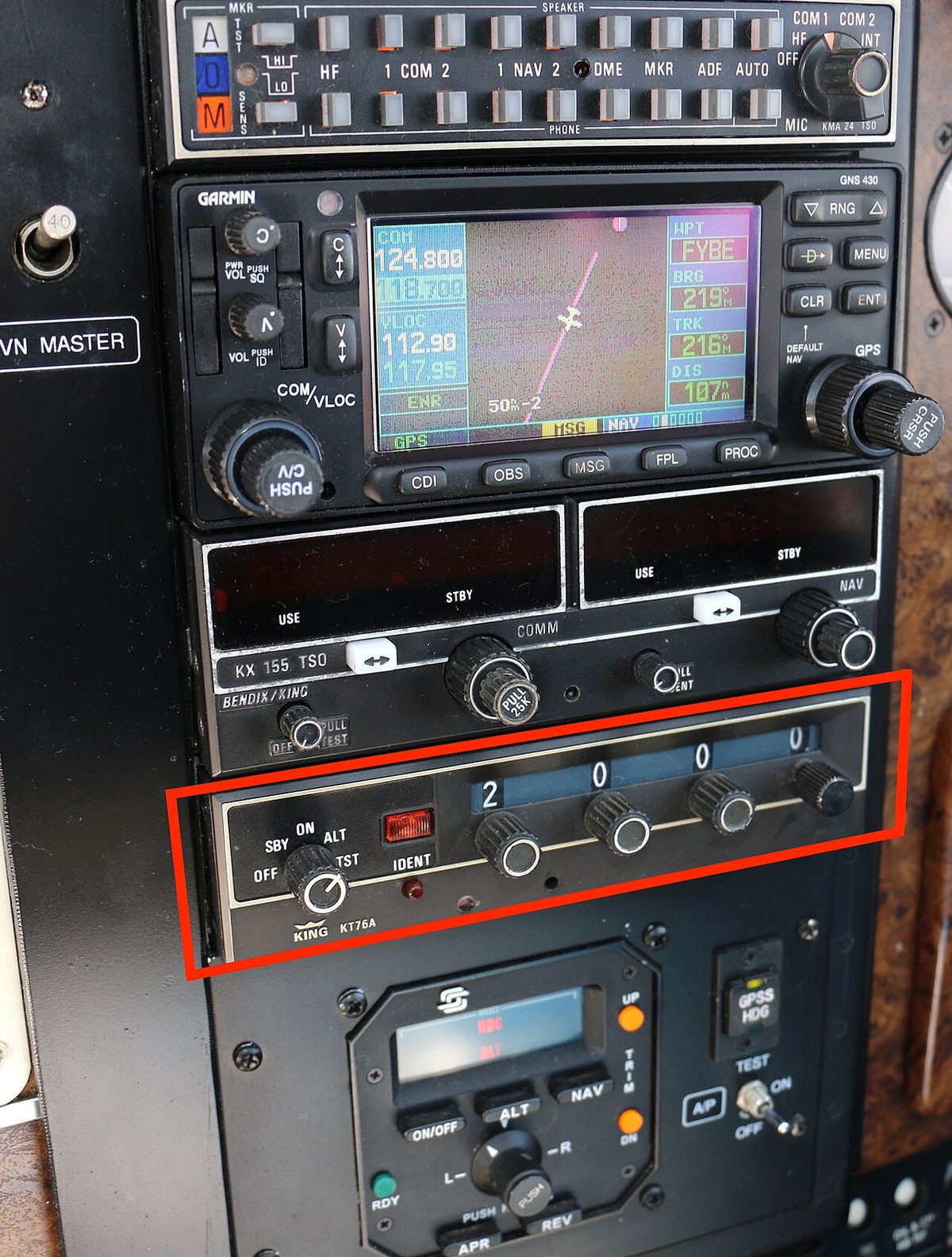
Ident and special position identification
Special position identification (SPI) is a feature of the reply that makes one aircraft stand out on the display. When the pilot presses the IDENT button, a Mode A/C transponder adds the SPI pulse to its replies, and a Mode S transponder sets an equivalent flag, for between 15 and 30 seconds under the equipment standard. The aircraft's label flashes or brightens on the controller's screen. The code and the mode are not changed, and the button is pressed once.
The instruction is "SQUAWK IDENT" in ICAO phraseology and simply "IDENT" in the FAA's, where "SQUAWK (code) AND IDENT" combines a code change with an ident. Transponder ident is one of the quickest ways for a controller to identify an aircraft, or to confirm its identity after a handover, which is exactly why it is used only on request: SERA forbids operating IDENT unless ATS asks for it, and the FAA warns that an unrequested ident may be taken as an acknowledgement from an aircraft with a radio failure. How controllers use it is described in radar services and vectoring.
Transponder phraseology
Transponder phraseology is standardised in ICAO Doc 4444 and SERA; the FAA's AIM gives its own list.
| Meaning | ICAO / SERA | FAA |
|---|---|---|
| Select the code | SQUAWK (code) | SQUAWK (number), altitude reporting on |
| Confirm the code set | CONFIRM SQUAWK; reply SQUAWKING (code) | |
| Reselect the assigned mode and code | RESET SQUAWK [(mode)] (code) | |
| Operate the SPI feature | SQUAWK IDENT | IDENT |
| Select 7700 | SQUAWK MAYDAY | SQUAWK MAYDAY |
| Select standby | SQUAWK STANDBY | SQUAWK STANDBY; SQUAWK NORMAL to resume |
| Select altitude reporting | SQUAWK CHARLIE | SQUAWK ALTITUDE |
| Stop altitude reporting | STOP SQUAWK CHARLIE [WRONG INDICATION] | STOP ALTITUDE SQUAWK [ALTITUDE DIFFERS BY (number) FEET] |
| Stop transponder operation | STOP SQUAWK | STOP SQUAWK |
| Select the VFR code | SQUAWK VFR |
Reset squawk asks the pilot to reselect the code already assigned, usually because the ground system is showing a wrong or garbled one. It does not mean switching the equipment off and on, and it is not a new assignment. Squawk standby leaves the transponder powered but silent, so the aircraft disappears from the secondary radar picture and from other aircraft's TCAS; after a handover, FAA controllers sometimes use it, or a code change, to confirm an identity.
Stop squawk Charlie removes only the altitude and keeps the code, so the controller retains identity and position. It normally follows a failed check of the Mode C readout against the level the pilot reports: the controller first asks the pilot to check the pressure setting and confirm the level, and stops the altitude only if the difference persists. The encoder always reports pressure altitude referenced to 1013.25 hPa, so a wrong subscale setting does not alter the readout, but it does make the aircraft fly at the wrong altitude; that is why the FAA tells pilots to check their altimeter setting whenever a readout is questioned. Stop squawk switches off transponder replies altogether and is rare; the FAA uses it, for example, for the aircraft that are not leading a formation receiving ATC services.
The transponder matters on the ground too. The FAA asks for the altitude-reporting mode whenever the aircraft is on the movement area, and many European aerodromes publish a similar rule because surface surveillance relies on it. A transponder that fails before departure and cannot be repaired is reported to ATS, preferably before the flight plan is filed; the flight plan then shows N in item 10, and the flight complies with the published exemption procedures.
Exam tip: RESET SQUAWK means reselect the same code; STOP SQUAWK CHARLIE removes only the altitude; SQUAWK MAYDAY means 7700. A squawk is always read back digit by digit.
Frequently asked questions
What does squawk 7700 mean and when should you set it?
7700 is the SSR emergency code. It produces a distinctive emergency indication on every secondary radar display that receives the aircraft. A crew in distress or urgency sets it unless ATC has already assigned a discrete code, in which case they may keep that code, because the controller already knows who they are, or change to 7700 if that seems better. An intercepted aircraft also sets 7700 unless ATS instructs otherwise.
What happens if you squawk 7500 by mistake?
ATC treats 7500 as a genuine report of unlawful interference and asks the crew to confirm the code. An affirmative reply or no reply at all is taken as confirmation. A pilot who selected it in error must say at once, in plain language, that the aircraft is not subject to unlawful interference, and then reset the assigned code. The best prevention is never to wind through 7500, 7600 or 7700 when changing codes.
What is squawk code 2000 used for?
2000 is the ICAO default code, set when neither ATC nor a regional air navigation agreement has prescribed a code. It tells the controller that the aircraft has received no transponder instructions. It is typically seen on IFR flights entering a surveillance area from a region where no code was assigned. France prescribes it for IFR flights without an assigned code, while VFR flights use 7000 in Europe and 1200 in the United States.
What does reset squawk mean?
RESET SQUAWK asks the pilot to reselect the mode and code already assigned, usually because the controller's display is showing a wrong or garbled code. It is not a new code and not an instruction to switch the transponder off and on. The pilot re-enters the code, reads it back and checks that the mode, including altitude reporting, is correct. It is different from SQUAWK IDENT, which operates the special position identification feature.
What does squawk ident mean?
SQUAWK IDENT, simply IDENT in FAA phraseology, asks the pilot to press the transponder's IDENT button once without changing the code or the mode. The transponder then sends the special position identification pulse, or its Mode S equivalent, for 15 to 30 seconds, and the aircraft's label is highlighted on the controller's display. Controllers use it to identify an aircraft or confirm its identity. Pilots press IDENT only when asked.
Test yourself on Transponder Codes and Squawk Phraseology
The v1prep banks cover this topic in Communications (090), with a worked explanation for every answer. EASA ATPL, PPL, IR and CPL, the FAA written tests and A320/B737 type ratings.
Start practising →Sources and further reading
- ICAO Doc 4444, Procedures for Air Navigation Services, Air Traffic Management (PANS-ATM), 16th edition, as published by Airservices Australia
- UK CAA Regulatory Library, SERA.13001 Operation of an SSR transponder
- UK CAA Regulatory Library, SERA.13005 SSR transponder Mode A code setting
- EASA, Commission Implementing Regulation (EU) 2024/404 amending SERA
- FAA Aeronautical Information Manual, Chapter 4 Section 1 (4-1-20, Transponder and ADS-B Out Operation)
- SKYbrary, Emergency Transponder Codes
Library articles are written for study and exam preparation. They do not replace your aircraft's approved documentation, your operator's procedures or the regulations themselves.